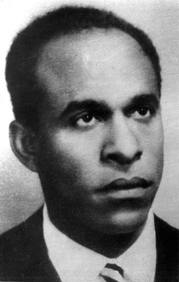
This is a great article by Frantz Fanon, which I published earlier in French. (You will find the original here). In view of all the events occurring in Africa (bombing of Cote d’Ivoire and Libya) with the UN approval, I thought that this article, published in 1964, was so important that I had to translate it into english for all to read! Enjoy…
—————————————————
The great success of the enemies of Africa is to have corrupted the Africans themselves. It is true that these Africans had vested interest in the murder of Lumumba. Heads of puppet governments, in a fake independence, faced everyday by massive opposition from their peoples, it did not take long to convince themselves that the real independence of the Congo would put them personally at risk. And there were other Africans, a little less puppet, but who get frightened when it comes to disengaging Africa from the West. It seems as if these African Heads of State are still afraid to face Africa. These, also, though less actively, but consciously, contributed to the deterioration of the situation in Congo. Little by little, we were reaching the agreement in the West that there was a need to intervene in Congo, we could not let things evolve at this pace.
Gradually, the idea of a UN intervention was taking shape. So we can say today that two simultaneous errors were committed by Africans.
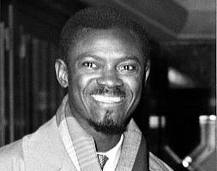
Patrice Lumumba
And first by Lumumba when he sought the intervention of the UN. He should have never called on the United Nations.The UN has never been able to properly solve problems brought to man’s consciousness by colonialism, and whenever it has intervened, it was to actually come to the aid of the colonial power to the oppressed country. Look at Cameroon. What kind of peace do the subjects of Mr. Ahidjo kept in check by a French expeditionary force, which most of the time, made its debut in Algeria, enjoy? The UN, however, controlled the autodetermination of Cameroon and the French government has set up a “Provisional Executive” there.
Look at Viet-Nam. Look at Laos.
It is not true to say that the UN fail because the causes are too difficult.
In reality the UN is the legal card used by imperialist interests when brute force has failed. The sharing, the mixed controlled joint committees, under guardianship are international means of torture to break the will of the people, cultivating anarchy, banditry and misery.
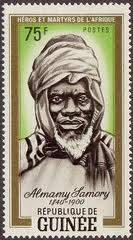
One of the great kings, and fighters of African freedom was the great Samori Touré. Over 100 years ago, Samori Touré was captured by the French and deported to Gabon where he died of pneumonia.
But who was Samori Touré?
Well, Samori Touré was born in 1830 in Manyambaladugu (some texts mentionSanankoro instead), a village southeast of Kankan in present-day Guinea. Samori was a great warrior who fought imperialism in the 19th century such as many leaders today. He refused to submit to French colonization and thus chose the path of confrontation using warfare and diplomacy.
Until the age of 20, Samori was a trader. After his mother was captured in a slave raid by the king Sori Birama, he offered to serve in his army and excelled by his military prowess and skills.
Samori Touré had a vision of unity for the Malinké people, and thus started organizing his empire using traditional and innovative methods. He effectively organized Malinké chiefdoms into a single state under his authority, at the core of which was the army. He managed to increase loyalty to the state in the Malinké people who now thought as one united people… this intensified their allegiance to him. His state was well-organized and efficient. Samori’s army was powerful, disciplined, professional, and trained in modern day warfare. They were equipped with European guns. The army was divided into two flanks, the infantry or sofa, with 30,000 to 35,000 men, and the cavalry or sere of 3,000 men. Each wind was further subdivided into permanent units, fostering camaraderie among members and loyalty to both the local leaders and Samori himself. Talk about African organization and discipline… this was really a strong army! His empire reached his apogee between 1883 and 1887, and he took the title of Almami or religious leader of a Muslim empire.
"L'Almami Samori Toure" de Khalil Fofana
Samori Touré created the Mandinka empire (the Wassoulou empire) between 1852 and 1882. His empire extended to the east as far as Sikasso (present-day Mali), to the west up to the Fouta Djallon empire (middle of modern day Guinea), to the north from Kankan to Bamako (in Mali); to the south, down to the borders of present-day Sierra Leone, Liberia, and Cote d’Ivoire. His capital was Bisandugu, in present day Gambia.
In the 1850s, slavery being abolished, European powers decided to establish colonies in Africa, and could not tolerate strong states like the Mandinka empire, and strong leaders like Samori Touré. These African leaders had to be crushed!
In 1882, at the height of the Mandinka empire, the French accused Samori Touré of refusing to comply to their order to withdraw from an important market center, Kenyeran (his army had blockaded the market). They thus started war on him. This was an excuse to start war! From 1882 to 1885, Samori fought the French and had to sign infamous treaties in 1886 and then 1887. In 1888, he took up arms again when the French reneged on the treaty by attempting to foster rebellion within his empire. He defeated the French several time between 1885 and 1889. After several confrontations, he concluded several treaties with the French in 1889.
Stamp from the Republic of Guinea
In 1890, he reorganized his army, and signed a treaty with the British in Sierra Leone, where he obtained modern weapons. He re-organized his army so as to stress defense, and employed guerilla tactics.
In December 1891, French forces overran the major cities of the Mandinka empire, leaving death and desolation in their wake (sounds familiar? Côted’Ivoire April 2011). These incursions into Touré’s empire led to exodus of the entire nation eastward. In 1893, Samori moved his capital east from Bisandugu to Dabakala. In 1894, the French assembled all their troops in western sudan (Senegal, Mali, Niger, etc…) to fight Samori.
Capture of Samori
Between 1893 and 1898, Samori’s army retreated eastward, toward the Bandama and Como (in modern day Cote d’Ivoire), conquering huge territories in the northern part of modern-day Cote d’ivoire. He led the scorched earth tactic, destroying every piece of land he evacuated. Although that tactic cut him from his new source of weapons in Liberia, he still managed to delay the French. He formed a second empire, and moved his capital to Kong, in upper Cote d’Ivoire. On May 1, 1898, the French seized the town of Sikasso and his army took up positions in the Liberian forests to resist a second invasion. This time Samori’s army fought valiantly but was no match to the power of the French arsenal. Samori forced to fight a total war against a foreign invader, and fighting against all odds, was captured on September 29, 1898, in his camp in Gué(lé)mou in present-day Côte d’Ivoire. He was exiled to Gabon where he died two years later on June 2, 1900.
Samori Touré was a warrior, a fighter, an empire builder, and one of the greatest African military leaders ever seen… he fought and won against the French army several times before his capture.
Interestingly enough, over 50 years later, the grandson of Samori, Sekou Touré, was the only one to say ‘NO’ to France, and to General De Gaulle: they preferred freedom over slavery under the European master… that was in Guinea!
Samori’s empire
Please check out the work of Pr. Yves Person on WebMande.net who wrote a book on Samori Touré, BlackHistoryPages, and this article published by the New York Times in 1898 about the Capture of Samori Toure by the French. According to the New York Times, Samori, “for nearly 13 years, was the most dangerous antagonists Europeans had had to deal with“. I could not find a good map of Samori’s empire anywhere… so I made my own based on all the boundaries and main cities conquered and his capitals: Bisandougou, Kankan, Bamako, Sikasso, Kong, Dabakala, Guelemou, etc… some of the cities may not be the same today (or even exist after 100 years), particularly the city of Dabadugu: Samori Toure defeated the French at Dabadugu, was it the city of Dabadugu near Kankan, or was it the city of Dabadugu near Nzerekore? I used Google map and made my own, respecting all the information found in all the different books and atlases I read. This is the entire kingdom, without taking into account the first and second empires. If you have further information, I will be happy to hear more.
Today I will be talking about Sylvanus Olympio, the first president of Togo, a small country in West Africa, which was once a German colony, and later became a French and British protectorate. The story of Togo is a little bit like that of my country Cameroon which was once a German colony but was later divided between France and Great Britain as protectorates (this will be a story for another day).
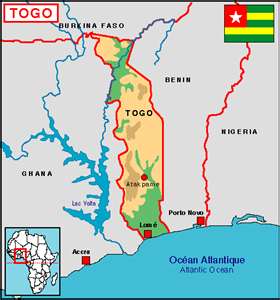
Sylvanus Olympio really embodies what the singer Tiken Jah Fakoly said in one of his songs “They [Europeans] divided the world among themselves, nothing amazes me anymore: part of the Mandinka empire found its way in the Wolof empire, part of the Mossi empire found its way in the Ghana empire, part of the Soussou empire found its way into the Mandinka empire and part of the Mandinka empire found its way into the Mossi’s empire …” what do I mean by this? Sylvanus Olympio was from Dahomey (current day Benin) of Afro-Brazilian ancestry, born in Kpando in actual Ghana, and became president of Togo! How was this possible? well because of the balkanization of Africa or rather the scramble for Africa which took place at the Berlin Conference in 1884 where Europeans split Africa among themselves dividing entire empires, people, villages, nations. One of these people were the Ewe people in West Africa who found themselves split among three countries: Gold Coast (Ghana), Togoland (Togo), and Dahomey (Benin).
Map of Togo
Sylvanus Olympio believed that the Ewe people should be reunited under one flag…. unfortunately he could never come to agreement with Kwame Nkrumah, his Ghanaian counterpart, and other powers at play. Olympio tried to unite and educate the people about their new nation, and the needs for development. From what a Togolese friend of mine once said, he used to ride a bike from villages to villages talking to people in their languages and educating them about politics, development, and patriotism, at a time when there was no radio (1950s) in most places.
Togo — A History
Sylvanus Olympio barely had a chance to execute anything politically. He was assassinated in a military coup in the US embassy compound in Lomé in 1963, two years after Togo’s independence and his investiture as president. The presidential palace was just next to the US embassy in Lomé. When Olympio heard gunshots, he sent his family to safety, and climbed the wall that separated him to the American embassy. Once there, he knocked at the door of the embassy to seek refuge… Unfortunately, the embassy was closed. Sylvanus hid in one of the cars in the American compound. The American Ambassador comes back to the compound and finds Olympio in the car who explains everything; the ambassador claimed not to have the keys to open the door… and asked him to wait while he would go find the keys. Rumors says that the American ambassador probably called his French counterpart who then contacted the gunmen and sent them to the American compound. Sylvanus was found in the car, and gunned by Eyadéma, one of Africa’s worst dictators backed by the West. The Time magazine wrote an article on that day entitled Togo: Death at the Gate; JFK also had a statement about his death. The journalist, Alain Foka, of RFI did a piece on Olympio.
Many wonder what Togo would have become under someone with such love, brilliance, and vision for his country. No one will ever know. Please enjoy this rare footage of an interview of Sylvanus Olympio to NBC in the US.
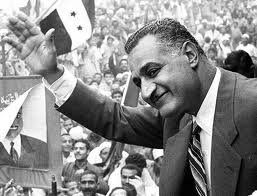
With this week’s event in Egypt, I thought that a trip down memory lane would be more than appropriate! One of the greatest political figures of modern Arab history and third world politics is the Egyptian president Gamal Abdel Nasser. Nasser was a pure political genius, and had great love and vision for his country, the Arab world, and developing countries in general. He was a strong player in the battle against imperialism in Africa, and in the Arab world. It was in Egypt that Um Nyobe and the UPC sought refuge to keep on working on Cameroon’s independence (this will be a story for another day).
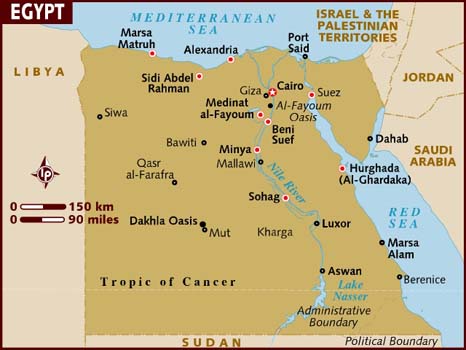
Map of Egypt
He was the first to negotiate the ownership/nationalization of the Suez Canal by Egyptians themselves. At its construction, as in most African countries, it belonged to the British since Egypt had been a British colony. Heled the Egyptian Revolution of 1952 which overthrew the monarchy of Egypt and Sudan, and started a new period of modernization and socialist reforms. He was determined to wean Egypt of its dependency on Western Economies. He was one of the few leaders in the world to declare his neutrality in the Cold War, which was considered very ‘gutsy‘. He moved Egypt toward a socialist economic system and instituted huge land, education and health reforms. As president, he was determined to modernize and improve Egyptians’ standard of living.
Nasser
After the humiliating Egyptian defeat during the Six-Day war against Israel, Nasser took responsibility for the debacle and resigned from the presidency (but thousands took to the street to demand that he returns to power). In his resignation speech he said: “I have taken a decision with which I need your help. I have decided to withdraw totally and for good from any official post or political role, and to return to the ranks of the masses, performing my duty in their midst, like any other citizen. This is a time for action, not grief…. My whole heart is with you, and let your hearts be with me. May God be with us—hope, light and guidance in our hearts.” You can read the entire speech on Al-Ahram Weekly. He died a couple of years later from a heart attack… many believe that the Six-day war defeat was a precursor. More than 5 million people attended his funeral. Nasser always wanted the best for his people!
Flag of Egypt
I wish more presidents, like Hosni Moubarak, in Africa could have the guts to resign from power, and could love their people so much as to want them to have the best. During an assassination attempt on Nasser’s life at a rally in Alexandria during the celebration of the British withdrawal from the Suez Canal, Nasser proclaimed: “If Abdel Nasser dies… Each of you is Gamal Abdel Nasser… Gamal Abdel Nasser is of you and from you and he is willing to sacrifice his life for the nation.” Moubarak today should learn from the past… like Dr. Zahi Hawass (world-renowned director of Egyptian Antiquities) said in a recent interview to BBC: “What will stay here after many years is Egypt… People will die, but Egypt will stay!” Moubarak should thus ask: “What would I be remembered by: those past few days of protests, or the love for my country?” If his answer is the second one, then he knows that he needs to pack his bags, and uphold Egypt’s liberty!
This Monday marked the 50 year anniversary of the assassination of the great African giant Patrice Lumumba. How could I pass on such an occasion to talk about him? 50 years later, his speech and his vision still ring true. Lumumba dared to defy the Belgian King Baudouin by telling him on independence day what he saw as the Belgian hold on Congo. He was blunt! He spoke the truth! He was not malleable… He could not be manipulated by Europeans! He was a menace because he was a free man proud to be Congolese.
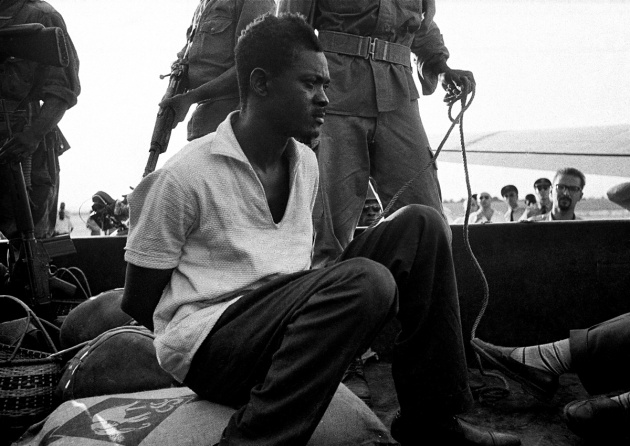
Lumumba detained
I always wondered what would have happened if Lumumba had not been so open about his ambitions for his country? What would have happened if he had played their game, and hidden his cards? Then we, Africans, would have never had our African hero! Someone had to say what we all felt: oppressed, hated, enslaved, diminished,… someone had to make us proud of being Congolese/African again… someone had to re-establish our dignity! That someone happened to be Patrice Emery Lumumba! Patrice died because he had great ideals, and because he trusted others. For the problem in the Katanga province, he went to the United Nations; he trusted that establishment to resolve the conflict peacefully, and to help solve the Katanga secession…. Instead they, with all the interests they represented (US, Belgium,France, etc…), refused to help him… the US of Kennedy refused to help him out, and thus he turned to the USSR to keep his country united. With the USSR, he was able to solve the rebellion in the Katanga and Kasai provinces… but the Americans and Belgians were mad that he had been helped by the Soviets; they decided to have him murdered after this affront (they used Mobutu, and Tshombe)! Once again, we Africans sold our own brother… I wonder where the Maurice Tshombe, or Kibwe, or the Joseph Mobutu are today… History will remember them as tyrants, dictators, and puppets of the West! Isn’t it interesting that history keeps repeating itself? Today the United Nations are starting a war in Ivory Coast in the name of installing a puppet-president in a soveraign country… Have you ever seen the UN so vehemently ask for war in a country? Only in Africa could this be possible… I used to dream that this was a peace organization! Actually, it is an organization to impose the will of the West on third world resource-rich countries.
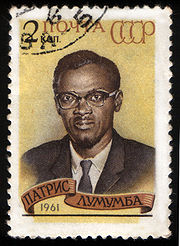
Lumumba on a USSR commemorative stamp in 1961
The following documentary will tell it all: how the Belgians did not like Lumumba because he was not a puppet, how they started the Katanga secession and supported it; how Lumumba went to the UN for help in keeping his country united and was refused help; how Lumumba went to the US to ask for help, and was not even received by president Kennedy; how he turned to the USSR to solve his problem in the Katanga and Kasai provinces; how that event precipitated his end. 50 years later, Lumumba’s ideals and vision are still actual. Lumumba is the symbol of aspirations of an entire continent. His spirit lives on, and his pride is ours!
Lumumba (2000)
I live you with an excerp from a letter he sent to his wife before his death: “… the future of the Congo is beautiful and [I] expect for each Congolese, to accomplish the sacred task of reconstruction of our independence and our sovereignty; for without dignity there is no liberty, without justice there is no dignity, and without independence there are no free men.” You can find the Integral version of this letter on AfricaWithin.com, as well as his famous 30 June 1960 independence day speech. Please don’t forget to check out: Wikipedia, The Guardian which deemed the assassination of Lumumba as the most important of the 20th century, The Daily Nation of Kenya deemed Lumumba the bright spark in a land of despair, and The New York Times which called it an assassination’s long shadow. At last, the movie Lumumba (2000) is what finally got the Belgian admitting their part in the assassination of Lumumba.
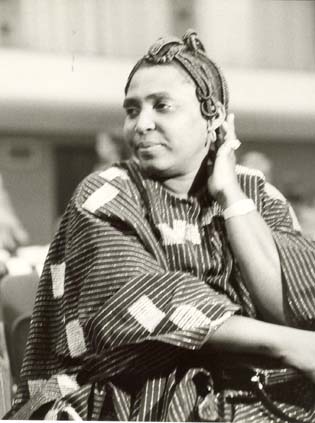
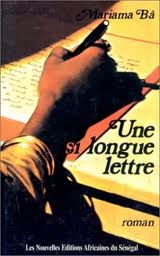
I have wanted to write about Mariama Bâ for the longest time. She is a writer from Senegal… she is the author of “Une Si Longue Lettre” [So Long a Letter], and “Chant Ecarlate” [Scarlet Song]. Her book “Une si Longue Lettre” [So Long a Letter] is considered by many as being the first truly African feminist book, as it describes the woman’s condition in an African and Muslim society. It talks about the place of the woman in society, the effect on polygamy on women and society, and the clash between modernism and traditions. It is written as a letter from a widow Ramatoulaye to her best friend Aissatou who left her husband when he decided to marry a second wife. This book really describes the feminine condition in Africa, and was truly the first to address so overtly the woman’s hurdle in African society. Six months after the publication of “Une Si Longue Lettre,” Mariama Ba passed away… and her novel “Chant Ecarlate” was published posthumously.
Une Si Longue lettre
Chant Ecarlate [Scarlet Song] also deals with feminine conditions, but addresses more the clash between two different cultures the European (of the protagonist Mireille), and the African (of Mireille’s husband), and again polygamy. I always felt deeply connected to Bâ’s first book, and always wondered what a great loss African literature suffered when she left. She will always be an inspiration for many: orphan from her mother, raised by her father and grand-parents, mother of nine children, divorcée, professor, highly educated woman, she embodied the strength and determination that can so clearly be seen in African women. Today, “Une Si Longue Lettre” is an African classic, read in all schools across the continent, and translated in numerous languages. We are forever grateful for her work… she opened the door to many bold young African female writers.
Scarlet Song
The following is an interview that Mariama Bâ gave to Alioune Toure Dia for the magazine Amina in November 1979: Interview de Mariama Bâ à Amina. Relax and enjoy!
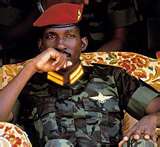
Thomas Isidore Sankara, notre héros africain, mort pour ses convictions et son amour de son peuple, et de sa patrie. Ce grand héros a fait l’un des plus beau discours que j’ai jamais entendu sur la dette africaine! Quelle éloquence mon Dieu! Quelle vérité! et quel humour! Je suis d’accord avec lui que la dette africaine ne peut pas être entièrement payée… et que les pays membres qui ne vont pas aux réunions de l’UA ne devraient pas recevoir les mêmes faveurs que ceux qui y assistent assidûment. De plus, il parle de consommer africain: toute sa délégation était habillée par des tisserands Burkinabés. Regardez, écoutez, et célébrez avec moi l’un des plus grands hommes qui ait foulé le sol du continent africain.
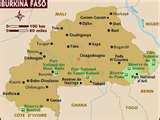
Burkina Faso
Thomas Isidore Sankara, our African hero, killed for his convictions, love of his people and his country. This great hero gave one of the greatest speech I have heard about the problem of African debt. Such an eloquence! Such Truth my Lord! Such humour! I do agree with him that the African debt cannot be entirely paid… and that the African nations who do not show up at the UA summit should not have favors extended to them the same as those who attend the meetings. Moreover, he talks about living and breathing African: his delegation and himself were entirely dressed by Burkinabes tailors with cotton from Burkina Faso. Please watch, listen, and celebrate one of the greatest man the African continent has ever seen!
Affectionately known as KK, Kenneth Kaunda was the first president of Zambia.
Kenneth Kaunda with Nelson Mandela
While president of Zambia, Kenneth Kaunda nationalized the copper mines, and also worked towards freeing all the Black people of Southern Africa from white supremacy. He supported freedom fighters in the Portuguese colonies of Angola and Mozambique, in Southern Rhodesia (today’s Zimbabwe), Namibia, and South Africa. He even met with Pieter Botha and B.J. Vorster to solve the issue of apartheid in South Africa, but got no results. Being so close to all these countries and seeing what his fellow brothers were going through made him want to fight. He played a crucial part in the liberation of all of southern Africa from white supremacy. Zambia paid a price for its backing of those countries by being bombed by the Apartheid government.
KK on a Zambian currency note
One thing I remember clearly is the day KK went on national television to sensibilize the Zambian people about the danger of AIDS. He had just lost his son to AIDS, and he was on tears, and urged the people of Zambia to take precautions. I was impressed! How many presidents do you see doing that? or at least how many African presidents do that?
Please enjoy this interview given by Kenneth Kaunda to CNN African voices. One other special plus… Kenneth Kaunda is a great singer!
Don’t forget to watch Part 2 and 3 of the interview.
“I have been a journalist since the age of 15. I started as an errand boy at a newspaper called Semences africaines, in the city of Yaoundé, Cameroon. Over the past 34 years, I have been arrested 126 times while carrying out my profession as a journalist. Physical and mental torture, death threats, the ransacking of my newsroom, etc., has often been my daily lot in a situation where repression and corruption, even within the press, have become the norm. Woe betide the slightest dissenting voice in this context, for it attracts all kinds of wrath, even from so-called colleagues…”
“I have never felt like a prisoner when I have been behind bars. You can be in prison without being a prisoner; the real prisoners are those who imprison journalists whose only crime is to inform or to express an opinion… ”
“… my long stay in prison above all stimulated my sense of solidarity with others, particularly the poor and the outcast… strengthened my determination to use journalism as a weapon against all kinds of abuse. For there is no better weapon than words for restoring peace and justice among people…”
“To have the privilege of writing taken away from you overnight feels like being victim of a crime…”
“During a lecture I once gave to students from a well-known university in New York, the director of the school of journalism made the following remark: “Mr. Njawe, my students and I appreciated your brilliant exposé of the situation regarding press freedom in Cameroon and in Africa in general. But I cannot help wondering one thing: either you invented all these stories to impress us, which I could understand, or everything you have told us is true and I am dying to ask you why you continue to work in the profession in the suicidal situation you describe?”
“It is indeed difficult to understand why people persist in a profession that causes them so much misery and suffering. As regards my own case, I invariably reply to everyone who wonders this, that I entered journalism the way you enter a religion; journalism is my religion.I believe in it, and a thousand trials, a thousand arrests, a thousand imprisonments and as many death threats will never make me change job. On the contrary, the harder it is, the more you have to believe in it and cling to it.”
“Even in the depths of a prison cell you can feel good about being a journalist. How many times have I not rubbed my hands in my cell, my fingers itching to once again hold a pen between them, when thinking back over my career? How many times have I smiled when recalling an editorial or an article that helped foil the most atrocious plans against Cameroon and its people? If only for consolation, one sometimes ends up saying: “They’re right to take it out on me like this, after all, I haven’t spared them in my articles…“. ”
Respecting ethical standards is of fundamental importance for anyone wishing to be a journalist. It protects you against all kinds of people who would like to teach you a lesson. When you are facing a judge who is being manipulated, it is your irreproachable professional defense that makes that judge examine his or her own conscience. It is what wins your colleagues over to your cause when you are in difficulty. Doing your job properly therefore seems to be the best advice anyone can give a journalist operating in a context of constant harassment. And doing your job properly also, and above all, means avoiding “gumbo journalism“, a practice becoming increasingly widespread in our profession, where people write what they are paid to write instead of giving real information and the truth. While journalists have the right to earn a decent living, even in emerging nations,honest journalists never need pockets in their shrouds…
Journalists perform a social function, which gives them not immunity, but the right to look critically at the way a nation is being run. While playing this crucial role, it is important for them to be protected by the law, but also by the whole of society for which they work…Every time a journalist is silenced, society loses one of its watchdogs.
Le 3 Mai est la journée internationale de la liberté de presse. Pour moi, quand je grandissais à Douala, la liberté de presse avait toujours été symbolisée par Pius Njawe et son journal ‘le Messager‘. Qui au Cameroun n’a pas lu ‘le Messager’? Qui n’a pas souri sous les caricatures du ‘Messager Popoli‘? Je dévorais assidument chaque page de son journal… Au debut, quand j’étais toute petite, la rubrique ‘Takala et Muyenga‘ était la seule qui m’interessait car elle était amusante et il y avait de très belles carricatures (oui j’admets… j’aimais les dessins). Petit à petit, j’ai commencé à lire l’éditorial écrit par Pius Njawe lui-même, et puis finalement le journal tout entier. Mon père étais un abonné hors-pair, et c’est grâce à lui que le ‘Messager’ est devenu presque synonyme de ‘vraies‘ nouvelles (i.e. non contrôlée par l’etat) dans mes pensées. Pius Njawe avait un don, une passion: il aimait la vérité! Il était à la recherche de la vérité et du bien-être de la société civile. Il n’avait pas peur d’aller en prison pour avoir publier des articles poignants contre le gouvernement en place; il avait d’ailleurs été arrêté plus de 126 fois. En 2000, Njawe est nommé parmi les 50heros de la liberté de la presse des derniers 50 ans.
Le Messager
Quand je pense que Njawe avait créé ‘le Messager’ à l’age de 22 ans en 1979, sans même avoir fait d’études avancées… C’est surprenant!… non, impressionant! Il avait toujours était guidé par sa passion, et c’est certainement pour cela que ‘Le Messager’ était si différent de tous les autres journaux de la place: il était authentique, mû entièrement par la passion et la recherche de la vérité impartiale… bref par le journalisme à l’état pur! Que puis-je dire? La perte de Pius Njawe est comme la perte d’une perle precieuse, car Pius Njawe était effectivement une perle rare pour le Cameroun. Il avait résisté pendant 30 ans, et avait payé de cela par ses détentions arbitraires en prison, le saccage de ses bureaux par le gouvernement, l’exil au Benin (qui avait duré 1 an), la fausse-couche de sa femme (qui avait été battue en prison), la mort de sa femme, et ensuite lui-même. Il a payé de sa vie son amour de sa patrie, de la vérité, et du journalisme. Une chose est sûre et certaine, il a touché chacun d’entre nous, et son oeuvre continuera à jamais. Hasta la vista Pius, tu nous a ouvert les yeux à la cause de la démocratie et de la liberté. Tu resteras dans nos memoires comme étant le plus grand combattant, et opposant camerounais, car tu t’es opposé au népotisme, à la dictature, à l’injustice, et à la gabegie. Comme disait si bien Agostinho Neto: “La lutte continue et la victoire est certaine!”
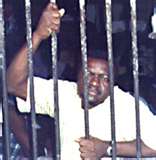
Pius Njawe in jail
May 3rd is the World Press Freedom Day. Pius Njawe and his journal ‘le Messager’ have come to symbolize this day to me. Pius Njawe’s pioneering work as the head of le ‘Messager‘ has marked me for as long as I can remember. His journal was not only the first true alternative to Cameroon Tribune (state-owned newspaper), but the real way to find news about what was truly going on in the country. In 2000, the Austria-based International Press Institute listed Mr. Njawe among its 50 world press freedom heroes of the past half-century. The institute called Mr. Njawe “Cameroon’s most beleaguered journalist and one of Africa’s most courageous fighters for press freedom.” Yes… Njawe was the quintessential freedom fighter in a country where the press was constantly controlled and held under the sword of Damocles by the regime. He was arrested over 126 times, most of the time simply for telling the truth and keeping the government under constant check. He embodied what true journalism is all about: the impartial search for truth. While resisting the regime for over 30 years, he had come to symbolize the true voice of the people, the voice of those who could not speak, those who had no one, the people of Cameroon. We salute you Pius, you were indeed a true freedom fighter, and the true representant of the people! You will sorely be missed!