Gungunyane: the Lion of Gaza or the Last African King of Mozambique

Gungunyane, the Lion of Gaza

Today, we will talk about one of the greatest chief in Mozambique‘s modern history: the Shangaan king Gungunyane, of the Gaza Empire.  He governed a region which encompassed parts of eastern Rhodesia (in modern day Zimbabwe), and southern Mozambique.  He was known as the Lion of Gaza.

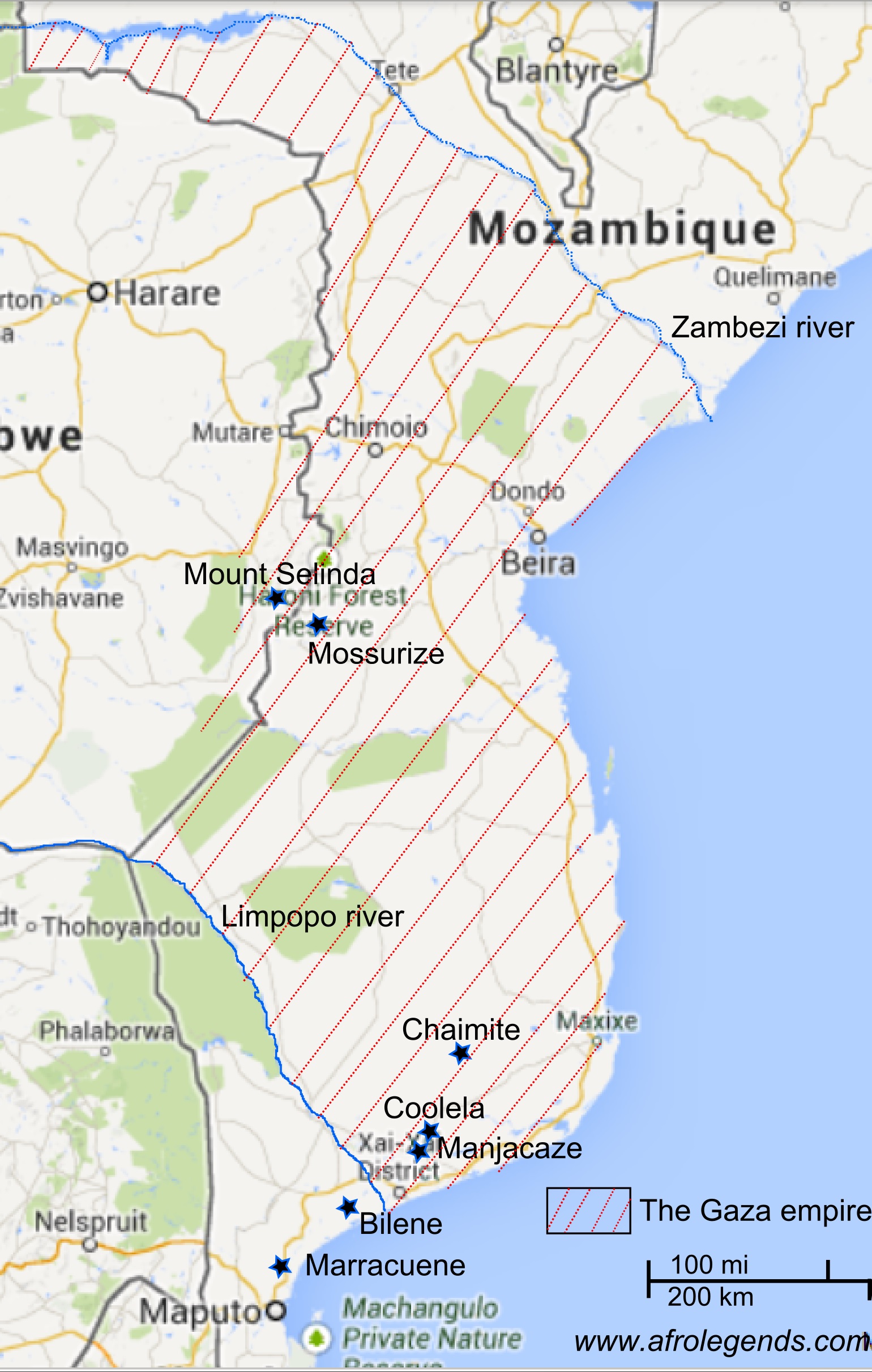
So who was Gungunyane?  Born Mdungazwe (which means ‘one who confuses the people’ in Zulu) around 1850, he will change his name from Mdungazwe to Gungunyane upon his ascension to the throne in 1884. Gungunyane was born on the Gaza territory, which extended from the rivers Zambezi and Incomati, to the Limpopo river, and would go all the way into modern-day Zimbabwe.  He was the son of Mzila, who reigned from 1861 to 1884.  He was also the grandson of Soshangane, the founder of the Nguni or Gaza empire, after his defeat at the hands of Shaka Zulu in 1820 in Zululand during the Battle of Mhlatuze river.  In its initial stages, the Gaza empire expanded over 56,000 km2 (22,000 sq mi) of land, with its capital being Chaimite.  At the death of his father Mzila, Gungunyane ascended the throne after a fratricidal battle with his other brothers.

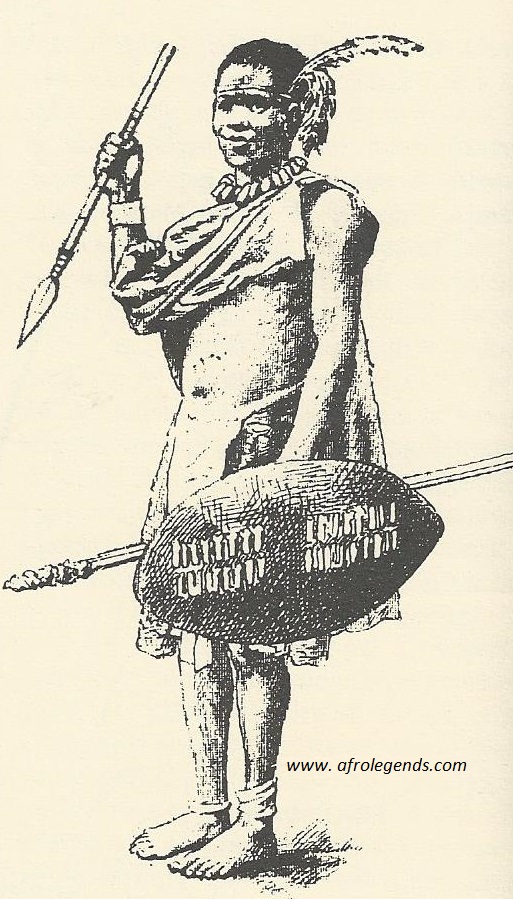
Picture of a Vatua-Shangaan warrior, taken at the end of the 19th century (Source: 'Les Africains', Vol.3, P.182, Ed. J.A. 1977)
Picture of a Vatua-Shangaan warrior, taken at the end of the 19th century (Source: ‘Les Africains’, Vol.3, P.182, Ed. J.A. 1977)

At his ascension, the Portuguese sent him emissaries in 1885 who tried to have him sign treaties to recognize Portugal’s sovereignty in the region promising: to give his territory to no other than Portugal, to allow that a Portuguese agent reside with him as advisor, to have Portugal’s colors raised over his kraals, to allow Portuguese subjects to circulate freely in his territory, to allow only Portuguese to exploit his mines, to allow the establishment of schools and churches, etc.  For which Gungunyane would retain full jurisdiction over the Gaza territory with the right to administer it, and to raise taxes.  This was unacceptable to Gungunyane who refused to sign.

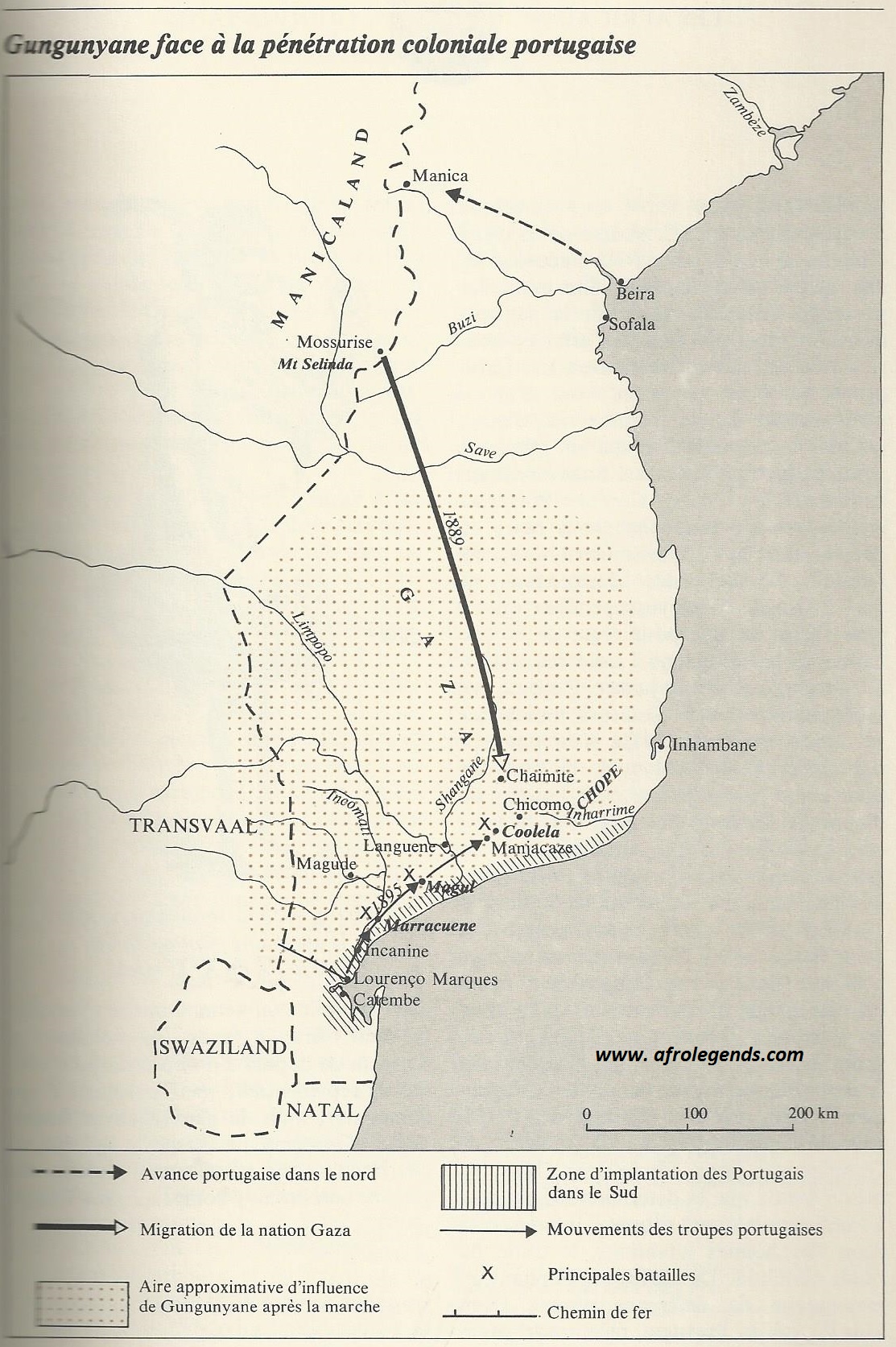
The southern region of Mozambique was a penetration road for the Portuguese who had been arming vassals of the Shangaan.  Thus in 1888, Gungunyane and his advisors decided to move their kraals from the Rhodesian plateau to the shores of the Limpopo river. This decision will end up costing them a lot, as 40,000 to 100,000 people made the move.  Several fractions left in april 1889, while the king himself moved from Mount Selinda on 15 June 1889.  This decision was motivated by the desire of Gungunyane to settle an old score with chief Speranhana (who was armed by the Portuguese) of the Chopi people from between the Limpopo and Inharrime, and the need to recover his father’s land in the region of Bilene.  In 1889, the Lion of Gaza invaded the Chopi territory, and installed a kraal in Manjacaze.  However, the battle against the Chopi will last until the end of his reign, and will greatly weaken the Shangaan.

Throughout his reign, Gungunyane never signed any treaties, because he never trusted neither the Portuguese nor the translator (even if the translator was his own son).  He was a skilled negotiator, and would always try to settle everything diplomatically.  He played well the British and Portuguese interests in the region… this might have been his downfall in the end.

In 1890, Gungunyane prohibited the sale of alcohol by Portuguese merchants on Gaza territory.  In 1891, the Portuguese adopted a decree to ban the sale of alcohol on Gazaland, and agreed to work with Gungunyane to implement this… but as we all know the Portuguese never stopped selling alcohol in the region (this seems like a century old practice from Europeans selling cheap alcohol in Africa, and turning Africans into drunkards).

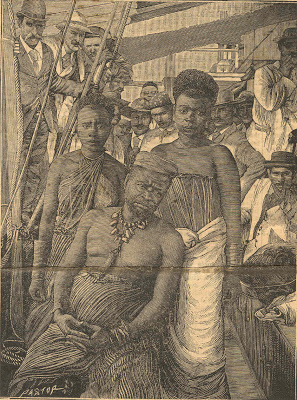
Picture of captured Gungunyane on board the ship 'Africa' from the Diario Ilustrado - 15 March 1896
Picture of captured Gungunyane on board the ship ‘Africa’ from the Diario Ilustrado – 15 March 1896

The Portuguese never stopped trying to control Gungunyane who never stopped wanting more independence (it was his land after all).  They kept enforcing treaties.  In 1893, the conflict in Matabeleland between the British and Lobengula forced several Ndebele to seek refuge in the Gaza territory (one of Gungunyane’s sister was married to Lobengula) creating confusion.  In 1894, the Portuguese used a succession quarrel between Ronga chiefs to attack Gungunyane.  No proof was found of Gungunyane’s involvement into the hostilities.  On 22 August 1894, war started, when the Ronga troops defeated the Afro-Portuguese troops with Ronga chiefs Mahazul and Matibejana of Zixaxa attacking Lourenço Marques.  However, the Ronga chiefs were defeated by the Portuguese during the battle of Marracuene on 2 February 1895.  The Ronga chiefs thus sought refuge into Gungunyane’s kingdom.  Gungunyane kept negotiating, but now the sine qua non condition to any negotiation was the surrender of the Ronga chiefs, with other clauses such as the full control of his territory by the Portuguese, the installation of military bases, the payment

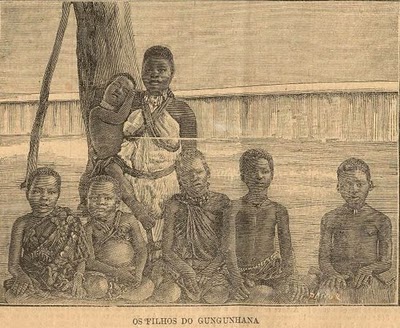
Picture of Gungunyane's children on board the ship 'Africa'- from the Diario Ilustrado -15 March 1896
Picture of Gungunyane’s children on board the ship ‘Africa’- from the Diario Ilustrado -15 March 1896

of an annual tax of 10,000 pounds, etc.  For the Lion of Gaza, this meant the end of his independence.  Negotiations were still ongoing, but by September, the Portuguese had invaded the territory of Cossine which was an integral part of the Gaza kingdom.  On 7 November 1895, on lake Coolela, not far from Manjacaze, the Portuguese crushed 8 Shangaan regiments.  Coolela became the Waterloo of Gungunyane.  The Lion gathered his treasures and took off.  For almost a month, Portuguese kept looking for him thinking that he had sought refuge in Transvaal.  However, Gungunyane had sought refuge in Chaimite, the sacred village of the Shangaan people.  While many of his dignitaries, and sons managed to escape into the Transvaal, the Lion never left Chaimite, and on 28 December 1895, he was captured there by Mousinho de Albuquerque, the Portuguese military governor of Gaza.  Gungunyane was first sent to Lisbon, and then later to the island of Terceira on the Portuguese Azores, with his son Godide, some of his wives, and dignitaries. He will die there on 23 December 1906.

In exile in Acores, from l to r: Zixaxa, Molungo, Godide, and Gungunyane
In exile in Acores, from l to r (top): Zixaxa, Molungo, Godide, and Gungunyane
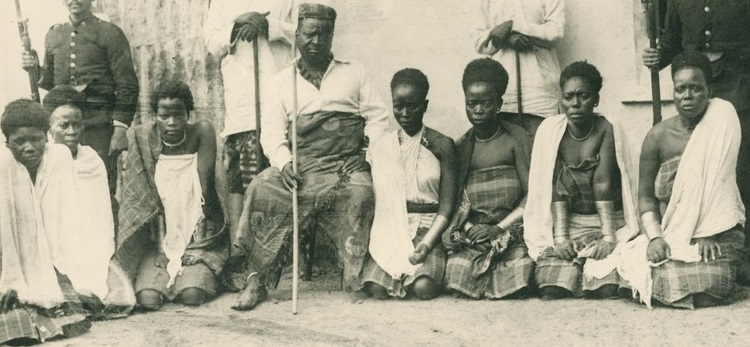
Gungunyane and his wives in exile in Acores

Under Gungunyane, the Shangaan empire grew more powerful compared to his father’s years.  The Shangaan system expanded at a time when Mozambique was at the center of European greed and attacks.  Portuguese who had arrived in the area in 1891, were amazed by Gungunyane’s power, and wrote that the Gaza empire was “the biggest empire that the negro race had created in oriental Africa.”  Many were quite skeptical when they learnt of the Lion of Gaza’s defeat.  A contemporary Portuguese wrote in 1910 that: “the king of the Vatua [Shangaan] empire was a fine diplomat who, knowing that we did not have the military strength to counter his power, managed to turn us [the Portuguese] into docile vassals.” To learn more, check out the book ‘Les Africains, Vol. 3, C. Julien, editions J.A. 1977’, as well as VidasLusoFonas, and the book Gungunhana no seu Reino by Maria da Conceicao Vilhena.

Commemorating Agostinho Neto’s life – Angola’s National Heroes Day

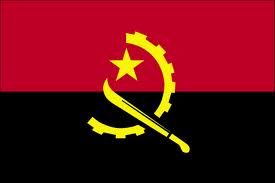
Flag of Angola
Flag of Angola

Today is Angola’s National Heroes’ Day commemorating Angolan heroes, and is a celebration of the life of one of their heroes, President Agostinho Neto who was born on this special day.  To mark this day, and to celebrate in style, I propose yet another poem from Angola’s greatest poet, President Neto himself.  Enjoy! (I translated from Portuguese to English so it might not be the greatest… if you have a better translation, feel free to share).

Noite by Agostinho Neto – Translation by Dr. Y., Afrolegends.com

Noite                                  

Eu vivo
nos bairros escuros do mundo
sem luz nem vida. 

Vou pelas ruas
às apalpadelas
encostado aos meus informes sonhos
tropeçando na escravidão
ao meu desejo de ser.

São bairros de escravos
mundos de miséria
bairros escuros.

Onde as vontades se diluíram
e os homens se confundiram
com as coisas.

Ando aos trambolhões
pelas ruas sem luz
desconhecidas
pejadas de mística e terror
de braço dado com fantasmas.

Também a noite é escura.

Night                                                                     

I live                                                                     in the dark quarters of the world                     without light and life.   

I fumbled through the  streets                                                          leaning on my dreams                                  stumbling on slavery                                                                 to my desire to be.

Slave quarters                                                worlds of misery                                                dark quarters.

Where the wills were diluted                                   and the men were confused                                   with things.

I walk in unknown streets                                                         without tripping                                                                 Streets soaked in with mystical light                    and the terror arm of ghosts.

The night is also dark.

The Principal Reasons why Osende Afana was defeated

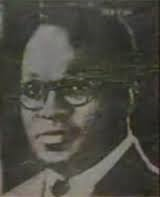
Castor Osende Afana
Castor Osende Afana

Castor Osendé Afana‘s maquis suffered a major defeat, and a final blow with the murder and decapitation of its leader on 15 March 1966.  Here are some of the principal reasons of the defeat of the Boumba-Ngoko maquis in the south east corner of Cameroon.  These reasons had been identified by Osendé Afana himself before his death, and by his some of his followers later on.

1 – The Boumba-Ngoko region (or Moloundou region) had not been exposed to any revolutionary movement, or any influx of political ideas about the liberation of Cameroon since the end of the second world war, like the populations of the West, Littoral, Center or Southern provinces.  The populations there being mostly Bakas pygmies and poor Bantous peasants and illiterate had almost never led major economic or political struggles against the exploitation and domination of the colonial and neocolonial forces.  Their political awareness was quite low, and they had very little experience fighting.

2 – The region was sparsely populated, which forced the guerilleros, who were supposed to move around the people as fish in the sea, to fight practically in the open against a very powerful enemy.

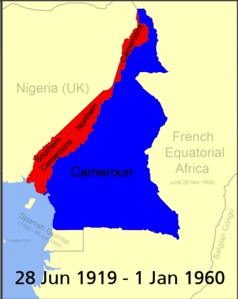
Map of Cameroon from 1919 to 1960, including both Cameroons (French in Blue, and British in red)

3 – The low number in Afana’s group which kept decreasing due to several desertions.  It was also very difficult to recruit among the local people.

4 – No members of the initial group were originally from that region, and thus had little knowledge of the field, the language, and customs of the local populations.

5 – The maquis’ entrance from Congo-Brazzaville had happened without much discretion, and all their subsequent movements in the region did not go unnoticed.  This made it easy for the colonial forces to trace them.

6 – No prior ground study had been done.

7 – The government of Congo, while giving their support to Afana, were opposed to any military action on their borders.

8 – Several tactical differences persisted within the group, with Osendé Afana, being more political and anxious of respecting the Congolese wishes, and with Fosso Francois, who was more military-centered.

9 – No prior contact/communication had been established with the Western maquis led by Ernest Ouandié.  This could have ensure some help.

10 – An incorrect assessment of the colonial forces, their tactics, their capacity of enrolment, and the political activity of the masses on the national scale.

11 – Lastly, too big a reliance on external help.

For more information, visit afrohistorama.com to learn more about these critical events in the history of Cameroon.

Castor Osendé Afana: A Cameroonian National Hero

Castor Osende Afana
Castor Osende Afana

Brilliant economist, Castor Osendé Afana is considered a national hero in Cameroon, however he is not as well-known as Ruben Um Nyobé, or Felix-Roland Moumié, or even his alter ego on the western front of Cameroon, Ernest Ouandié.  Like those three, he was also assassinated, and paid with his life for his passion for the freedom of Cameroon, and Africa from colonialism.  So who was Castor Osendé Afana?

Well, Castor Osendé Afana was born in 1930 in Ngoksa near Sa’a, in the Centre Region of Cameroon.  In 1948 he was admitted to the seminary at Mvolyé, in Yaoundé, where he became a strong friend of Albert Ndongmo, the future Bishop of Nkongsamba.  He was excluded from the seminary in 1950 because of his critical and rebellious character.  It is as a ‘candidat libre’ that he successfully passed the first part of the Baccalauréat.  He then started in philosophy at the Lycée Leclerc where he headed student manifestations demonstrating against the poor food service there.  He nonetheless went on to successfully pass the 2nd part of the baccalauréat in 1952.

Later, Osendé Afana obtained a full scholarship to study Economics in Toulouse, France.  By 1956, he was a vice-president of the Black African Students Federation in France (Fédération des étudiants d’Afrique noire en France – FEANF), and was managing director of the FEANF organ L’Etudiant d’Afrique noire.   As a UPC militant he ensured that the issues of Cameroon were well-covered in the magazine.  In 1958, Osendé Afana was named General Treasurer of FEANF, as well as being responsible for the UPC in France.

UPC Leaders (L. to R.) front row: Castor Osende Afana, Abel Kingué, Ruben Um Nyobé, Felix Moumié, and Ernest Ouandié

After the French government dissolved the UPC by decree on 13 July 1955,  most of the UPC leaders moved to Kumba in the British-administered Southern Cameroons to avoid being jailed by the colonial power.  In July 1957, under pressure from the French, the British authorities in western Cameroon deported the leaders of the UPC to Khartoum, Sudan.  They moved in turn to Cairo, Egypt, to Conakry, Guinea and finally to Accra, Ghana, where they were hosted by President Nkrumah.  In 1958, after Ruben Um Nyobé’s death, Osendé Afana decided to abandon his thesis and rejoin the leadership of the UPC, proposing himself as a candidate for the new Secretary General.  Nyobé’s successor, Félix-Roland Moumié, told him “There is no longer a Secretary General.  There was one, he is dead, that is it.”  However, Osendé Afana was designated UPC representative at the Afro-Asian People’s Solidarity Conference in Cairo in December 1957 – January 1958.  After Cameroon’s independence in 1960, the UPC continued to fight the government of President Ahmadou Ahidjo whom they considered a puppet of the French colonial power. Continue reading “Castor Osendé Afana: A Cameroonian National Hero”

Gerard Sekoto: the Father of Urban Black Painting

Gerard Sekoto (Source: Africansuccess.org)

Today, I will be talking about the late South African painter Gerard Sekoto.  Gerard Sekoto is known today as the father of urban black art and social realism.  Born in 1913, Gerard Sekoto grew up in South Africa at a time of apartheid.  His entire art has been influenced by his life experience.  He held exhibition in Johannesburg and Cape Town.  His painting was actually the first painting by a Black artist to be exposed at the Johannesburg Art Gallery.  He was a big fan of oil painting.

Gerard Sekoto's depiction of Steve Biko's death
Gerard Sekoto’s depiction of Steve Biko’s death

In 1947, he exiled himself to Paris.  His first two years were quite depressing and hard; they actually had nothing to do with painting.  He played in French nightclubs as a pianist, and composed over 25 songs whose main themes were the loneliness of exile, and the courage of an immigrant trying to survive in a foreign country.  Quite a global theme these days, in this global world!

In 1966, he visited Senegal, and was actually a guest of President Léopold Sédar Senghor.  He visited Dakar for a year, and this visit reignited his passion for painting.  Armed with his brushes, he fully immersed himself into the ‘Dakarois’ environment, and once again started painting African scenes.

Prisoners laboring hard in South Africa - by Gerard Sekoto
Prisoners laboring hard in South Africa – by Gerard Sekoto

In the 1970s, he started expressing his opposition to the apartheid system back in his homeland, and started painting about it.  One of his famous paintings is poignant depiction of Steve Biko‘s death, with Biko’s tearful mother at the center of the painting, Biko to the right of her, and a white policeman to the left.  It is very sorrowful and vivid depiction… and to think of Biko’s mother! Most often, people paint the victim, and forget those they’ve left behind.

Sekoto never had a chance to return to South Africa, not even for his mother’s funeral. He ended his days in a retirement home for artists on the outskirts of Paris in 1993.

Please check out the website of the Gerard Sekoto Foundation, the Gerard Sekoto Webpages, and this photo-journal by the BBC.  Don’t forget to read about how Sekoto used to capture his subjects on AfricanColours.com.

May 3rd: World Press Day – Norbert Zongo

Norbert Zongo
Norbert Zongo

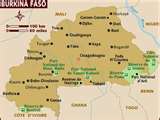
May 3rd marks the World Press Freedom Day, or simply World Press Day.  This day is to raise awareness of the importance of the freedom of the press and remind governments across the world to respect the right to freedom of expression.  Today I would like to commemorate the life of an African journalist hailing from Burkina Faso, Norbert Zongo, who just like the great Cameroonian journalist Pius Njawe, stood for justice and fought injustice.

Norbert Zongo was the publisher and editor of Burkina Faso newspaper L’Independant.  On 13 December 1998, Norbert Zongo was assassinated after his newspaper investigated the murder of a driver (David Ouédraogo) who had worked for the brother of the president Blaise Compaoré, François Compaoré.  Zongo’s burned body was found along with the bodies of three other people: his brother Ernest Zongo, his chauffeur Ablasse Nikiema, and Blaise Ilboudo, in a vehicle near Sapouy, 100 km from the capital Ouagadougou.  An investigation showed that Zongo was killed for political reasons.  His murder rocked Burkina Faso, and manifestations arose within the country, and neighboring countries.  The most violent manifestations took place in the city of Koudougou, Zongo’s birthplace, and government supporters organized a militia armed with clubs engaged to hunt protesters in many cities of the country.

Burkina Faso
Burkina Faso

Bowing to popular discontent, President Blaise Compaoré, had to open a judicial investigation where his brother was charged for murder and harboring the body of the victim in connection with the death of David Ouédraogo who died of torture.  The charges were later dropped by a military tribunal.  In August 2000, five members of the presidential guard were charged for the murder of Ouédraogo, were convicted and sentenced to lengthy prison terms, but all were later freed.  In seven years of trial, one suspect, a member of the presidential guard was charged, but the accusing witness later recanted.  The Zongo trial ended in July of 2006 with a non-place which caused an international outcry.

Norbert Zongo is also the writer of the book, The Parachute Drop (Le Parachutage), which was translated to English and published in 2004.  Many of his articles can be found in the review Mobutuization of Burkina Faso.

Today, Norbert Zongo is celebrated as a martyr, one who stood for truth, in a country where not many dared to talk.  This is why he should be the man of the day, for a day like World Press Day: He dared to talk, he expressed the truth to enlighten others, and sought justice for another man.  In 2003, a documentary was made to talk about his murder: Borry Bana, the fatal destiny of Norbert Zongo.  In 2012, a memorial was erected at the Highway N6 (Ouagadougou – Léo) near Sapouy, exactly where Zongo was murdered.  Please watch this video of Norbert Zongo talking to African youths.  His message is that of maintaining intrinsic values of principle, of growth, of conscience.

Chinua Achebe in His Own Words

Chinua Achebe
Chinua Achebe

Africa just lost a giant… the world just lost a literary genius.  Chinua Achebe was made of the cloth of kings.  He was the emperor of words and just made reality seems so funny.  He wrote in English, but yet made it his own; he made it African.  Please hear the maestro in his own words.

Age was respected among his people, but achievement was revered.  As the elders said, if a child washed his hands he could eat with kings.”  – Things Fall Apart.

The white man is very clever.  He came quietly and peaceably with his religion.  We were amused at his foolishness and allowed him to stay. Now he has won our  brothers, and our clan can no longer act like one.  He has put a knife on the  things that held us together and we have fallen apart,” –  Things fall Apart.

Achebe was a man of character, who could not be corrupted by honors.  He twice turned down the offer of a title Commander of the Order of the Federal Republic, once in 2004 from Nigeria’s then President Olusegun Obasanjo and again in 2011 from President Goodluck Jonathan. He explained on the BBC: “What’s the good of being a democracy if people are hungry and despondent and the infrastructure is not there,” … “There is no security of life. Parts of the country are alienated. Religious conflicts spring up now and again. The country is not working.” Declining the honor, he wrote that “for some time now I have watched events in Nigeria with alarm and dismay.  I have watched particularly the chaos in my own state of Anambra where a small clique of renegades, openly boasting its connections in high places, seems determined to turn my homeland into a bankrupt and lawless fiefdom.  I am appalled by the brazenness of this clique and the silence, if not connivance, of the presidency …  Nigeria’s condition today under your watch is, however, too dangerous for silence.  I must register my disappointment and protest by declining to accept the high honour awarded me in the 2004 honours list.”

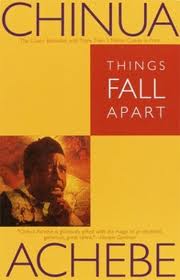
'Things Fall Apart' by Chinua Achebe
‘Things Fall Apart’ by Chinua Achebe

He wrote: “You see we, the little people of the world, are ever expendable.”

It is sometimes good to be brave and courageous, but sometimes it is better to be a coward.  We often stand in the compound of the fool and point at the ruins where a brave man used to live.  He who has never submitted to anything will one day submit to his burial mat.” – Things fall apart.

While we do our good works let us not forget that the real solution lies in a world in which charity will have become unnecessary.”  – Anthills of the Savannah.

To me, being an intellectual doesn’t mean knowing about intellectual issues; it means taking pleasure in them.”

Nobody can teach me who I am. You can describe parts of me, but who I am – and what I need – is something I have to find out myself.”

One of the truest tests of integrity is its blunt refusal to be compromised. ”

We cannot trample upon the humanity of others without devaluing our own. The Igbo, always practical, put it concretely in their proverb Onye ji onye n’ani ji onwe ya: “He who will hold another down in the mud must stay in the mud to keep him down.”  – The Education of a British-Protected Child: Essays.

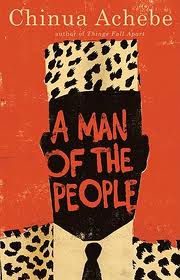
'A Man of the People' by Chinua Achebe
‘A Man of the People’ by Chinua Achebe

‘It’s true that a child belongs to its father.  But when a father beats his child, it seeks sympathy in its mother’s hut.  A man belongs to his fatherland when things are good and life is sweet.  But when there is sorrow and bitterness he finds refuge in his motherland.  Your mother is there to protect you.  She is buried there.  And that is why we say that mother is supreme.” – Things fall Apart.

Unfortunately, oppression does not automatically produce only meaningful struggle.  It has the ability to call into being a wide range of responses between partial acceptance and violent rebellion.  In between you can have, for instance, a vague, unfocused dissatisfaction; or, worst of all, savage infighting among the oppressed, a fierce love-hate entanglement with one another like crabs inside the fisherman’s bucket, which ensures that no crab gets away.  This is a serious issue for African-American deliberation…. To answer oppression with appropriate resistance requires knowledge of two kinds: in the first place, self-knowledge by the victim, which means awareness that oppression exists, an awareness that the victim has fallen from a great height of glory or promise into the present depths; secondly, the victim must know who the enemy is.  He must know his oppressor’s real name, not an alias, a pseudonym, or a nom de plume!” The Education of a British-Protected Child: Essays.

Women and music should not be dated.”  – No Longer at Ease

A man who pays respect to the great, paves the way for his own greatness.

'No Longer at Ease' by Chinua Achebe
‘No Longer at Ease’ by Chinua Achebe

I would be quite satisfied if my novels (especially the ones I set in the past) did no more than teach my readers that their past – with all its imperfections – was not one long night of savagery from which the first Europeans acting on God’s behalf delivered them.”

Procrastination is a lazy man’s apology.”  – Anthills of the Savannah

About his gift of writing, he said: “There is that great proverb — that until the lions have their own historians, the history of the hunt will always glorify the hunter. … Once I realized that, I had to be a writer. I had to be that historian.”… “It’s not one man’s job.  It’s not one person’s job.  But it is something we have to do, so that the story of the hunt will also reflect the agony, the travail — the bravery, even, of the lions.”

Tributes are pouring out from all corners of the world.  Truly to have written a book which has been translated in over 50 languages is a great achievement for an African, and for anybody in this world.  To boast over 20 literary works is amazing.  As the Igbo proverb says: ” it is simply impossible for an iroko tree to fall and the forest to remain quiet.” A giant left us today, but his fingerprints will remain forever.

If the nobel prize was made to celebrate excellence, Chinua Achebe, should have certainly gotten it.  Today his work is celebrated in every corner of the world!

Chinua Achebe, the Maestro is no Longer

Chinua Achebe
Chinua Achebe

This morning, I woke up to the horrible news of Chinua Achebe’s passing.  Weird, how just yesterday I had ordered his latest book “There was a Country”, a memoir on the Biafran war.  My goodness, how can Achebe be gone?  I have all his books in my home library.  Just yesterday, I was talking about how great his sense of humor was.  My goodness, I was dreaming about reading more books from Achebe.  What kind of thing is this?Chinua Achebe, you have inspired me… you have made me want to be a blogger… You have made me want to be a writer, an activist, and a truth speaker … hopefully, one day I will write books as funny as you did.

A friend’s dad went to school with Chinua Achebe, and he had this moral story to tell about Achebe: ” You can never be who you are not and never force your child to be what they were NOT meant to be.  Achebe’s parents always wanted him to be a medical doctor.  While in school, science was a struggle for him.  But once he got back into himself and did what God had planned for him, the sky became his limit.”

So long to the Father of African literature, the inspiration to generations of writers, the maestro himself.  Today, I truly felt like ‘things were falling apart.’

Here is a peace I wrote about him back at the very beginning of my blog: see… he was the first article I published in my ‘Great Literature’ section. Chinua Achebe: A Writer like No Other.

Queen Nzingha: Great Queen of Angola

Queen Nzingha of Angola

Today, I will be talking about another great queen of Africa: the Queen Nzingha of Angola, who defended her kingdom against the Portuguese for 40 years and defeated them.  Yes! DEFEATED THE PORTUGUESE IN THE 1600s!  See… another gap in our textbooks: anybody heard of this great queen and of her military and diplomatic genius?

Well, the great Queen Nzingha was born in Angola at the end of the 1500s, just over 100 years after the Portuguese started slavery ports across Africa.  She was born to Ndambi Kiluanji, Ngola (king) of the Mbundu and Ndongo people and his second wife Kangela, in 1582.  At her birth, a wise woman predicted that she will one day become queen, which was unheard of since there were no women rulers in those days.

In her youth, Nzingha was strongly favored by her father, who allowed her to witness as he governed his kingdom, and who carried her with him to war.  She participated in all the intense training for warriors. Nzingha grew up in a world normally suited for males.  She was educated in the fields of hunting and archery, and in diplomay and trade.  Nzingha was a true politician, and showed true military and intellectual genius.  She also had two sisters Kifunji and Mukambu, and a brother Mbandi.

Queen Nzingha sitting on the back of her servant
Queen Nzingha sitting on the back of her servant, during her audience with the Portuguese governor

Nzingha was special in the sense that she was well-educated and spoke and wrote fluent Portuguese.  As the Portuguese were setting a slave port in Luanda (present-day capital of Angola), and capturing the people for slavery, Ngola Kiluanji tried to work diplomatically with the Portuguese to keep the Mbundu people safe, but many were captured and taken into slavery.  At the death of her father in 1617, Nzingha’s brother, Mbandi, took over the throne as required by tradition.  In 1622, Nzingha went to Luanda working for Mbandi as a special emissary to negociate peace treaties with the Portuguese.  When she met with the Portuguese governor of Luanda, João Correia de Sousa, she was refused a seat.  As a mark of power, she sat on the back of one of her male servants and made him a human bench, to show the governor that she would not negociate with him from an inferior footing.  This was a woman ahead of her time, and who would not be made inferior!  There she succeeded in negociating a peace treatment.

After her return to Kabasa (the capital of the Mbundu kingdom), Mbandi committed suicide.  The Portuguese profited from this moment of weakness to attack Kabasa and burnt it to the ground.  Nzingha fleed with her people, and moved her people to the mountains where she formed an army to fight against the Portuguese.  She was named Ngola of the Mbundu people in 1624, with two of her war leaders and closest advisors being her sisters Kifunji and Mukambu.  In 1626, after the Portuguese betrayed yet another treaty, she was led to move her people further west and establish a kingdom in Matamba.  There, she organized several alliances with neighboring people such as the Imbangala people, and developed a new form of military organization known as kilombo, in which youths moved away from their families, and were raised communally in militias.  Nzingha also made alliances with the Dutch to fight the Portuguese, but to realize later that they were all the same as the Portuguese: treacherous, and only there to enslave the Mbundu people.  From 1630 to her death in 1663, Nzingha, Queen General of Matamba, launched a formidable opposition to the Portuguese regime from the rocky slopes of Matamba.  The Portuguese came to respect her for her strength, dignity, pride, shrewdness, and her intransigence.  She was their strongest enemy in Angola.  Nzingha ruled for almost 40 years in both Ndongo and Matamba.

Nzingha's Kingdom
Nzingha’s Kingdom

Nzingha died in 1663, at the age of 82. She was succeeded on the throne by her sister Mukambu (also known as Barbara).  Mukambu gave Nzingha a burial befitting of the greatest Ngolas: Nzingha was laid to rest in her leopard skins and with her bow over her shoulder and arrows in her hand.  This was the first time in history that the Mbundu people had been led by a woman, and everyone remembered Nzingha as an outstanding, impressive, female warrior, ruler and field commander.  For the Mbundu people, she is remembered for her love of her people, her strength, charisma, and her fight for their sovereignty and freedom.  No wonder, her influence was felt centuries later, when African slaves in Brazil organized themselves in Quilombo to fight their white masters and retain their freedom.

Pedras Negras mountains of Pungo Andongo
Pedras Negras mountains of Pungo Andongo (once the capital of Ndongo kingdom)

It took me 3 christmas and new year holidays to finally realize this video of Queen Nzingha de Mbande of Angola.  It took me this long not only because I only worked on it a few days of the year, but also because the time and references had to be right.  I am so glad to be able to present to you this great video which talks about another great queen of Africa, one who defended, and defeated the Portuguese for over 40 years.  See… another thing that is not written in African history books; we tend to think that our leaders were all weaklings, but we had real kings and real leaders like Samori Toure, Behanzin, Ranavalona I, Amanishakheto, Beatrice of Congo, and Nzingha who fought the foreign invaders for the freedom of their people.  Enjoy learning about Queen Nzingha of Angola. You can also read Nzingha: Warrior Queen of Matamba, Angola by Patricia McKissack, as well as Black Women of Antiquity by Ivan van Sertima; don’t forget to check out this piece on Metropolitan Museum‘s website.

Did you know about Nzingha? How do you feel, now that you know that there was a great queen like her?

Love for Hugo Chavez’ legacy

Hugo Chavez
Hugo Chavez
Venezuelans accompanying Chavez' procession in Caracas
Venezuelans accompanying Chavez’ procession through the streets of Caracas

I was immensely touched by the outpouring of love for Chavez coming from all corners of the world.  Tell me: how many leaders of this world, have had this great show of love?  How many can boast the millions of Venezuelans who have been mourning for Chavez?  How many can boast popular support in their respective countries like Chavez did?  Remember, he won a third term in office.

Over 55 foreign delegations with 32 head of states were present in Caracas (the capital of Venezuela) to give a last hommage to the great Comandante.  Even Spain sent in the crown prince.  An immense crowd was there to salute Hugo Rafael Chávez Frías.  Chavez’ passing has shown to the world what a true leader is.  Besides his Venezuelan funerals, 55 countries across the globe have declared a national day of mourning.  Argentina declared 5 days of national mourning, Brazil 2, Bolivia 5, Nigeria and Benin 7, and so on and so forth.  Imagine that: 55 countries declaring national days of mourning for the president of another country!  Who can boast better? Can you believe it? Praise be given to the great Comandante, the man who gave us hope, love, courage, and resilience.  Find below videos showing Hugo Chavez’s great work… and love, applaud, and be proud to have lived in a time when a great man gave love and freedom to his people, and the world.