Over 50 years after the Civil Rights movements, and almost 20 years after the avenue of “democracy” in South Africa, people around the world are still fighting for ‘equal rights‘. The Black people of Brazil are screaming for equal rights, women in many countries of the world are still fighting for equal rights, people of lower social classes in the society are crying for equal rights, people of different castes in India are demanding equal rights… many African countries and governments just want equal rights to be treated and dealt with like proper economic partners to the G8 and G20 countries. One of my favorite Reggae singers, the Jamaican Peter Tosh sang it so well over 20 years ago… and I just want to reiterate that it is a basic human need to be treated equally with respect no matter who we are, what the color of our skin is, what our gender is, what our social background is, what our religious affiliations are, etc.: we are first human beings and we deserve equal rights!
Amilcar Cabral on a stamp with the flag of Guinea Bissau
January 20th, is the day of Amilcar Cabral, the father of Cape Verde and Guinea Bissau independence was murdered. I would like to celebrate this day of remembrance with a poem written by Amilcar Cabral himself. He used to sign his poem by the name Larbac, which is an anagram of his last name Cabral. The current poem is attributed to him… I was unable to find the Portuguese version. Enjoy this poem by one of Africa’s greatest sons.
===========
… No, Poetry … Do not hide within the inscrutability of my soul Do not run away from life itself. Break the invisible bars of my prison, Open wide the doors of my being
– Come out… Come out to struggle (life is a struggle) The men outside call for you, And you, Poetry, you are also a Man.
Love everyone’s poetry, – Love Men Let your poems flow to every race, to all things. Merge with me …
Oh Poetry, Take my arms to embrace the World, Give me your arms to embrace Life I am my own Poetry.
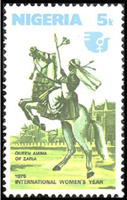
Queen Amina of Zazzau was born around 1533 in the province of Zazzau, in modern-day Nigeria. Zazzau refers to the Zaria emirate which is a traditional state with headquarters in the city of Zaria in Kaduna state in Nigeria. Zazzau was one of the seven Hausa city-states which dominated the subsaharan trade after the collapse of the Songhai Empire at the end of the 16th century. Its wealth was due to the commerce of leather, textile, horses, salt, kola, cloth, and metals imported from the East.
Queen Amina celebrated on a Nigerian stamp
As a toddler, Amina was already attending state business on her grandfather, the king’s laps. At the age of 16, Amina was seen as a potential contender to her mother’s throne (Magajiya), the queen Bakwa of Turunku. Amina started to learn the responsibilities of a queen from her mother: taking part in daily assemblies with high dignitaries of the kingdom. Even though her mother’s reign had been one of peace and prosperity, Amina chose to learn military skills from the warriors.
Queen Bakwa died around 1566, and the Zazzau kingdom was governed by her youngest brother Karama. During the reign of her brother, Amina emerged as principal warrior of the kingdom’s cavalry. Her military successes brought her wealth and power. When her brother died after ten years of reign, Amina was crowned queen of Zazzau in 1576. During her reign, which lasted 34 years, she expanded her kingdom’s boundaries down to the Atlantic coast, she founded several cities, and personally led an army of 20,000 soldiers to numerous battles. However, her focus was not on annexation of neighboring lands, but on forcing local rulers to accept vassal status and allow Hausa traders safe passage.
Portrait of Queen Amina
During her reign, she commanded the construction of a defensive mural around each military camp that she established. Later, those camps evolved into prosperous cities within those walls, and some can still be seen today in northern Nigeria. Those cities are known as walls ‘ganuwar of Amina’ or ‘Amina’s walls‘. It is believed that Amina died in the town of Altagara in 1610. Today, Amina is remembered in Nigeria as ‘Amina, rana de Yar Bakwa ta San’ (Amina, daughter of Nikatau, woman as capable as a man). The introduction of kola nuts into the region is often attributed to Amina. Amina is celebrated across the Hausaland as a great warrior queen who was born to rule, and led thousands of soldiers to war. To learn more, check out Black history heroes, History and Women, as well as the book African Princess which dedicates a chapter to this great queen. Amina’s achievement was the closest that any ruler had come in bringing the region now known as Nigeria under a single authority. Enjoy the video below of great African queens including Amina.
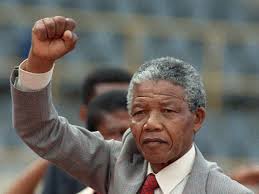
Nelson and Winnie Mandela, on Nelson’s release from prison on 11 Feb. 1990
I remember the day Nelson Mandela was freed from jail after 27 years of imprisonment. It was on 11 February 1990. This being a national holiday in Cameroon, we were all at home, and could watch live as Nelson Mandela was released from prison and walked hand in hand with Winnie Mandela, both with their fists raised high up. Later that day, Mandela stood outside the balcony with his fist raised high up, and said: “Amandla!” to which the overjoyed crowd replied “Ngawethu!”, in other words, “Power to the People!” And he finished “iAfrika!” I am leaving you here with some words by Mandela himself.
========
“I raised my right fist and there was a roar. I had not been able to do that for 27 years and it gave me a surge of strength and joy.” Describing the day of his release from prison in 1990 – Long Walk to Freedom, Nelson Mandela, 1994.
“I am fundamentally an optimist.Whether that comes from nature or nurture, I cannot say. Part of being optimistic is keeping one’s head pointed toward the sun, one’s feet moving forward. There were many dark moments when my faith in humanity was sorely tested, but I would not and could not give myself up to despair. That way lays defeat and death.” Long Walk to Freedom, Nelson Mandela, 1994.
Nelson Mandela ca 1955
“I learned that courage was not the absence of fear, but the triumph over it. The brave man is not he who does not feel afraid, but he who conquers that fear.” Long Walk to Freedom, Nelson Mandela, 1994.
“Everyone can rise above their circumstances and achieve success if they are dedicated to and passionate about what they do.” Long Walk to Freedom, Nelson Mandela, 1994.
“Education is the most powerful weapon which you can use to change the world.” Long Walk to Freedom, Nelson Mandela, 1994.
“Resentment is like drinking poison and then hoping it will kill your enemies.”Long Walk to Freedom, Nelson Mandela, 1994.
“I like friends who have independent minds because they tend to make you see problems from all angles.” Long Walk to Freedom, Nelson Mandela, 1994.
Madiba
“I found solitary confinement the most forbidding aspect of prison life. There is no end and no beginning; there is only one’s own mind, which can begin to play tricks. Was that a dream or did it really happen? One begins to question everything. Did I make the right decision, was my sacrifice worth it? … But the human body has an enormous capacity for adjusting to trying circumstances. I have found that one can bear the unbearable if one can keep one’s spirits strong even when one’s body is being tested. Strong convictions are the secret of surviving deprivation; your spirit can be full even when your stomach is empty.“ On Prison – Long Walk to Freedom, Nelson Mandela, 1994.
Zindzi Mandela reading her father’s refusal to leave prison – 1985
“In the name of the law, I found myself treated as a criminal… not because of what I had done, but because of what I stood for, because of my conscience. No-one in his right senses would choose such a life, but there comes a time when a man is denied the right to live a normal life, when he can only live the life of an outlaw because the government has so decreed to use the law. … The question being asked up and down the country is this: Is it politically correct to continue preaching peace and non-violence when dealing with a government whose barbaric practices have brought so much suffering and misery to Africans?I cannot and will not give any undertaking at a time when I, and you, the people, are not free. Your freedom and mine cannot be separated. I will return.” Message read by his daughter, Zindzi Mandela, at a rally in Soweto in 1985.
“It seems the destiny of freedom fighters to have unstable personal lives… to be the father of a nation is a great honour, but to be the father of a family is a greater joy. But it was a job I had far too little of.” Talking about fatherhood – Long Walk to Freedom, Nelson Mandela, 1994.
“A man who takes away another man’s freedom is a prisoner of hatred, he is locked behind bars of prejudice and narrow-mindedness… The oppressed and the oppressor alike are robbed of their humanity.” On prison – Long Walk to Freedom, Nelson Mandela, 1994.
Nelson Mandela raising the freedom fist
“The value of our shared reward will and must be measured by the joyful peace which will triumph, because the common humanity that bonds both black and white into one human race will have said to each one of us that we shall all live like the children of paradise… But there are still some within our country who wrongly believe they can make a contribution to the cause of justice and peace by clinging to the shibboleths [dogmas] that have been proved to spell nothing but disaster. It remains our hope that these, too, will be blessed with sufficient reason to realize that history will not be denied and that the new society cannot be created by reproducing the repugnant past, however refined or enticingly repackaged.” On receiving the Nobel Peace Prize with F.W. de Klerk, 1993.
“There is no passion to be found playing small – in settling for a life that is less than the one you are capable of living.” Presidential Inauguration, 10 May 1994.
“Never, never, and never again shall it be that this beautiful land will again experience the oppression of one by another… The sun shall never set on so glorious a human achievement. Let freedom reign. God bless Africa!” Presidential inauguration, 10 May 1994.
“There is no easy walk to freedom anywhere, and many of us will have to pass through the valley of the shadow of death again and again before we reach the mountaintop of our desires.” Long Walk to Freedom, Nelson Mandela, 1994.
Nelson Rolihlahla Mandela (18 July 1918 – 05 Dec 2013)
“I am confident that nobody … will accuse me of selfishness if I ask to spend time, while I am still in good health with my family, my friends, and also with myself.” On stepping down after his first term as president.
“Sometimes it falls upon a generation to be great. You be that great generation. Let your greatness blossom. Of course the task will not be easy. But not to do this would be a crime against humanity, against which I ask all humanity now to rise up.” Message at the Live 8 Concert in Edinburgh, July 2005.
Words cannot quite express my sadness at the loss of Africa’s greatest man, and probably one of the world’s greatest icon:Nelson Rolihlahla Mandela. Just to think that this man spent27 years in jailso that we, Black people, could have rights, could have freedom, could be free to love, live, and work, is beyond amazing! Yes… almost 3 decades, and more, since he did not really lead a ‘true’ family life because he spent most of his time pursuing his cause for the freedom of Blacks in South Africa. What tribute could I possibly give for a man who spent most of his life fighting so that I, a Black child, could walk free in South Africaafter our land was taken by the Boer invader, and we were beaten under oppressive laws?What could I possibly say for a man who epitomizes true leadership, statesmanship, democracy, humility, and love… love in the face of so much hate. Because, for Nelson Mandela to make it, there were those likeSteve BikoorChris Haniwho were killed by the apartheid system. I would just like to say farewell Madiba… for you, I am a proud African child… Farewell Father Mandela, for you, I can roam the streets of South Africa free… Farewell Nelson, for you, I am free… because of you, I am a proud Black child, for you I am a proud African!
Nelson Mandela raising the freedom fist
I live you with one of his quotes: “What counts in life is not the mere fact that we have lived. It is what difference we have made to the lives of others that will determine the significance of the life we lead.”Madiba, you have truly changed my life, and that of millions around the globe! The world is a better place because you stepped on it! So long… Madiba!
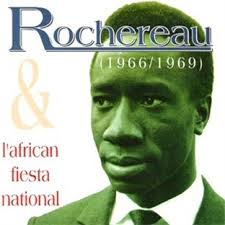
Is it possible to talk about Congolese music without mentioning ‘Le Seigneur’ Rochereau (Lord Rochereau)? Is it possible to talk about Africans performing at the great Olympia hall in Paris, without mentioning the first African ever to have performed there? Is it possible to talk about Rumba, without talking about the impact Tabu Ley Rochereau had on Congolese, and therefore African music?
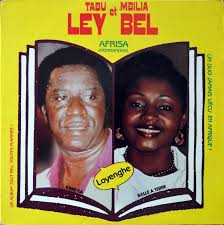
Tabu Ley Rochereau & M’bilia Bel in ‘Loyenghe’
I remember listening to his love ballads ‘Pitié’ on the radio, while growing up. I remember watching the gorgeous M’bilia Bel singing with Tabu Ley Rochereau. Well, Tabu Ley Rochereau was one of those rare artists who have written/composed/performed/produced over 3,000 songs, and have more than 250albums in his repertoire. He is one of the few who could claim to have influenced entire generations both in music and in politics as he later became vice-governor of Kinshasa. Just listening to the interviews of the likes of Koffi Olomide, Lokua Kanza, M’Bilia Bel, Papa Wemba, tells us a lot about him. When asked about the impact of Tabu Ley Rochereau on Couleurs Tropicales, Lokua Kanza (one of my favorites) replied: “Just like an American child can say that Nat King Cole rocked his childhood, Tabu Ley Rochereau rocked mine (Lokua’s),” and that of most Congolese children. That was the impact of ‘Le Seigneur Rochereau’.
Tabu Ley Rochereau & The African Fiesta National
As Kinshasa, Congo, and Africa mourns Tabu Ley Rochereau, we will remember ‘Le Seigneur Rochereau’ by dancing and singing to his great tunes. We will celebrate his life (Rochereau even wrote the song ‘Mokolo Nakokufa’ (the day of my death) a bit like Mozart composed Requiem) and influence on all of our lives (even when he stood against Mobutu with the title ‘Trop c’est Trop’). Tabu Ley was a uniter (when Kenya banned Congolese music, he sang ‘Twende Nairobi’ with M’Bilia Bel), a decider, a crooner, a lover, an activist, a melodist, but above all, Tabu Ley Rochereau was a baobab! Listen to ‘Pitié’ below, and do not forget to read these really good articles on his life on Philly.com, AFP, RFI Musique, and the best on Radio Okapi.
On August 8th, 1914, a proclamation signed by Governor Karl Ebermaier was posted on all the principal places of the town of Douala, stating:
“People of Douala, I am here to announce thatManga (Rudolf) Bellis condemned today to death by hanging because he has betrayed the Kaiser and the empire.”
That same day, at 5PM (17:00) in the evening, the respondent was executed by hanging, with his relative and secretary Ngosso Din.
The official statement from the governor stating the charges incriminating the Bell king, continues as follows:
Adolf Ngoso Din, Assistant to Rudolf Manga Bell
“He [Manga Bell] admitted, at the last minute, that he had been led by the fear of revenge from his countrymen, from those whom you know, who, by fear, secretly remain in the background, those who brood poison and seduce the people. May the blood of Manga fall back on those who led him on the path of crime! He who does not want to become a traitor, like Duala Manga and his aids, should pull away from his seducers, who secretly remain in the background preparing poison! Whoever has fair intentions will be welcome. The government of Kaiser will always be just and grateful to the loyal aids and loyal subjects.
What we deplore is the result of machinations carried by these of men of darkness who – the governor says – have always been at work to excite the people, to maintain it in terror with their poisons and kept under the yoke to their benefit. T ear yourself from them and you will be happy. Manga himself, in his last hour, prayed his people that with his death, loyalty to the Kaiser and obedience towards the government may return into the heart of the Douala people.”
The translation to English is offered to you here by Dr. Y., www.afrolegends.com. You can find the original published in French by the Cameroonian Quotidien Mutations on Bonaberi.com. Don’t forget to read the article by Suzanne Kala-Lobé on NjanguiPress.com.
Today, I would like to talk about one of the heroes of Cameroonian history, Rudolf Douala Manga Bell, who stood against the Germans in the 1910s in Kamerun. His courage, and strong determination earned him the right of martyr and hero in the history of the Douala (or Duala) people, and thus of Cameroon.
Rudolf Douala Manga Bell was born in 1872, and studied in Cameroontown (modern-day Douala). He was the first son of King Manga Ndumbe Bell, of the Douala people. After completing his primary education and part of his secondary school in Cameroon, he went to study at the Lycée of Aalen in Bonn (Germany) finishing secondary school. He later went on to study law at the university there.
Kamerun (German Cameroon)
Manga Bell married Emily Engome Dayas, the daughter of an English trader and a Douala woman after his return home in 1896. He also became a civil servant. On 2 September 1908, he succeeded to his father as Paramount Chief (Chef Supérieur) of the Bell dynasty (founded since 1792) which encompassed the Bonamandone, Bonapriso, Bonadoumbe, all owners and inhabitants of the Plateau Joss in Douala. In those days, Douala was composed of several tribes: Bakole, Bakweri, Bamboko, Isubu (or Isuwu), Limba (or Malimba), Mungo, and Wovea. Among those chiefs, some of them including the famous King Akwa, signed a Germano-Douala treaty on 12 July 1884, which placed Cameroon under German protection. Cameroontown thus became Kamerunstadt.
Rudolf Douala Manga Bell, Leader of Douala people
In 1910, the German governor of Cameroon, Theodor Seitz, approved an urbanization project for the city of Douala (Kamerunstadt had been renamed Douala) set to turn it into one of the largest ports of Africa. The project outlined a plan to relocate the Douala people inland from the Wouri river to allow European-only settlement of the area. Neighborhoods such as Neu Bell, Neu Akwa, and Neu Deido were to be created for the indigenous people; these new allotments were going to be separated from the ‘European city’ by a barrier 1km wide (early version of apartheid!). The expropriations affected most of the Douala clans, who were angered and formed a united front behind Manga Bell. Rudolf Douala immediately refused, and told the Germans that the treaty signed in 1884 did not stipulate the removal/expulsion of the locals from their lands, and that this separation constituted a form of apartheid. Manga Bell then enlisted the help of Hellmut von Gerlach, a German journalist. Gerlach managed to secure a suspension order from the Reichstag Budget Commission in March, but the order was overturned when Colonial Secretary Wilhelm Solf convinced elements of the press, businessmen in the colony, politicians, and other groups to finally rally behind the expropriation. Manga Bell and the Douala requested permission to send envoys to Germany to plead their case, but the authorities denied them. In secret, Manga Bell sent Adolf Ngoso Din to Germany to hire a lawyer for the Douala and pursue the matter in court.
Adolf Ngoso Din, Assistant to Rudolf Manga Bell
Manga Bell then turned to other European governments and to leaders of other African ethnic groups for support. His envoys to other Cameroonian leaders reached Bali, Balong, Dschang, Foumban, Ngaoundéré, Yabassi, and Yaoundé. Charles Atangana (Karl Atangana), leader of the Ewondo and Bane peoples, kept Manga Bell’s plan secret but urged the Douala leader to reconsider. In Bulu lands on the other hand, Martin-Paul Samba agreed to contact the French for military support if Manga Bell petitioned the British. However, there is no evidence that Manga Bell ever did so. In Foumban, Ibrahim Njoya, sultan of the Bamum people, rejected the plan and informed the Basel Mission on 27 April 1914 that Manga Bell was planning a pan-Kamerun rebellion. The missionaries alerted the Germans.
Noticing the German lack of respect of the signed law, who started removing locals from their lands, Bell allied with other chiefs of Cameroon to counter the colonial plans. During the mutiny, the Germans arrested the Douala leader and Ngoso Din on 10 May 1914 accusing him of high treason. Their trial was held on 7 August 1914. World War I had just begun, and an attack by the Allied West Africa Campaign in Kamerun was imminent; accordingly, the trial was rushed. On 8 August 1914, Rudolf Douala Manga Bell and Ngoso Din were hanged.
Let us all celebrate Rudolph Douala Manga Bell, the Tét’èkombo (the king of kings in Douala), the first, the uniter of Cameroon (already reaching out to other kings), and one of Cameroon’s biggest resistant. Enjoy this old rendition by Charles Ewandje (probably recorded in the 70′s) of Tet’Ekombo an ode to resistance and to the land. The song was written in 1929 in memory of Rudolf Douala Manga Bell.
As South Africa‘s President Jacob Zuma opened an exhibition about the life of the country’s first black leader, Nelson Mandela, in Johannesburg yesterday, I thought it befitting to remind you of this great speech by Nelson Mandela where he was prepared to give his life for South Africa, and for his cause. Enjoy! The integral speech can be found here: Nelson Mandela 1964 speech_I am prepared to die.
========
“I am the First Accused.
… At the outset, I want to say that the suggestion made by the State in its opening that the struggle in South Africa is under the influence of foreigners or communists is wholly incorrect. I have done whatever I did, both as an individual and as a leader of my people, because of my experience in South Africa and my own proudly felt African background, and not because of what any outsider might have said….
Nelson Mandela
Our fight is against real, and not imaginary, hardships … Basically, we fight against two features which are the hallmarks of African life in South Africa and which are entrenched by legislation which we seek to have repealed. These features are poverty and lack of human dignity, and we do not need communists or so-called ‘agitators’ to teach us about these things. …
… This struggle is a truly national one. It is a struggle of the African people, inspired by their own suffering and their own experience. It is a struggle for the right to live.
Nelson Mandela clothed in a Pathe’O shirt
During my lifetime I have dedicated myself to this struggle of the African people.I have fought against white domination, and I have fought against black domination.I have cherished the ideal of a democratic and free society in which all persons live together in harmony and with equal opportunities. It is an ideal which I hope to live for and to achieve. But if needs be, it is an ideal for which I am prepared to die.”
Today I would like to talk about the man who invented the process of pollination of vanilla when he was only 12 years of age: the Reunionese Edmond Albius. His technique allowed for the pollinating of the vanilla orchids quickly and profitably. Albius’s technique revolutionized the cultivation of vanilla and made it possible to profitably grow vanilla beans away from their native Mexico.
Vanilla flowers
Edmond Albius, at the time of his discovery was a slave, who was born in Sainte-Suzanne in 1829, on the island of Bourbon (modern-day Réunion). He was orphaned from birth, as he lost his mother and never knew his father. Later, his master sent him to work with Fereol Bellier-Beaumont who initiated him into horticulture, and then botany. Albius spent most of his time following Beaumont around the estate as tended to his plants. Beaumont later wrote about Albius, that “this young black boy became my constant companion, a favorite child always at my feet.”
Bottle of Vanilla
French colonists brought vanilla beans to Réunion in the 1820s with the hope of starting production there. However, the vines were sterile because no insect would pollinate them. In the 1830s, Charles Morren, a professor of botany at the University of Liège in Belgium, developed a method of hand-pollinating vanilla, but his technique was slow and required too much effort to make cultivating vanilla a money-making proposition. Albius discovered in 1841 the practical process for the pollination of vanilla, a process which has revolutionized the culture of this almost ubiquitous spice. He discovered how to quickly pollinate the vanilla orchid with a thin stick or blade of grass and a simple thumb gesture. With the stick or grass blade, field hands lift the rostellum, the flap that separates the male anther from the female stigma, and then, with their thumbs, smear the sticky pollen from the anther over the stigma. Albius’s manual pollination method is still used today, as nearly all vanilla is pollinated by hand. His discovery thereby allowed the Island of Reunion to become for a while, the largest world supplier of vanilla, and the cradle for the diffusion of his process.
Vanilla
Since this discovery was made by a child, who was black, and a slave, the invention was quickly contested by all the jealous people. The unscrupulous botanist Jean-Michel-Claude Richard would pretend to have taught the technique to the slave Albius three or four years earlier. The lie will reach its paroxysm when at the beginning of the 20th century, the French press will go as far as claiming that Edmond Albius was white. Albius eventually gained his freedom with the abolition of slavery in 1848, but will not get any financial benefit from his invention which made the fortune of planters and of the French economy. He died in misery in 1880.
As you enjoy vanilla aromas in cakes, perfumes, and all those delicacies, don’t forget to celebrate the genius of Edmond Albius as well, and read Voices to learn more.











 African Heritage