In celebration of Valentine’s day which is going to be this Sunday, the song ‘IyawoMi‘ by Nigerian singer Timi Dakolo seems appropriate. The song is about a promise of love to that precious one… it is a ‘forever and for always‘ promise. It is a beautiful song which can be played at weddings as well. And the beat is simply amazing; it is a classic. The chorus: “Iyawo mi, Ololufe mi, Ore mi, Alayo mi, I will love you forever.” In Yorùbá, Iyawo mi= my wife, Ololufe mi= mylover, Ore mi= my friend, Alayo mi= my joy (one who brings mejoy). It could be sung to a man as well, by substituting the words oko mi (myhusband) to iyawomi(mywife). Enjoy and happy Valentine’s day to all… and in reality, one day is not enough to tell that loved one about your love, everyday should be an occasion to declare your love, in some way, shape, or form; because in reality, all we have is today, the present (a gift)… make the best out of it!
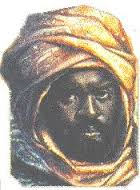
Today, I will be talking about Idris Alooma (also Idris Alaoma, or Idris Alauma), the only Bornu King whose name has survived the test of time. This article is long overdue, as it focuses on the Bornu and Kanem-Bornu empires.
Idris Alooma’s reign belonged to the great Sayfawa or Sefuwa dynasty which ruled the Bornu empire from the 16th and 17th centuries. According to the Diwan al-salatin Bornu, Idris Alaoma was the 54th King of the Sefawadynasty, and ruled the Kanem-Bornu empire located in modern-day Chad, Cameroon and Nigeria. In many works, he is known by his mother’s name, Idris Amsami, i.e. Idris, son of Amsa. The name Aloomais a posthumous qualificative, named after a place, Aloor Alao, where he was buried. He was crowned king at the age of 25-26. According to the Diwan, he ruled from 1564 to 1596. He died during a battle in the Baguirmi where he was mortally wounded; he was later buried in Lake Alo, south of the actual Maiduguri, thus the name Alooma.
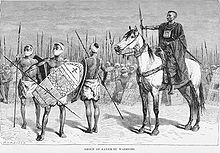
Group of Kanem-Bu warriors in the 1800s
Idris was an outstanding statesman, and under his rule, the Kanem-Bornu touched the zenith of its power. He is remembered for his military skills, administrative reforms and Islamic piety. His feats are mainly known through his chroniclerAhmad bin Fartuwa. During his reign, Idris avoided the capital Ngazargamu, preferring to set his palace 5 km away, near the Yo river (Komadugu Yobe), in a place named Gambaru. The walls of the city were red, leading to a new architecture using red bricks characteristic of his reign. To this day, some murals still exist in Gambaru and are over 3m tall. These are vestiges of a flourishing empire. Idris Alooma was known by the Kanuri title of Mai for king.
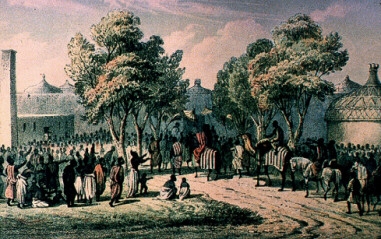
Kanem-Bornu court in the 1700s
His main adversaries were the Hausa to the west, the Tuareg and Toubou to the north, the Bulala to the east, and the Sao who were strongly implanted in the Bornu region (and will be decimated by Alooma’s military campaigns). One epic poem extols his victories in 330 wars and more than 1,000 battles. His innovations included the employment of fixed military camps with walls, permanent sieges and scorched earth tactics where soldiers burned everything in their path, armored horses and riders as well as the use of Berber camels, Kotoko boatmen, and iron-helmeted musketeers trained by Ottoman military advisers. His active diplomacy featured relations with Tripoli, Egypt, and the Ottoman Empire, which sent a 200-memberambassadorial party across the desert to Alooma’s court at Ngazargamu. Alooma also signed what was probably the first written treaty or ceasefire in Chadian history.
Alooma introduced a number of legal and administrative reforms based on his religious beliefs and Islamic law. He sponsored the construction of numerous mosques and made a pilgrimage to Mecca, where he arranged for the establishment of a hostel to be used by pilgrims from his empire. As with other dynamic politicians, Alooma’s reformist goals led him to seek loyal and competent advisers and allies, and he frequently relied on eunuchs and slaves who had been educated in noble homes. Alooma regularly sought advice from a council composed of heads of the most important clans. He required major political figures to live at the court, and he reinforced political alliances through appropriate marriages (Alooma himself was the son of a Kanuri father and a Bulala mother).
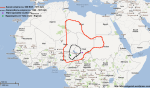
Map of the Kanem and Kanem-Bornu empires
Kanem-Bornu under Alooma was strong and wealthy. Government revenue came from tribute (or booty if the recalcitrant people had to be conquered) and duties on and participation in trade. His kingdom was central to one of the most convenient routes across the Sahara desert. Many products were sent north, including natron (sodium carbonate), cotton, kola nuts, ivory, ostrich feathers, perfume, wax, and hides, but the most profitable trade was in slaves. Imports included salt, horses, silk, glass, muskets, and copper.
Alooma took a keen interest in trade and other economic matters. He is credited with having cleared the roads, designed better boats for Lake Chad, introduced standard units of measure for grain, and moving farmers into new lands. In addition, he improved the ease and security of transit through the empire with the goal of making it so safe that “a lone woman clad in gold might walk with none to fear but God.” To learn more, check out the books: History of the first twelve years of the reign of Mai Idris Alooma of Bornu (1571-1533) by his Imam: Ahmed ibn Fartua; together with the “Diwan of the sultans of Bornu” and “Girgam” of the Magumi; and The Africans, ed. J.A. Tome 3, 1977.
The poem below ‘To My Homeland’ by Huda Sha’arawi shows her love for her country and the extent to which she is willing to fight for her country’s well-being, for her country’s dignity. Her poem was written at the time when Egypt was under British rule, or had just gained independence. In the poem, one senses Huda’s love for her homeland which she refers to as if it were a woman, a mother. Enjoy! The original in French was published in L’Egyptienne, Number 69 of May 1931. The translation to English is brought to you by Dr. Y. on Afrolegends.com
Ama Patrie
J’ai fait voeu de t’offrir tout ce qui m’appartient
O ma belle Patrie,
mon bras, mon Coeur, mon âme ainsi que tous mes biens
sans excepter ma vie.
J’ai fait voeu de peiner, de lutter, de souffrir,
de braver l’infamie.
Sans froncer le sourcil, sans poser au martyre,
sans même une aide amie.
J’ai juré de franchir les frontières des mers
si ton honneur l’exige,
afin de rehausser, aux yeux de l’univers,
ton nom et ton prestige.
J’ai juré d’oublier les affronts des déments
Et la haine et l’insulte
que l’envie incita, contre mon dévouement
à ta cause et ton culte.
Peu m’importe l’exil, leur courroux, la prison,
j’accepte la mort même.
Puisque leurs vils exploits n’auront jamaisraison
de l’humble coeur qui t’aime.
To my Homeland
I vowed to offer you all that is mine
O my beautiful homeland,
my arm, my heart, my soul, as well as all my belongings
not excepting my life.
I vowed to struggle, to fight, to suffer,
to brave infamy.
Without frowning, without asking for martyrdom,
without even using a friend.
I have sworn to cross the borders of the seas
if your honor depends on it,
to enhance, in the eyes of the universe,
your name and your prestige.
I have sworn to forget the offenses of the demented
and the hatred and insult
Which prompted envy, against my dedication
To your cause and your worship.
I do not care about exile, their anger, the prison,
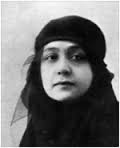
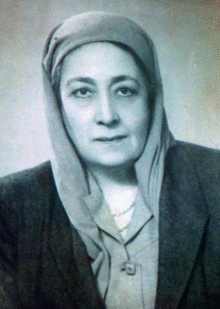
Today, we will be talking about Huda Sha’arawi (also Hoda Shaarawi, or Hoda Charaaoui), one of Egypt’s top feminists. She was a pioneering Egyptianfeminist leader, nationalist, and founder of the Egyptian Feminist Union. Sha’arawi’s work was immense in redefining the place of the woman in Egyptian society, and led to a new dawn for Egyptian women.
Huda Sha’arawi (Wikipedia)
Sha’arawi was born in a wealthy family in Minya on 23 June 1879. Her father was Muhammad Sultan, the first president of the Egyptian Representative Council, and the first Egyptian to rise through all the ranks of government at the time. Her father passed away when she was 4 years old. She was married at the tender age of 13 (very common in those days) to Ali Sha’arawi, a widower, cousin, and tutor with 4 children. The independent teen could not stand the austere life with her spouse and ran back to her mother where she stayed for the next 7 years. During those years of separation, she got further education and grew more independent. At the end of the 7 years, she returned to her husband with whom she later had 2 children. Her husband, Ali Sha’arawi was a political figure, and he associated his wife to his fight against British rule.
Hatshepsut (Wikipedia – MET Museum)
At the end of the 19th and beginning of the 20th centuries, women in Egypt were confined to houses or harems, and wore veils… This, in an Egypt which had seen Hatshepsut the female Pharaoh, Queen Cleopatra and Sultana Shajar al-Durr. As seen in all her pictures, Huda is wearing a Hijab. Sha’arawi resented such restrictions on women’s movements, and started organizing lectures for women on topics of interest to them. This brought many women out of their homes and into public places for the first time. Sha’arawi even convinced them to help her establish a women’s welfare society to raise money for the poor women of Egypt. In 1910, Sha’arawi opened a school for girls where she focused on teaching academic subjects rather than practical skills such as midwifery.
After World War I, as Egyptian men started to rise loudly for their rights, many women took part in political actions against the British rule as well. In 1919, Sha’arawi helped organize the largest women’s anti-British demonstration. In defiance of British orders to disperse, the women remained still for three hours in the hot sun. Such a thing had never been heard of in the history of Egypt and even of Islam.
The first 3 Egyptian Ladies to abandon the veil: Nabaireya Moussa, Hoda Chaaraoui, and Ceza Nabaroui
Sha’arawi made a decision to stop wearing her veil in public after her husband’s death in 1922. In March 1923, Sha’arawi founded and became the first president of the Egyptian Feminist Union, after returning from the International Woman Suffrage Alliance Congress in Romeshe removed her face veil in public for the first time, a signal event in the history of Egyptian feminism.
She fought for the suppression of precocious marriage for young girls, giving them access to all levels of education. She led Egyptian women pickets at the opening of Parliament in January 1924 and submitted a list of nationalist and feminist demands, which were ignored by the Wafdist government, whereupon she resigned from the Wafdist Women’s Central Committee. The Egyptian Feminist Union campaigned for various reforms to improve women’s lives. Among them were raising the minimum age of marriage for girls to sixteen, increasing women’s educational opportunities and improving health care. Egypt’s first secondary school for girls was founded in 1927 as a result of this pressure. In 1933, a new law is agreed in parliament (through her push) regulating the work of women in industry: making sure a woman could not be made to work more than 9 hours per day, giving her a rest day, one month of maternity leave, and 15 days of leave at half-salary after delivery of a child. This was a victory for the Union.
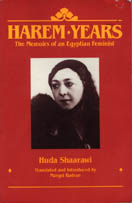
‘Harem Years: The Memoirs of an Egyptian Feminist’ by Huda Sha’arawi
She continued to lead the Egyptian Feminist Union until her death, publishing the feminist magazine L’Égyptienne (and el-Masreyya), and representing Egypt at women’s congresses in Graz, Paris, Amsterdam, Berlin, Marseilles, Istanbul, Brussels, Budapest, Copenhagen, Interlaken, and Geneva. She advocated peace and disarmament. Even if only some of her demands were met during her lifetime, she laid the groundwork for later gains by Egyptian women and remains the symbolic standard-bearer for their liberation movement. In 1943, King Farouk decorated Huda Sha’arawi with the Order of Kamal. Sha’arawi wrote poetry in both Arabic and French. In 1944, she founded the All-Arab Federation of Women. Huda Sha’arawi died in 1947. Sha’arawi later recounted her early life in her memoir Harem Years: The Memoirs of an Egyptian Feminist, 1879-1924. To learn more about her, check out her memoir, read Casting Off the Veil: The Life of Huda Shaarawi, Egypt’s First Feminist by Sania Sharawi Lanfranchi, this article on Forbes, and this amazing chapter dedicated to her in Les Africains, Tome 10, ed. J.A. 1978, P. 107-141. With her strong personality, unique blend of western-style feminism with her own country’s customs, culture, and Egyptian nationalism, Huda Sha’arawi influenced millions of Egyptian and Arab women and people all around the world.
What is the definition of feminism? Is it the same when applied to African women? Is there such a thing as African, or Asian, or European feminism? Why should feminism be dismissed as something only good for women, and not men as well? The condition of the woman is closely linked to that of the man, and as a woman is empowered, as she is given her rightful place in society, then are we ALL empowered as a human species. I live you here with a TED speech by Chimamanda Ngozi Adichie, the Nigerian author of the Top New York Times Bestseller book of the year 2014. Yes, she talks about feminism, but in reality, she talks about the reason why ALL of usshould be feminists: including MEN. Imagine for instance a working couple, where the woman in the couple is paid lower than men doing the same job, imagine the impact of that salary on the entire family budget if she was paid the same as a man, the opportunities for her children, healthcare, vacation, well-being, etc. Enjoy! Adichie’s speech ‘We Should All Be Feminists‘ has now been made into a book, which is going to be thought in schools in Norway and Sweden (The Guardian article). And yes feminism is not about angry females or beating men out of the world, it is about girls being given the same chances as boys, women being recognized for their impact on society, being allowed to rise, being intelligent and bright.
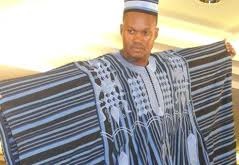
Today we will be talking about the Faso Dan Fani, known as Burkina Faso‘s national cloth. For starters, the Faso Dan Fanimeans “woven cloth of the homeland” (pagne tissé de la patrie). All the words are Dioula: Fani = cloth/wrapper(pagne), Dan = woven(tissé), Faso = homeland (patrie). It is known locally as FDF. As you have probably guessed, the Faso Dan Fani is a handwoven cotton cloth. The weaving style and patterns differ depending on the ethnic group. As you all know, weaving cotton is an ancient African tradition (African textiles): in the old days, the spinning was done by women, while the men were left with weaving the cotton threads into cloth. With time, women took over the weaving business as well.
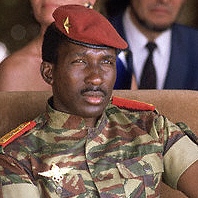
Thomas Sankara a Ouagadougou
In 1986, the President of the Faso, Thomas Sankara, declared that it was important to “produce and consume Burkinabé“. Thus, he declared “In all the villages of Burkina Faso, we know how to grow cotton. In all villages, women know how to spin cotton, men know how to weave it into cloth, and other men know how to sew those threads into clothes... [Dans tous les villages du Burkina Faso, l’on sait cultiver le coton. Dans tous les villages, des femmes savent filer le coton, des hommes savent tisser ce fil en pagnes et d’autres hommes savent coudre les pagnes en vêtements …]” and further “We should not be slave of what others produce[Nous ne devons pas être esclave de ce que les autres produisent].” For the president, “wearing the Faso Dan Fani is an economic act, cultural, and political to challenge imperialism[porter le Faso Dan Fani est un acte économique, culturel, et politique de défi à l’impérialisme].”
Faso Dan Fani
Thus under Thomas Sankara’s revolution, the traditional attire was imposed in work places. … Many were not pleased with it, to the extent that some had nicknamed the FDF, “Sankara is coming“ [Sankara arrive] since the PF was known to do impromptu visit of his ministries. Under him, the FDF had become the signature of Burkinabé outside the country. Sankara even made a speech at the United Nations where all the members of his delegation and himself were dressed with the Faso Dan Fani entirely made by local Burkinabé artists to be consumed by Burkinabe.
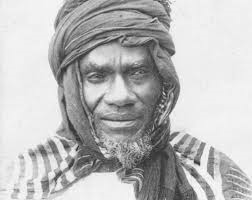
All, I am giving you below a portrait of Samori Touré made by Commandant Binger, a contemporary of Samori Touré, one of the great kings and fighters for African freedom. Bear in mind that this description is certainly tainted by the European (Binger) colonizer’s stereotypes of Africans. The original text in French is found on page 255 of Les Africains, Tome 1. Translation to English by Dr. Y. Afrolegends.com. Enjoy!
=============
Samori Touré
The almamy is a tall handsome manof about50 years of age; his features are a bit hard, and, unlike men of his race, he has a long slim nose, which gives a refined expression to his entire physiognomy; his eyes are very mobile, but he does not often look across his interlocutor.
His exterior appears to me affable rather than hard: very attentive when a compliment is made to him, he can be distracted and indifferent when he does not want to answer a question categorically. He speaks with great volubility, and I think him capable of being warm and persuasive when the occasion arises.
Sitting in a cotton hammock with white and blue rays brought to him from Paris by his son, he holds in his hands, a big piece of tender wood which is called inBambaraniendossila, or ngossé (it is sotiou inWolof) and with which he cleans his teeth.
“L’Almami Samori Toure” de Khalil Fofana
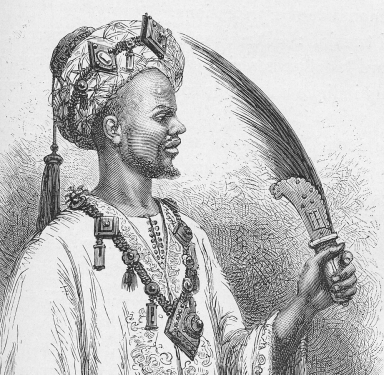
He is dressed with a big doroké in purple florence, of inferior quality, and wears indigenous cotton pants with black and red rays of European make; his legs, a brown chocolate lighter than his face, are coated with shea butter; he is wearing indigenous red leather sandals.
On his head is a red fez of sharpshooter around which is wrapped a thin white turban which goes on his mouth and frames his black face. On his shoulders, he negligently wears a haïk of low price.
Imaginary portrait of Samori Touré
Sitting at his feet are: an old kokisi who never leaves him, two marabouts, a few griots, and the four captives assigned to the hammock, the chair, the camping bowl in which he washes his hands, and the kettle containingwater for occasional rinsing of the mouth. These objects and captives rarely leave his side; wherever he goes, this paraphernalia follows.
Within his reach, and under the same shelter (sort of shed to which the hammock is docked), two tailors are busy sewing yellow florence for his wives. One of the griots carries a big red umbrella, while the other one carries a crank-rod gun. All the objects mentioned above are of English make, except the hammock and the camping bowl, which is a regular bowl.
Here are letters written by King Behanzin to the French president about his kingdom, his land, and French attacks to force him into war. The originals can be found in French archives, and Benin Archives; the translations from French to English are by Dr. Y., afrolegends.com . Enjoy!
==============
“Our desire is that you have the kindness to send us an officer of your house to deal with litigation issues. As for Cotonou, my father never signed it away, and never will we sign it away. It is impossible for us, because if we do, it will be a great prejudice to us, and thunder will crush anyone who would dare dwell on that territory.”
Behanzin, to the President of the French Republic, 30 April 1890, Archives of the Marines, Paris.
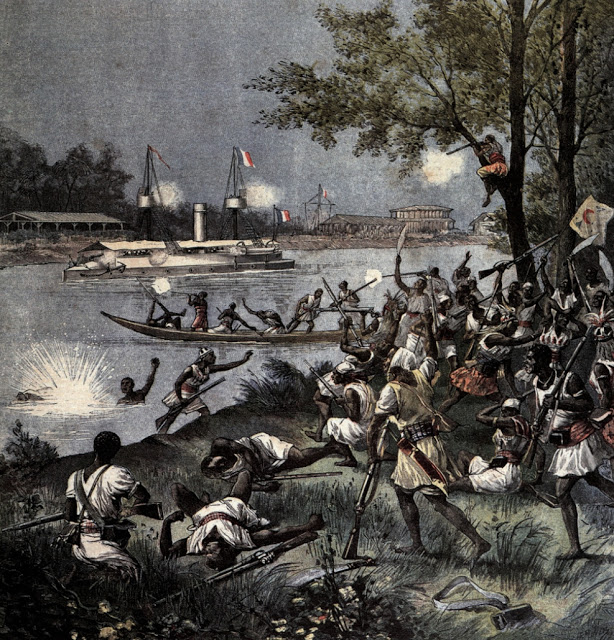
French invasion of the Dahomey along the Oueme River in 1892
“I have just been informed that the French government has declared war on the Dahomey (…). You could start on all the points you want (…) I, too, will do the same. About what happened at the Ouémé River, you caused it (…). If you had not come to start war against me on the Atchoupa way, I would not have done anything to you first (…). Now, I come to tell you that, if you remain calm, I too will remain calm and we will have peace(…).
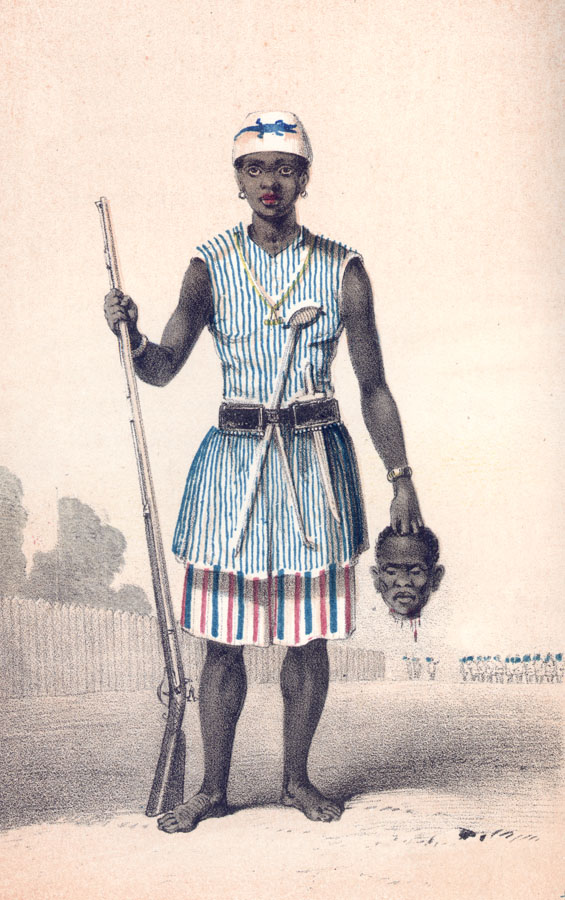
Seh-Dong Hong-Beh, leader of Dahomey Amazons (painted by Frederick Forbes in 1851)
The first time I did not know how to fight a war, now I know. If you start war, I have troops ready. My men are as numerous as works coming out of the earth. I am the king of the Africans and the Europeans have no say in what I do. The villages you are talking about do actually belong to me, they belong to me and wanted to become independent (under your influence), so I gave orders for them to be destroyed (…).
I desire to know how many independent French villages were destroyed by me, King of Dahomey. Remain calm, so your trade in Porto-Novo, this way we will always remain in peace as in the past. If you want war, I am ready. I will not end it even if it lasts a hundred years or kills 20,000 men.”
Behanzin, to Victor Ballot in Porto-Novo, 10 Avril 1892, Archives of the Popular Republic of Benin.
On October 4th, 1984, Thomas Sankara addressed the General Assembly of the United Nations. It was a historical speech, as only he, the great orator, could speak. It was moving, it was strong, and it was good. Below is an extract of his speech. For the whole speech, go to thomassankara.net. Enjoy!!!
============
“I speak on behalf of the millions of human beings … thrown out of work by a system that is structurally unjust and periodically unhinged, who are reduced to only glimpsing in life a reflection of the lives of the affluent. I speak on behalf of women the world over, who suffer from a male-imposed system of exploitation. … Women who struggle and who proclaim with us that the slave who is not able to take charge of his own revolt deserves no pity for his lot. This harbors illusions in the dubious generosity of a master pretending to set him free. Freedom can be won only through struggle, and we call on all our sisters of all races to go on the offensive to conquer their rights.
I speak on behalf of the mothers of our destitute countries who watch their children die of malaria or diarrhea, unaware that simple means to save them exist. The science of the multinationals does not offer them these means, preferring to invest in cosmetics laboratories and plastic surgery to satisfy the whims of a few women or men whose smart appearance is threatened by too many calories in their overly rich meals, the regularity of which would make you—or rather us from the Sahel—dizzy. We have decided to adopt and popularize these simple means, recommended by the WHO and UNICEF.
I speak, too, on behalf of the child. The child of a poor man who is hungry and who furtively eyes the accumulation of abundance in a store for the rich. The store protected by a thick plate glass window. The window protected by impregnable shutters. The shutters guarded by a policeman with a helmet, gloves, and armed with a billy club. The policeman posted there by the father of another child, who will come and serve himself—or rather be served—because he offers guarantees of representing the capitalistic norms of the system, which he corresponds to.
“We are heirs of the revolution” by Thomas Sankara
I speak on behalf of artists—poets, painters, sculptors, musicians, and actors—good men who see their art prostituted by the alchemy of show-business tricks.
I cry out on behalf of journalists who are either reduced to silence or to lies in order to not suffer the harsh low of unemployment.
I protest on behalf of the athletes of the entire world whose muscles are exploited by political systems or by modern-day slave merchants.
Burkina Faso
My country is brimming with all the misfortunes of the people of the world, a painful synthesis of all humanity’s suffering, but also—and above all—of the promise of our struggles. This is why my heart beats naturally on behalf of the sick who anxiously scan the horizons of science monopolized by arms merchants. My thoughts go out to all of those affected by the destruction of nature and to those 30 million who will die as they do each year, struck down by the formidable weapon of hunger. As a military man, I cannot forget the soldier who is obeying orders, his finger on the trigger, who knows the bullet being fired bears only the message of death. …. I protest on behalf of all those who vainly seek a forum in this world where they can make their voice heard and have it genuinely taken into consideration. Many have preceded me at this podium and others will follow. But only a few will make the decisions. Yet we are officially presented as being equals. Well, I am acting as spokesperson for all those who vainly see a forum in this world where they can make themselves heard. So yes, I wish to speak on behalf of all “those left behind,” for “I am human, nothing that is human is alien to me.”
Flag of Burkina Faso
Our revolution in Burkina Faso embraces misfortunes of all peoples. It also draws inspiration from all of man’s experiences since his first breath. We wish to be the heirs of all the world’s revolutions and all the liberation struggles of the peoples of the Third World. Our eyes are on the profound upheavals that have transformed the world. We draw the lessons of the American Revolution, the lessons of its victory over colonial domination and the consequences of that victory. We adopt as our own the affirmation of the Doctrine whereby Europeans must not intervene in American affairs, nor Americans in European affairs. Just as Monroe proclaimed “America to the Americans” in 1823, we echo this today by saying “Africa to the Africans,” “Burkina to the Burkinabè.”
In view of recent events in Burkina Faso, and to continue our fight for democracy, for equal rights, for the right of a nation to choose its leaders without military/external forces dictating it, I live you with a quote by President Thomas Sankara, president of Burkina Faso. It was previously published in a “prayer for Cote d’Ivoire.” As the quote goes:
================
La patrie ou la mort nous vaincrons!
Telle était la devise de Thomas Sankara, notre grand Che africain, ce grand maitre de la révolution Burkinabé, le president du Faso. Telle est la devise que nous nous devons de garder dans nos coeurs en ce moment pour le Burkina Faso: savoir que nous nous battons pour notre liberté, pour notre patrie, pour la seule terre que le bon Dieu a bien voulu nous donner! Amandla!… Ngawethu!
Flag of Burkina Faso
Homeland or death, we shall overcome!
Such was the motto of Thomas Sankara, our great African Che, this great master of the Burkinabe revolution, the president of Burkina Faso. This is the motto that we must keep in our hearts for Burkina Faso right now: to know that we are fighting for our freedom, for our country, for the only land God ever gave us! Amandla! …Ngawethu! Power to the People!
Patria o muerte, venceremos!
Tal era el lema de Thomas Sankara, nuestro gran Che de África, este gran maestro de la revolución de Burkina Faso, el presidente de Burkina Faso. Este es el lema que debemos tener en nuestros corazones para Burkina Faso en este momento: saber que estamos luchando por nuestra libertad, para nuestro país, por la tierra sólo Dios nunca nos dio! Amandla!… Ngawethu!
Burkina Faso
Pátria ou morte, venceremos!
Esse foi o lema de Thomas Sankara, o nosso grande Africano Che, este grande mestre da revolução burkinabe, o presidente do Burkina Faso. Este é o lema que devemos ter em nossos corações para Burkina Faso agora: saber que estamos lutando por nossa liberdade, para o nosso país, para a única terra que Deus já nos deu! Amandla!… Ngawethu!