I really enjoyed Godfrey Nzamujo‘s TEDx talk. Nzamujo is the founder of the Songhai Center in Benin and has been implementing, for over 30 years now, sustainable agriculture to address Africa’s food problems, and also to fight against rural exodus which forces youths to leave their villages to go to the city. One of his center’s aim is promotes entrepreneurship in agriculture aimed at making the poor producers, actors and managers of their own future. His main goal is to erect green rural towns where nothing is wasted. His approach is fully 100% re-use, recycle agriculture, zero-waste emission! Watch, listen, share, and enjoy!
Imagine an organic farm where nothing is wasted: from the crops, the chicken, everything is generated in house, even the energy for the farm is generated with the bio-gas from the animal waste. I recently came across the Songhai Center, and loved the idea that Godfrey Nzamujo has implemented in Porto-Novo, Benin. Created in 1985 by Godfrey Nzamujo, a Dominican priest with doctorate degrees in electronics, development science and microbiology, the Songhai Center is an NGO which promotes entrepreneurship in agriculture aimed at making the poor producers, actors and managers of their own future. His main goal is to erect green rural towns where nothing is wasted. Have rural people be proud of staying and enriching their villages / towns. Songhai has found recognition beyond Benin. The UNDP (2008) regards its approach as successful in the promotion of agricultural entrepreneurship and the creation of decent jobs in rural areas.
A farm
His farm is centered around agriculture, animal husbandry, and core production. The waste from one sector becomes an input in another sector. The waste from the animal production is used to produce maggots that feed the fish, and the wastewater from fish ponds is used to irrigate the crops where vegetables and grains are produced, and the waste from the crops are used for bio-gas or to feed the animals (grains for the animals), and the droppings from the animals are used for compost. And the products, meat, eggs, fruits, etc, are eaten by men. Everything is bio: fertilizers are from compost, no chemicals are used! Natural fertilizers are used. No pesticides are used: pest management is implemented using plants themselves via inter-cropping or integrated pest management. The pure clean water used for drinking comes from a deep well; the water from the rain is also harvested, and water from sewage is purified using plants and various organisms to be used in the agriculture and plants. Part of the electricity comes from the bio-gas, some from the diesel, and some from the national grid. Even the plastic bottles containers for the juices produced in-house are made from plastic waste used at the center, while the machinery for the farm is built in-house as well! Watch, Enjoy, and get Inspired!
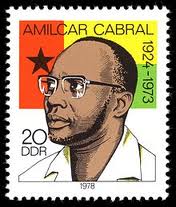
Amilcar Cabral on a stamp with the flag of Guinea Bissau
“The colonists usually say that it was they who brought us into history: today we show that this is not so. They made us leave history, our history, to follow them, right at the back, to follow the progress of their history. Today, in taking up arms to liberate ourselves, in following the example of other peoples who have taken up arms to liberate themselves, we want to return to our history, on our own feet, by our own means and through our own sacrifices.” Amilcar Cabral
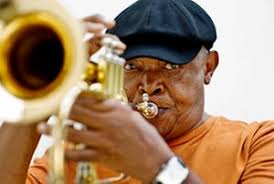
Bra Hugh was involved in African heritage restoration. He gave a talk at the TEDx about African culture, and restoration. So I am leaving you here with his TEDx talk. He used to say, ” I’ve got to where am in life not because of something I brought to the world but through something I found – the wealth of African culture.” Enjoy!
This past Sunday, Hugh Masekela was honoured with a musical tribute at the University of Johannesburg (UJ)’s Soweto Campus. Various musicians performed at this final public tribute to the legendary artist, activist and composer.
Waiting for Rain (for Hugh Masekela) by Niyi Osundare
Your trumpet pumps the wind into a bold, metallic roar; the universe throbs in awe a worsted thunder whines in a blue corner of the sky
Waiting, waiting for the Rain
…
Memory hides in your song in the sepia folds of a tune which remembers its tongue in the throat which bakes the bread for our common feast
…
The Nile’s long-limbed gallop the limpid lyric of the Limp, the Limp, the Limpopo the Kukuruku’s tall whisper in the ears of the Kilimanjaro the sun never sets in the empire of your song your garland a forest of flowers and dappled murmurs
…
Niyi Osundare (from Pages from the Book of the Sun: New & Selected Poems, 2002, pp. 42-43
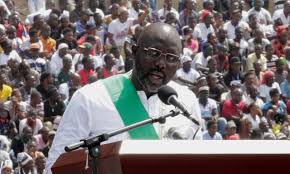
George Weah delivering his inaugural speech at the Samuel Doe stadium
On Monday, January 22nd, Former Football star and Ballon d’Or George Weah was sworn in as the 25thPresident of Liberia, in the country’s first democratic transfer of power in over 70 years. Weah, a decorated football star, took over from Africa’s first female president, Ellen Johnson Sirleaf. Liberians of all ages formed long lines outside the Samuel Kanyon Doe Stadium, near the capital, Monrovia, to watch Weah’s inauguration.
Moved by the population’s love, Weah said in his inaugural speech, “I have spent many years of my life in stadiums, but today is a feeling like no other. I am overwhelmed with the crowd and the energy here today, … Today, we all wear the jersey of Liberia, and the victory belongs to the people, to peace, and to democracy.”
Flag of Liberia
He added: “I promise to do everything in my power to be the agent of positive change. But I cannot do it alone. … […] And so, My Fellow Citizens, I want to admonish you, that the foundation of the New Liberia must be reinforced by the steel of integrity. We need men and women, boys and girls, whose integrity provides the foundation of the trust that is required for Liberian society to benefit her people.”
Brother Weah, we wish you the very best in governing the beautiful country of Liberia. We know that your getting there stems for your great love of your country, and our prayers will carry you throughout this journey!
For the full speech, watch the video below, and read The Patriotic Vanguard Patriotic Vanguard for the full transcript of President George Weah’s inaugural speech. Enjoy!
As a child, my mother had all of Hugh Masekela‘s CDs, and so I grew up listening to his music. A few years back, I was fortunate enough to attend one of his concerts when he was on tour in the US. As his colleague and friend Yvonne Chaka Chaka said in the interview below, Masekela was very down to earth. After his concert, he came out, and greeted us… so I queued up and even got a chance to talk to him! Imagine that! I talked to the great Hugh Masekela! His enthusiasm was contagious! I particularly loved what he could do with his trumpet and his voice: simply amazing! Some of my favorite tracks were ‘Chileshe,’ ‘Strawberries‘ (not sure why, maybe because of the children’s chorus or the fact that as a child I could taste those juicy strawberries), ‘Coal Train (Stimela),’ ‘Khawuleza,’ ‘ The Boyz doin’ it‘, and countless others. Maybe it was his voice, slightly cracked and full of power, or the magic that came out of his trumpet, or the mix of African sounds,… all of it combined made Hugh Masekela, a genius African Jazz Trumpeter and musician.
Ramopolo Hugh Masekela was born on April 4, 1939, in Witbank, South Africa, a coal-mining town near Johannesburg. His father, Thomas Selema Masekela, was a health inspector and noted sculptor; his mother, Pauline Bowers Masekela, was a social worker. From a young age, he developed an early affinity to music, and was encouraged by his mentors to further the study of it. During an early trip to the US, he met Louis Armstrong, who offered his band a gift: a trumpet.
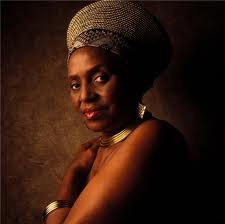
A true African beauty: Mama Africa, Miriam Makeba
Hugh Masekela was not just a musician, but he was also a political activist who fought against that hateful system called apartheid. Throughout his career, he performed with great names such as Jimi Hendrix, Janis Joplin, Otis Redding, and collaborated with Harry Belafonte, Herb Alpert, Bob Marley, Fela Kuti, Paul Simon — and his ex-wife, Miriam Makeba. For almost 30 years, “Bra Hugh,” as he was fondly known, was exiled from his native country.
And almost despite himself — as he struggled for decades with copious drug and alcohol abuse — Masekela became a leading international voice against apartheid. In that sense,Masekela was like the prodigal son, whom God greatly loved, and who despite the drugs, was redeemed and even founded an organization, the Musicians and Artists Assistance Program of South Africa, to help South Africans artists battle substance abuse.
He sought solace on his home continent. “For me, songs come like a tidal wave,” he said. “At this low point, for some reason, the tidal wave that whooshed in on me came all the way from the other side of the Atlantic: from Africa, from home.” Indeed, when one listens to songs like ‘Khawuleza’full of energy, one does feel the tidal wave!
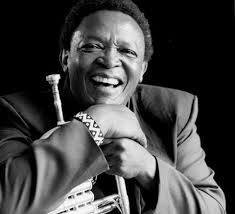
Hugh Masekela
Now Bra Hugh has taken his tidal wave and trumpet to the angels, who will be rocking to the sounds of ‘Chileshe‘ in heaven. I can clearly say that Hugh Masekela was one of the greatest, if not the greatest African Trumpeter of all. The New York Times published a very good article on him, the NPR as well, and the Guardian did a beautiful photo-Journal article on him: Hugh Masekela: life and career of the jazz trumpeter – in pictures. I live you with another great African singer, Yvonne Chaka Chaka, tribute to Bra Hugh. Enjoy!
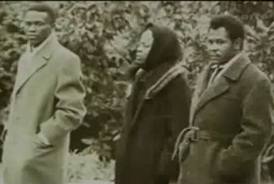
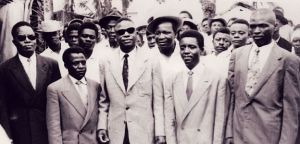
Ernest Ouandié, Marthe Moumié, and Abel Kingue in Geneva after Felix Moumié’s death
Here is an interview of Ernest Ouandié, leader of the UPC, on the Assassination of a fellow leader of the UPC, Félix Moumié. As you can see, this was a brilliant man who was fighting for the independence of Cameroon from foreign colonial powers; he was fighting for One Kamerun! One can also watch Marthe Moumié, the wife of the deceased Felix Moumié, and watch her dedication not just to her husband, but to the great cause of the freedom of her country. Enjoy!
Ernest Ouandie, a few minutes before his execution in Bafoussam
On 15 January 1971, Ernest Ouandié, the leader of the UPC, was publicly executed in the capital of the Western region, Bafoussam, his natal province.
In reality, three people had been executed. Those 3 were: Gabriel Tabeu, aka “Wambo, the electricity“, Raphaël Fotsing, and Ernest Ouandié. The three were tied to a pole, facing a firing squad. The first two fell first. Ernest Ouandié, who had been accused of attempting to create a revolution, the organization of an armed bands, assassinations and other things, refused to be blindfolded. This led to a dispute between the authorities and him. Finally, they granted him his final wish, and as he was falling through the weight of the bullets, he shouted “Others will continue the struggle” staring death in the eye.
“Up until the last minute, we did not think that the government was going to execute Ernest Ouandié and his comrades. People thought that they could be condemned for life. It was for us a big surprise. They made us get out of school to go watch the execution of the nationalists. In the crowd, we disapproved of what was going to happen, even kids like us. There was in reality, a strong current of sympathy for the rebels. That is why as soon as Ernest Ouandié and his companions were shot, it was as if I had been wounded in the depths of my heart. The gust had wounded the head of a person who was at the parish of the evangelical church,” says Wanko Tchonla, a trader in Bafoussam. On the day of the event, he was a student at the Saint Joseph school of the cathedral. He still keeps in memory that sad day of 15 January 1971.” [“Jusqu’à la dernière minute, nous ne croyions pas que le gouvernement allait faire exécuter Ernest Ouandié et ses camarades. Les gens pensaient qu’on pouvait les condamner à vie. C’était pour nous une grande surprise. On nous a fait sortir de l’école pour voir l’exécution des nationalistes. Dans la foule, on désapprouvait ce qui allait se passer, même les enfants comme nous. Il y avait en réalité un fort courant de sympathie pour les rebelles. C’est pour cela que dès que l’on a tiré sur Ernest Ouandié et ses compagnons, c’est comme si j’avais reçu une blessure au fond de mon cœur. La rafale avait blessé la tête d’une personne qui se trouvait au niveau de la paroisse du plateau de l’église évangélique ”, raconte Wanko Tchonla, commerçant à Bafoussam. Au moment des faits, il est élève à l’école Saint Joseph de la cathédrale. Il garde en souvenir la triste journée du 15 janvier 1971.]
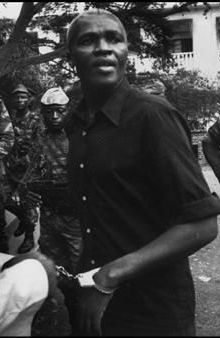
Ernest Ouandie, on his way to his execution
“It is no coincidence that the government of Ahmadou Ahidjo had decided to execute Ernest Ouandié in Bafoussam even though his conviction had been pronounced by the military court of Yaoundé. It is was important to create a collective psychosis in the minds. That is why people are always afraid to demonstrate for their rights. People are even afraid to join a political party by fear of being killed.” [“Ce n’est pas par simple hasard que le gouvernement d’Ahmadou Ahidjo avait décidé de faire exécuter Ernest Ouandié à Bafoussam alors que sa condamnation avait été prononcé par le tribunal militaire de Yaoundé. Il fallait créer une psychose collective dans les esprits. C’est pour cela que vous voyez que les gens ici ont peur de manifester pour revendiquer leurs droits. Les gens ont même peur de s’engager dans un parti politique parce qu’ils craignent d’être tués.”] Jean Michel Tékam, candidate for the Cameroonian Social Democratic Party (Parti social démocrate camerounais) in 1996.
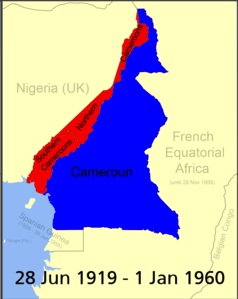
Map of Cameroon from 1919 to 1960, including both Cameroons (French in Blue, and British in red) – Ouandie was fighting for One Cameroon and its freedom from colonial powers
Martin Kapnang, retired communal agent, remembers the staging around Ouandié’s execution. “ We knew that they had arrested the rebel chiefs. The administration had brought people, even from surrounding villages, to watch the execution of rebels. But the conditions under which their trial had unfolded always seemed very confusing. Because as soon as the arrest of Ernest Ouandié and others had been announced, we knew that they will be executed even if the greatest attorneys in the world intervened in their favor.” [“Nous savions que l’on avait arrêté les chefs maquisards. L’administration avait fait venir les gens même des villages environnants pour voir comment on devait tuer les maquisards. Mais les conditions dans lesquelles leur procès s’était déroulé semblaient toujours floues. Car dès que l’on avait annoncé l’arrestation de Ernest Ouandié et autres on savait qu’ils devaient être exécutés même si les plus grands avocats du monde intervenaient en leur faveur.”]
As soon as the first salvo is fired, he shouts: “Long live Cameroon” and then falls to the ground. A European officer detaches himself from the group of spectators, walks toward the dying man, puts his hand on his holster, leans forward and shoots… [cited in Jean Ziegler, Les Rebelles: Contre l´Ordre du Monde: Mouvements Armes de Liberation Nationale du Tiers Monde, Published 1983, Editions du Seuil ]
UPC Leaders (L. to R.) front row: Castor Osende Afana, Abel Kingué, Ruben Um Nyobé, Felix Moumié, and Ernest Ouandié
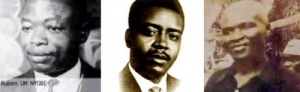
15 January 1971 marks the day of the execution of a Cameroonian and African hero: Ernest Ouandié! Outspoken, and brilliant, Ernest Ouandié is considered by many in Cameroon as a national hero. However, he has never been celebrated the way a hero should. He was a martyr! Ouandié was the last leader of the Union des Populations du Cameroun (UPC). The other renowned leaders of the UPC were Ruben Um Nyobé, Felix-Roland Moumié, Abel Kingué , and Castor Osendé Afana who, except Abel Kingué, were all assassinated by France or its puppets. Like those three, Ernest Ouandié was also assassinated, and paid with his life for his passion for the freedom of Cameroon, and Africa, from colonialism. So who was Ernest Ouandié?
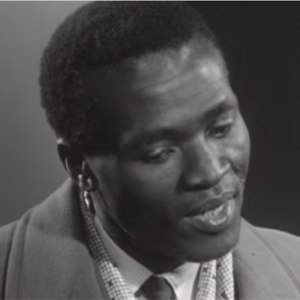
Ernest Ouandie, during an interview, talking about the assassination of Felix Moumie in 1961
Ernest Ouandié was born in 1924 in Badoumla, Bana district in the Haut-Nkam region of the Western province of Cameroon . He attended public school in Bafoussam, and then l’Ecole Primaire Supérieure de Yaoundé where he obtained a Diplôme des Moniteurs Indigènes (DMI) in November 1943 and began work as a teacher. In 1944 he joined the Union of Confederate Trade-Unions of Cameroon, affiliated with the French General Confederation of Labour (CGT). From 1944 to 1948, Ernest Ouandié taught in Edéa. On 7 October 1948, he was posted to Dschang. A month later, he was posted to Douala as director of the New-Bell Bamiléké public school.
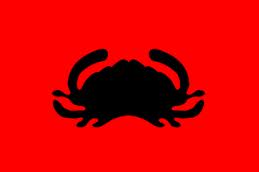
Flag of the UPC
In 1948 Ouandié became a member of the Union of the Peoples of Cameroon (Union des Populations du Cameroun – UPC), and 4 years later, was elected vice-president of the UPC. In September 1953 he was assigned to Doumé and Yoko in Mbam-et-Kim. In December 1954 he was posted to Batouri, then Bertoua. Finally, in January 1955 he was assigned to Douala again. He attended the World Congress of Democratic Youth in China in December 1954, and also traveled to Paris and Moscow.
Les leaders de l’UPC: Ruben Um Nyobe, Felix Moumie, et Ernest Ouandie
In April and May 1955 the UPC held a series of militant meetings, circulated pamphlets and organised strikes. On 20 June 1955 the UPC leader, Ruben Um Nyobé, was sentenced in absentia to six months in prison and a large fine. On 13 July 1955 the French government dissolved the UPC by decree. Most of the UPC leaders moved to Kumba in the British-administered Southern Cameroons to avoid being jailed by the colonial power. Armed revolution broke out in Cameroon. The UPC nationalist rebels conducted a fierce struggle against the French, who fought back equally ruthlessly. The insurgents were forced to take refuge in the swamps and forests. Ruben Um Nyobé was cornered in the Sanaga-Maritime area and killed on 13 September 1958.
Ahmadou Ahidjo, first president of Cameroon
Ouandié had taken refuge in Kumba in 1956. In July 1957, under pressure from the French, the British authorities in western Cameroon deported Ernest Ouandié and other leaders of the UPC to Khartoum, Sudan. Ouandié then moved in turn to Cairo, Egypt, to Conakry, Guinea and finally to Accra, Ghana. After Cameroon gained independence in 1960, UPC rebels who had been fighting the French colonial government continued to fight the government of President Ahmadou Ahidjo, whom they considered to be a puppet of the French. Ahidjo had asked the French to lend troops to keep peace during and after the transition to democracy. What followed is a campaign of pacification of the Bamiléké territory, and some regions in the Centre and Littoral provinces; this is one of the greatest genocides committed by France, with the death toll in the hundreds of thousands (French President Acknowledges French Genocide in Cameroon)!
Ernest Ouandié, Marthe Moumié, and Abel Kingue in Geneva after Felix Moumié’s death
In 1960 Ouandié, Félix-Roland Moumié, Abel Kingué and other UPC leaders were exiled, isolated and desperate. Moumié was poisoned by French agents using thallium on 13 October 1960 and died on 4 November 1960, leaving Ouandié as head of the UPC. On 1 May 1961 the military tribunal in Yaoundé condemned Ouandié and Abel Kingué (in absentia) to deportation. That year, Ouandié secretly returned from Accra to Cameroon to work towards the overthrow of the Ahidjo regime. The Southern Cameroons (now the Southwest and Northwest regions) gained independence from the British and joined a loose federation with East Cameroon on 1 October 1961.Abel Kingué died in Cairo on 16 June 1964, leaving Ouandié the last member of the original leadership. President Ahidjo then declared Ouandié public enemy number one.
A post-colonial struggle by UPC rebels opposing the new Cameroon army (trained and armed by France) continued until August 1970 when the last battalion of the UPC, commanded by Ernest Ouandié, was arrested. Ouandié was sentenced to death and was shot by a death squad in the market on 15 January 1971, in Bafoussam. That day was a historic day in Bafoussam, as the populations were forced to witness the execution of their leader: my mother witnessed the event, she was just a child. The civil war, resulting in the destruction of villages and use of napalm is estimated to have resulted in at least 30,000 to 500,000 deaths. It has been conveniently removed from official history, both in Cameroon and in France (French President Acknowledges French Genocide in Cameroon).
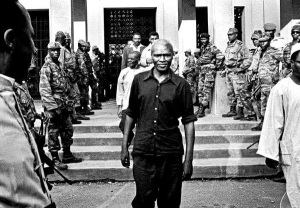
Ernest Ouandie, on the day of his execution
On that fateful day, 15 January 1971, three people were executed in Bafoussam, the capital of the Western region. The three were Gabriel Tabeu, alias “Wambo, the electricity“, Raphael Fotsing (condemned to capital punishment 10 days prior, by a military tribunal) and Ernest Ouandié. The three were tied to a pole, facing a firing squad. The first two fell first. Ernest Ouandié, who had been accused of attempting to create a revolution, the organization of armed bands, assassinations and other things, refused to be blindfolded. This led to a dispute between the authorities and him. Finally, they granted him his final wish, and as he was falling through the weight of the bullets, he shouted “Others will continue the struggle” staring death in the eye.
Check out the website Grioo.com where there is a good biography on Ernest Ouandie’s life. Don’t forget to check out the website of Dibussi Tande. The great Cameroonian writer Mongo Béti wrote the book Main basse sur le Cameroun, autopsie d’une décolonisation (about the Cameroonian resistance led by the UPC) which was banned in France in the 70s, which led to him to write Remember Ruben in honor of Ruben Um Nyobé’s memory, in which he describes the firing squad to Ouandié’s execution.










 African Heritage