‘I am Black Mamba’ : Arrivederci Kobe Bryant

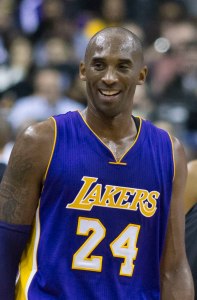
Lakers at Wizards 12/2/15
Kobe Bryant in 2015 (Source: Wikipedia)

I was too young to be in awe by the likes of Michael Jordan  or Magic Johnson. To me basketball was revealed through Kobe Bryant, LeBron James, and all their pairs.

Yes… I am the generation of the Black Mamba. It is with sadness that I learnt of his passing yesterday. I became an amateur basketball lover and player thanks to the ‘Black Mamba’. As an African, I always liked his nickname ‘The Black Mamba‘ because his speed on the court was so similar to that of the animal itself which I was familiar with, and he was especially lethal to his adversaries who never saw him coming. His aura and awesomeness seemed to pervade his life, especially with that big grin of his… always ready to smile and seemingly make others comfortable. Moreover, I was sold when I learnt that he was an American who was tri-lingual, and loved soccer, and just like me was a huge fan of Barcelona and A.C. Milan. Could I ask for more? I was hooked on Basketball then! To me Kobe Bryant was one of the greatest Basketball players the game ever saw!

Kobe Bryant handling ball in 2014
Kobe Bryant handling a ball on court in 2014 (Source: Wikipedia)

Being on the world stage like Kobe, you become somewhat super-human and everyone gets an opinion of you; it is tough not to fall under the pressure. What I liked the most about Kobe Bryant, was his determination, and his drive for perfection. To me, that epitomizes what all of us should strive for: awesome work ethics, tenacity, perfection, and desire to be great. Once you have found a passion in life, you should strive to be a Black Mamba, be like Kobe Bryant: perfect your craft, and go all the way out. Arrivederci Kobe… You have inspired so many of us, given us great memories,… You have made us all ‘Black Mambas’!

Bernard Dadié on African Immigration and the Return

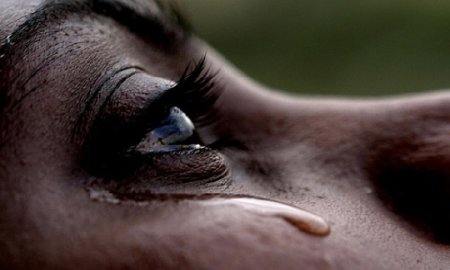
African tears
Dry your tears Africa
Sèche tes pleurs Afrique!
Tes enfants te reviennent
dans l’orage et la tempête des voyages infructueux.

Sèche tes pleurs, Afrique!
Tes enfants te reviennent
Les mains pleines de jouets
Et le coeur plein d’amour.
Ils reviennent te vêtir
De leurs rêves et de leurs espoirs.

Dry your tears, Afrika!
Your Children come back to you
Out of the storm and squalls of fruitless journeys.

Dry your tears, Afrika!
Your children come back to you
Their hand full of playthings
And their heart full of love
They return to clothe you
In their dreams in their hopes


With the end of the ‘year of return‘, I think parts of the poem above by Bernard Binlin Dadié are appropriate and perfect to talk about African immigration and illustrate the return. Africa’s children are coming back, and they are coming to contribute, and also to build her… this applies to those of the diaspora whose ancestors made it to the new world in ships of the Mali emperor’s (Kankan Musa‘s predecessor) or via slave ships, or simply to recent African immigration to other part of the world: Africa needs you, and together, united, we have the potential to usher in a new positive era.  Excerpts above are from the poem titled “Dry your Tears Africa” or “Sèche Tes Pleurs,” published in 1967 by Bernard Dadié“Seche Tes Pleurs” de Bernard Binlin Dadié / “Dry your Tears Afrika” by Bernard B. Dadié

French Colonial Treaty in Madagascar : 18 January 1896

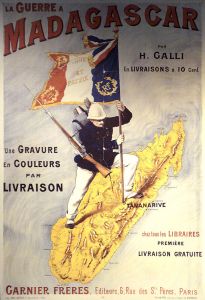
Madagascar
Madagascar

The treaty below with the Queen of Madagascar marked the full possession of Madagascar by France. It also marked the end of the Kingdom of Madagascar, or Merina Kingdom, officially known as Kingdom of Imerina. In essence, Ranavalona III, the last monarch of the Kingdom of Madagascar, tried to stave off the French colonization of her land by strengthening trade and diplomatic relations with the United States and Great Britain throughout her reign; however, French attacks on coastal port towns and an assault on the capital city of Antananarivo ultimately led to the capture of the royal palace in 1895, ending the sovereignty and political autonomy of the century-old kingdom. France officially annexed Madagascar on January 1, 1896.

As you read the treaty below, you could see the beginning of the schemes for the FCFA and the 11 Components of the French Colonial Tax in Africa we talked about a while back. Note that Madagascar was banned from dealing directly economically with foreign powers: everything had to go through France… isn’t this a predecessor to the FCFA?

=====

Ranavalona_III_of_Madagascar
Queen Ranavalona III of Madagascar

H.E. the Queen of Madagascar, after reading the declaration of possession of the Island of Madagascar by the government of the French Republic, declares to accept the following conditions below:

Article I

The government of the French Republic will be represented to the Queen of Madagascar by a Resident General.

Article II

The government of the French Republic will represent Madagascar in all external relations.

The resident general will be in charge of relations with the agents from foreign powers. Matters of interest to foreigners pertaining to Madagascar will be dealt with by through him.

The diplomatic and consular agents of France in foreign countries will be in charge of the protection of Malagasy subjects and interests.

Article III

The government of the French Republic reserves the right to maintain in Madagascar the military forces necessary for its authority.

Article IV

Ranavalona III conceded defeat to the French in Sept 1895
Ranavalona III conceded defeat to the French in September 1895

The Resident General will control the internal administration of the Island.

H.E. the Queen of Madagascar commits herself to proceed to the reforms that the French government will judge useful for the economic development and the progress of civilization.

Article V

The government of H.E. the Queen of Madagascar is prohibited from contracting any loan without the authorization of the government of the French Republic.

Antananarivo, January 19, 1896

Hoy Ranavalomanjaka III

Mpanjakany Madagascar

‘Antsa’ by Jacques Rabemananjara

rabemananjara
Jacques Rabemananjara (Project for Innovative Poetry – PIP)

Today, we will join the poet Jacques Rabemananjara in singing the praises of the Great Island… you know the one and only, Madagascar! Published in 1956 in Présence Africaine, Antsa is an ode to the Great island, a love song to Rabemananjara’s land of birth, Madagascar. Jacques Rabemananjara, like Léon Gontran Damas, was also part of the Negritude movement in France; he was said to be the most prolific writer of the negritude generation after Léopold Sédar Senghor, and he had the first négritude poetry published. He was a Malagasy politician, playwright and poet, who served as a government minister,  and later rose to the rank of Vice President of Madagascar under Philibert Tsiranana. He was one of the heroes of the Malagasy independence.


Madagascar
Madagascar

As you read Antsa, enjoy the island of syllables of flame, feel the love, the sweetness sweeter than honey, the patriotism expressed like the most ardent lover, the most faithful, feel the oneness with the homeland as no owl’s cry or burning could disturb the love the author feels for his motherland. Enjoy it, and try expressing it for the land of your birth… not the people… the land and its beauty!


Antsa par Jacques Rabemananjara


Ile !

Ile aux syllabes de flammes !

Jamais ton nom

Ne  fut plus cher à mon âme !

Ile,

Ne fut plus doux à mon cœur !

Ile aux syllabes de flamme,

Madagascar !


Quelle résonnance !

Les  mots

fondent dans ma bouche :

Le miel des claires saisons

Dans le mystère de tes sylves,

Madagascar !


Je mords la chair vierge et rouge

Avec l’âpre ferveur

Du mourant aux dents de lumière

Madagascar !


Un viatique d’innocence

dans mes entrailles d’affamé,

Je m’allongerai sur ton sein avec la fouge

du plus ardent de tes amants,

du plus fidèle,

Madagascar !


Qu’importent le hululement des chouettes

le vol rasant et bas

des hiboux apeurés sous le faîtage

de la maison incendiée !oh, les renards,

qu’ils lèchent

leur peau puante du sang des poussins, du sang auréolé des flamants-roses !

Nous autres, les hallucinés de l’azur,

nous scrutons  éperdument tout l’infini de bleu de la nue,

Madagascar !


Antsa by Jacques Rabemananjara


Island!

Island with syllables of flames!

Never your name

Was so dear to my soul!

Island,

So sweet to my heart!

Island with syllables of flames,

Madagascar!


Such resonance!

The words

Melt in my mouth:

The honey of clear seasons

In the mystery of your forests,

Madagascar!


I bite the virgin and red flesh

With the bitter fervor

Of the dying with bright teeth

Madagascar!


A viaticum of innocence

In my guts filled with hunger,

I will lie on your breast with the passion

Of the most ardent of your lovers,

Of the most faithful,

Madagascar!


No matter how much the owls hoot,

The low flying and frightened owls under ridge

Or the burning house! Oh the foxes,

May they lick

Their pungent skin from the chicks’ blood, the haloed blood of pink flamingoes!

We, the hallucinated of the azure,

We madly scour the infinite of the blue from the clouds

Madagascar!


Antsa, 1956, Présence Africaine

Jacques RABEMANANJARA

France Returns Sword of Senegalese Hero Omar Tall … Temporarily

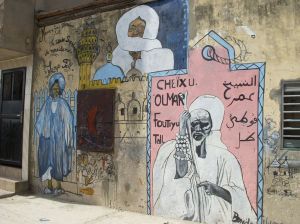
Omar Tall
Mural in Dakar showing Omar Tall (Source: Wikipedia)

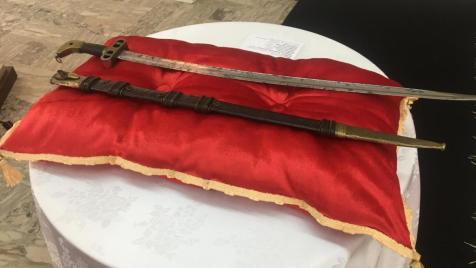
At first I was thrilled by the news that France had returned the sword of the Senegalese hero Omar Tall, … until I read the fine prints! Then I read that this was a temporary return, more like a 5-year loan to Senegal, until the French parliament approves whether to permanently return it or not. Moreover, the sword was already on loan at a Museum in Senegal. Nevertheless, you will notice like me that the media titled it a ‘return.‘ In reality, this is more like a publicity campaign for the French who seemingly appear to be returning looted treasures.

Before delving into the excerpt below from the BBC article, it is good to say a few words about Omar Saidou Tall or Umar Tall, and why he is so venered by Senegalese. Omar Saidou Tall was a religious, political, and military leader who fought against French colonization in the region then known as French Sudan which encompassed Senegal, Mali, and Guinea. He opposed a fierce resistance to the French from 1857 to 1859. Senegalese tend to remember him as a hero of anti-French resistance, while Malian sources tend to describe him as an invader who paved the way for the French by weakening West Africa. We will go deeper into his life and legacy in the next post.

======

France has restored to Senegal a sabre that belonged to a 19th Century Islamic scholar and ruler.

It is part of a commitment to return to its former West African colonies key items of their cultural heritage.

The artefact originally belonged to the revered west African leader Omar Saidou Tall, who led an anti-colonial struggle against the French.

… Mr Philippe [France’s prime minister] said it was “the first step” in a project aimed at returning more Senegalese artefacts currently in French museums, which hold at least 90,000 artefacts from sub-Saharan Africa.

Last year a group of experts commissioned by France’s President Emmanuel Macron recommended that African treasures in French museums be returned to their countries of origin.

sabre_0
Omar Tall’s Sword (Source: RFI)

Their official report states that most of the Africa collection in Paris’ Quai Branly museum – approximately 46,000 pieces – was acquired with some degree of duress [not sure that they will return all these artefacts and leave their museums empty].

It’s symbolic. It had been lent to us before, but now it is being restored to us,” the head of Dakar’s Museum of Black Civilisations Hamady Bocoum told AFP news agency about the sabre.

The curved iron, brass and wood sword has been kept in its leather sheath in the museum in Senegal’s capital on loan from France. But Sunday’s ceremony saw the item formally returned for a period of five years.

The next stage will be for French MPs to vote on whether to permanently return this and other artefacts.

When A Nigerian Movie gets Disqualified from the Oscars for having … too much English in it!

Lionheart_(2018_film)_poster
Lionheart (2018 film)

I was quite stunned when I heard the reason why the Nigerian movie Lionheart (2018 film) had been disqualified from the Best International Film section of the Oscars: because of … too much English in it! Can you imagine that? Isn’t English the official language of Nigeria? So no movies made in English by Nigerians should be accepted? But an Algerian movie with French in it (French the language of the colonizer) gets accepted in that section? In other words, a Jamaican movie sent to the academy cannot be in English, a Ghanaian, Ugandan, Canadian, or Australian one should not be in English, etc… even though English is the official language in these countries? But an Algerian movie could be in French, an Ivorian or Comoros movie in French, and these would be qualified as ‘international’ enough! This does not even take into account that Lionheart (2018 film) does have sections in Igbo, one of the languages spoken in Nigeria. I think, as always the oscars academy has shown why they are really not inclusive at all, and above all, quite narrow-minded!

Below is the article from The Guardian.

======

Oscars_1
The Oscars

[…] The Academy was considering a Nigerian movie called Lionheart in its best international feature film category. I watched Lionheart when it came out last year, partly because of the novelty of seeing a movie from Nigeria’s burgeoning Nollywood film industry on Netflix.

Directed by and starring the Nollywood titan Genevieve Nnaji, it is a captivating look at family, class, sexism, politics and the texture of life in the Niger delta. It’s both very Nigerian and very relatable for audiences who know nothing about Nigeria. It’s incredible that Nigeria has never had an Oscars submission before, but this is a good choice for its first. Yet Lionheart has just been disqualified because there is too much English in it.

In fact, Lionheart does feature the Igbo language, which millions of people in eastern Nigeria speak. But the film reflects the way many Nigerians – as former imperial British subjects – speak in real life. As in most of anglophone west Africa, education, politics and formal economic activity is conducted in English, which people interchange with the dozens – in Nigeria’s case, hundreds – of African languages that they also speak. This is the legacy of empire. And this legacy of empire, even though they were once part of it, is what some American institutions don’t seem able to comprehend.

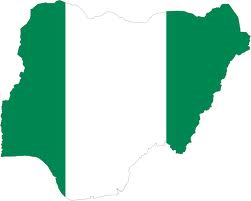
Flag and map of Nigeria

So the American Academy expects films competing in its “international feature film” category to emphatically not be in English. Its rules are very clear on the matter, stating that “an international film is defined as a feature-length motion picture (defined as over 40 minutes) produced outside the United States of America with a predominantly non-English dialogue track”.

But these rules have nonsensical implications. For example, the Algerian film Papicha, which is a favourite in the category, features a good deal of French – the language Algeria inherited from its colonisers. The message seems to be that as long as your imperial power spoke what Americans regard as a “foreign” language – in other words, anything but English – you can speak it and remain authentic. But if you share an imperial past with the US to the extent that English is your nation’s lingua franca as a result, then it is somehow less authentic to speak it. …

“Ils sont venus ce soir” / “They Came Tonight” by Leon Gontran Damas

Léon_Damas
Léon-Gontran Damas

They Came Tonight” is a poem by the celebrated French Guyanese author Léon-Gontran Damas. He is renowned as one of the founders of the Négritude movement, along Aimé Césaire and Leopold Senghor. In 1935, the three men published the first issue of the literary review L’Étudiant Noir (The Black Student), which provided the foundation for what is now known as the Négritude Movement, a literary and ideological movement of French-speaking black intellectuals, writers, and politicians of the African diaspora during the 1930s, aimed at raising and cultivating “Black consciousness” across Africa and its diaspora; this movement rejected the political, social and moral domination of the West.

Slavery_Ship1
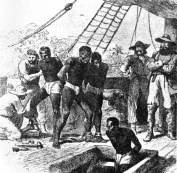
Slaves on board a ship

They Came Tonight” is a poem similar to ‘Ils Sont Venus’ de François Sengat-Kuo / ‘They Came’ by François Sengat-Kuo. In this case, it talks about when the Europeans came during slavery time, one night as the drums were thundering, and after that many Africans were taken away from their homes, from their loved ones, many were captured, and the day was never the same, history was never the same, families were destroyed, kingdoms destroyed, and to this day, Africa has not recovered for 400 years of slavery. This poem was first published in Pigments 1937, and later in Présence africaine, 1962.


Ils sont venus ce soir (Pour Léopold-Sedar Senghor)

ils sont venus ce soir où le
tam
tam
roulait de
rythme en
rythme
la frénésie

des yeux
la frénésie des mains
la frénésie
des pieds de statues
DEPUIS
combien de MOI MOI MOI
sont morts
depuis qu’ils sont venus ce soir où le
tam
tam
roulait de
rythme en
rythme
la frénésie
des yeux
la frénésie
des mains
la frénésie
des pieds de statues

They Came Tonight
for Léopold-Sedar Senghor

They came the night the
drums
spun from
rhythm
to
rhythm
the frenzy

of eyes
the frenzy of hands
the frenzy
of the feet of statues
SINCE
how many of ME ME ME
are dead
since they came that night when the
drums
spun from
rhythm
to
rhythm
frenzy
of eyes
frenzy
of hands
frenzy
of the feet of statues

Kais Saied aka ‘The Robot’: The Political Outsider Who Won the Tunisian Presidential Election

Tunisia_Saied
Kais Saied, new president of Tunisia getting sworn in (Source: Al Jazeera)

Last week marked another big step towards democracy for Tunisia. Kais Saied, a political outsider and retired law professor, won the presidential election with a landslide victory. The Robot, as he is affectionately called, was sworn in as Tunisian president on Wednesday, 23rd of October. His win delivered a heavy blow to a governing elite accused of failing to improve living standards or end corruption since the 2011 revolution that introduced democracy after years of authoritarian rule. Below are excerpts of an article from Al Jazeera.  Enjoy!

=====

Kais Saied has been sworn in as Tunisia‘s new president. 

The 61-year-old law professor has no prior political experience, never held office and barely ran a campaign.

Saied sealed a resounding victory in a runoff election on October 13, largely buoyed by a groundswell of support from young voters. He won just over 72 percent of the votes, with about 27 percent of ballots cast for his media-mogul opponent Nabil Karoui.

Tunisia_Essebsi_1
Beji Essebsi, Former president of Tunisia (Source: Wikipedia)

He succeeds former President Beji Caïd Essebsi, Tunisia’s First Democratically Elected Presidentwho died in office in July. 

A perhaps unlikely aspiring leader in the Arab world, the austere and scholarly Saied stood apart from the other 25 candidates in the first round of Tunisia’s presidential election.

After winning that round, he announced he would not campaign ahead of the run-off election against then-imprisoned Karoui, saying it would give him an “unfair advantage”.

Observers say it’s that openness and obsession with equity that has connected with Tunisia’s youth, who, above all, see Saied as an honest leader offering them the keys to the nation’s future

During his meteoric rise, Saied vowed to fight corruption and promote social justice, while saying access to healthcare and water is part of national security and that education would “immunise” youth against extremism

[…] Selim Kharrat, president of Tunisian NGO Al Bawsala, said Saied’s popularity was in part fuelled by disenfranchisement with a political system that has failed to address core economic needs.

Tunisia_Flag
Flag of Tunisia

“The current atmosphere where many politicians are caught up in corruption scandals has helped this seemingly simple man,” Kharrat told Al Jazeera after the first round of elections.

Saied’s unadorned profile has stood in stark contrast to that of Karoui, who was arrested in late August on money-laundering and tax evasion charges, Kharrat said.

“He’s received no funding from any of the big parties or abroad, notably the better-off Arab Gulf countries, and this has shielded him from any suspicion,” he added.

….

Abiy Ahmed, the Prime Minister of Ethiopia is Awarded the Nobel Peace Prize

Ethiopia_Abiy Ahmed
Prime Minister Abiy Ahmed (Source: sa.breakingnews.co.za)

A year after the Congolese doctor, Denis Mukwege shared the  Nobel Peace Prize 2018, another African has won it again: Abiy Ahmed Ali, Ethiopia’s prime minister was awarded the  Nobel Peace Prize last week for his work in ending the 20-year post-war territorial stalemate between Ethiopia and Eritrea.

Abiy Ahmed became prime minister of Ethiopia at a time of profound strife, and through a serious of deft political gestures, including the release of thousands of political prisoners and overturning highly repressive restrictions on civil society and political groups, he probably averted a civil war. Last year, he was the first Ethiopian leader to meet with his Eritrean counterpart in over 2 decades , and both countries signed a “Joint Declaration of Peace and Friendship.”

Nobel prize
Nobel Prize medal (Wikipedia)

Berit Reiss-Andersen, the chairwoman of the five-member committee that made the decision to award the Nobel Peace Prize, credited Abiy with a peace initiative aimed at ending two decades of conflict between the two east-African neighbors that began over border disputes in 1998 only a few years after Eritrea gained independence.

When Abiy Ahmed became prime minster in April 2018, he made it clear he wishes to resume pace talks with Eritrea,” she said. “In close cooperation with the president of Eritrea, Abiy Ahmed quickly worked out the principles for a peace agreement to end the long no peace stalemate between the two countries.”

When Abiy took office, he freed political prisoners and managed in the same year to sign a peace deal with the Eritrean leader, Isaias Afwerki — agreeing in the process to cede disputed land to his country’s erstwhile enemy.

Peace does not arise from the actions of one party alone,” Reiss-Andersen said. “When Prime Minister Abiy reached out his hand, President Afwerki grasped it, and helped to formalize the peace process between the two countries.

Map of Ethiopia
Map of Ethiopia

Additionally, Abiy Ahmed has sought to mediate between Kenya and Somalia in their protracted conflict over rights to a disputed marine area. There is now hope for a resolution to this conflict,” she said.

In Sudan, the military regime and the opposition have returned to the negotiating table. On the 17th of August, they released a joint draft of a new constitution intended to secure a peaceful transition to civil rule in the country. Prime Minister Abiy played a key role in the process that led to the agreement,” Reiss-Andersen added.

Ethiopia Eritrea
Map of Ethiopia and Eritrea, the two sisters

Although it is quite early in his career – after all, it has only been one year since he became prime minister – I think his is more justified than the one given to Obama for his speeches. Ever since I have grown to understand politics, I am always skeptical of these prizes anyway. However, this prize should encourage African and world leaders to work towards peace for their people at all times. We congratulate prime minister Abiy Ahmed, and wish him well in continuing to lead Ethiopia with a steady head.

Quote by Toni Morrison

Toni Morrison_1
Toni Morrison (Source: OvationTV.com)

You wanna fly, you got to give up the shit that weighs you down.” Toni Morrison in Song of Solomon