Stele of Amanishakheto (center) from the temple of Amun in Wad ban Naqa (Wikipedia)
Amanishakheto was a great queen of Nubia and is known as a great warrior and pyramid builder; she built numerous pyramids and temples at Meroë. She is also the daughter of Amanirenas, the fearless and one-eyed queen who defeated the Romans, and the mother of Amanitore, another great queen. Today, vestiges of her palace which had been destroyed and plundered by the Italian explorer Giuseppe Ferlini can still be seen at Wad ban Naqa, and her jewelry (looted by the same Italian), are now on display at the Egyptian Museum of Berlin, and at the Egyptian Museum of Munich.
Great women are often left out of history. Rarely do we hear or read about African queens. It is already hard enough to read about great African men and leaders in history books, but as for African women… it is more like impossible. How many have heard of the great warrior queen of Nubia, Amanishakheto, who defeated a Roman army? Who has heard of this great queen whose pyramid/tomb was leveled to the ground by an Italian treasure hunter, Giuseppe Ferlini, in 1832? Who has heard of this woman who led her people with a strong arm, and built pyramids in Meroë? Who has heard of this great candace, whose daughter Amanitore, also queen of Nubia, is mentioned in the Bible (Acts 8:27) … yeah the Queen of Sheba is not the only African…
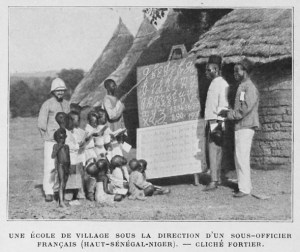
Village school in French West Africa (AOF) 1900s – French assimilationism (Louis Sonolet, Source: http://exhibitions.nypl.org)
The poem ‘My Name‘ by Magoleng wa Selepe has touched many strong chords. It is the truth, and still rings true today. During colonial times, our parents, grandparents, and great-grandparents were stripped of their names and identity: to go to school, they had to have a European name, and very often their own names were distorted because the European colonizer could not spell it properly. Depending on the origin of the colonizer, whether it was France, Great Britain, Germany, or Portugal, one ended up with a French, British, German, or Portuguese name. Enjoy !!!
I just thought about what happened to our fathers, mothers, grandmothers, and grandfathers during colonial times: to go to school African children were forced by European missionaries to adopt a christian name such as John, Peter (Jean, Pierre), etc… as opposed to their good old African name Nomzimo, Makeba, Ndoumbe, Keïta, etc. Thus many Africans who would have just worn the name ‘Ndoumbe Mpondo‘ or ‘Binlin Dadié‘ or ‘Um Nyobé‘ had to adopt a European name such as John + their own name, such that they became: John Ndoumbe Mpondo or Bernard Binlin Dadié or Ruben Um Nyobé. To this day, the tradition has remained… most Africans would have three or four names: their family name, and their given name, plus the European first name and in some cases a European middle name as well. The poem below entitled…
This is yet another favorite on the African Heritage blog.
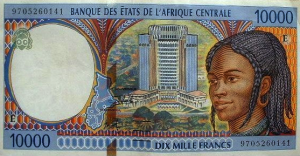
Please take a moment to reflect on this colonial tax African countries have been made to pay for the past 70+ years, particularly in view of the new West African money ECO which is trying to come to life. We applaud the idea of a common currency in West Africa, and in Africa as a whole… remember that this was Kwame Nkrumah‘s dream and the forefathers of the African Union, but when we hear France’s puppet Alassane Ouattara of Côted’Ivoire say that the ECO will be just another name for the FCFA, we can only scream against it, or rather against France’s scheming yet again to impoverish African countries. What France is doing to African countries, by getting over 500 billion dollars every year for free (Africa is funding Europe!), is the same thing that Nazi Germany did to France with their currency at the time of World War II: the FCFA was inspired from it. Yet… after pillaging Africa yearly and raping her daily, they do not seem to hold their economy down, dealing with unemployment, and the Yellow Vests! Free money is always like that: because you did not work for it, it always seems to run out quickly! It’s about time they think of a partnership… but then it is France, so that will probably never happen!
African countries continue to pay colonial tax to France 50 years after their independence. This system is an abomination destined to keep African countries poor forever! Here are some excerpts from the article by Mawuna R. Koutonin. For the full article, go to France Colonial Tax , and do not forget to check out the article I wrote a while back on the Franc CFA: slave currency! Also, please read the book by Pr. Nicolas Agbohou on the subject: ‘Le Franc CFA et l’Euro contre l’Afrique.’
===========
Did you know that many African countries continue to pay colonial tax to France since their independence till today?
Sekou Toure, Cover Time Magazine, Feb. 16, 1959
Sékou Touré of Guinea decided in 1958 to get out of french colonial empire, and opted for the country’s independence, the french colonial elite in Paris got so…
Reblogging this all-time favorite poem on the African Heritage Blog.
A few questions for the readers: what do you like the most about this poem by Sandile Dikeni? What is special? And what made you connect to it? What in this poem describes your country or is there something in it which describes your country?
In the past I have always wished that we, Africans, could be patriotic. I came across this beautiful poem ‘Love poem for my country‘ by South African writer Sandile Dikeni. I really enjoy the way the author describes his country, the valleys, the birds, the ancient rivers, and its beauty. He feels the peace, the wealth, and the health his country brings. He is one with hiscountry.He is at home! His country is not just words or food, or friends, or family, it is more, it is his essence! That is true patriotism, the bond that links us to the bone to our motherland. Enjoy!
My country is for love so say its valleys where ancient rivers flow the full circle of life under the proud eye of birds adorning the…
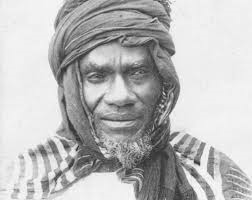
This post on Samori Touré has been an all-time favorite post on Afrolegends.com . I am reblogging it here, because on this 10-year anniversary of the African Heritage Blog, it has been the most viewed and loved article. As you know, Samori Touré, grandfather to the African president Sekou Touré (another resistant to French imperialism – Guinea: the country who dared say ‘NO’ to France), was a leader and ruled over a vast empire which spanned big areas of West Africa from Guinea all the way to modern-day Côte d’Ivoire. He was a strong fighter to France imperialism in Africa, and opposed a great resistance to the French several times. This is to one of Africa’s great kings, warriors, and resistant.
One of the great kings, and fighters of African freedom was the great Samori Touré. Over 100 years ago, Samori Touré was captured by the French and deported to Gabon where he died of pneumonia.
But who was Samori Touré?
Well, Samori Touré was born in 1830 in Manyambaladugu (some texts mentionSanankoro instead), a village southeast of Kankan in present-day Guinea. Samori was a great warrior who fought imperialism in the 19th century such as many leaders today. He refused to submit to French colonization and thus chose the path of confrontation using warfare and diplomacy.
Until the age of 20, Samori was a trader. After his mother was captured in a slave raid by the king Sori Birama, he offered to serve in his army and excelled by his military prowess and skills.
Samori Touré had a vision of unity for the Malinké people, and…
Yesterday, August 1, the African Heritage blog passed the 2 million views cap. This is particularly moving, and coincidental with the fact that this August will also mark a significant milestone: the 10 years anniversary of blogging on Afrolegends.com, the African Heritage blog. Time flies! Goodness Gracious, time flies! It has been a fun and tough 10-years ride. I could fill another blog just to tell you how these past 10-years have been, but I will spare you the details for now. All I can tell you is that YOU, the readers and subscribers, have made it possible with your constant support, comments, corrections, and contributions. This is truly a celebration to you, and to your readership! A big thanks to all of you.
I have always been stunned by the beautyof the flower below (growing up, I was always enthralled by its beauty) because of its vibrancy, its distinction, its determination, and above all its uniqueness… so in upcoming years, this will be our motto here on Afrolegends. As we embark on this new journey, we promise to bring you more good content and stories, and of course capture great memories for the African continent. As you know, the past 10 years have been tough years for Africa, but they have also been years of learning, growth, and rebirth. Like always, “A luta continua e la vitoria e certa.”
To celebrate this milestone, for the month of August, we will feature the top articles on the blogfor the past 10 years, and bring out the all-time favorites.
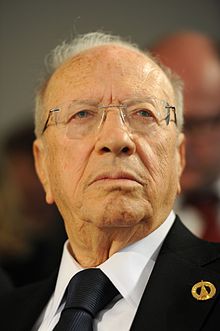
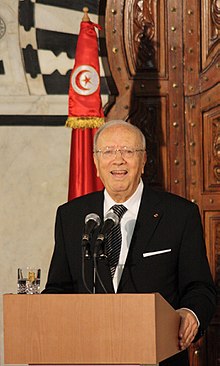
This past Saturday, July 28 2019, millions of Tunisians bid farewell to their first democratically elected president Mohamed Béji Caïd Essebsi at a state funeral attended by numerous foreign leaders including French President Emanuel Macron, Qatari EmirSheikh Tamim bin Hamad Al Thani, Palestinian President Mahmoud Abbas and Felipe VI of Spain. Essebsi passed away this past Thursday, July 25 at 92 years old. His was a great life of public service, and determination to serve the Tunisian people to the best of his ability.
Essebsi was a seasoned politician whose career spanned over six decades. His first involvement in politics started in 1941, when he joined the Neo Destour youth organization in Hammam-Lif. He was known for his integrity, exceptional public service, and served under Tunisia’s first president Habib Bourguiba, at different positions, including chief of the regional administration, general director of the Sûreté nationale, Interior Minister, Minister-Delegate to the Prime Minister, Defense Minister, and then Ambassador to Paris. The coincidence of him dying on the anniversary of the republic reminded people of the role he played in nation-building since independence.
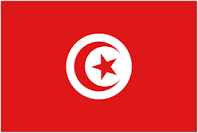
Flag of Tunisia
In recent years, Essebsi rose to prominence after the overthrow of veteran autocrat Zine El Abidine Ben Ali, which was followed by “Arab Spring” revolts against authoritarian leaders across the Middle East and North Africa, including in Libya and Egypt. He was seen as a unifying figure. He founded the Nidaa Tounes political party, which won a plurality in the 2014 parliamentary election. In December 2014, he won the first regular presidential election following the Tunisian Revolution, becoming Tunisia’s first freely elected president.
Essebsi in 2011 (Wikipedia)
Hours after Essebsi’s death, parliament speaker Mohamed Ennaceur was sworn in as interim president in line with the constitution in a smooth transition of power. The presidential election is scheduled for Sept. 15, as stated in the constitution which gives 90-days after the death of the president for new elections to take place; this comes two months earlier than scheduled.
The interim President stated, “[Mohamed Beji Caid Essebsi] spent his life in the service of Tunisia, preserving its gains and defending its values.” “He was a man of consensus, dialogue and national unity.” Don’t we all need dialogue and national unity?
Please take some time to read the good article The Arab Weekly wrote on the life of this great man who always put the interest of the Tunisian people first.
Alvin Zhakata in Khartoum, Sudan (Source: Alvin Zhakata)
What would you do for the love of football? How far would you go for a chance to watch the biggest continental football event of the year? Will you cross mountains, rivers, plains, and valleys? Well, Alvin Zhakata, a Zimbabwean man, trekked 10,000 km to cheer for the Zimbabwean warriors at the Africa Cup of Nations 2019 in Cairo this past month. He traveled from Cape Town to Cairo by road enduring visa delays, internet blackouts and revolutionary protests all for the love of football. It took him a total of 44 days; he missed his team who were eliminated in the first round, but the CAF president gave him a VVIP ticket to the final between Algeria and Senegal last Friday.
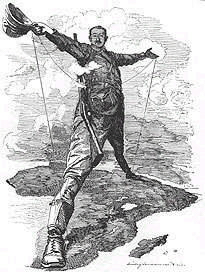
Cecil Rhodes with his transafrican train project from Cairo to Cape Town – the most imperialist ever
What Zhakata did, is no simple feat. He did what even the infamous Cecil Rhodes could not achieve: go from Cape Town at the tip of Africa, to Cairo at the very top of the continent. For those who do not know: the words Cape to Cairo immediately bring to mind the European Scramble for Africa, Cecil Rhodes and his ambition for Great Britain to control the whole of Africa from Cape to Cairo, and of course to link all British colonies via the Cape to Cairo Railway crossing Africa from south to north by rail. The Cape to Cairo Road was also planned to roughly connect the same countries; however, it is not praticable today, and has remained more of a dream or rather a possibility, which needs revamping.
What Zhakata did is not just a show of undying love of a fan for football, but also a political statement to all African leaders: we need roads to connect each other; we need better visa system, or rather a borderless Africa for better and safer travel, increased trade among each other: we need a united Africa. Zhakata’s statement is one of Unity,… African Unity. Enjoy the excerpt below from BBC.
====
Africa Cup of Nations 2019 in Cairo, Egypt
A Zimbabwean nurse travelled from Cape Town to Cairo by road enduring visa delays, internet blackouts and revolutionary protests all for the love of football.
Alvin “Aluvah” Zhakata had intended to make it to Egypt for the opening match of the Africa Cup of Nations on 21 June, when Zimbabwe’s Warriors took on the hosts.
But he missed the match because his epic journey took much longer than expected.
Yet thanks to those following his adventures on Twitter, he has now become a celebrity – and the African football boss has presented him with a ticket to this Friday’s final between Algeria and Senegal.
When the 32-year-old arrived in the Egyptian capital last week, completing his 44-day10,000km (6,200-mile) trip, he said it was well worth it despite some nerve-wracking experiences.
Cape to Cairo (Source: BBC)
His other more sobering discovery was that “Africa is not friendly to Africans” – in terms of visas and borders. “And some of the visa fees for African countries, they are actually more expensive than visa fees when you want to go to Europe – and the waiting period takes too long. “I believe we need a borderless Africa.”
The journey began on 27 May on a route passing through South Africa, Zimbabwe, Zambia, Tanzania, Kenya, Ethiopia, Sudan and Egypt.
CAF president recognizing Alvin Zhakata for his feat, and presenting him with a VVIP ticket to the AFCON 2019 final
[…] His one disappointment has been the performance of the Warriors, who crashed out in the first round – amidst rows over pay.
But he says his achievement – which has become one of the biggest stories of this Africa Cup of Nations tournament – shows it pays to “dare to dream“.
“If you have a passion for something, go for it. Pursue it until you get it. It may be delayed, but delay is not denial – be patient and be strong, because the harder the battle, the sweeter the victory,” he says.
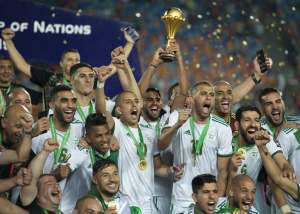
The Fennecs of Algeria celebrate winning AFCON 2019 (The Guardian)
This past Friday, the Fennecsof Algeria defeated the Lions of Teranga of Senegal1-0 to become Africa’s new champions. This was their second title since 1990. Even though the final was not the desert foxes’s best game, they clearly were the best team of the tournament. Baghdad Bounedjah‘s early goal propelled Algeria to a first Africa Cup of Nations title in 29 years with a fiery 1-0 victory over Senegal in Friday’s final in Cairo.
Algeria’s coach Djamel Belmadi and Senegal’s coach Aliou Cisse
I would like to salute both coaches. The 2019 Africa Cup of Nations was the first time in over 20 years when both finalists were led by African coaches: Algeria by Djamel Belmadiand Senegal by Aliou Cissé. This should be the norm, rather than the exception. Coincidentally, both coaches grew up in the same suburb of Paris, are the same age only separated by one day, and played against each other at youth level. They came head-to-head in a league game between Marseille and Paris Saint-Germain in February 2001, and then with their national teams two months later. Again African teams should be led by Africans… No wonder Egypt performed so poorly at the AFCON 2019 (this is the first time, they were not led by a local).
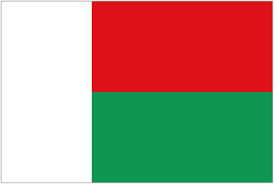
Flag of Madagascar
The revelation of this tournament was the Bareaof Madagascar which for their first participation ever to the African Cup of Nations, performed extremely well, and went as far as the quarter finals. For their successful performance, their country’s president knighted the whole team.
Overall, AFCON 2019 brought us a lot of joy and tears, and we applaud the winners of this year’s tournament Algeria.
As I stated before, Sudan has more pyramids than Egypt, and at one point its pharaohs ruled Egypt for over a century. Only in recent years, has Nubia (Africa’s Forbidden Pyramids: Meroe, Nubia, and Sudan) attracted the attention of more archaeologists. One archaeologist used scuba diving to explore one of the pyramids at the ancient royal burial site of Nuri; making it the first time it is used in Sudan. He unearthed some amazing pottery figurines and gold leaves. The expert below is from theBBC; for the full article, follow thelink.
=====
Nuri Archaeological expedition / Pearce Paul Creasman (Source: BBC)
An underwater archaeologist has told the BBC of the extraordinary lengths he went to to access a pharaoh’s tomb underneath a pyramid.
Pearce Paul Creasman and his team were the first people to go into the tomb for 100years and, in that time, it has become harder to access because of the rising water level. Mr Creasman told BBC Newsday that this was the first time underwater archaeology had been carried out in Sudan, the location of the ancient royal burial site of Nuri.
He found pottery figurines and gold leaf.
“The gold offerings were still sitting there – these small glass-type statues had been leafed in gold. And while the water destroyed the glass underneath, the little gold flake was still there,” he told Newsday.
He believes these offerings were for Nastasen, a minor pharaoh who ruled the Kush kingdom from 335 BC to 315 BC.
Mr Creasman told the BBC that the team “dug as far as we could” down a 65-step stairway which led to the tomb entry. …
Nuri archaeological expedition / Pearce Paul Creasman (Source: BBC)
He described what he found as “remarkable“:
“There are three chambers, with these beautiful arched ceilings, about the size of a small bus, you go in one chamber into the next, it’s pitch black, you know you’re in a tomb if your flash lights aren’t on. And it starts revealing the secrets that are held within.”
The tomb is part of the ancient site of Nuri which is spread across more than 170 acres in northern Sudan.
These pyramids mark the burials of Kushite royals who are sometimes referred to as “black pharaohs“. The Kush kingdom lasted for many hundreds of years and, in the 8th Century BC, it conquered Egypt which it ruled for almost a century.


 Candace Amanishakheto on a mural


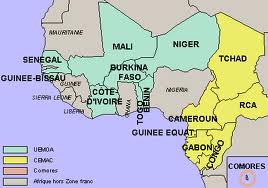 Carte des pays de la zone CFA
 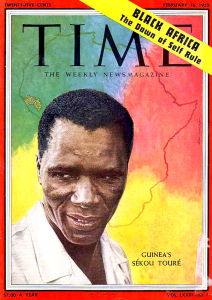 Sekou Toure, Cover Time Magazine, Feb. 16, 1959




 Yesterday, August 1, the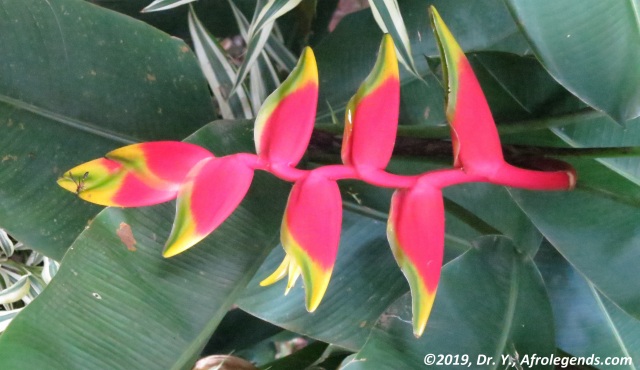








 African Heritage