Kais Saied aka ‘The Robot’: The Political Outsider Who Won the Tunisian Presidential Election

Tunisia_Saied
Kais Saied, new president of Tunisia getting sworn in (Source: Al Jazeera)

Last week marked another big step towards democracy for Tunisia. Kais Saied, a political outsider and retired law professor, won the presidential election with a landslide victory. The Robot, as he is affectionately called, was sworn in as Tunisian president on Wednesday, 23rd of October. His win delivered a heavy blow to a governing elite accused of failing to improve living standards or end corruption since the 2011 revolution that introduced democracy after years of authoritarian rule. Below are excerpts of an article from Al Jazeera.  Enjoy!

=====

Kais Saied has been sworn in as Tunisia‘s new president. 

The 61-year-old law professor has no prior political experience, never held office and barely ran a campaign.

Saied sealed a resounding victory in a runoff election on October 13, largely buoyed by a groundswell of support from young voters. He won just over 72 percent of the votes, with about 27 percent of ballots cast for his media-mogul opponent Nabil Karoui.

Tunisia_Essebsi_1
Beji Essebsi, Former president of Tunisia (Source: Wikipedia)

He succeeds former President Beji Caïd Essebsi, Tunisia’s First Democratically Elected Presidentwho died in office in July. 

A perhaps unlikely aspiring leader in the Arab world, the austere and scholarly Saied stood apart from the other 25 candidates in the first round of Tunisia’s presidential election.

After winning that round, he announced he would not campaign ahead of the run-off election against then-imprisoned Karoui, saying it would give him an “unfair advantage”.

Observers say it’s that openness and obsession with equity that has connected with Tunisia’s youth, who, above all, see Saied as an honest leader offering them the keys to the nation’s future

During his meteoric rise, Saied vowed to fight corruption and promote social justice, while saying access to healthcare and water is part of national security and that education would “immunise” youth against extremism

[…] Selim Kharrat, president of Tunisian NGO Al Bawsala, said Saied’s popularity was in part fuelled by disenfranchisement with a political system that has failed to address core economic needs.

Tunisia_Flag
Flag of Tunisia

“The current atmosphere where many politicians are caught up in corruption scandals has helped this seemingly simple man,” Kharrat told Al Jazeera after the first round of elections.

Saied’s unadorned profile has stood in stark contrast to that of Karoui, who was arrested in late August on money-laundering and tax evasion charges, Kharrat said.

“He’s received no funding from any of the big parties or abroad, notably the better-off Arab Gulf countries, and this has shielded him from any suspicion,” he added.

….

Abiy Ahmed, the Prime Minister of Ethiopia is Awarded the Nobel Peace Prize

Ethiopia_Abiy Ahmed
Prime Minister Abiy Ahmed (Source: sa.breakingnews.co.za)

A year after the Congolese doctor, Denis Mukwege shared the  Nobel Peace Prize 2018, another African has won it again: Abiy Ahmed Ali, Ethiopia’s prime minister was awarded the  Nobel Peace Prize last week for his work in ending the 20-year post-war territorial stalemate between Ethiopia and Eritrea.

Abiy Ahmed became prime minister of Ethiopia at a time of profound strife, and through a serious of deft political gestures, including the release of thousands of political prisoners and overturning highly repressive restrictions on civil society and political groups, he probably averted a civil war. Last year, he was the first Ethiopian leader to meet with his Eritrean counterpart in over 2 decades , and both countries signed a “Joint Declaration of Peace and Friendship.”

Nobel prize
Nobel Prize medal (Wikipedia)

Berit Reiss-Andersen, the chairwoman of the five-member committee that made the decision to award the Nobel Peace Prize, credited Abiy with a peace initiative aimed at ending two decades of conflict between the two east-African neighbors that began over border disputes in 1998 only a few years after Eritrea gained independence.

When Abiy Ahmed became prime minster in April 2018, he made it clear he wishes to resume pace talks with Eritrea,” she said. “In close cooperation with the president of Eritrea, Abiy Ahmed quickly worked out the principles for a peace agreement to end the long no peace stalemate between the two countries.”

When Abiy took office, he freed political prisoners and managed in the same year to sign a peace deal with the Eritrean leader, Isaias Afwerki — agreeing in the process to cede disputed land to his country’s erstwhile enemy.

Peace does not arise from the actions of one party alone,” Reiss-Andersen said. “When Prime Minister Abiy reached out his hand, President Afwerki grasped it, and helped to formalize the peace process between the two countries.

Map of Ethiopia
Map of Ethiopia

Additionally, Abiy Ahmed has sought to mediate between Kenya and Somalia in their protracted conflict over rights to a disputed marine area. There is now hope for a resolution to this conflict,” she said.

In Sudan, the military regime and the opposition have returned to the negotiating table. On the 17th of August, they released a joint draft of a new constitution intended to secure a peaceful transition to civil rule in the country. Prime Minister Abiy played a key role in the process that led to the agreement,” Reiss-Andersen added.

Ethiopia Eritrea
Map of Ethiopia and Eritrea, the two sisters

Although it is quite early in his career – after all, it has only been one year since he became prime minister – I think his is more justified than the one given to Obama for his speeches. Ever since I have grown to understand politics, I am always skeptical of these prizes anyway. However, this prize should encourage African and world leaders to work towards peace for their people at all times. We congratulate prime minister Abiy Ahmed, and wish him well in continuing to lead Ethiopia with a steady head.

A Weekend of Firsts in Sports set by … Africans and Afro-Descendants

Kipchoge_INEOS 2019
Eliud Kipchoge after crossing the sub-2hour marathon line (Source: Standard.co.uk)

This past weekend was a weekend of firsts in sports, firsts set by African and Afro-descendant athletes. It was also a strong weekend for Black female athletes, with dominant, outstanding, and even historic performances by world record marathoner Brigid Kosgei, tennis champion Coco Gauff and Simone Biles, the greatest gymnast in the history of the sport. We watched with great joy when:


Eliud Kipchoge of Kenya ran a sub-2 hour marathon to become the first person in recorded history to run a marathon in such times. On 12 October 2019, Kipchoge ran the marathon distance on a special course in Vienna, Austria, achieving a time of 1:59:40 in the Ineos 1:59 Challenge. However, his record will not go down as a world record, because this technical feat required unprecedented planning and support, and was heavily engineered. We nonetheless celebrate the history and meaning for mankind.


Simone Biles2
Simone Biles breaking all records at the World championships in Stuttgart (Source: time.com)

Simone Biles became the most decorated gymnast of all times. The four-time Olympic gold medalist, at 22, broke a world championships record with her medals on Sunday. Winning gold medals for both her floor routine and the balance beam, Biles became the most-decorated gymnast at the world championship amassing 25 medals, breaking the long-held record of 23, which was set by male gymnast Vitaly Scherbo back in the 1990s. She is not only the most decorated in history, but the highest and fastest champion the sport has ever seen.


Kosgei_Chicago2019
Brigid Kosgei at the Chicago Marathon showing her record (Source: Reuters)

Kenya’s Brigid Kosgei set a jaw-dropping new women’s world record in Chicago over the weekend with a time of 2:14:04, breaking the record set by British runner Paula Radcliffe in 2003, 16 years ago. Unlike Kipchoge’s record, whose effort employed rotating pacers and just one “racer,” this one will count as a world record. Kosgei removed 81 seconds from the previous record, an unprecedented feat!


Gauff1
Coco Gauff after winning her first WTA title (Source: cbc.ca)

Tennis player Coco Gauff  became the youngest singles champion, at 15, in 15 years and the youngest American to win a singles title on the tour since 1991. She became the youngest woman to win Women’s Tennis Association (WTA) title since 2004 (and the youngest American to do so in 28 years) by winning Austria’s Linz Open on Sunday. I love the advice her dad who is her coach gave her: “Just relax, you’re not going to sprint to the finish line,… We’re going to walk to the finish line, OK?” And relaxed she got, in order to cruise to victory.


It was truly a weekend of Firsts, unprecedented, and of course Outstanding performances!!!


At the Almamy Samori Touré’s Court

Samori Toure holding the Coran
Samori Toure

What happens when a colonizer visits the court of an African King in the 19th century? How do the two cultures collide? Below is a description of an audience at the court of the great king Samori Touré, by the French commander Marie Étienne Péroz who even wrote a book later “Au Soudan français : souvenirs de guerre et de mission,” C. Lévy, 1889.  As you can see, the European man is in awe at what he sees in court, the arrangement, and most importantly the calm confidence and simplicity emanating from  Samori Touré. Also note the importance of Samori’s griot, Ansoumana, “without whom no decision is taken.” Enjoy! The original in French can be found on p. 281 of Les Africains, Vol.1, Editions du Jaguar, 1977. The English translation is brought to you by Dr. Y., Afrolegends.com.

======

The number of important personalities who had been summoned to it [the meeting], the riches and the pomp of the occasion, indicated the importance the almamy attached to it.

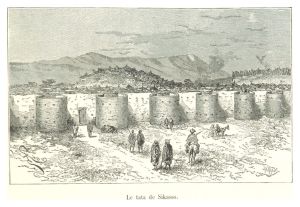
We were, ourselves, very impressed by the skill of the décor of which the original setting of the mosque, dungeon, high huts and ramparts of the palace had been done to enhance its brilliance (beauty). We slowly get closer, guided by Karamoko, towards the large canopy which shelters the Almamy and its court.

The Almamy is half lying on an elevated tara where blankets with bright patterns are piled up. He is simply dressed: Moorish boots, a black turban, a dark-colored caftan under which can be seen a white boubou. His headgear, a kind of diadem in finely chiseled gold and a necklace of the same metal deliciously crafted are the only insignia revealing his rank. His entourage, on the contrary, sitting on very low armchairs, brings out the severity of this costume by means of garments in showy colors in which they are clothed: this variegation of colors gives a warm tone to the entire scene. On his left, squatting on the ground and against his tara, Ansoumana, his family griot, without whom no decision is taken: he is wearing a blue boubou, and a black smock. Then, on the same side, Kissi, the head of treasury, whose green boubou constellated with grigris, throws the first happy note.

Samory does not get up when we dismount [from the horse]. We stop in front of him after greeting him and he extends his hand in a very affable way. From all sides explode the raucous accents of the horns, adding into the hum of the tam-tams, and the rumbling of the Almamy’s war drum. […]

20190804_172909_1
Vivid reception at the Almamy’s court (Les Africains, Vol.1 , P. 281, editions Jaguar)

The dreadful noise of instruments of all kinds greeting our arrival prevents at the beginning of all conversation, and covers the words of welcome he addresses us in a veiled tone; thus do we take this reprieve to admire in all sincerity the striking spectacle taking place in front of us.

What strikes us at first sight is the form he affects as a whole: the crescent. Just as his entourage is arranged in such a way which may appear to be the results of chance, but which, in reality, is very skillfully calculated so as to form a happy harmony of colors and forms, just as the security escorts of the different leaders who accompany him form in front of his dais a perfect half-oval, which leaves between him and them a vast place covered with white sands brought in from the river.  

Commandant Péroz

French Sudan

Robert Mugabe and His Contribution to Africa

Robert Mugabe Ave in Namibia_3
Robert Mugabe Avenue, next to the Parliament, in Windhoek, Namibia

Namibia’s Founding President Sam Nujoma has described the late Zimbabwean President Robert Gabriel Mugabe as one of the continent’s most iconic leaders who fought for the liberation of his country and that of Africa at large. “He will be remembered as one who stood firm when others wavered. He was an iconic Pan-Africanist,” Nujoma said.

Robert Mugabe_7
Zimababwe’s President Robert Mugabe chants Zanu PF slogans with supporters gathered at the Harare International Conference Centre in Harare, Wednesday May 3, 2000. Mugabe launched the Zanu PF’s election manifesto which bears the slogan “Land is the Economy and the Economy is Land”. (AP Photo/Christine Nesbitt)

Robert Mugabe’s contribution to the freedom of Namibia, and all of Southern Africa and Central Africa is so immense that there are streets named after him throughout the region; for instance, an avenue bears his name in downtown Windhoek, the capital of Namibia. He worked tirelessly for the liberation of most of Southern Africa, including his very own country of Zimbabwe. Many countries such as Mozambique, Namibia, South Africa (with the fall of the Apartheid regime), Angola, owe their freedom to his unwavering support. Even in the  Democratic Republic of the Congo, (DRC), his support, sending troops there, helped avert total chaos. Joseph Kabila, former president of the DRC said, “We will forever remember the worthy son of Africa, who came to our rescue when our country was victim of a foreign aggressor. The continent has lost one of its pan-African leaders, a hero of independence.

Don’t agree with everything you read online, in the Western newspapers. When an African leader stands for his people and is fighting for their freedom, the western press calls him a dictator, a heretic: Laurent Gbagbo, Muammar KadhafiKwame Nkrumah at the end of his life, Sekou TouréPatrice Lumumba, … When he serves western interests in pillaging his country, he is a democrat and a friend: Paul Biya, Omar BongoAlassane Ouattara,  Mobutu Sese Seko, and countless others. Pay attention and you will see… and since the media are controlled by the west, we get a different version, very far from reality.

Robert Mugabe - Fidel Castro in Namibia1
Map of Windhoek’s city center on the plate of the National Museum of Namibia, showing the Robert Mugabe Ave and the Fidel Castro St., as well as the Sam Nujoma Ave.

Everybody is stricken by some amnesia and forgets that the economic problems of Zimbabwe stemmed from economic sanctions imposed on them by Western powers such as the UK, US, and Europe. Before Mugabe fought for land restoration, he was knighted by the Queen of England, when he asked for the land of his forefathers to be returned to their rightful owners, he became a dictator. Go figure!

No wonder, Julius Malema of the EFF said “We must not allow our enemies to tell us how to remember [Robert Mugabe]; we know our heroes.”


Ethiopia Breaks World Record,Plants 350 million Trees In One Day

Ethiopia_Prime minister Abiy Ahmed
Ethiopian prime minister Abiy Ahmed plants a tree as part of the reforestation project (Source: Office of the Prime Minister – Ethiopia)

Last August, Ethiopia broke a world record for… not in long distance running, people… but for the most trees planted in a single day in the world. The goal was to plant 200 million trees to fight against deforestation and droughts in Ethiopia. Kudos to the prime minister Abiy Ahmed and to the strong people of Ethiopia.

Enjoy the excerpt below below from Borkena; you will find the full article there.

=====

Prime minister Abiy Ahmed’s administration has been mobilizing for months for what it called “Green Legacy” project which aimed at planting over 200 million trees in a single day.

Government affiliated media, Fana Broadcasting Corporation (FBC), cited the coordinating committee of the project to report that 353,633,660 trees have been planted across the country.

Religious leaders, workers, business people, actors, members of the Ethiopian Defense force, senior government officials, students, among others, have participated in the campaign.

[…] Over the last decades, Ethiopia lost much of forest coverage across the country due to deforestation. Currently, the forest coverage is said to be below 3 percent.

Organizers of the green legacy campaign and Abiy Ahmed’s administration pride itself by claiming world record with the 200 million trees in a day campaign.

According to Guinness World Records, the record for individuals was registered in 2001 in Canada. Ken Chaplain planted 15,170 trees in one day in Saskatchewan.

In terms of tree planting by volunteers, the highest number of trees planted is India in 2016, as per The National Geographic report. About 50 million trees were planted on June 11, 2016.

Robert Mugabe in His Own Words

Robert Mugabe_12
Robert Mugabe

Africa must revert to what it was before the imperialists divided it. These are artificial divisions which we, in our pan-African concept, will seek to remove.” – Speech at Salisbury, 1962

Was it not enough punishment and suffering in history that we were uprooted and made helpless slaves not only in new colonial outposts but also domestically.” 1960s

We of Africa protest that, in this day and age, we should be treated as lesser human beings than other races.” 2003

Flag of Zimbabwe
Flag of Zimbabwe

“If the choice were made, one for us to lose our sovereignty and become a member of the Commonwealth or remain with our sovereignty and lose the membership of the Commonwealth, I would say let the Commonwealth go. What is it to us? Our people are overjoyed, the land is ours. We are now the rulers and owners of Zimbabwe.” – Speech at ZANU-PF Congress December 2003 . This is somewhat reminiscent of when Sekou Touré said ‘NO’ to France in 1958, “It is better to be poor and free, than to live in opulence and be a slave.”

Zimbabwe2
Map of Zimbabwe

We have fought for our land, we have fought for our sovereignty, small as we are we have won our independence and we are prepared to shed our blood … So, Blair keep your England, and let me keep my Zimbabwe.” – Earth Summit, South Africa, 2002

We don’t mind having sanctions banning us from Europe. We are not Europeans.” 2000s

Our small and peaceful country is threatened daily by covetous and bigoted big powers whose hunger for domination and control of other nations and their resources knows no bounds.” 2000s – Isn’t this true for Africa as a whole today since the Berlin conference of 1884?

“The white man is not indigenous to Africa. Africa is for Africans. Zimbabwe is for Zimbabweans.” ZANU-PF Congress December 2000.

The land is ours. It’s not European and we have taken it, we have given it to the rightful people … Those of white extraction who happen to be in the country and are farming are welcome to do so, but they must do so on the basis of equality.” 2000s

Robert Mugabe_ZANU PF
Robert Mugabe at a ZANU PF Congress (Source: Nehanda Radio)

“Mr Bush, Mr. Blair and now Mr Brown’s sense of human rights precludes our people’s right to their God-given resources, which in their view must be controlled by their kith and kin. I am termed dictator because I have rejected this supremacist view and frustrated the neo-colonialists.” UN General Assembly 2007.

African resources belong to Africa. Others may come to assist as our friends and allies, but no longer as colonisers or oppressors, no longer as racists.” 2015

“We have said we will never collapse, never ever. We may have our droughts, our poverty, but as a people, we shall never collapse, never ever.” 

Robert Mugabe, Freedom Fighter and First President of Zimbabwe Lives On

Robert Mugabe_4
Robert Mugabe (History.com)

One of Zimbabwe‘s great sons is no longer: Robert Mugabe, the first president of Zimbabwe has passed away. This was a man who tirelessly fought for his country’s liberation, and for the Black race as a whole. Some have called him an icon of liberation, and indeed he was!

Robert Mugabe epitomized the freedom fights of then Rhodesia, a British colony ruthlessly run by a white minority. This once beautiful place had been renamed after  Cecil Rhodes a white tyrant who committed the greatest atrocities in that country in the name of the superiority of one race over the other and capitalism. It was only befitting that a freedom fighter like Robert Mugabe should come up, and fight to not only reclaim the land of his ancestors, but also appropriately reinstate it to its past glory, that of Great Zimbabwe !

Flag of Zimbabwe
Flag of Zimbabwe

Few people have sacrificed so much for a fight for freedom. After criticizing the government of Rhodesia in 1964, Robert Mugabe was imprisoned for more than a decade without trial. Mugabe lost his then only child while in prison; the colonial government did not allow him to bury him (almost 30 years later, he went on to have other children).

Robert Mugabe embodied Africa’s struggle against colonialism. He was a courageous politician, imprisoned for daring to defy white-minority rule. Later on, he was vilified by the ‘international community‘ (now we all know that this means: parts of Europe + USA) for restoring their lands to Africans, because this attacked whites’ interests in his country. I am not sure how to this day, some people believe that it is okay for less than 5% of the population to own 90% of the land in a country which is not even theirs… that is beyond me… what about those who were born there? what about those whose land it is? Will it be okay if the few Africans who have immigrated to say France, owned 90% of the land there?… Now will we all hear about injustice!

Robert Mugabe_7
Zimababwe’s President Robert Mugabe chants Zanu PF slogans with supporters gathered at the Harare International Conference Centre in Harare, Wednesday May 3, 2000. (AP Photo/Christine Nesbitt)

Learning of the passing of Robert Mugabe, many world leaders have expressed their condolences… below are just a few.

Julius Malema of South Africa said, “I’m saddened by the passing of our martyr and giant of the African revolution cde President Robert Mugabe. Let’s continue the fight and protect his legacy. We must not allow our enemies to tell us how to remember him; we know our heroes.”

Joseph Kabila, former president of the Democratic Republic of Congo (DRC) said, “We will forever remember the worthy son of Africa, who came to our rescue when our country was victim of a foreign aggressor. The continent has lost one of its pan-African leaders, a hero of independence.

Hage Geingob
Hage Geingob of Namibia (ZimbabweSituation.com)

Kenya’s President Uhuru Kenyatta said Mr Mugabe had “played a major role in shaping the interests of the African continent” and was “a man of courage who was never afraid to fight for what he believed in even when it was not popular.

Hage Geingob, president of Namibia added, “… Robert Mugabe [was] an extraordinary revolutionary and tenacious freedom fighter who contributed immensely to Africa and Namibia’s cause for freedom.

Jerry J. Rawlings, former president of Ghana said, “RIP Comrade Mugabe. You lived for the dignity of your fellow black. Your African pride, dignity and audacity were unassailable. Africa has lost a bold and noble Statesman.

Cyril Ramaphosa
Cyril Ramaphosa of South Africa (AlJazeera.com)

South Africa’s President Cyril Ramaphosa called Mr Mugabe a “champion of Africa‘s cause against colonialism” who inspired our own struggle against apartheid“. And indeed Robert Mugabe supported the fight against apartheid and tremendously helped the ANC in its struggle to defeat that monster called apartheid. Ramaphosa added that under Mugabe’s leadership, “Zimbabwe’s sustained and valiant struggle against colonialism inspired our own struggle against apartheid and built in us the hope that one day South Africa too would be free”. During the decades of our own struggle, Zimbabwe’s liberation movement supported our own liberation movement to fight oppression on multiple fronts. After Zimbabwe achieved independence, the apartheid state brutalised and violated Zimbabwe as punishment for supporting our own struggle” . Many Zimbabweans paid with their lives so that we could be free. We will never forget or dishonour this sacrifice and solidarity.”

Robert Mugabe_China
Xi Jinping of China with Robert Mugabe (Source: South China Morning Post)

In his condolence message, Chinese President Xi Jinping said China had “lost an old friend and a good friend.” Foreign ministry spokesman Geng Shuang said Mugabe’s death was deeply mourned in China, noting that the former president opposed foreign interference and actively promoted Beijing’s relations with Zimbabwe and Africa. China described Mugabe as an “outstanding leader of the national liberation movement and statesmanwho firmly defended the country’s sovereignty, as African leaders termed him a “liberator” and “pan-Africanist.

Amanishakheto, Warrior Queen of Nubia

Nubia_Stele of Amanishakheto from the temple of Amun in Naqa
Stele of Amanishakheto (center) from the temple of Amun in Wad ban Naqa (Wikipedia)

Amanishakheto was a great queen of Nubia and is known as a great warrior and pyramid builder; she built numerous pyramids and temples at Meroë. She is also the daughter of Amanirenas, the fearless and one-eyed queen who defeated the Romans, and the mother of Amanitore, another great queen. Today, vestiges of her palace which had been destroyed and plundered by the Italian explorer Giuseppe Ferlini can still be seen at Wad ban Naqa, and her jewelry (looted by the same Italian), are now on display at the Egyptian Museum of Berlin, and at the Egyptian Museum of Munich.

Dr. Y.'s avatarAfrican Heritage

Candace Amanishakheto on a mural Candace Amanishakheto on a mural

Great women are often left out of history.  Rarely do we hear or read about African queens.  It is already hard enough to read about great African men and leaders in history books, but as for African women… it is more like impossible.  How many have heard of the great warrior queen of Nubia, Amanishakheto, who defeated a Roman army?  Who has heard of this great queen whose pyramid/tomb was leveled to the ground by an Italian treasure hunter, Giuseppe Ferlini, in 1832? Who has heard of this woman who led her people with a strong arm, and built pyramids in Meroë?  Who has heard of this great candace, whose daughter Amanitore, also queen of Nubia, is mentioned in the Bible (Acts 8:27) … yeah the Queen of Sheba is not the only African…

View original post 379 more words

‘My Name’ by Magoleng wa Selepe

Colonization in Africa
Village school in French West Africa (AOF) 1900s – French assimilationism (Louis Sonolet, Source: http://exhibitions.nypl.org)

The poem ‘My Name‘ by Magoleng wa Selepe has touched many strong chords. It is the truth, and still rings true today. During colonial times, our parents, grandparents, and great-grandparents were stripped of their names and identity: to go to school, they had to have a European name, and very often their own names were distorted because the European colonizer could not spell it properly. Depending on the origin of the colonizer, whether it was France, Great Britain, Germany, or Portugal, one ended up with a French, British, German, or Portuguese name. Enjoy !!!

Dr. Y.'s avatarAfrican Heritage

African Savanna

I just thought about what happened to our fathers, mothers, grandmothers, and grandfathers during colonial times: to go to school African children were forced by European missionaries to adopt a christian name such as John, Peter (Jean, Pierre), etc… as opposed to their good old African name Nomzimo, Makeba, Ndoumbe, Keïta, etc.  Thus many Africans who would have just worn the name ‘Ndoumbe Mpondo‘ or ‘Binlin Dadié‘ or ‘Um Nyobé‘ had to adopt a European name such as John + their own name, such that they became: John Ndoumbe Mpondo or Bernard Binlin Dadié or Ruben Um Nyobé.  To this day, the tradition has remained… most Africans would have three or four names: their family name, and their given name, plus the European first name and in some cases a European middle name as well.  The poem below entitled…

View original post 116 more words