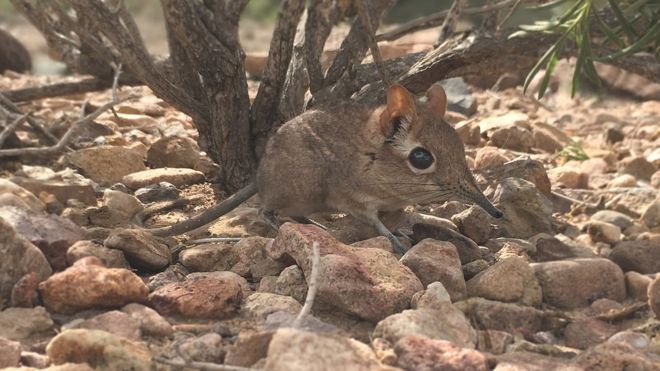
Elephant shrew (sengi) in Djibouti (source: Steven Heritage – BBC)
When I heard about the re-discovery of the elephant shrew, I wondered how could the elephant go missing and I didn’t hear about it? Since when? … then I realized that the elephant shrew was a sort of tiny rodent which is common on the horn of Africa; in the case at hand, it used to be common in Djibouti, but disappeared about 50 years ago. Not sure why it is called ‘elephant’ shrew. They say that it is related to the elephant, but how? Maybe the original scientist who said that had a little too much to drink? Or just looked at its pointed trunk-like nose and decided? Excerpts below are from an article on the BBC. As a side note, we really need to preserve our fauna (and flora), because we do not need a day when the elephant, the real one, will go missing
====
A little-known mammal related to an elephant but as small as a mouse has been rediscovered in Africa after 50 years of obscurity.
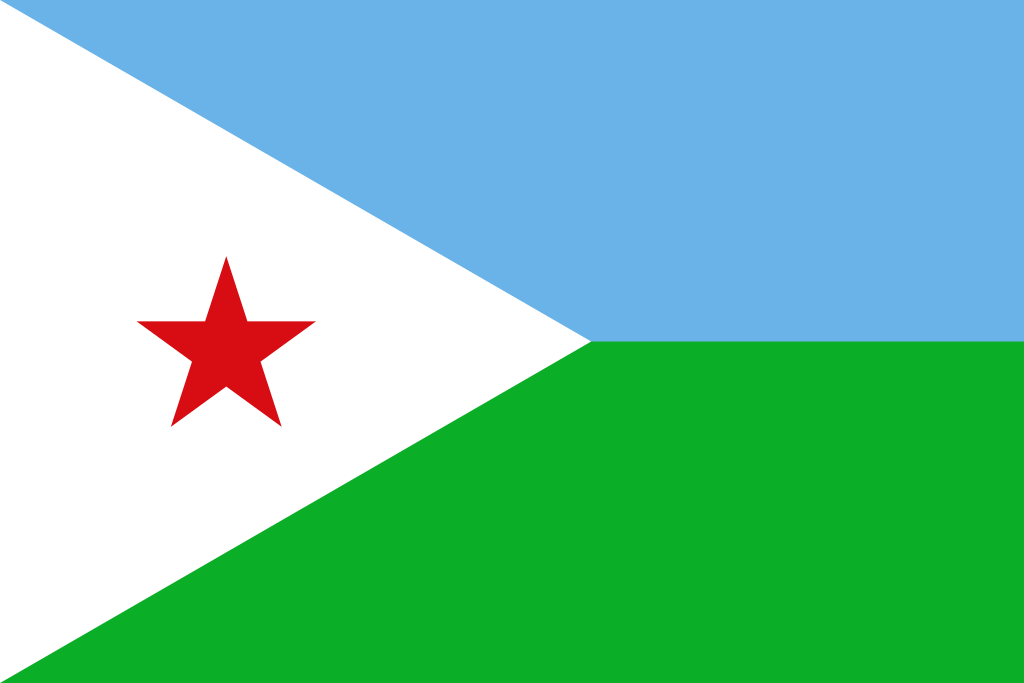
Flag of Djibouti
The last scientific record of the “lost species” of elephant shrew was in the 1970s, despite local sightings.
The creature was found alive and well in Djibouti, a country in the Horn of Africa, during a scientific expedition.
Elephant shrews, or sengis [the name is of Somali origin], are neither elephants nor shrews, but related to aardvarks, elephants and manatees.
They have distinctive trunk-like noses, which they use to feast on insects.
There are 20 species of sengis in the world, and the Somali sengi (Elephantulus revoilii) is one of the most mysterious, known to science only from 39 individuals collected decades ago and stored in museums. The species was previously known only from Somalia, hence its name.
Steven Heritage, a research scientist at the Duke University Lemur Center in Durham, US, and a member of the expedition to the Horn of Africa in 2019, said he was thrilled to put the species “back on the radar”.
He told the BBC: …”We did not know which species occurred in Djibouti and when we saw the diagnostic feature of a little tufted tail, we looked at each other and we knew that it was something special.”
The scientists had heard reports of sightings in Djibouti, and Houssein Rayaleh, a Djiboutian research ecologist and conservationist who joined the trip, believed he had seen the animal before.
He said while people living in Djibouti never considered the sengis to be “lost” [seems like a case of ‘only Europeans discover things’ like Columbus and the Americas], the new research brings the Somali sengi back into the scientific community, which is valued.
“For Djibouti this is an important story that highlights the great biodiversity of the country and the region and shows that there are opportunities for new science and research here,” he said.
In recent months, racial and social justice, and systemic racism have been at the forefront of the battle for human equality. A few days ago, Mrs. Gisele Yitamben wrote a piece for the World Economic Forum (WEF) where she addressed a very important point in the battle against systemic racism, namely the fact that the history of the victim needs to be told accurately in all its glory and entirety for the healing process to start. There is a saying that “until the lion tells its story, the hunter will always be the hero.” Mrs Yitamben has been most gracious to share with us her ideas on ways to address systemic racism, and expand on her WEF article here. Enjoy!
======
History of Histories is Needed to Address Systemic Racism
By Gisele Yitamben*
“Systemic racism” is used to talk about all of the policies and practices entrenched in established institutions that harm certain racial groups and help others. “Systemic” distinguishes what’s happening here from individual racism or overt discrimination, and refers to the way this operates in major parts of society: the economy, politics, education, and more.
Systemic racism is also a form of racism that is embedded as normal practice within society or an organization. It can lead to such issues as discrimination in criminal justice, employment, housing, health care, political power and education, among other issues.
“Systemic racism has its roots in extractive capitalism”
It is “a deeply rooted prejudice, combined with institutional power and systemic oppression of certain groups of people.” continuing inequalities in education, housing, employment, wealth, and representation in leadership positions are rooted in humanity’s shameful history of slavery and systemic racism.
In the case of African and people of African descent, it is a direct consequence of doctrine patiently distilled, policies developed and communications put in place to downgrade the blacks with the end results of taking their wealth, their souls.
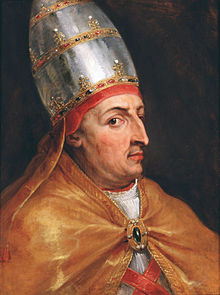
To support the Portuguese expansion, Pope Nicholas V issued a Papal bull on 18 June 1452 authorizing Afonso V of Portugal to conquer Saracens (Africans) and pagans and consign them to “perpetual servitude”. Successive popes reiterated the Bull: Pope Callixtus III in 1456 with Inter Pope Sixtus IV in 1481 and Pope Leo X in 1514 with precise denotations.
Pope Nicholas V
This position of the Catholic Church, accompanied by the legend of Shem in the Bible, that the noble institution disseminated without being encumbered with its real textual and theological foundation, too happy to have new territories of crusades, of evangelization, would be authority sweeping the reluctance herding slave traders and neophyte traders.
The position of the Catholic Church in relation to the slave trade was not going to be an epiphenomenon, far from it, its encouragements to enslavement would continue throughout the Negro period, like doctrinaire activism of the eminent French theologian Bellon de Saint Quentin, who used the “Holy Scriptures” to free the conscience of those who relied on his science.
All sorts of means will be used to dehumanize races, as a matter of policy to seek to assimilate cultures, for example, US and Canada, established boarding schools, prevented native language speaking, and separated children from their parents to put them in foster homes.
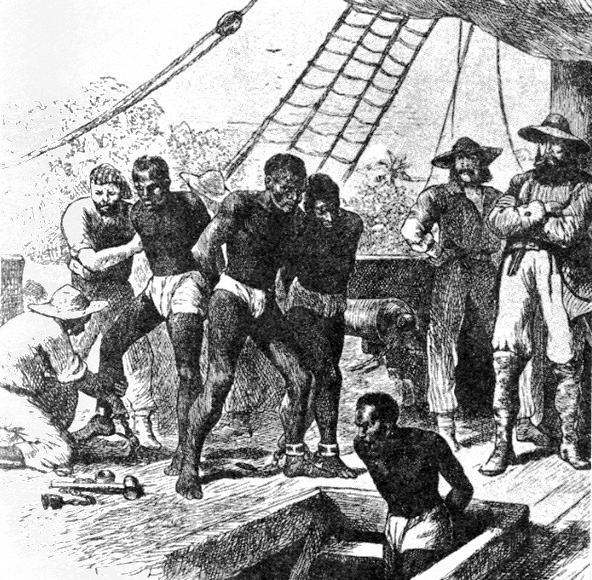
Slaves on board a ship
“People went as far as exhibiting Africans in Zoos”
Human zoos
Paris, the capital of lights celebrated 100 years of freedom, equality and fraternity in 1989 with a “Universal Exhibition”. In addition to the brand new Eiffel Tower, the main attraction offered to the 28 million visitors to the “Universal Exhibition is the “Negro village” and its 400 Africans, exhibited on the Esplanade des Invalides, in the middle of the colonial pavilions. For ten years, these indigenous villages have been present in most of the major exhibitions, and they continued to be so for much of the 20th century in Hamburg, London, Brussels, Chicago, Geneva, Barcelona, Osaka. Senegalese, Nubians, Dahomeans, Egyptians, Lapps, Amerindians, Koreans, and other so-called exotic peoples were thus presented in an environment evoking their countries, often in junk costumes and alongside wild beasts. More than 1 billion visitors rushed to these exhibitions between 1870 and 1940.
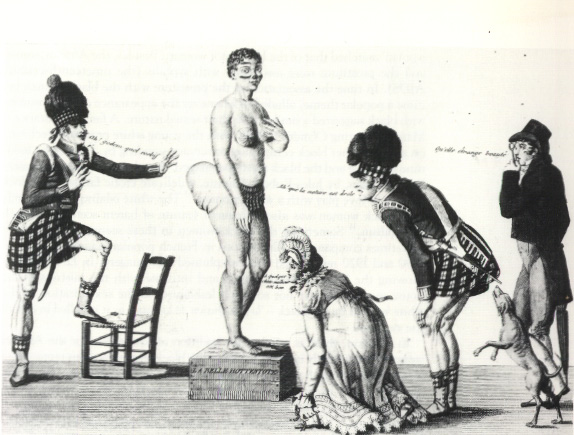
Caricature of Sarah Baartman from the 19th century
One of the most pathetic cases, of those human zoos, is that of Sarah Baartman, who was put on display around Europe as a sexual freak, paraded naked on runways by a keeper who obliged her to walk, sit or stand so that audiences could better see her protruding backside
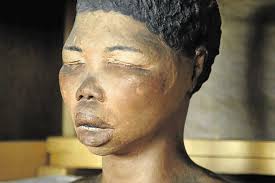
Even when she died, destitute and diseased, the ”Hottentot Venus,” as she was called, did not get a decent burial. Napoleon Bonaparte’s surgeon general made a plaster cast of her body before dissecting it. He preserved her skeleton and pickled her brain and genitals, placing them in jars displayed at Paris’s Museum of Man. Her brain, skeleton, and sexual organs remained on display in a Paris museum until 1974. Her remains weren’t repatriated and buried until 2002.
It was President Nelson Mandelawho took up the cause of trying to get the young woman’s remains a proper resting place. Nelson Mandela sought the intervention of President François Mitterrand for his help in the matter when the two men met in South Africa in 1994. It took 8 more years to finally get Sarah buried.
Exposed face of Sarah Baartman from the French Museum
For more than five centuries, the Doctrine of Discovery and the laws based upon it have legalized the theft of land, labour and resources from Indigenous Peoples across the world. This has regrettably rendered indigenous peoples to be seen as dolls (see history of Sarah Baartman) that appeared not to have made any contribution to the evolution of mankind. Research has proven that modern day medicine took roots from traditional medicines practised by indigenous people. It is the same with other domains of social science.
Addressing the root causes of systemic racism and bias
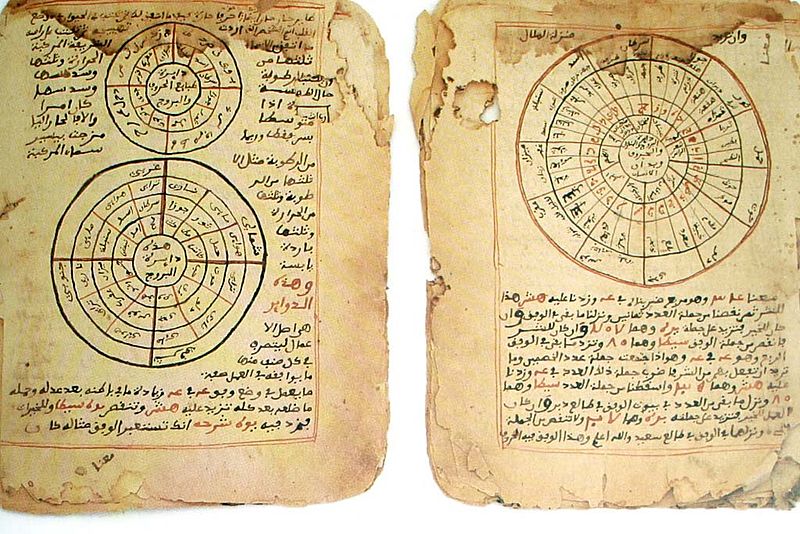
Manuscripts a Tombouctou (Mali) montrant de l’astronomie et mathematique
As a Black woman in Africa, I am living the reality that the “deep roots” of systemic racism lie in extractive capitalism on this continent. Slavery, the colonization of Africa and the economic exploitation and speculation that continues today, are driven by greed for profit which is underpinned by cheap replaceable labour and raw materials seemingly at any cost, using obnoxious cooperative accords inherited from the colonial era [The Charter of Imperialism]. Ultimately, it is greed that has led all European to the systematic and methodical devaluation of all Africans. For centuries, African peoples have been discounted and devalued as the colonizers sought to maximize profits and focused on their own needs and “happiness”. This mindset continues to drive racist attitudes today. What is amazing is that the exploitation of African resources have been going on for 500 years and the minerals are showing no signs of depletion [The Lost Libraries of Timbuktu]!!! This should have called in a big change of the system’s approach.
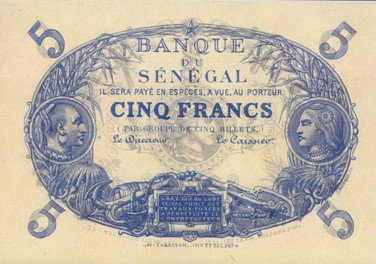
Current approaches to addressing racism have failed for the most part because they have addressed the symptoms but not the root causes of racism. We see this when we consider that while slavery and colonialism were officially abolished, the system of oppression merely transitioned into Central banks serving slave owners [The Bank of Senegal: Ancestor to the FCFA – producing Bank], but not former slaves [Reclaiming History: Britain’s Forgotten Slave Owners], and police forces serving elected officials rather than ordinary citizens. In Liberia for instance, a country populated by ‘freed’ slaves, plantations enslave the rural populace.
If we want to end systemic racism we need to get beneath the surface and understand what’s really going on, especially on an unconscious or subconscious level. And to do this, we need to go beyond campaigns, slogans and figureheads—important as these are—and re-write the real stories of each race and its contribution to humanity.
Writing the history as it happens
Black Pharaohs of Nubia
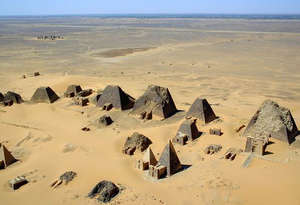
It has always been curious to me that the “black pharaohs” of Egypt – powerful Kushite leaders that ruled all of Egypt from Nubia to the Mediterranean Sea from about 760 B.C. to 650 B.C. – have been largely forgotten by history [The forgotten kingdom of Nubia]. This dynasty of leaders embarked on an ambitious building program up and down the Nile, including the construction of pyramids in modern-day Sudan [Africa’s Forbidden Pyramids: Meroe, Nubia, and Sudan], under which their kings are buried. Yet the average person – black and white alike – if you mention pyramids, they think of those in Cairo first, and are not even aware that such structures exist further down the Nile in Sudan because this southern country is mostly a Black country.
“Black people need to start telling their stories”
In confronting racial stereotypes we need to tell the story as it happens and show how the development of the world is made of interwoven efforts; that will rebuild respect. There’s a reason why the Black Lives Matter activists are targeting statues of colonial and slave oppressors – because they recognize that there is power in these stories and symbols that have kept people trapped for centuries. As David Adjaye – lead designer of the Smithsonian Museum’s National Museum for African American History and Culture in Washington DC –once wrote: “there is a direct relationship between symbols and systems and that people are starting to seek complex truths in new symbols that don’t ignore the losers or the forgotten underbelly of history”.
Pyramids of Nubia, Sudan
For many years, the narratives about Africa have been about misrule, corruption, poverty and hunger, yet it remains one of the richest continents in terms of mineral wealth and agricultural potential. This is not to discount the reality of poor governance and corruption, which I must stress out is being encouraged and promoted by developed countries within the frame work of the exploitation strategy.; Many people lose their lives each year trying to cross dangerous waters into Europe in search of a better life largely because of these factors [Francis Bebey, Fatou Diome, and Immigration]. But there are positive stories we can tell too.
“When we really know each other, their contribution to common history and see that their solutions also hold value, we may start to shift systems”
Africa needs to take the lead in telling her stories to shape a new perception. This new perception will be positively shaped if truth is told. It is not about begging to be accepted. We need to tell the stories that make visible the things we value, the beauty and the power that have been written out of history. We have a saying – “Until the lioness tells her side of the story, the tale of the hunt will always glorify the hunter.”
Driving systems change at the local level
By telling real Africa’s stories (victories and downfalls) and making Black history more visible we can start the work of unraveling the systems that hold racism and oppression in place, but this alone will not be enough. Systemic racism has also to be tackled at structural, institutional and political levels. A system that has historically devalued a whole group of people is by definition exclusionary; we need to therefore re-design systems that value inclusiveness. In this, solutions cannot be imposed from outside. Those that need change most must be involved in bringing it about.
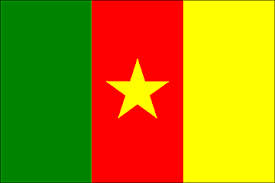
Flag of Cameroon
The COVID-19 pandemic may ironically be showing us a way here. In Cameroun working in remote areas with social entrepreneurs – lockdown measures have effectively cut us off from our usual means of trade; incomes have collapsed and we’ve been forced to create new systems to ensure that people can attend to their basic needs. This has included creating a local currency to allow people to trade during this time and setting up of new localized trade routes. While driven in this instance by necessity, there is power in this approach in that it starts with what is under the control of the beneficiaries and needed and what is valued and then builds around that.
Going forward, we can seek to apply this principle of localization more broadly. When we start to respect others and see that their solutions also hold value, we can start to shift systems. These systems are built on mutual trust.
I believe social entrepreneurs will have a central role to play in this regard by driving localized solutions, for example, creating access to affordable finance for initiatives that can improve livelihoods for future generations of Africans. In this way we can build out a new narrative for the continent and create systems that value people, and their happiness and well-being, over profits.
We are at a historic moment in the fight against systemic racism. There is a wider moral recognition that some things in our society are fundamentally wrong and a broader understanding of the need to address the root causes of these ills. We have an opportunity to uproot systemic racism and it starts with rediscovering what has been forgotten and revaluing what has been systematically devalued.
Gisele Yitamben is the Founder and President of Association pour le Soutien et l’Appui à la Femme Entrepreneur (ASAFE) a social enterprise that provides business training and development services, alternative financing and access to e-commerce to support thousands of women entrepreneurs in Cameroon as well as in Guinea, Benin, Chad and the Democratic Republic of the Congo. She can be reached on myitamben@yahoo.fr
My people, have you ever heard about The Bank of Senegal? The grandparent to the current FCFA producing banks (BCEAO, BEAC)? The bank which was created to cover the losses of slaveowners when slavery was abolished?The owner of slaves were compensated, but not the slaves who had been over-exploited. In essence, after the abolition of slavery, in French colonies, a new system of exploitation was put in place through the banking system (The 11 Components of the French Colonial Tax in Africa).
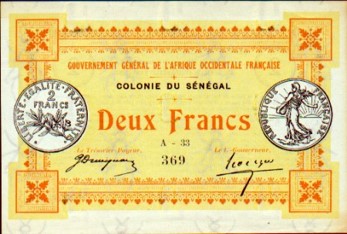
2 Francs BAO 1917
Well, the Bank of Senegal was created by Napoleon III by imperial decree on 23 December 1853. First established in Saint-Louis in Senegal. In 1867, a branch was opened in Gorée (then transferred to Dakar in 1884), then another branch in Rufisque. It was started as a public limited company with a capital of 230,000 F, approved by the Emperor established by reference to the law of April 30, 1849, to settle the problem of compensation granted to slaveholders following the abolition of slavery (Décret d’abolition de l’esclavage du 27 avril 1848).
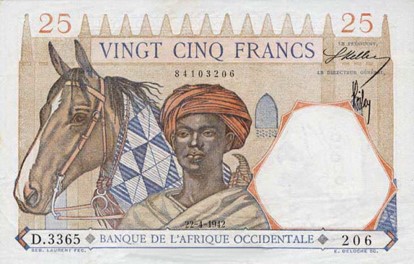
25 Francs BAO – 1938
The Bank of Senegal was created to finance the campaigns of the traders in the purchase of tropical products and the sale of manufactured products. The distribution of capital in this new bank depended on the number of slaves owned or sold. The owner of slaves were compensated, but not the slaves who had been over-exploited. This Private bank had the power to issue bearer, banknotes. In 1901, the bank evolved and became the Bank of West Africa whose shareholders were the Bordeaux houses (60%) (The Maurel house, Teisseire and Beynis), the CNEP (20%), the Marseillais (20%) (Charles Bohn).
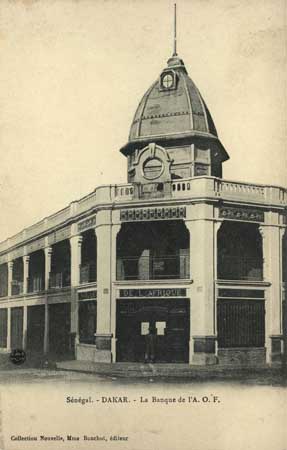
B.A.O. Building in Dakar, Senegal, 1904
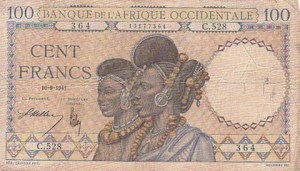
In 1901, the Bank of Senegal became La Banque de l’Afrique Occidentale (Bank of West Africa), B.A.O. . In 1929, its emission privilege was expanded and extended to French Equatorial Africa, Cameroon and Togo. The system put in place would help build multinational plantations for international market. As you see, there were no opportunity to access finance for local entrepreneurs. On April 14, 1959, the Central Bank of the Equatorial African States and Cameroon BEAC and the Central Bank of the West African States BCEAO were created. Although they are called Central Banks, they do not play the role of a central bank which is that of implementing monetary policies, setting official interest rate used to manage both inflation and the country’s exchange rate and controlling the nation’s entire money supply.
Let’s examine one of the most incongruous accords in humanity after the black code
100 Francs BAO 1941
It is the convention between France and 14, 15 African countries in the franc zone which stipulates that:
“The member states agree to pool their external assets in a foreign exchange reserve fund. These reserves will be subject to a deposit with the French Treasury in a current account called “operations account.”
From 1945 to 1973, these Africans exported, for example, raw materials for 100 billiondollars they deposited all the 100 billion dollars in the French treasury.
From 1973 to 2005, if they exported for $ 100 billion, these same African countries were obliged to deposit 65 billion in the French Treasury in the operations account.
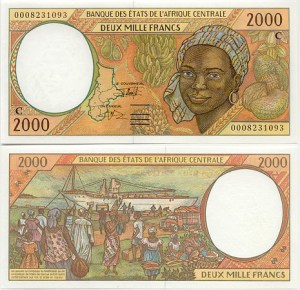
2000 Francs – BEAC 1994
Paradoxically, it is France which decides when the currency can be devalued like in 1994 when the FCFA was devalued by 50%. Since September 20, 2005, the deposit amount stands at 50% for West Africa and 60% for Central Africa. This simply means that if Africans export up to 100 billion dollars or Euros, Yuan, etc. they are obliged to deposit 50 billion in the French treasury.
For Central Africa, 60% of these dollars are purely and simply recovered by the Banque de France, while only 40% go down into the treasury of the African countries
France claims that she is retaining this money to guarantee the fixed exchange rate 1 € = 655 FCFA. This is purely an economic nonsense. First we are told that the rate is fixed, and then we learn that in reality it is not because of market forces that no one can control.
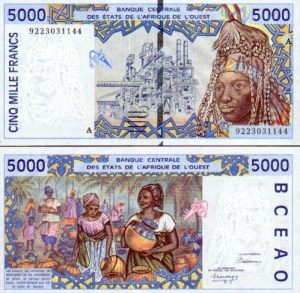
5000 Francs – BCEAO
As major consequences, when African countries of the Franc zone export their raw materials to France, let’s say for example 100 million euros, France does not pay a single dime. All she does is mark a plus on the country’s name in the Operation Account better known in French as the “Compte d’opération” in the French treasury. But if it is Nigeria or Ghana that export to France, De Gaulle’s country, will be obliged to take 100 million euros from the Operation Account to pay them.
All this to say, that we, Africans, need to break these chains of economic slavery that have been on our necks for the past 167 years. We need to free ourselves, and not expect France to free us. As Thomas Sankara said in his 1984 speech at the UN, “the slave who is not capable of assuming his rebellion does not deserve that we feel sorry for him. This slave will respond only to his misfortune if he is deluding himself about the suspect condescension of a master who claims to free him. Only struggle liberates [«… l’esclave qui n’est pas capable d’assumer sa révolte ne mérite pas que l’on s’apitoie sur son sort. Cet esclave répondra seul de son malheur s’il se fait des illusions sur la condescendance suspecte d’un maître qui prétend l’affranchir. Seule la lutte libère … »]…!” AFRICA MUST UNITE and FREE ITSELF!!!
After the Zimbabwean government agreed to compensate the White farmers the hefty sum of $3.5 bn last month (Is Zimbabwe the New Haiti?) when they have no money in their coffers, it was only a short step to agreeing to return seized land to foreigners. Excerpts below are from an article on the BBC website. Again why are the people, who will be forced to pay for all this, not consulted?
=====
Zimbabwe has offered to return land to foreign nationals whose farms were seized under a controversial government programme two decades ago. Thousands of white farmers were forced from their land, often violently, between 2000 and 2001. The seizures were meant to redress colonial-era land grabs but contributed to the country’s economic decline and ruined relations with the West [caused by foreign economic sanctions and embargo]. A separate compensation scheme has been launched for local white farmers. They have not been offered land, but the government last month promised them $3.5bn (£2.6bn) for seized infrastructure[Is Zimbabwe the New Haiti?]. The US has said compensating farmers is one of the requirements for it to lift decades of economic sanctions.
Zimbabwe on Monday said foreign citizens who had their land seized could now apply to get it back. Hundreds of Europeans – mostly Dutch, British and German nationals – whose investments were protected under international agreements could benefit from the offer [if their investments were protected, why do they need compensation now?], reports the BBC’s Shingai Nyoka from the capital, Harare. …
In a joint statement on Monday, the ministers of finance and agriculture said some black farmers who received land under the programme would now be moved [to where?]. To allow the former owners “to regain possession” of their land, the government will revoke offers made to black farmers [will they also be compensated like the white farmers?]currently occupying the farms and “offer them alternative land elsewhere” [really? – I don’t trust this sneaky government- with the West they have binding agreements, but with the locals… nothing ], the statement said. …
Yes… I know this is another news that is just outrageous! What about the breaking of the country into two: Sudan and South Sudan… Some of it had been supported or helped by the US and foreign forces… so is there compensation for that? Excerpts below are from an article on the Guardian’s website. All of this makes my blood boil! And weird how all these funky deals are taking place right now in these uncertain times during lockdown. Is it because African economies have been hit by the pandemic, thus are vulnerable, and so the leadership is ready to make blood-boiling deals like these? It’s like the elders made a mistake (by the way, which one?) and the kids are paying for it…. yet, when we talk about compensation from genocide perpetrated on our parents and grandparents, nobody wants to hear! Lastly, why are these deals made without consulting the people?
=====
A US proposal to remove Sudan from a list of states that sponsor terrorism – in exchange for a $330 million payment compensation to American victims of al-Qaida – has caused anger in the poverty-stricken east African country.
Mike Pompeo, the US secretary of state, visited Khartoum on Tuesday to underline US support for the new transitional government that took power following the fall ofOmar al-Bashirlast year, whose 30 year authoritarian rule saw Sudan become an international pariah.
… The US has moved to incrementallyrestore relations with Sudanover recent years but has insisted that outstanding legal claims are settled before the country is struck from the list of state sponsors of terrorism. …
Sudan has been on the list since 1993, and so faces a range of damaging measures including the denial of much needed financial aid from international multilateral institutions.
The double bombing ofembassies in Tanzania and Kenya in 1998 was the work of al-Qaida, then run by Osama bin Laden from Afghanistan. More than 224 people died and 4,000 were injured in the bombings.
Courts in the US have found Sudan guilty of providing essential support to al-Qaida when Bin Laden was based in the country between 1991 and 1996.
But ministers, opposition leaders and ordinary people in the country have expressed their dismay at the prospect of a multimillion-dollar payment to the US. Some complained that it was unfair that the new reformist government in Sudan should suffer for the misdeeds of a fallen dictator.
Activist Mohamed Babiker, 32, accused the US of intensifying Sudan’s problems: “We opposed the regime and overthrew it. Now we have to pay for what it did wrong,” he said.
Shamael el-Noor, a participant in the mass protests that led to Bashir’s ousting, said that the US should have immediately removed Sudan’s name from the list of countries supporting terror once Bashir was gone.
“The terrorism was linked to the former regime’s ideology … It’s unfair to keep Sudan on that list while people revolted against the terrorism of that regime,” El-Noor said.
Others contested the basis for the compensation claim, saying that Sudan had sought to cooperate with the US by expelling Bin Laden and that the attacks had occurred two years after the Saudi-born extremist had left their country.
Google Doodle of 28 August 2020 commemorating Alexandre Dumas (Source: Google)
Today I am happily surprised by the Google Doodle of the day which commemorates the French writer Alexandre Dumas, the author of The Three Musketeers and The Count of Monte Cristo, to name just a few of his works. In the Doodle he is clearly depicted as a Black man! Why does it matter? Do you know how long it has taken for him to be recognized as so? Do you know that it took over 100 years for Alexandre Dumas, the most read French writer to be buried at the Pantheon? just because of the color of his skin! It is only in 2002 that, then French president Jacques Chirac had Dumas’ body exhumed and then enterred at the pantheon! The most prolific French writer of all times!
Please check out the article I wrote about this great man a few years ago:
The guts of these people sometimes! How can Germany after killing, and exterminating the Herero and San people of Namibia, thus perpetrating the First Genocide of the 20th Century, dare offer 10 million Euros for compensation to the Namibian government? Such an insult! Germany must really think that Namibians, Africans, are nobodies, below sub-humans… because it is quite unbelievable! They have almost eradicated an entire race, and to this day, Namibia is struggling because of this. And they give 10 million Euros? 10 millions Euros for torturing, killing, raping, destroying, displacing for years? Do you think they could have dared to make such an offer if the Namibians were Jews? This money is not even what they give as compensations to victims (and sometimes only one) during lawsuits against big companies. I clap for the Namibian government, and hope that they stand their ground; the rest of Africa is watching them! Excerpts below are from an article on the Guardian.
====
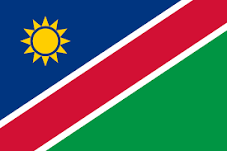
Flag of Namibia
Namibia has rejected a German offer of compensation for the mass murder of tens of thousands of indigenous people more than a century ago.
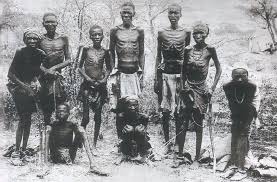
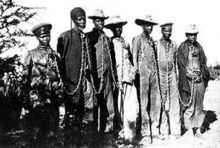
German occupiers in Namibia almost destroyed the Herero and Nama peoples between 1904 and 1908 as they consolidated their rule in the new colony in south-west Africa. Some historians have described the bloodshed as the first genocide of the 20th century.
The two countries have been discussing an agreement on an official apology from Germany and an increase in development aid, but the talks appear now to be running out of momentum.
Namibia’s president, Hage Geingob, said on Tuesday that the most recent offer “for reparations made by the German government … is not acceptable” and needed to be “revised”.
Chained (by German forces) Herero men
No details were provided on Berlin’s proposal, but unconfirmedmedia reportshave referred to a sum of €10m.
…. Other countries in Africa are watching the negotiations between Namibia and Germany closely as they consider launching their own efforts to gain compensation for the violence and theft of decades of European rule.
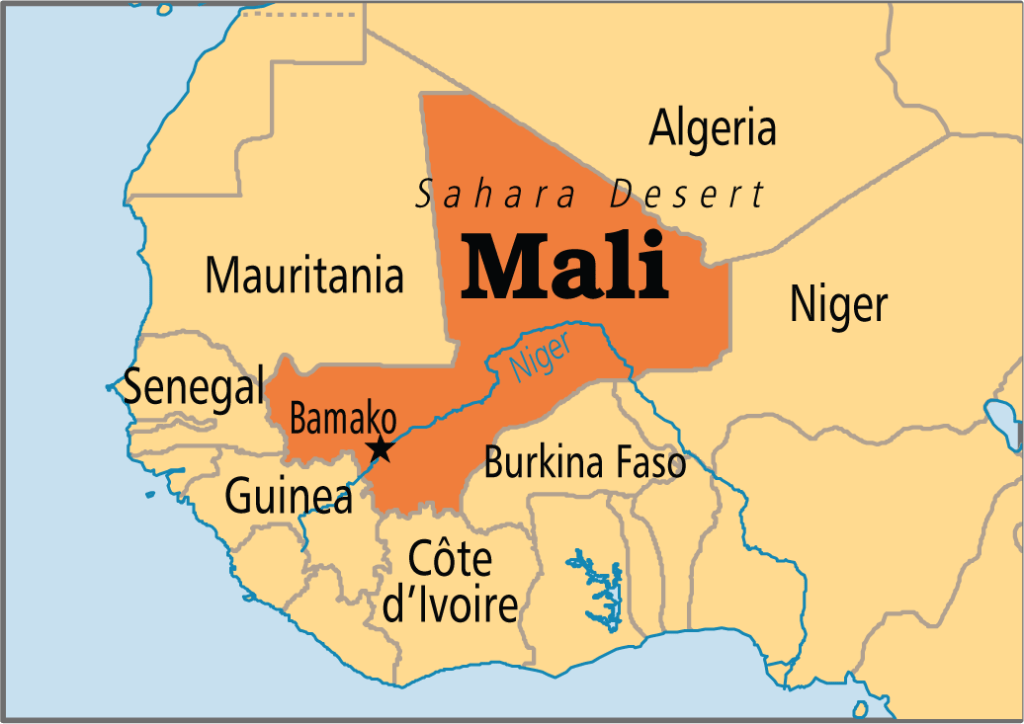
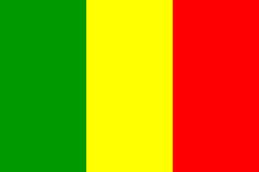
Ibrahim Boubacar Keita, affectionately known as IBK, has been booted out of office on Tuesday of this week. The prime minister and the president (IBK) were taken from the office and held by the military. It has been months that the population of Mali was asking for him to leave because, as a puppet of France, he was not doing anything to help the situation of Malians, and nothing while the country was getting split into two by jihadjist forces funded by the West, and foreign forces on Malian soil, and the poverty. We salute the work of the Malian army which heard the cry of the population, and ousted the impostor.
Flag of Mali
The opposition coalition has called for a rally today, Friday, to celebrate IBK’s departure. Meanwhile, France (the puppet master) and its croonies (the international community) have been screaming against the departure of their puppet. The Malian people need to be extra vigilant that their movement and freedom is not hijacked yet again by France to place another version of IBK. A luta continua e la vitoria e certa!
Did you guys hear about the government of Zimbabwe agreeing to compensate white farmers the hefty sum of 3.5 billion dollars? I was shocked! When there is barely any money in the country, and the economy is in shambles, how can the government agree to this? Moreover, did these white farmers ever compensate the Africans after independence in 1980 for using their lands for a century, for abusing them off their lands? And for all the years of economic embargo forced on the country? Lastly, the clause is set so that the country will be paying this debt forever… 12 months to raise half of the money when the country is on life support? This is so disgusting, Robert Mugabe must be rolling in his grave!
Flag of Haiti
So my question is, is Zimbabwe the new Haiti? Remember how Haiti was made to pay France for over a century because of their freedom (When France extorted Haiti, the greatest heist in history)? Because the past slaves had beaten the masters, they were forced to pay France for over a century the hefty sum of 90 million goldfrancs (equivalent to 21 billion U.S. dollars in today’s money – when Jean-Bertrand Aristide requested reparations, he was ousted) after winning its freedom from France…? And this is why Haiti is so poor! Imagine this: Someone abuses you for years, not to say decades and generations, you finally free yourself, and now you are forced to compensate them because you freed yourself through a ruthless battle from their years of inhumanity. How fair is that? We must be living in a different type of world, because I just don’t understand the logic! Now, it would seem to be Zimbabwe’s turn?
I have always been skeptical of Mnangagwa… but now it has been fully confirmed! When I see this, I wonder why Africa’s leadership is so full of traitors, collabos, and haters of their own people! This will be the topic for another day. Excerpts below are from the CNN article of July 29, 2020.
======
Zimbabwe’s government signed an agreement Wednesday worth $3.5 billion to compensate white farmers who were evicted from their land during a controversial and often violent land redistribution program in the early 2000s under former President Robert Mugabe.
“This momentous occasion is historic in many respects, brings both closure and a new beginning in the history of the land discourse in our country Zimbabwe,” said current President Emmerson Mnangagwa, after signing the agreement at State House with Andrew Pascoe, the president of the Commercial Farmers Union of Zimbabwe….
According to the agreement, 50 percent of the $3.5 billion would be paid with 12 months from the day of signing, while the balance is paid within five years.
Economists agree that the Zimbabwean government, cash strapped after years of hyper-inflation and allegations of mismanagement [and economic embargo imposed by Western powers], cannot afford to make the compensation.
In a statement, the Finance Ministry said that they will be issuing long term bonds and that the parties will approach international donors to try and raise the funds.
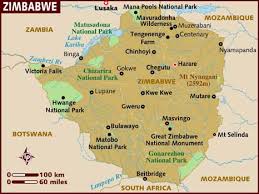
I always loved the sound of the name Bulawayo, the second largest city in Zimbabwe, after the capital Harare, and the largest city in the country’s province of Matabeleland. BU-LA-WA-YO… Doesn’t it roll on your tongue? Doesn’t it sound like thunder ? … like something big must have happened there? Well, …
Flag of Zimbabwe
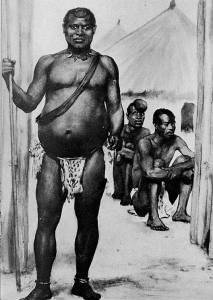
Bulawayo was founded by the Ndebele king, Lobengula, son of Mzilikazi, when he settled in Zimbabwe in the 1840s, after the Ndebele’s people great trek from northern Kwazulu, in South Africa. The name Bulawayo comes from the Ndebele word bulalawhich translates to “the one to be killed.” It is said that at the time of the city’s founding, there was a civil war due to a kingship succession dispute. The dispute was between Mbiko ka Madlenya Masuku, a trusted confident of King Mzilikazi and leader of the Zwangendaba regiment, and Prince Lobengula who he (Mbiko Masuku) thought was not a legitimate heir because Lobengula was the son of the king born to a Swazi mother, of a lesser rank.
King Lobengula of Matabeleland
At the time Lobengula, was a prince fighting to ascend the throne of his father Mzilikazi. It was common at the time for people to refer to Bulawayo as “KoBulawayo UmntwaneNkosi“, “a place where they are fighting or rising against the prince” or the “the place where the prince shall be slain“. The city of Bulawayo coincidentally has the same name as the capital of the great Zulu warrior king Shaka ka Senzangakhona in Kwazulu, where Mzilikazi and his Khumalo clan and other Nguni people came from.
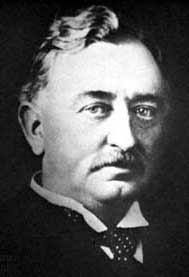
In the 1860s, the city was highly coveted by Europeans, because of its land, wealth, and strategic location. Cecil Rhodes tried different tactics to trick King Lobengula. Lobengula once described Britain as a chameleon and himself as the fly. The fact that Lobengula was a force to reckon with is not to be ignored. Cecil Rhodes himself confided to Rothschild saying, “I have always been afraid of the difficulty of dealing with the Matabele King. He is the only block to central Africa, as, once we have his territory, the rest is easy … the rest is simply a village system with separate headmen …” So trickery was the only resort for Rhodes in order to get Lobengula. Thus, the treacherous Rudd Concession – 30 October 1888 (British Colonial Treaties in Africa: The Ruud Concession in Zimbabwe 30 Oct 1888).
Cecil Rhodes
During the 1893 Matabele War, British South Africa Company (BSAC) troops invaded and forced King Lobengula to evacuate, after first detonating munitions and setting fire to the town. BSAC troops and white settlers occupied the ruins. On 4 November 1893, Leander Starr Jameson declared Bulawayo a settlement under the rule of the British South Africa Company. Cecil Rhodes ordered the new settlement to be founded on the ruins of Lobengula’s royal kraal,a typical action by a conquering power. This is where the State House stands today.
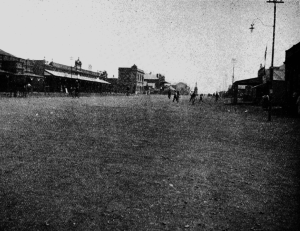
The principal street of Bulawayo in 1905
Historically Bulawayo has been the principal industrial centre of Zimbabwe (former Southern Rhodesia – after Cecil Rhodes); its factories produce cars and car products, building materials, electronic products, textiles, furniture, and food products. Bulawayo is also the hub of Zimbabwe’s rail network and the headquarters of the National Railways of Zimbabwe. Thus its nickname: “City of Kings” and also “kontuthu ziyathunqa” – meaning “smoke arising” in Ndebele, because of its large industrial base, and the large cooling towers of its coal-powered electricity generating plant situated in the city center which once used to exhaust steam and smoke. Today, as the rest of Zimbabwe, it slowly pushes through the steam.
Well, if you visit the city of Kings, remember King Lobengula, remember his fire, and his fight for his people’s freedom from western domination… remember the greatness of the Ndebele king, and remember the fire that burns dormant in the people of Bulawayo, fanned by their ancestors. Enjoy the video below on Bulawayo.
















 African Heritage