The Textile Industry in Kongo in the 16th Century

“Quand l’Africain était l’or noir de l’Europe” de Bwemba Bong

I came across a gem in the book of Professor Bwemba Bong, “Quand l’Africain était l’or noir de l’Europe. L’Afrique: Actrice ou Victime de la Traite des Noirs? – Démontage des mensonges et de la falsification de l’histoire de l’hydre des razzias négrières transatlantiques” (When the African was the black gold of Europe. Africa: Actress or Victim of the Slave Trade ? – Dismantling the lies and falsification of the hydra history of the transatlantic Slave Raids).” This text talks about the advanced textile industry in the Kingdom of Kongo in the 16th century. We had previously discussed the History of African Fabrics and Textiles and the falsification of history by Western media who are always trying to pretend that African textile industry started with the Dutch company Vlisco! We had also shared a description by Italian explorer Alvise Cadamosto, of clothing worn by Africans in the 15th century (Description of African Dressing in 1400s).

Nzingha's Kingdom
The Kingdom of Kongo with Queen Nzingha’s Kingdom in the south and east

In the 16th century, the Portuguese Filippo Pigafetta et Duarte Lopez wrote about the Kingdom of Kongo describing the economic situation of precolonial Africa, and reported that Africa had nothing to envy to Europe. Some of the fabrics described then, resemble fabrics weaved today by the Kuba people of the Democratic Republic of Congo, who use raffia and make some of the most beautiful hand-woven blankets, clothing, and sculptures. In the text, Lopez described not only the quality of the fabric, but the entire industry needed to create this type of fabric: the kind of tree used, the way the tree was pruned, and the value of the fabric. Another important point is that everyone was dressed within his/her means… thus the idea that Africans were walking naked, as we have previously seen, is another falsification of history!

Filippo Pigafetta et Duarte Lopes, Le royaume de Congo et les contrees environnantes (1591), Chandeigne/Unesco, 2002, p.112-113 (trad. Willy Bal, présentation et notes Willy Bal); Bwemba Bong, Quand l’Africain était l’or noir de l’Europe. L’Afrique: Actrice ou Victime de la Traite des Noirs?, MedouNeter 2022, p.180 (translated to English by Dr. Y, Afrolegends.com). Enjoy!

=====

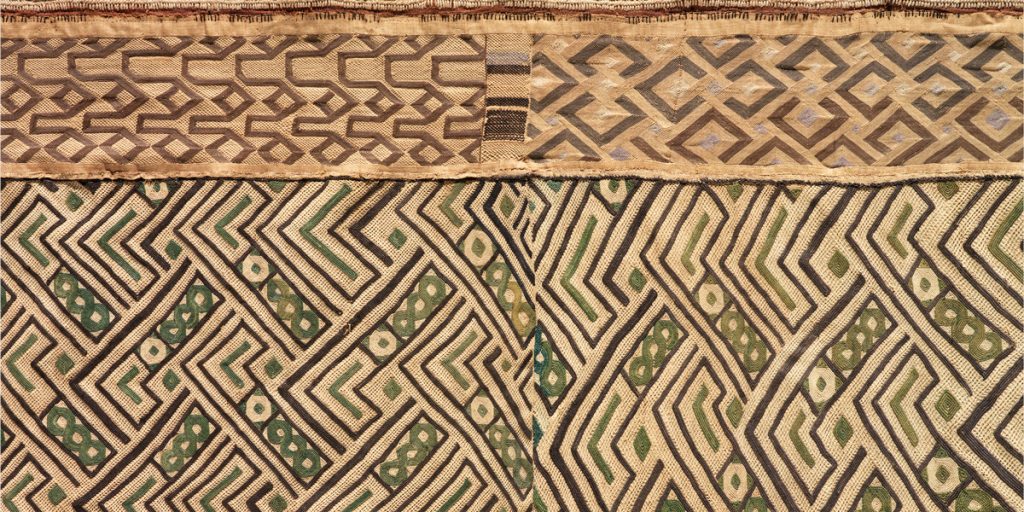
Women’s ceremonial overskirt from the 20th century, made by the Bushongo people. Image courtesy of The Textile Museum and The George Washington University Museum.

“And since we are here, I must decry the extraordinary art with which the inhabitants of this country and neighboring regions weave various kinds of fabrics, such as velvets with pile and without pile, brocades, satins, taffetas, damask, armoisins and other similar fabrics, which are certainly not made of silk, since we do not know the silkworm; if some people dress in silk, it is silk imported from our regions. But these fabrics that we have just listed are taken from the leaf of the palm tree; it is therefore necessary to keep the trees low, and to do this, prune and prune them each year, so that in the new season the leaves will grow more tender.

Le palmier de raphia
le palmier de raphia/ Raffia palm tree

After having treated these leaves in their own way, they draw threads from them, all equally fine and delicate; the longer the thread, the more it is valued because it allows larger pieces to be weaved. In different ways, they make fabrics with pile, resembling velvets, on each side, and sheets called damask with decorative patterns and varied textures, as well as brocades that are called high and those that are called low, which are worth more than our brocade. Only the king and those whom he deems good to do this favor can wear this fabric. The largest pieces are of brocade: they reach four or five palms in length, and three or four in width. The brocade is called incorimbas (named after the region where it is made, which is located around the Vumba river [in northern Congo]). Velvets have the same width: they are called enzacas, damasks are called infutas, satins are called maricas, taffetas are tangas and Anziques are the largest pieces which reach six palms in length and five in width. It is out of these fabrics that we commonly dress, each according to their means. Furthermore, they are light and very robust in water. The Portuguese began to use them as tent canvases: they wonderfully resist to water and wind.”

Africans, let us not Fall in the Trap of Democracy!

We have been reflecting on a word which has been used around the world to destabilize countries: the word “democracy.” This word has been used to impose treacherous regimes and sanctions upon “weaker” countries. By “weaker,” we basically mean those that used to be called “third-world” countries. The “global” world we are getting marched towards does not apply to all; there still needs to be some uniqueness which applies to local issues, needs, cultures, and people.

Libya, the Prey of the West

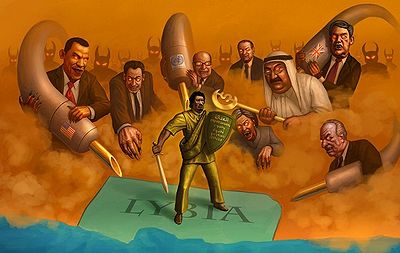
Over a decade ago, we wrote the article “Africans and the Trap of Democracy,” when NATO forces were bombing Libya. Reading it, almost every single word is still relevant today and can be applied to situations in so many countries on the African continent and beyond. Back then, we were shocked that so many Africans were applauding the actions of NATO using the word “democracy” … we hope that they can see what the destabilization of Libya has done to the rest of Africa, and that in reality the word “democracy” is used to fool Africans into hating those who actually work for Africa’s survival and its real independence. Libya under Khadafi was a prosperous country; Singapore, in Asia, under Lee Kuan Yew became one of the most successful economies in the world. There are so many dictatorships in Africa disguised under the name democracies where there are elections every few years and which are praised by the West because they serve their interests in Africa. Let us NOT fall into this trap called “democracy” in Mali, Niger, or Burkina Faso. Instead let us support our brothers of the Alliance of the Sahel (AES), and acknowledge that the continent with the first constitution in the world born in the Empire of Mali, the Kourougan Fouga, cannot learn about ways to govern itself from foreigners. The answer is within!

Enjoy! Africans and the Trap of Democracy

====

With the bombing of the presidential residence in Cote d’Ivoire by French forces for over a week, followed by the arrest of president Laurent Gbagbo, with the current intense bombing of Libya by NATO for the past 6 months, I cannot help but try to answer some of the same justifications used by Africans to approve the bombings by foreign troops on their neighbors’ countries, and ultimately on African soil. Any African who claimed and accepted that Cote d’Ivoire should be bombed by the French, shame on you! Any African who thought that the bombing of Libya was correct… shame on you! Any African who uses the same stupid phrase used by the West to abuse us: “… well Gbagbo had his day, he was in power for 10 years!… or Kadhafi was there 42 years!” Well my friend… Shame on you! Should democracy be imposed using bombs? Should democracy be imposed using warplanes, and Apache helicopters? Is it democracy to bomb the people you plan to help? Is it democracy to deliberately bomb civilian targets, hospitals, state televisions, homes, etc… to, like NATO said “protect civilians”? Was there not a peaceful solution? Was it so hard to re-count the votes in Cote d’Ivoire? Was it so hard to organize elections as Kadhafi asked? Why bomb? Why bomb? Why bomb?…

… I have not seen anywhere that the definition of democracy was “government imposed by external forces, for external forces, to crush the people of a country!” I am tired of this stupid debate the media-lies (CNN, BBC, France24, etc) always bring and which Africans always fall to: “this one is a democrat, and the other one is a dictator.” Please stop bothering people with the same rhetoric, and stop bothering people with your pseudo-democracies where nobody has the right to say anything. Frankly every other year when elections come around, don’t you ever wonder how come with all the bright politicians coming out of top schools, how come we always end up with only 2 (and somehow the worst of all)?

Burkina Faso’s Transition Government Gets a 5-year Confidence Vote by the People

Flag of Burkina Faso

Last Saturday, the people of Burkina Faso came out in a resounding form, via Civil society representatives, security and defence forces and lawmakers in a transitional assembly to approve a new charter which extends the transition government of Ibrahim Traoré, by 60 months starting on July 2, 2024. Thus, at the end of the 2-day national dialogue, Ibrahim Traoré has been given a vote of confidence for 5 more years, at the end of which he can also run for president when the elections take place. This charter also states that elections marking the end of the transition may be organized before this deadline if the security situation permits. As one can see, in a country which has been under attack by jihadist terrorists and whose territory is divided, security and territorial integrity is of utmost importance. [France to Withdraw Troops from Burkina FasoMali, Burkina Faso, and Niger Sign a Mutual Defence PactMali, Burkina Faso, and Niger all leave the ECOWASMali and Niger end Long-Standing Tax Treaties with France].

Now, Western media cry about democracy, and are calling this national dialogue consultation by the people of Burkina Faso, a slide away from democracy, yet they did not see a problem with Ukraine not holding elections given that it is currently a country at war.

Excerpts below are from Jurist News.

=====

Ibrahim Traore lays the foundation for the Thomas Sankara Mausoleum (Source: LeFaso.net)

Burkina Faso’s acting president Captain Ibrahim Traoré, who seized power following a 2022 coup, signed a new amended Transition Charter Saturday that extends the transition period to five years. The original charter called for the transition period to end in July 2024.

Article 22 of the new Transition Charter states that the duration of the transition is set at sixty months starting from July 2, 2024. The provision also states that elections marking the end of the transition may be organized before this deadline if the security situation permits. …

The amended Transition Charter in Burkina Faso also includes several new provisions. For instance, according to Article 5, Captain Traoré now holds the titles of President of Faso, Head of State, and Supreme Commander of the Armed Forces. Additionally, Traoré, along with the Prime Minister and the President of the Transitional Legislative Assembly, will be eligible to run in the presidential, legislative, and municipal elections organized to mark the end of the transition period.

Burkina Faso
Burkina Faso

An alarming pattern [alarming to the West] has emerged across West Africa where military forces have overthrown democratically-elected governments [more like puppet governments of the West], accusing them of breaking promises made to citizens. Burkina Faso has been caught up in this trend. In September 2022, the current military junta took power by ousting the previous military regime under Lt. Col. Paul Henri Sandaogo Damiba, which had itself seized control just eight months prior through a coup that removed President Roch Marc Kaboré from his elected position. Following the latest coup, Captain Traoré was appointed as the transitional president. …

The Vultures are Getting Ready

French flag

Today, we will introduce a new word: “Vulturing”! It is a word we thought of after the events of recent months, and let’s face it because of the New Scramble for Africa. The vultures are at it again, and honestly never stopped. About a month ago, on April 14 2024, a former Chief of Staff of the French army, General Francois Lecointre, announced in an interview to Le Figaro, that France and Europe, for their survival would have to proceed in an armed recolonization of Africa in the upcoming 10 years. To paraphrase, he said, “we cannot let these poor Africans live in chaos just on our doorstep… within a few years, Africans will have a population boom like no other continent [why do Africans having babies, bother them so much?] … Europe should act as a political entity that defends its own interests, including through military commitment… We must return and help these African countries [nobody asked for your help].”

The New Scramble for Africa (Source: Source: Dr Jack & Curtis for City Press, National Institute African Studies (NIAS))

Would we not call it “vulturing”? Why can’t the predator leave the prey? Do you know that France is 4th producer of gold, even though there are no gold mines in France, and the gold comes from Mali? Do you know that because of Niger’s coup, now France cannot have easy access to free uranium as in the past? Now that the AES, Mali – Burkina Faso – Niger, is no longer a part of the French zone of influence (Mali, Burkina Faso, and Niger all leave the ECOWASMali, Burkina Faso, and Niger Sign a Mutual Defence Pact), there has been a lot of shortfall that can be felt in France. For the French military bases that have been removed from Mali, Burkina Faso, and Niger… where would those French troops go? If they go back to France, there might be a government topple, then why not send them to another place at war, in Eastern Europe for instance, or try wars in Africa? It is no secret, that since Niger has asked for the Americans to remove their drone base (one of the world’s largest drone bases) from its soil, the Americans have been making deals to move troops and bases to neighboring countries surrounding the AES.

This is a WAKE UP call to Africans to unite and fight! It is not just for French speaking countries in Africa, but to all of Africa. Africa is the key to the world! There will be blood for Africa’s resources, and Africans have to be at the forefront of the battle for their own resources and take hold of what is theirs. Africans better wake up, the vultures are flying over!

Watch the interview of the General Lecointre to Le Figaro, and read a quick summary on APA News.

Thousands take part in Annual re-plastering of the Great Mosque of Djenné in Mali

Great Mosque of Djenné

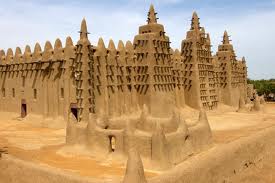
I love the togetherness that is embodied by Malians who live in the city of Djenné, who, every year come together to re-plaster the walls of the Great Mosque of Djenné, the largest mud-brick building in the world. This past Sunday, the whole town, young and old, men and women, poor and rich, worked together to preserve this centuries-old gift from their ancestors that is the Great Mosque of Djenné. This is a tradition passed on from generations to generations for centuries: men and boys are responsible for climbing the mosque and putting the new layer of mud on it, while women and girls are responsible for fetching water from the nearby river to mix with clay to make more of the mud needed for the walls. It is a great exercise in unity and peace for the preservation of an heritage that is dear to all. Since 2016, the Great Mosque of Djenné has been added to the UNESCO’s World Heritage Danger list, because of the jihadists’ attacks in northern Mali that have divided the country (Mali Forces Succeed in Kidal where France and Allies could not!At the United Nations, Outstanding Speech by Mali PM who Slams France, Praises Russia TiesMali, Burkina Faso, and Niger all leave the ECOWAS“Le Mali en miettes. A qui le tour?” de Chems Eddine Chitour)..

Please read below the article I wrote a few years back about the city of Djenné, and for this past Sunday’s re-plastering event, check out Africanews.

=====

Djenné
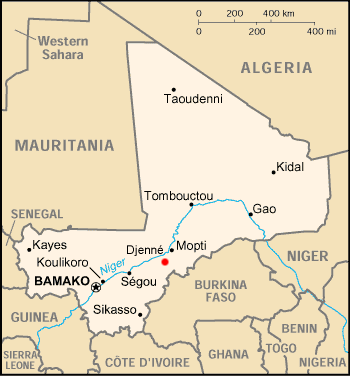
Map of Mali with Djenne in red

Djenné is a city of Mali whose history is closely linked to that of Timbuktu. It is well-renowned for its mud brick architecture, and today most of the city is considered a UNESCO World Heritage Site. In no place in the world do you have a civilization entirely built on mud! Maybe that is why Malians are so renowned for their work on mudcloth a.k.a. bogolan! The Djennenké say that nowhere in the world would you find people who can build in mud like Djenné’s masons: their work with mud is pure magic, as illustrated by the beautiful Great Mosque of Djenné. The masons’ family lines stretch back half a millenium! They mix the clay from the surrounding plains with the water from the Bani river, and bring to life an architecture purely from Djenné rising with splendor.

Djenné: the mud brick (adobe) city

Coincidence or Not? Coltan-rich Town Captured

Flag of the Democratic Republic of Congo

As the silent genocide in the east of the Democratic Republic of Congo (DRC) continues, under the complicit eyes of the “international” community, last Friday, the town with the one of the biggest coltan reservoirs in the world, Rubaya, … was captured by the M23 rebels. What is coltan? For those who just discover it, coltan is a dull black metal from which niobium and tantalum are extracted. Thus, the name coltan comes from col in columbite (the niobium-dominant mineral) and tan in tantalite(the tantalum-dominant mineral). It is the material at the heart of the mobile phone boom, and is found everywhere in the computer, automotive, and electronics industries. It has been classified by the US Defense department since World War 2 as a material key to the nation’s security.

Democratic Republic of Congo (DRC) mineral map (Source: Atlas du continent africain, Jeune Afrique et editions Jaguar, 2000)

It is no secret that the M23 rebels are backed by neighboring Rwanda, who is in turn supported by … . Why DRC one may ask? As discussed earlier, Congo is a geological scandal, a country rich with some of the most important minerals on earth.  When much of eastern Congo came under the control of Rwandan forces in the 1990s, Rwanda suddenly became a major exporter of coltan and many other minerals (a Rwandan I spoke to admitted, minerals Rwanda never thought possible are being “discovered” every day on “their soil”), benefiting from the turmoil and weakness of the Congolese government. According to a UN report, the soaring price and interest in coltan has “brought in as much as $20 million a month to rebel groups” and other factions trading coltan mined in northeastern DRC. Lastly, the government of DRC (The Democratic Republic of Congo Accuses Apple) recently threatened many big companies, including Apple, of illegally obtaining minerals including coltan, and therefore of supporting rebels group. Is it then a surprise that Rubaya was captured last Friday? 

Excerpts below are from the BBC. To learn more, please read article on Africanews, and The East African.

=====

A town at the heart of mining coltan, a key ingredient in making mobile phones, has been seized in eastern Democratic Republic of Congo by rebel forces, their spokesman has said.

Rubaya fell into the hands of M23 fighters on Tuesday following heavy clashes with government troops, Willy Ngoma [M23 spokesperson] said. 

The government has not yet commented, but a civil society activist confirmed that M23 had captured the strategic town.

It happened on the day France’s President Emmanuel Macron called on neighbouring Rwanda to “halt its support” for the M23 rebel group.

Mr Macron made his comments after holding talks with DR Congo’s President Félix Tshisekedi in France’s capital, Paris.

Rwanda has repeatedly denied backing the rebels, who have captured much territory in the mineral-rich east during fighting over the past 18 months.

DR Congo is the world’s second-biggest producer of coltan, with most of it coming from the mines around Rubaya in the Masisi district.

Coltan is used to make batteries for electric vehicles and mobile phones.

DR Congo’s government accuses Rwanda of backing the rebels to steal its mineral wealth, an allegation the government in Kigali denies.

….

The Democratic Republic of Congo Accuses Apple

Flag of the Democratic Republic of Congo

Early this week, we shared the “Einstein Letter” signed by the Nobel Prize of Physics Albert Einstein and  addressed to the President of the United States F. Roosevelt talking about Uranium and its place in the energetic plan of the United States. It also highlighted the important place of the Democratic Republic of Congo (DRC) in this plan, today more than ever, given that the DRC is what many call a “geological scandal”, as first termed by Belgian geologist Jules Cornet in 1892, with all its minerals, some of which can only be found there.

Democratic Republic of Congo (DRC) mineral map (Source: Atlas du continent africain, Jeune Afrique et editions Jaguar, 2000)

Last week, DRC’s president and its government threatened the technology giant Apple with a lawsuit, over “blood” minerals, illegally exploited. There is currently a real genocide in the DRC which has been ongoing for the past 30 years and which has claimed over 10 million lives; however it is a silent genocide given that the “international community” is complicit and has turned a blind eye. As the DRC government sends this out to Apple, where are the other tech giants? Where is Tesla, as we know that Tesla’s batteries cannot work without minerals from the DRC? Where are all the other companies/ multinationals?

Enjoy excerpts below from CBS News.

=====

The government of the Democratic Republic of Congo has threatened U.S. tech giant Apple with legal action over what it says are “illegally exploited” minerals from the impoverished nation in its products. U.S. and French lawyers representing the DRC’s government sent a letter to Apple on April 22 warning the company it could face legal action if it continues with the alleged practice.

The letter accuses Apple of purchasing minerals smuggled out of the DRC into Rwanda [we all know that Rwanda has zero minerals… the minerals reported of Rwandan origin are all pillaged from neighboring DRC], where their origin is allegedly obscured so they can find their way into the global technology supply chain. It makes clear that the DRC government intends to address the matter and is looking into legal options to do so.

The letter sent by the lawyers to Apple CEO Tim Cook includes a list of questions laying out the DRC’s concerns over alleged “blood minerals” in Apple’s supply chain, and it demands answers within three weeks. Similar letters, seen by CBS News, were also sent to two of Apple’s subsidiaries in France, demanding answers in the same timeframe.

Apple has affirmed that it verifies the origins of minerals it uses to manufacture its products,” the letter notes. “It says that the tin, tungsten, tantalum — the 3Ts — and gold that its suppliers purchase are conflict free and do not finance war. But those claims do not appear to be based on concrete, verifiable evidence.”

Amsterdam & Partners, the law firm representing the DRC government, has written a 53-page report outlining the claims against Apple, entitled “Blood Minerals: Everyone sees the massacres in Eastern Congo, but everyone is silent. The laundering of DRC’s 3T Minerals by Rwanda and by private entities.

In their letter to Apple, the lawyers said that in the process of preparing their report, “it has become clear to us that year after year, Apple has sold technology made with minerals sourced from a region whose population is being devastated by grave violations of human rights. The iPhones, Mac computers and accessories that Apple sells to its customers around the world rely on supply chains that are too opaque, and that are tainted by the blood of the Congolese people.”

When Einstein Wrote to the US President about Congo for its Uranium

Albert Einstein in 1947

In 1939, Nobel prize winner of physics Albert Einstein signed a letter written in conjunction with Hungarian physicist Leo Szilard, which was then sent to the President of the United States Franklin D. Roosevelt, in which he noted the importance of uranium, and warned of the possibility that Nazi Germany might develop a nuclear bomb. In the letter, countries where uranium ore was found in abundance were cited, among which was then Belgian Congo.

It is no secret that the uranium used in the bombs that were dropped on Hiroshima and Nagasaki came from the Democratic Republic of Congo, then Belgian Congo.

The document became known as the “Einsten letter” which marked the beginning of the atomic age, and also launched the race for the uranium of Congo, and later for other Congolese minerals that were found to be important for the energetic needs of the United States.

Democratic Republic of Congo (DRC) mineral map (Source: Atlas du continent africain, Jeune Afrique et editions Jaguar, 2000)

A top-secret American Intelligence report published in November 1943 mentioned the Congolese uranium: “The most important deposit of uranium yet discovered in the world is in the Shinkolobwe Mine in the Belgian Congo.”

The Congo’s “known resources of uranium, which are the world’s largest,” the report concluded, “are vital to the welfare of the United States. Definite steps should be taken to insure access to the resources for the United States.”

After the “independence” of the Belgian Congo, the new Prime Minister Patrice Emery Lumumba made it clear that he would not give the U.S. the same freedom to control Congo’s uranium as had Belgium. On July 11, 1960, the Katanga province where the Shinkolobwe mine (which produced the ore for the bombs dropped on Nagasaki and Hiroshima) was located seceded from the country.  Lumumba was assassinated on January 17, 1961. Since then, the country has spiraled in a cycle of instability, violence and war which today has claimed the lives of over 10 million people, at the heart of which is the control of the minerals of Congo.

As we now know the place that uranium holds in the energetic needs of many countries, what do you think of the place of Niger? and then of other African countries rich in key minerals? Will the predator leave the prey?

Read more at Atomic Archive.

=====

Einstein’s Letter to President Roosevelt – 1939

Albert Einstein
Old Grove Road
Peconic, Long Island
August 2nd, 1939

F.D. Roosevelt
President of the United States
White House
Washington, D.C.

Sir:

Some recent work by E. Fermi and L. Szilard, which has been communicated to me in manuscript, leads me to expect that the element uranium may be turned into a new and important source of energy in the immediate future. Certain aspects of the situation which has arisen seem to call for watchfulness and if necessary, quick action on the part of the Administration. I believe therefore that it is my duty to bring to your attention the following facts and recommendations.

In the course of the last four months it has been made probable through the work of Joliot in France as well as Fermi and Szilard in America–that it may be possible to set up a nuclear chain reaction in a large mass of uranium, by which vast amounts of power and large quantities of new radium-like elements would be generated. Now it appears almost certain that this could be achieved in the immediate future.

This new phenomenon would also lead to the construction of bombs, and it is conceivable–though much less certain–that extremely powerful bombs of this type may thus be constructed. A single bomb of this type, carried by boat and exploded in a port, might very well destroy the whole port together with some of the surrounding territory. However, such bombs might very well prove too heavy for transportation by air.

The United States has only very poor ores of uranium in moderate quantities. There is some good ore in Canada and former Czechoslovakia, while the most important source of uranium is in the Belgian Congo.

In view of this situation you may think it desirable to have some permanent contact maintained between the Administration and the group of physicists working on chain reactions in America. One possible way of achieving this might be for you to entrust the task with a person who has your confidence and who could perhaps serve in an unofficial capacity. His task might comprise the following:

a) to approach Government Departments, keep them informed of the further development, and put forward recommendations for Government action, giving particular attention to the problem of securing a supply of uranium ore for the United States.

b) to speed up the experimental work, which is at present being carried on within the limits of the budgets of University laboratories, by providing funds, if such funds be required, through his contacts with private persons who are willing to make contributions for this cause, and perhaps also by obtaining co-operation of industrial laboratories which have necessary equipment.

I understand that Germany has actually stopped the sale of uranium from the Czechoslovakian mines which she has taken over. That she should have taken such early action might perhaps be understood on the ground that the son of the German Under-Secretary of State, von Weizsacker, is attached to the Kaiser-Wilhelm Institute in Berlin, where some of the American work on uranium is now being repeated.

Yours very truly,

SignatureAlbert Einstein

The “Einstein-Szilard letter” or the “Einstein Letter”

UK Museums “Long-term Loan” looted Asante Gold Artifacts to Ghana

The V&A is lending 17 items including an Asante gold ring (top left), a gold badge worn by the king’s “soul washer” and a ceremonial pipe (Source: V&A / BBC)

Last week, the Victoria & Albert Museum (V&A) and the British Museum “returned” some artifacts looted from the Ashanti Kingdom in modern-day Ghana, after over 150 years. When one reads the headlines in the news, one can only clap, until learning that this is a “long-term loan“! Wait! What? About 32 gold and silver items which had been stolen from the court of the Asantehene (Asante king) in the 19th century, have been sent on a long-term loan back to the Asante court. First, how long is a “long-term loan”? Second, why is it a loan, when these objects were looted from the Asantehene’s court back in the 19th century? They were not gifted, they were not sold, they were STOLEN! And to top it off, there has been a chief negotiator on the Ghanaian side to ensure that the objects will be in safe hands in Ghana! What? So, these objects do not belong to Ghanaians, and if something were to happen to these Ghanaian objects that were stolen by the British but are now hosted in British museums while on Ghanaian soil on long-term loan, then one can only bet that the British would make the Ghanaians pay for something that is theirs! Which world are we living in? Knowing the treacherous nature of these people, who is to say that they will not orchestrate a new theft of these objects so as to further deepen the debts under which Ghanaians are already crumbling? Actually, long-term in this case means 3 years, with the option of renewing for 3 years! This loan is probably not even free! Why, oh why, do we, Africans, agree to such deals?

Read for yourself… excerpts from the BBC

=====

Burning of Kumasi by British troops in 1874

The UK has returned [how can it be called return when it is a loan?] dozens of artefacts looted from what is today Ghana – more than 150 years after they were taken [i.e. stolen].

Some 32 gold and silver items have been sent on long-term loan to the country by the Victoria & Albert Museum (V&A) and the British Museum.

They were stolen from the court of the Asante king, known as the Asantehene, during 19th century conflicts between the British and powerful Asante people.

The objects are expected to be returned [loaned – see how the writer of this piece wants to create confusion in our minds?] to the current king on Friday.

His chief negotiator, Ivor Agyeman-Duah, told the BBC that the objects are currently in “safe hands” in Ghana ahead of them being formally received. They are due to go on display next month at the Manhyia Palace Museum in Kumasi, the capital of the Ashanti region, as part of celebrations to mark the silver jubilee of the current Asante King Otumfuo Osei Tutu II.

British troops ransacking Fomena Palace en route to Kumasi in 1874

Among the returned artefacts are a gold peace pipe, a sword of state and gold badges worn by officials charged with cleansing the soul of the king. The gold artefacts are the ultimate symbol of the Asante royal government and are believed to be invested with the spirits of former Asante kings.

The loan, which was negotiated with the king and not with the Ghanaian government [always the divide-and-conquer scheme – negotiate with smaller entities, so as to exert more bending power over them], will last for three years with the option to extend for a further three years. [and they have the audacity to call it “long-term”! and for what belongs to you!]… The return of the Asante items comes a month ahead of celebrations marking the silver jubilee of the Asantehene.

The Asante people built what was once one of the most powerful and formidable states in west Africa – trading in, among others, gold, textiles and enslaved people. The kingdom was famed for its military might and wealth. 

The Military Treaty at the Heart of Niger’s Breakup with the US

Flag of Niger

About a month ago, we saw the government of Niger revoke military accords with the United States, and ordering the US withdrawal of its military personnel and drone base from Niger [Niger suspends military “cooperation” with the US, effective immediately]. Among Niger’s grievances, were the non-respect of Niger, but above all was a treaty imposed upon Niger by the US to implant their largest drone base in the country.  The spokesman of Niger’s government, Colonel Amadou Abdramane, exposed the fact that the military “cooperation” with the US was not even a real one, i.e. the US had installed their largest drone base in Africa, and possibly in the world, in Niger via a verbal agreement only, and the Niger people had to pay for the American base in their country, while the Americans never raised a hand to help Niger fight against the terrorist attacks that were maiming their citizens.

We have previously discussed here, on Afrolegends.com, other treaties signed during colonial era in the Liptako, Zinder, and Gaya regions of Niger between the French and the local kingdoms (mostly under duress). We have found the above-mentioned treaty between Niger and the US, and it is only about 13-pages long, more like 10, and really reminiscent of colonial era treaties that have no respect for the local governments and impose upon them unfair rules.

Flag of the United States of America

In the July 6, 2012 treaty between the US and Niger, US citizens are subject to American laws, and the government of Niger has no power over them on Niger soil, so if for instance, an American citizen hurts or kills a Niger citizen on Niger’s soil, s/he will face no retribution about this from Niger. They do not pay taxes to the country. While reading, it is understood that this document was unilaterally and entirely written by the American side; no accord, agreement/discussion went in front of the Niger parliament. By the way, guess who was the Niger counterpart who signed this traitorous document? Mohamed Bazoum who was, back then under President Mahamadou Issoufou, Minister of Foreign Affairs… Both puppets signed the document … do you understand now why all these foreign powers have been screaming and begging for the return of Bazoum to office?

In the document, the American army makes Niger foot the bills for all American army vehicles and planes that enter the Niger’s airspace. There is no sharing of information with the Niger government who does not know the exact number of American troops on its soil, or the number of its drones, or the equipment, etc. More importantly, there is no obligation of support from the US to Niger in its fight against the terrorism that has engulfed Niger’s northern territories for several years.

In summary, someone installs a base on your territory, you have no say about it; as one of the poorest countries on earth, you have to foot the bills for his planes entering your territory; this someone is not subject to your laws, taxes, and looks the other way as you are mired in a conflict for your survival; yet this someone has installed a military force or your soil! How is this not reminiscent of colonial treaties? How fair is it? As you read this treaty, what is Niger’s gain in it? Are these treaties always outrageous like that, or is it just in Africa?

Excerpts below are from the full document found on the US Department of State website.

===== 

Map of Niger

The Embassy of the United States of America presents its compliments to the Ministry of Foreign Affairs, Cooperation, African Integration, and Nigeriens Abroad of the Republic of Niger, and has the honor to refer to recent discussions between representatives of, our two Governments regarding issues related to United States military and civilian personnel …

… As a result Of these discussions, the Embassy proposes that United States personnel be accorded the privileges, exemptions, and immunities equivalent to those accorded to the administrative and technical staff of a diplomatic mission under the Vienna Convention on Diplomatic Relations of April 18, 1961.

… The Government of the Republic of Niger … authorizes the Government of the United States to exercise criminal jurisdiction over United States military personnel while in the Republic of Niger.

… The Embassy further proposes that the United States Department of Defense and United States personnel shall not be liable to pay any tax or similar charge assessed within the Republic of Niger and that the United States Department’of Defense and United States personnel may import into, export out of, and Use in the Republic of Niger any personal property, equipment, supplies, materiel, technology, training, or services in connection with activities under this Agreement. Such importation, exportation, and use shall be exempt from any inspection, license, other restrictions, customs, duties, taxes, or any other charges assessed within the Republic of Niger.

… The Embassy proposes that vehicles operated by or, at the time, exclusively for the United States Department of Defense may enter, exit, and move freely within the territory of the Republic of Niger, and that such vehicles (whether self-propelled or towed) shall not be subject to the payment of overland transit tolls. Aircraft owned or operated by or, at the time, exclusively for the United States Department of Defense shall not be subject to the payment of landing or parking fees at facilities owned and operated by the Government of the Republic of Niger. Aircraft owned and operated by or, at the time, exclusively for the United States Department of Defense shall not be subject to payment of navigation, overflight, terminal, or similar charges When in the territory of the Republic of Niger.

… Further, the Embassy proposes that the Parties waive any and all claims (other than contractual claims) against each other for damage to, loss, or destruction of the other’s property or injury or death to personnel of either Party’s armed forces or their civilian personnel arising out of the performance of their official duties in connection with activities under this Agreement.

Embassy of the United States of America
Niamey, July 6, 2012.