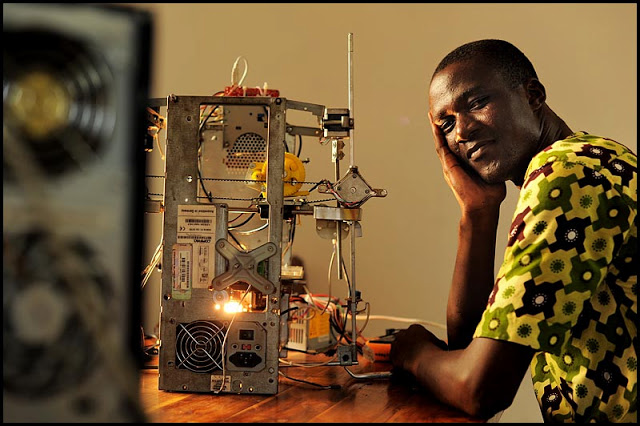
Afate Gnikou and his 3D printer (Source: WoeLab.com)
Just as almost everywhere else in the world, 3D printing offers the possibility of revolutionizing entire industries. In Africa, the 3D printer could bring a new industrial revolution, allowing goods to be made with less dependence on imported commodities, at a cheaper rate, and creating jobs locally. For the past three years, in Lomé, the capital of Togo, members of a small and innovative community have been building 3D printers. The machines are now part of an ambitious education program.
e-waste
In Lomé, piles of discarded computers, printers and scanners from industrialized countries accumulate in trash dumps. Afate Gnikou, a system’s developer, has found a place to work on his invention in a group of like-minded computer-lovers. It is called WoeLab; enjoy. BBC also did a video about it.
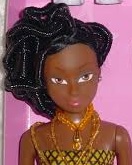
Growing up, the prominent option for dolls in the market were European dolls with European features, like Barbie dolls. The only other option was to make our own dolls with wool, bamboo, wood, raffia, and other materials. For a parent looking to offer his daughter, or niece, a “hip” doll, he/she basically had to get these European dolls that looked nothing like us (nothing wrong with that, but self-love starts with seeing one’s likeness in the most basic daily toy). Some of my friends resorted to coloring those dolls chocolate, so that the doll would look just like them, or braiding their hairs, and dressing them with left-over fabric from their Mommy’s wrappers or Boubou. I was quite pleased by the work of entrepreneur’s Taofick Okoya who created two lines of dolls: the Naija Princess, and the Queens of Africa. The Naija princess is more affordable for the average Nigerian family, and the Queens of Africa is the ‘haut-de-gamme’ of his collection.
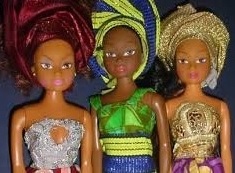
Queens of Africa dolls
His dolls basically have ‘African’ features, and are from three of the main tribes of Nigeria: Nneka is from the Igbo region, Azeezah is Haussa, while Wuraola is Yoruba. The dolls all wear African clothing from their particular regions, and have their hairs in braids, Afro, or plated. It is simply beautiful. As Mr. Okoya said himself, he first started because his daughter was getting confused about her skin color wishing hers to be just like that of her doll. See… how, even as kids, we get brainwashed? This is where we teach young girls to love and appreciate who they are, their skin colors, and the gorgeous hair they were endowed with naturally and divinely. I am so proud of Okoya’s dolls, which has beaten Mattel’s Barbie on the Nigerian market, and are now sold around the globe. I raise my hat to him, and wish for him to keep up the work, and for others to make dolls more representative of our different cultures: i.e. having Maasai dolls, Bushmen dolls, Bamileke dolls, or making them more “hip” for our daughters. Please do check out the website of Taofick Okoya, Queens of Africa Dolls.
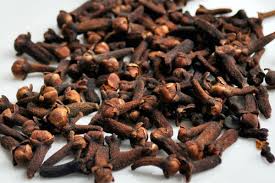
I really enjoyed this week’s BBC Photojournal on the harvesting of cloves in Tanzania. I did not know that so much was involved in getting that tiny spice that I often add to my sauces. Harvesting the flower buds, drying them, and then taking them to weighing stations is not an easy labor, for that spice to find its way into plates around the world, food, drinks, cosmetics, wine, and medicine. The photojournal focuses on the harvest of cloves on the archipelago of Zanzibar in Tanzania, and particularly on Pemba island. Zanzibar was once known as the Spice islands, and was once the world’s largest producer of cloves. Next time you use that tiny spice, remember Zanzibar. Enjoy BBC Photojournal on the harvesting of cloves!
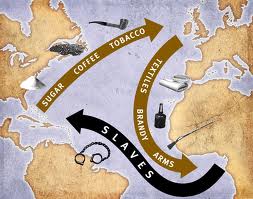
I am going to start a series on reclaiming our history. I will be talking about slave forts across Africa. There were over 30 slave forts in Ghana only. How many in other countries?We will find out through this exercise. These fortified trading posts were built between 1482 and early 1800s by Portuguese, British, Swedish, English, Danish, Dutch, and French traders that plied the African coast. Initially, they had come in search of gold (in Ghana), ivory (in Ivory Coast), pepper (along the Pepper Coast) and then later, they discovered cheap labor: thus was born the slave trade. There was intense rivalry between those European powers for the control of the West African coast from Senegal, to as far south as Angola.
Slaves marching after capture
It is estimated that over 20 million Africans were sold into slavery during the Atlantic slave trade; this does not account for those who died during the trip aboard the ship (about 1/3), and those who were killed during the capture. Slaves were taken to North America, the Caribbeans, and Brazil. Moreover, this is an estimate for the transatlantic slave trade only, but did you know that slaves were also taken by Arabic sailors from the East Coast of Africa, to places like Saudi Arabia and as far as India?
The Transatlantic slave trade
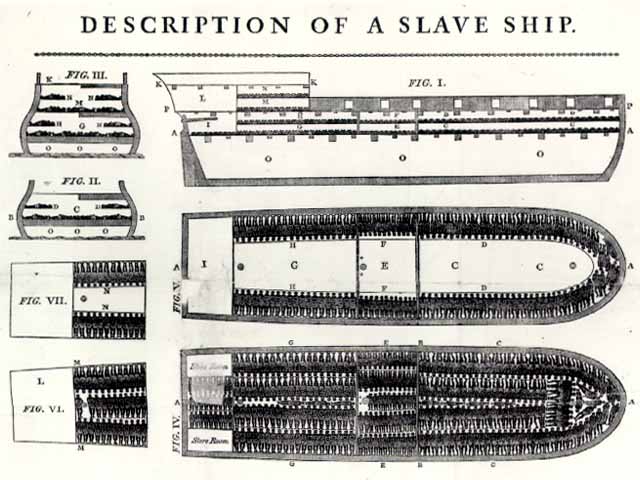
The Portuguese began dealing in black slaves from Africa in the 15th century. Initially, they purchased slaves from Islamic traders, who had established inland trading routes to the sub-Sahara region. Later, as the Portuguese explored the coast of Africa, they came upon the Senegal River, and found that they could purchase slaves directly from Africans. The European slave trading activity moved south along the African coast over time, as far south as Angola. On the east coast of Africa and in the Indian Ocean region, slaves were also taken from Mozambique, Zanzibar and Madagascar. Many of the slaves were from the interior of Africa, having been taken captive as a result of tribal wars, or else having been kidnapped by black slave traders engaged in the business of trading slaves for European goods. These slaves would be marched to the coast to be sold, sometimes traveling hundreds of miles. Many perished along the way. The captured Africans were held in forts or slave castles along the coast. They remained there for months crammed in horrible conditions inside dungeons for months before being shipped on board European merchant ships chained at the wrists and legs with irons, to North America, Brazil, and the West Indies.
Slaves on board a ship
Some African rulers were instrumental in the slave trade, as they exchanged prisoners of war (rarely their own people) for firearms which in turn allowed them to expand their territories. The slave trade had a profound effect on the economy and politics of Africa, leading in many cases to an increase in tension and violence, as many kingdoms were expanding.
Inspection of slave for sale
The slave trade was responsible for major disruption to the people of Africa. Women and men were taken young, in their most productive years, thus damaging African economies. The physical experience of slavery was painful, traumatic and long-lasting. We know this from the written evidence of several freed slaves. Captivity marked the beginning of a dehumanizing process that affected European attitudes towards African people. Can you imagine losing 1/3 or more of your active population? It is hard to fathom what crippling effect that will have on any country’s progress. That is why, in upcoming months, I will be talking and trying to identify slave forts in Africa, in an attempt to reclaim our history. I know this is a touchy subject, but it is history: the bad, the ugly, the beautiful, the joyous. It is important to know history in order to be able to claim the future fully, without any baggage.
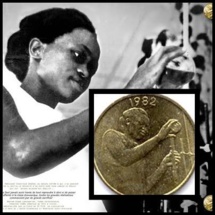
Mme Dicoh Mariam Konan, 1ere femme chimiste de Cote d’Ivoire, sur la piece de monnaie avec ses burettes
Je suis sûre que si vous êtes de l’Afrique de l’Ouest, et de la zone CFA, vous êtes certainement tombée sur cette pièce de 25FCFA sur laquelle une femme est representée. Eh bien cette femme-là est la toute première femme chimiste de la Côte d’Ivoire, Mme Konan née Dicoh Mariam. Elle est gravée sur la pièce de 25f CFA avec une burette de chimiste.
On utilise cette pièce sans même se demander qui est cette personne qui se trouve dessus… ou même ce qu’elle fait, ou ce qu’elle tient en main.
Mme Konan, une brillante chimiste qui a su manier plein de formules chimiques est le genre de personnes dont on doit parler; elle mérite bien plus qu’un prix d’excellence. C’est un exemple pour toutes les filles de l’Afrique, et du monde entier, parce qu’elle a su briller par son ambition et sa motivation. Chapeau à elle et à toutes les autres femmes en Afrique qu’on ne nomme pas, car elle est une femme très battante et remarquable. Un modèle de femme dont on doit se souvenir dans le futur de génération en génération. Waou… premiere femme chimiste de tout un pays… quel merveilleux exemple de détermination!
Aujourd’hui, Mme Konan est propriétaire de l’espace gastronomique ” La Gorge d’Or,” à Abidjan. Elle est une fierté pour toute l’Afrique. Longue vie à cette femme intelligente et nous espèrons en apprendre plus sur toutes les femmes brillantes du continent.
=======
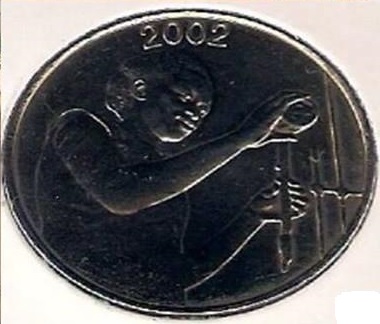
25FCFA coin
If you are from West Africa, and from the CFA economic zone, you have probably come across the 25 FCFA coin on which a woman is engraved. That woman happens to be the first woman chemist of Côte d’Ivoire, Mrs Konan Dicoh Mariam. She is engraved on the 25 FCFA coin with a burette.
People use this coin without wondering who is on it, or even what she is doing, or even what she is holding.
Mariam Dicoh Konan
Mrs Konan, a bright chemist who was able to handle a lot of chemistry formulas, is the kind of people we should be talking about; she deserves an excellence prize. She is an example for all the girls and women of Africa, and the world, because she was able to shine by her ambition and motivation. I raise my hat to her and all other women who remain unnamed, because she is a strong and remarkable woman. She is a model who should be remembered in the future by all generations. Wow… first female chemist of an entire country… such a marvelous example of determination!
Today, Mrs Konan is the owner of a gastronomical space ‘La Gorge d’Or‘ in Abidjan. She makes all Africans proud. Long life to this intelligent woman, and we hope to learn more about all the other bright women of the continent.
Avez-vous deja goûté au soya? de la viande rôtie à la camerounaise? Le soya est vraiment différent du kebab turque ou maroccain, et est définitivement différent du barbecue sucré américain. Le soya est spécial. Il est pimenté, d’un piment épicé, aux épices du Cameroun. Au Cameroun, la cuisson du soya est génèralement tenu par les maguidas ou vendeurs de soya, qui sont des habitants de la partie septentrionale du pays, et qui ont toujours été de grands éleveurs de boeufs depuis des siècles. La viande de boeuf est donc découpée en quartiers et tranches et arrosés d’un bon piment qui fait du soya ‘un mets digne de la table des dieux’ comme le dit si bien l’écrivain camerounais Sévérin Cécile Abega. Abega dit si bien dans sa nouvelle Au ministère du soya dans son livre Les Bimanes: [le soya est] “cet Everest de l’art culinaire qu’est la viande en tranches ou en brochettes grillées au feu…“… “Nul autre qu’un maguida ne peut, avec la même virtuosité, avec le même bonheur, réussir cette alchimie. Souriant, chantant, plaisantant, semblant ignorer eux-mêmes l’immense portée … les créateurs de la huitième et la plus quotidienne, la plus appétissante aussi des merveilles du monde, chaque soir, transforment la plus banale des viandes, celle du boeuf, en soya.”
Allez-y savourer le soya… ce met digne de la table des dieux made in Cameroun.
========================
Soya sellers at the entrance of Douala (in Bonaberi)
Have you ever tasted soya? roasted meat à la Camerounaise? I don’t mean meat broiled or barbecued meat with some sweet American sauce, or the Moroccan or Turkish kebab. The soya is special. It is spiced with chilis, and spices from Cameroon. In Cameroon, the cooking of soya is generally led by the maguidas or soya seller, who are inhabitants of the northern part of the country, and who have always been great cattle rearers for centuries. The beef meat is cut in quarters and slices, and basted with some good chili which make soya ‘a dish worthy to be served at the table of the gods’ like the Cameroonian author Sévérin Cécile Abega said. Abega tells it so well in his novella At the ministry of soya: [the soya is] “this Everest of the culinary art which is meat in slices or in grilled skewers on the fire…” … “None other than a maguida can, with the same virtuosity, with the same happiness, succeed in this alchemy. Smiling, singing, joking, seeming to ignore themselves its immense scope… the creators of the eighth and daily, most delicious of the world’s wonders, every evening, transform the most common of meats, that of beef, into soya.”
Enjoy the soya … this dish worthy of the table of the gods, made in Cameroon.
Avec l’approche de l’été, j’ai trouvé bon de vous introduire à un rafraîchissant favori des africains, et en particulier des camerounais. Durant les mois chauds de l’année, les camerounais adorent les fruits: les oranges, les pastèques, et les ananas (en fonction de la saison). Les marchands ambulants au bord des routes vous pèlent et vendent des oranges à longueur de journée. Je me suis toujours dit que la façon dont les oranges étaient pelées était très artistique: le marchand vous pèle l’orange à une de ces vitesses de telle sorte que les épluchures tombent sur le sol de façon géometrique; aucune machine ne pourrait competir avec cela. Dans la ville de Douala, en plus des oranges, les ananas et les pastèques sont particulièrement en vogue, et les vendeurs épluchent et coupent ces fruits et les arrangent géometriquement dans un contenaire géant en plastique transparent a la forme d’un seau cylindrique, et rempli de glaçons. Une tranche d’ananas ou de pastèque, aura tres vite fait de vous téléporter vers d’autres cieux. Amusez-vous à regarder cette video d’une vendeuse de fruits au Cameroun, et prêtez attention à la vitesse et précision avec laquelle elle épluche ses oranges!
==================
Pineapple (ananas)Watermelon (pastèque)
As summer approaches, I thought it wise to talk about one of the favorite refreshers of people in Africa, and most particularly of Cameroon. During the hot months, people in Cameroon particularly enjoy fruits: oranges, watermelons, and pineapples depending on the season. So the street hawkers will peel and sell you oranges. I always thought that the way the oranges were peeled was quite artistic: the seller peels it in a quick succession, and no machine could even compete. In the city of Douala, pineapples and watermelons are particularly en vogue, and the street hawkers will peel and cut the fruits and lay them out in an artistic and geometric way inside a transparent plastic in the shape of a cylindrical bucket full of ice. Once the customer places the order, one slice of pineapple or watermelon, and you are suddenly transported to heaven! Enjoy a video of a fruit seller in Cameroon, and pay attention to the precision with which she peels the oranges.
Very often, Africans are depicted on old pictures as naked people, walking around without any clothing. This seems to be quite at odd with the fact that the Dutch textile company VLISCO has been installed in Africa, more precisely in Togo, since 1846. So how could pictures from the 1800s and early 1900s only show naked Africans? The BBC recently ran a story on VLISCO and African textile tradition actually being European. The New York Times claimed that Africa’s fabric was entirely Dutch. I find this quite appalling, and I call this a falsification of history.
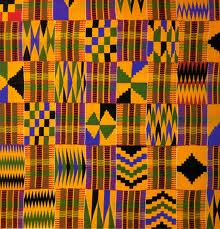
For starters, before VLISCO, Africa had a very rich textile industry as noted by Kankan Moussa‘s entire delegation being clothed from cotton woven with golden threads in 1300s during his pilgrimage to the Mecca (this will be a story for another day), or the Kanembu clothing tradition which dates as far back as the 800s. It is misleading to believe that the Wax hollandais is the only fabric worn by Africans, when we know that the Bogolan rises from a long tradition of weavers in Mali, or the Kente cloth of Ghana.A piece of Bogolan cloth
So what is the history of African fabric? Is there an African history of textile?
As pointed earlier, the African fabric industry is very old, and dates as far back as 5,000BC when ancient Egyptians began cultivating flax and weaving it into linen. An ancient pottery found at Badari shows an ancient depiction of a loom dating back to this period, while a 12th dynasty image from the tomb of Khnumhotep shows weavers using a horizontal loom (ca 2400 BC). Moreover, pyramids, sculptures, and hieroglyphs clearly show all Egyptians clothed.Even their neighbors to the south, the Nubians, had a flourishing textile industry, as can be seen on images on pyramids at Meroë, and images of the great queen Amanishakheto, as well as those of pharaoh Piye.Later on, as several civilizations flourished throughout Africa, cotton became a more commonly used fabric. The explorer Ibn Battuta does mention the presence of weavers in the Mali empire, and in Timbuktu, in the 1300s. As Islam was introduced in West Africa, many began wearing today’s version of the boubou.Kente cloth
Today, one can find a full tradition of textile flourishing throughout Africa. The Bogolan or ‘mud cloth’ is hand-woven fabric hailing from Mali. Kente cloth, is Ghana’s national fabric, with the most expensive ones made with golden threads for kings only (in the olden days). It is said that the British explorers were amazed by the beauty of the Ashanti king’s attire. Cameroon has a long history of cloth made from the bark of trees, with some fabric particularly made from the obom. Fibers from the raffia are still commonly used to make bags, and clothing. Moreover, in West Cameroon, Kings are dressed with finely woven clothing made by the best weavers of the kingdom embellished with beads. The Pygmies use bark cloth made from tropical fig trees, while people from Chad and the Central African Republic weave cotton strips on horizontal looms; they use a variety of natural dyes.
Ndebele woman
The Kuba people of the Democratic Republic of Congo, use raffia and make some of the most beautiful hand-woven blankets, clothing, and sculptures. The Ndebele of South Africa and Zimbabwe have a rich tradition of gorgeous colorful quilts and blankets entirely hand-made. Many would envy the elegance, color, and presentation of well-dressed Ndebele women.
So why are the New York Times and the BBC trying to falsify history?Even VLISCO patterns are not Europeans, as they are inspired by Africans, and made to address the needs of the African population. Yes, Africans wear have worn VLISCO textiles and many Nana Benz have prospered from it, but that doesn’t mean that they do not have their own rich tradition of textile. Africans have their textile industry which dates back millennia, and has probably inspired many in the world. So today as you wear a wax hollandais, remember that there are Kente cloth, Bogolan, and many other beautiful garments made by local artists well-deserving of praise.I am leaving you with a documentary video on Kente cloth weaving. Enjoy!
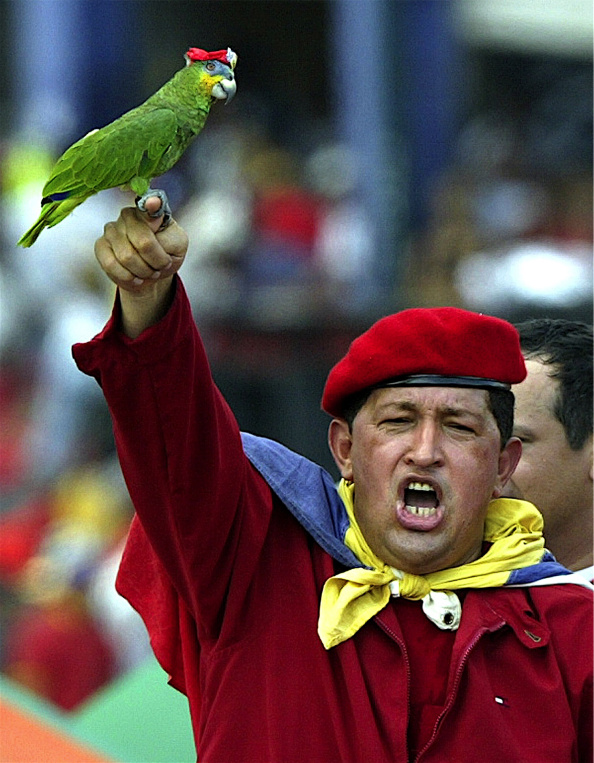
Hugo ChavezVenezuelans accompanying Chavez’ procession through the streets of Caracas
I was immensely touched by the outpouring of love for Chavez coming from all corners of the world. Tell me: how many leaders of this world, have had this great show of love? How many can boast the millions of Venezuelans who have been mourning for Chavez? How many can boast popular support in their respective countries like Chavez did? Remember, he won a third term in office.
Over 55 foreign delegations with 32 head of states were present in Caracas (the capital of Venezuela) to give a last hommage to the great Comandante. Even Spain sent in the crown prince. An immense crowd was there to salute Hugo Rafael Chávez Frías. Chavez’ passing has shown to the world what a true leader is. Besides his Venezuelan funerals, 55 countries across the globe have declared a national day of mourning. Argentina declared 5 days of national mourning, Brazil 2, Bolivia 5, Nigeria and Benin 7, and so on and so forth. Imagine that: 55 countries declaring national days of mourning for the president of another country! Who can boast better? Can you believe it? Praise be given to the great Comandante, the man who gave us hope, love, courage, and resilience. Find below videos showing Hugo Chavez’s great work… and love, applaud, and be proud to have lived in a time when a great man gave love and freedom to his people, and the world.
I salute the ingenuity of Congolese entrepreneur Verone Mankou, whose smartphone and tablet truly address the needs of Congolese in particular, and of Africans in general. Verone Mankou, the founder of VMK, tailors affordable smartphone and tablet to Africans. He said at the Tech4Africa conference in Johannesburg recently: “Only Africans can know what Africa needs. … Apple is huge in the US, Samsung is huge in Asia, and we want VMK to be huge in Africa.” … I totally agree with him, and I am proud to see an electronic product conceived and engineered by a Congolese for Congolese, and all Africans. Have fun, and enjoy!

















 African Heritage