Taytu Betul: the Great Ethiopian Empress who Said ‘NO’ to Colonization

Empress Taytu Betul of Ethiopia

After learning about the origin of the name Addis Ababa, from Empress Taytu Betul‘s visit to its location, I could not help but talk about the Empress herself.  Who was Taytu Betul?

Well, Taytu Betul was Emperor Menelik II‘s third wife and was thereby Empress of Ethiopia.  She was his confidante, a loyal wife, a commander, and a brilliant military strategist.

Taytu Betul (also Taitu Betul), whose name Taytu means Sunshine, was a sunshine for her nation when it was about to fall into the hands of the Italian colonizer.  Perhaps, there would not have been the famous Battle of Adwa on March 1, 1896, which marked the Ethiopian victory against colonialism, without Empress Taytu, for she inspired it.

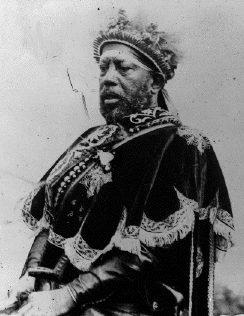
Emperor Menelik II, of Ethiopia

Empress Taytu Betul was born in Wollo from a Christian and Muslim family.  She had a comprehensive education and was fluent in Ge’ez, the classical Ethiopian language; which was a rare achievement for a woman at the time, as education was mostly reserved for boys.  Taytu was the third of four children in an aristocratic family related to the Solomonic dynasty of Ethiopia.  Her uncle, Dejazmach Wube Haile Maryam, was the ruler of Tigray and much of Northern Ethiopia in the 1840s, and a rival of Emperor Tewodros II.  Her father’s family were the ruling family of Semien province, claiming descent from Emperor Susenyos I.  Her grandfather was Ras Gugsa, a member of the powerful ruling family of Yejju, of Oromo origin, which had ruled as Regents in Gondar during the Zemene Mesafint (“Era of the Princes”).  After four failed marriages, Taytu Betul was married to Emperor Menelik II (he was still King of Shewa at the time) in 1883 in a full communion church service and thus fully canonical and insoluble, which Menelik had not had with either of his previous wives (whom he had divorced).  Their marriage was not just about romance but was also a political marriage sealing alliances with the northern regions of Begemder, Lasta, Semien, and Yeju.  She remained his wife until his death in 1913.

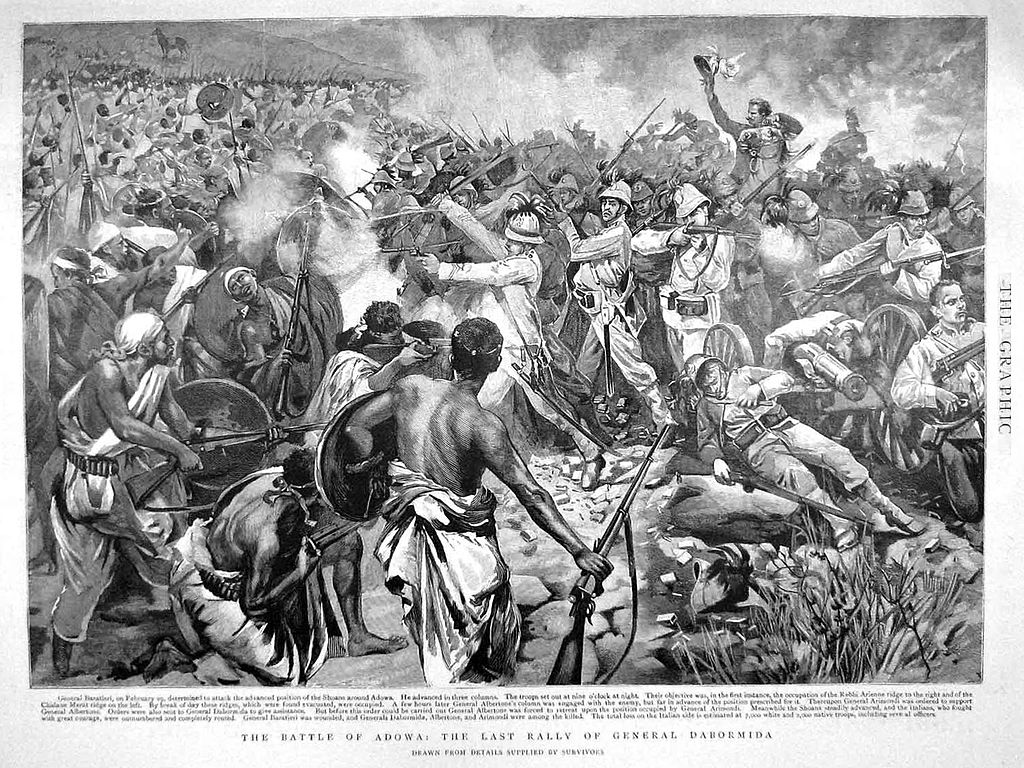
The Battle of Adwa, 1896

Empress Taytu was a loyal and respectful wife to her husband Emperor Menelik II.  According to royal historians, she was co-equal with Menelik, who always consulted her prior to making important decisions.  She was the one who pushed him to declare war against Italy at the Battle of Adwa—tearing up the 1889 Treaty of Wuchale between the Ethiopian Empire and Italy, a treaty whose article 17 had two different meanings in Amharic and Italian versions: The Amharic version recognized the sovereignty of Ethiopia and its relationship with Italy as just a diplomatic partnership, while the Italian version made Ethiopia Italy’s protectorate.  The moment that discrepancy was uncovered, Empress Taytu was the first to agitate the hesitant Emperor and other men to stand up for liberty, dignity and against Italian aggression. 

Edition of the Petit Journal of August 1896 titled: "Negus Menelik II at the Battle of Adwa"
Edition of the Petit Journal of August 1896 titled: “Negus Menelik II at the Battle of Adwa”

Empress Taytu, as a military strategist, facilitated the downfall of Italy at the Battle of AdwaShe had her own battalion, which she bravely commanded in the battlefield, fighting in the frontline and motivating men against retreat.  She also mobilized women, both as fighters and nurses of wounded soldiers.   At the Battle of Mekelle, she advised Ras Mekonen to cut off the water supply to the Italians in order to disgorge them from their entrenched and heavily fortified positions at Endeyesus Hill on the eastern part of Mekelle City.  Taytu was also the receiver and analyzer of intelligence information collected by spies, which historians have characterized as of crucial importance to the Ethiopian victory at the battleThis information enabled Menelik to attack the Italians, at a site of his choosing, at Adwa instead of Adigrat, near the Eritrean border where the Italians expected to have a relative logistical advantage.  The Italians were hoping that Menelik would meet them in Adigrat, close to where they had a well-protected military base.

Empress Taytu Betul in Le Petit Journal of March 1896

Independence and cooperation defined Taytu’s relationship with Emperor Menelik II.  Their marriage was that of equals characterized by trust, respect and reciprocity.  After Menelik was incapacitated due to strokes in 1906, she essentially governed the country, angering all the rivals to the throne.  She was ousted from power in 1910.  After Menelik II’s death in 1913, she was banished to the old palace at Entoto.

Taytu Betul was an authentic Ethiopian leader.  Her deeds at a critical moment in Ethiopian history not only saved Ethiopia from European colonization, but it also paved the way for the decolonization of Africa.  Her advice and action resulted in the defeat of the Italian army at the 1896 Battle of Adwa, a mighty European army defeat at the hands of Africans.  Taytu strongly defended national interests by overcoming challenges both from within and from without.  Just as there was no Menelik II without Taytu Betul, there would have been no Ethiopia without Taytu’s great strength, courage, devotion, and determination. Taytu Betul was truly Ethiopia’s sunshine, and should forever be remembered as one of the greatest empresses of Ethiopia and of Africa as a whole.  Please check out Tadias.com which has outstanding information on this great empress.  Enjoy this video about the Battle of Adwa.


Adinkra Symbols and the Rich Akan Culture

Adinkra in 1817
Adinkra in 1817

Today, we will talk about Adinkra symbols of the Akan people of Côte d’Ivoire and Ghana.

The Adinkra symbols are believed to originate in Gyaman, a former kingdom in modern day Côte d’Ivoire.  According to an Ashanti (Asante) legend, Adinkra was the name of a king of the Gyaman kingdom, Nana Kofi Adinkra.  King Adinkra was defeated and captured in a battle.  According to the legend, Nana Adinkra wore patterned cloth, which was interpreted as a way of expressing his sorrow on being taken to Kumasi, the capital of Asante.  He was finally killed and his territory was annexed to the kingdom of Asante.  The Asante people, around the 19th century, took to painting of traditional symbols of the Gyamans onto cloth, a tradition which has remained to this day.

Adinkra work, 1825
Adinkra work, 1825

The arrival of the adinkra in Akan culture seems to date as far back as 1817, when the English T.E. Bowdich collected a piece of adinkra cotton cloth from the city of Kumasi.  The patterns on it were printed using carved calabash stamps and a vegetable-based dye.  The cloth featured fifteen stamped symbols, including nsroma (stars), dono ntoasuo (double Dono drums), and diamonds, and is currently hosted at the British Museum in London.

Sankofa symbol
Sankofa symbol

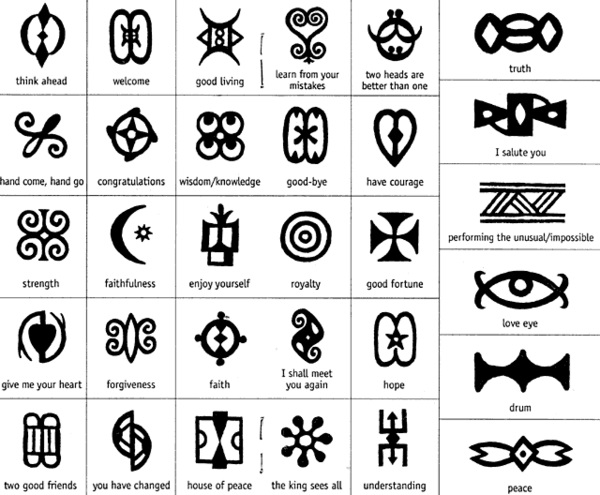
Adinkra symbols are visual representation of concepts and aphorism developed by the Akan people of Ghana.  Adinkra symbols are extensively used in fabrics, pottery, logos, and advertising.  They can also be found on architectural buildings, as well as on traditional Akan gold weights, and sculptures as well as stools used for traditional rituals.  The adinkra symbols are not just decorative objects, or drawings, but actual messages conveying ancient traditional wisdom relevant to aspects of life or the environment.  A lot of the Adinkra symbols have meanings linked to proverbs, such as the sankofa symbol.  Sankofa, in the Twi language, translates in English to ” reach back and get it” (santo return; koto go; fato look, to seek and take) or the Adinkra symbol of a bird with its head turned backwards taking an egg off its back, or of a stylised heart shape.  It is often associated with the proverb, “Se wo were fi na wosankofa a yenkyi,” which translates “It is not wrong to go back for that which you have forgotten.”  Other Adinkra symbols depict historical events, human behavior and attitudes, animal behavior, plant life, and objects’ shapes.

Adinkra means ‘goodbye’ or ‘farewell’ in the Twi language of the Akan ethnic group, to which the Asante belong.  No wonder the Akan people, and particularly the Asante, wore clothes decorated with Adinkra symbols mostly for funerals as a way to show their sorrow, and to bid farewell to the deceased.

Some Adinkra symbols

Adinkra cloths were traditionally only worn by royalty and spiritual leaders for funerals and special occasions.  They were also hand printed on undyed, red, dark brown, or black hand-woven cotton fabric depending on the occasion and the wearer’s status.  Today, adinkra is worn by anyone, women, men or children, and it is frequently mass-produced on brighter colored fabrics.  The 3 most important funerary Adinkra are: the dark – brown (kuntunkuni), the brick – red (kobene), and the black (brisi).  There are however, other forms of which cannot be properly called mourning cloth. Their bright and light backgrounds classify them as Kwasiada Adinkra or Sunday Adinkra meaning fancy clothes which cannot be suitable for funerary contents but appropriate for most festive occasions or even daily wear.

Adinkra symbols and their meaning

The center of traditional production of adinkra cloth is Ntonso, 20 km northwest of Kumasi, the city where the Englishman was first given it in 1817.  Dark Adinkra aduro pigment for the stamping is made in Ntonso, by soaking, pulverizing, and boiling the inner bark and roots of the badie tree (Bridelia ferruginea) in water over a wood fire.  Once the dark color is released, the mixture is strained, and then boiled for several more hours until it thickens.  The stamps are carved out of the bottom of a calabash piece, and measure on average 5 to 8 cm2.

Enjoy the video below on Adinkra, and the articles on Adinkra symbols, Adinkra in Ntonso and the article on The 21st Century Voices of the Ashanti Adinkra and Kente Cloths of Ghana with gorgeous images of the process of making Adinkra stamps and clothes, and lastly GhanaCulture.

Fasilides Castle: a Pure Gem of Ethiopia’s Rich History

Map of Ethiopia
Map of Ethiopia

Throughout human history, every great empire has had great builders and phenomenal architectural fits: The Romans with Emperor Titus who built the Colosseum, the Inca builders of Machu Picchu, the Egyptian pharaohs with the great sphinx of Giza and the great pyramids, the first emperor of China and the Ming dynasty with the Great Wall of China.  However, few today know of the Abyssinian builder Fasilides and his work.

Ethiopian Emperor Fasilides is one of most remarkable rulers of Abyssinia, the ancient name of Ethiopia.  A member of the Solomonic dynasty, emperor Fasilides ruled over Abyssinia from 1632 to 1667.  He founded the city of Gondar in 1636 which became the capital of Abyssinia, in the northwestern part of Ethiopia.  He was known as Alam Sagad or ‘To whom the world bows.’  Today, thousands bow to his work, and his footprints have marked the history of Ethiopia forever.

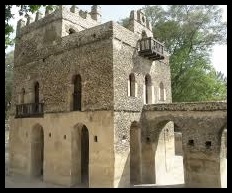
Fasilides' Castle
Fasilides’ Castle

Among the buildings he constructed there are the beginnings of the complex later known as Fasil Ghebbi, as well as some of the earliest of Gondar’s famous 44 churches: Adababay Iyasus, Adababay Tekle Haymanot, Atatami Mikael, Gimjabet Maryam, Fit Mikael, and Fit Abbo.  Fasilides is also credited with building seven stone bridges in Ethiopia.  Sebara Dildiy (broken bridge in Amharic) was one of two stone bridges built over the Blue Nile River during Fasilides reign.  Sebara Dildiy was later repaired during Emperor Menelik II‘s reign in 1901.  Emperor Fasilides also built the Cathedral Church of St Mary of Zion at Axum.  Fasilides’ church is known today as the “Old Cathedral” and stands next to a newer cathedral built by Emperor Haile Selassie.

Fasilides' Bath
Fasilides’ Bath

When King Fasilides made Gondar the seat of his empire in 1636, he constructed a palace that would eventually sprawl into a large complex, as succeessors added their own buildings to the compound.  Set in the heart of what is now one of Ethiopia’s largest cities, the palace complex is a mixture of beautifully-preserved period architecture with European and Moorish influences, and rambling ruins.  Interestingly, Fasilides’ Castle itself is the best-preserved, with its lower halls, reservoirs and steam-baths, remains of kitchens and stables, and even enclosures for leopards and lions that used to grace the grounds.  The castle is located near the city center.  Its structure is purely made of stone.  Today, Fasilides baths are used for baptism during the Timkat festival, the epiphany, in late January; they are only filled with water for the festival.  The castle can be found in Gondar, Amhara regionFasilides’ Castle is definitely a representation of Ethiopia’s great and rich history.


Mirambo’s Empire: Urambo

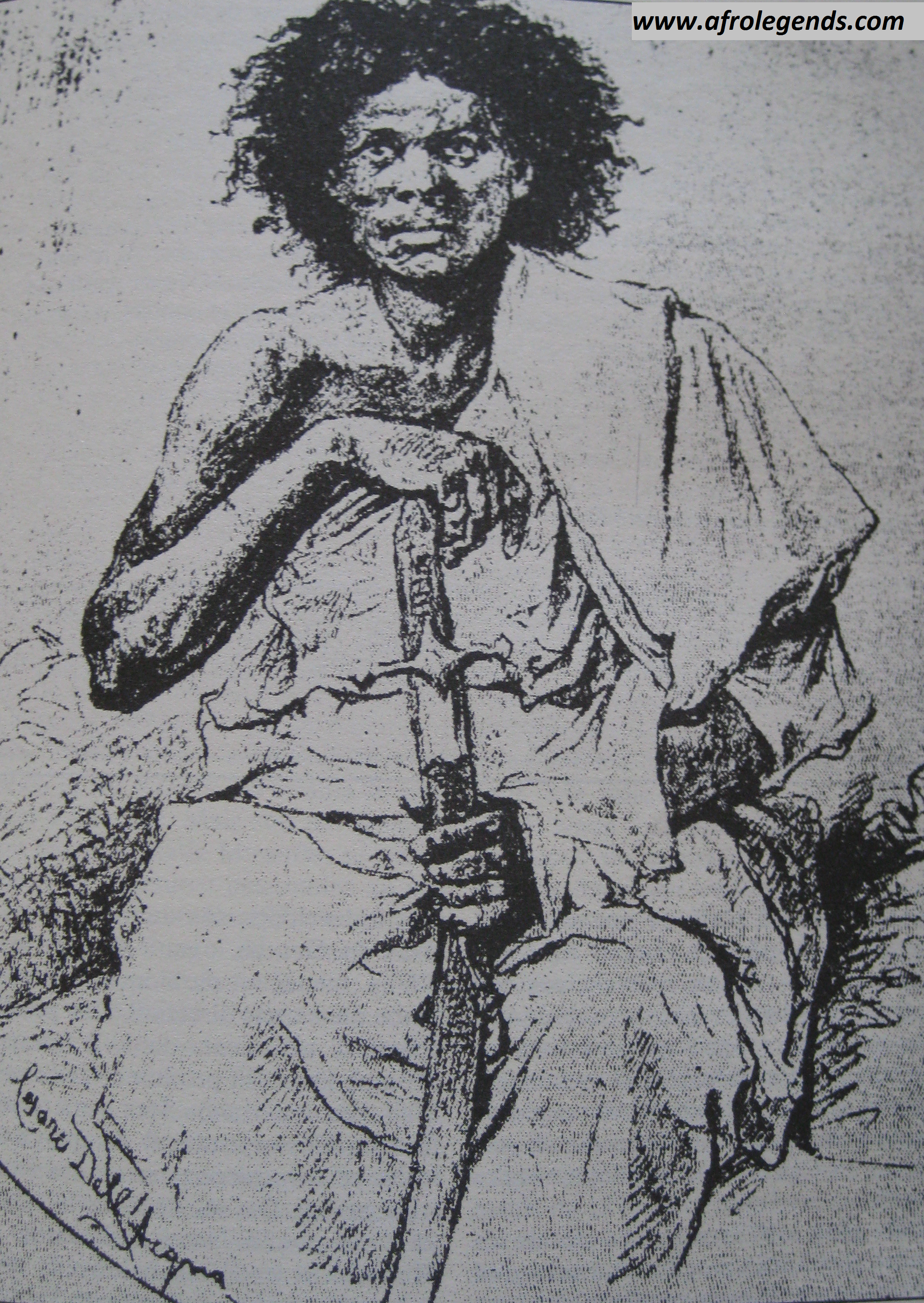
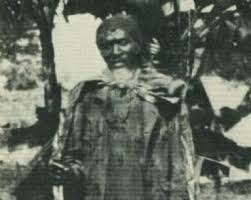
Mirambo, the Black Napoleon
Mirambo, the Black Napoleon (Source: Les Africain, C.-A. Julien, Ed. J.A., Vol, 6, P. 137 (1977))
Mirambo's empire, Urambo (source: Les Africains, C.-A. Julien, Ed. J.A., Vol.6, P. 135 (1977))
Mirambo’s empire, Urambo (source: Les Africains, C.-A. Julien, Ed. J.A., Vol.6, P. 135 (1977))

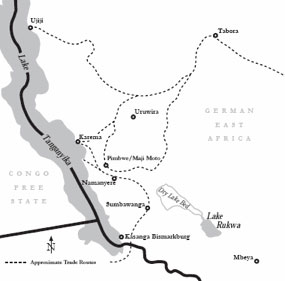
Following up on the article on Mirambo, the Black Napoleon or the Black Bonaparte, I propose here a map of his zone of influence after conquest of different regions.  I found a map of Mirambo‘s kingdom, the Nyamwezi empire, Urambo, in ‘Les Africains, C.-A. Julien, Editions J.A., Vol. 6, P. 135 (1977).’  You will find his capitals: Iseramagazi and Ikonongo, Tabora, Ujiji, Lake Victoria and Lake Tanganyika the northern and western borders respectively.  Enjoy!

Mirambo: the Black Napoleon

Mirambo, towards the end of his life

Today, I will talk about Mirambo, the man the explorer Henry Morton Stanley first referred to as a bandit, and later on as the Napoleon of Africa for his military prowess.  Who was Mirambo?

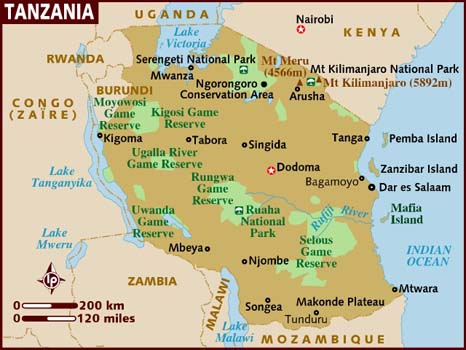
Map of Tanzania
Map of Tanzania

Born Mbula Mtelya, Mirambo is the man who revolutionized nineteenth century Tanzania, and made it hard for the Germans to conquer the region: he united the numerous Nyamwezi tribes, and gained control over Swahili-Arab trade routes.  Mirambo was the leader of the Nyamwezi people on a 200,000 km2 territory south of Lake Nyanza (Lake Victoria), and east of Lake Tanganyika.  He was not a vulgar chief of brigands as the Arab traders made Stanley believe in 1871, but his links to different families of Ntemi (kings) were a little bit blurred as many historians had mixed up dynastic and genealogical lineages, different in a matrilineal system such as that of the Nyamwezis.  In 1858, Mirambo managed to inherit the chiefdom of Uyowa from his father, Kasanda, who was a renowned warrior; he was only 18 years old.  In 1860, he joined two chiefdoms located 100 km west of Tabora, in the kingdom of Unyanyembe.  He learned the Ngoni language (Ngoni people trace their origin to the Zulu people of KwaZulu Natal), as well as their military techniques.  Later in 1860, he conquered the neighboring territory of Ulyankuru.

Map of Mirambo's kingdom
Map of Mirambo’s kingdom

He then moved his capital to Iseramagazi where he built a Boma, a fortified residence, with walls made up of dry bricks, retrenchments and hedges of euphorbia flowers.  From his father and mother, he was a descendent of Mshimba (lion), the last ruler of the legendary kingdom of Usagali, and Mirambo was thus recreating the old empire.  Thus in 1860, he created a new Nyamwezi state, the Urambo, from the name he had adopted for himself, ‘corpses‘ in kinyamwezi, Mirambo.  From 1860 to 1870, he strengthened his authority along the banks of the river Gombe, i.e. on the road to Ujiji, thereby threatening to block the Arab commerce in the area.  In 1871, he defeated the Arab traders at Tabora.  The Sultan of Zanzibar, Barghash bin Said, retaliated by sending 3000 soldiers (2000 Swahili, and 1000 Balutchi).  Mirambo’s resistance was one of the most fierce: Nyamwezi’s fighters would go as far as melting their copper bracelets to make bullets for their guns.  A compromise was made to keep commerce flowing with the coast: caravans could pass after paying a tax (hongo) to Mirambo.

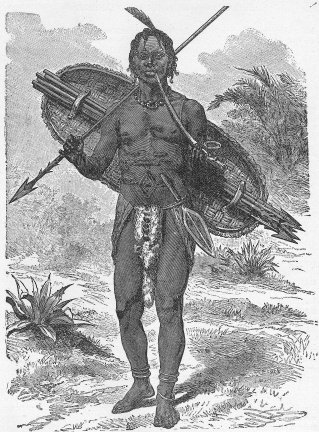
Illustration of the Ntemi of Urambo, Mirambo (from James William Buels Heroes of the Dark Continent (1890))

Every year, during the dry season, Mirambo would dispatch his ruga-ruga in all directions to continue the expansion of his territory.  From 1876 to 1878, the territory was expanded to the north, up to the southern banks of Lake Victoria.  From 1879 to 1881, expansion to the west toward Uvinza, for the control of Lake Tanganyika.  The Muhambwe of King Ruhaga fell under Nyamwezi domination, and the Ruguru of King Ntare had to seek protection from Mirambo and agree to the presence of a ruga-ruga post on the eastern border of his kingdom.  In 1879, there was also the expansion towards Burundi.  His alliance with the Ngoni fell apart in the early 1880sHe was greatly hated by the Arabs who used to dominate the commerce in the region, and other neighboring kings who feared him, and the Europeans who saw in him as a powerful adversary.  After 1881, the Arabs managed to convince the International African Association (AIA – Association Internationale Africaine), a European power created under King Leopold II’s initiative to inflict an embargo on arms and munitions on Mirambo (yup… European unions already inflicted embargo on arms back then).  The goal of the AIA was to “open up central Africa to civilization.”  At first Mirambo’s army succeeded in entering Burundi by surprise using a feud between the local king and his brother, but in 1884, his army was defeated by Burundi warriors (aided by Ngoni warriors).  After his defeat in Burundi, and another defeat against the alliance of the Arabs and the Ntemi of Bukune, Mirambo’s troops were led by Mpandashalo as he was increasingly sick.  Mirambo died on 2 December 1884.

Flag of Tanzania
Flag of Tanzania

Mirambo was a strong and ambitious leader.  He expanded his authority and influence over a number of Nyamwezi chiefs.  One of his challenges was to devise a political system that would allow him to consolidate his power, while ever expanding his territory.  For that, he made sure not to change the structure of the Nyamwezi’s society: once in power, he would usually choose a successor from the same family.  As long as the new chiefs pledged allegiance to him, they would be left to go about their political duties.  The conquered chiefs had to provide troops at all times.  His greatest strength was military.  He used surprise as a tactical ployHis capital was both a military and economic center.  He had two residences: Iseramagazi from 1879, and Ikonongo from 1881.

Mirambo was actually a simple man, deeply rooted in his culture and traditions, but also very curious of the world.  He was a man of order and progress, who will set the price of commodities in the capital’s markets, and regulated the consumption of alcohol in his kingdoms (he thought that alcohol weakened societies – just like Gungunyane), and meditated on the decadence of Africa in the 19th centuryHe was nostalgic of the magnificent ancient African capitals, and kingdomsIn essence, Mirambo had 4 faces: the traditional king, the warrior leader, the state builder, and the modernizer. To learn more, go to: ThinkAfricaPress.com, BlackPast.org, and Les Africains, Vol. 6, editions J.A, C.-A. Julien, P. 127-157, (1977).

The Timkat Festival or the Ethiopian Epiphany

Young girl attending the Timkat Festival (Carlos de Souza, AFP)
Timkat festival
Timkat festival

Today, I would like to talk about the Timkat Festival, which is an Ethiopian celebration of Epiphany.  It is usually celebrated on 19 January or on 20 January on leap years (which is the 10th day of the Terr – Ethiopian calendar).  This festival celebrates the baptism of Jesus Christ on the Jordan river by John the Baptist.  It is particularly praised for its reenactment of the baptism.  Pilgrims come from around the country to celebrate the Epiphany, which lasts three (3) days.  During the ceremonies of Timkat, the Tabot, a model of the Ark of the Covenant, is reverently wrapped in rich cloth and borne in procession on the head of the most senior priest to a place near the river, where a special tent will be erected for it.  The Tabot represents the manifestation of Jesus as the Messiah when he came to the Jordan river for baptism; this holy relic is also said to hold the ten commandments as handed down to Moses by God on Mount Sinai.  The Divine Liturgy is celebrated near a stream or pool early in the morning (around 2 a.m.).  Then the nearby body of water is blessed towards dawn and sprinkled on the participants, some of whom enter the water and immerse themselves, symbolically renewing their baptismal vows.  It is a feast of celebration, and processional crosses of varying size and elaboration as well as various Ethiopian artifacts can be seen on the occasion.  Participants wear the traditional shamma, which is a thin, white cotton wrap worn like a toga and as headdress.  The best place to attend the event is in Lalibela, Gondar, or Addis Ababa.  The actual ark of the Covenant is said to be held in a place in northern Ethiopia, guarded by priests who have sworn never to leave the chapel grounds.

Here are photojournals from The Guardian, the Huffington Post, and the BBC on the Timkat Festival; my favorite one is from the Guardian.  Enjoy!!!

The Battle of Isandlwana: the Day the British Lost the War to the Zulus

The Battle of Isandlwana

Today, I will tell you about the Battle of Isandlwana, the battle where the mighty Great Britain lost to African warriors… Yes you heard me right: Great Britain lost to Zulu warriors in South Africa on 22 January 1879The battle of Isandlwana remains the single greatest defeat of the British army at the hands of a native army.  This occurred in KwaZulu-Natal, where approximately 22,000 Zulu warriors defeated a contingent of approximately 1,350 British and Native troops (notice… the real number for the native forces cannot be found anywhere) in one of the first engagements of the Anglo-Zulu war.  The Zulu force was under King Cetshwayo, a nephew of King Shaka Zulu.

Zulu King Cetshwayo, ca 1879

The Battle of Isandlwana is a battle of pride as it reminds us that our ancestors did not quietly accept colonization, and were not easily defeated.  They fought, and even defeated the European colonizers, as is the case for Cetshwayo’s forces.  The battle was a decisive victory for the Zulus and caused the defeat of the first British invasion of Zululand.  For the first time, the British Army suffered its worst defeat against a technologically inferior indigenous force.  Isandlwana resulted in the British taking a much more aggressive approach in the Anglo–Zulu War, leading to a heavily reinforced second invasion and the destruction of King Cetshwayo’s hopes of a negotiated peace.

A depiction of the Battle of Isandlwana, taken from the London News

The Zulus were equipped mainly with the traditional assegai (iklwa) iron spears and cow-hide shields.  The British and colonial troops were armed with the state-of-the-art Martini-Henry breech-loading rifle and two 7 pounder artillery pieces as well as a rocket battery.  He he he…  Despite a vast disadvantage in weapons technology, the numerically superior Zulus commanded by inDunas (Princes) Ntshingwayo kaMahole Khoza and Mavumengwana kaNdlela Ntuli ultimately overwhelmed the British, killing over 1,300 troops, including all those out on the forward firing line.   The Zulu army wiped six (6) companies of the 24th regiment as well as volunteers from the Natal province and Basotho auxiliaries under Colonel Durnford.  The Zulu army suffered around a thousand killed.

Zulu warriors at Isandlwana, 1879

The primary reason for the Zulu victory is that the Zulus, unlike the British, kept their main fighting force concentratedFurther, they made a very successful effort to conceal the advance and location of their force until they were within a few hours’ striking distance of their enemy.  See… my ancestors were military geniuses too!!  Created by King Shaka, the Zulu army or Zulu impi was the most powerful war machine the British ever faced in Southern Africa.  The combat strategy was perfected by King Shaka himself, who added great organization and discipline to the traditional qualities of courage and mobility cultivated within African armies.  During the battle, the Zulu army would organize itself as an arc facing the adversary.  At the center (known as the chest in Zulu) were found the most seasoned regiments; on the wings (or horns) were found the regiments of younger warriors.  The latter used their speed and agility to outflank the enemy by attacking him on the flanks while trying to encircle him, while the chest warriors engaged him in the front.  Behind the chest, and with their back turned so as to keep their calm, were the veteran regiments (also known as the kidneys) who will wait as reserves, intervening only to switch the battle to victory.  Every man knew his place, moves, and maneuvers with extreme precision.

A Zulu regiment attacking at Isandlwana (C. Fripp)

Finally, when the location of the main Zulu Impi was discovered by British scouts, the Zulus, without hesitation, immediately advanced and attacked, achieving tactical surprise.  This tactical surprise prevented the British, although they now had some warning of a Zulu advance, from concentrating their central column.  The Zulus had outmanoeuvred Chelmsford, and their victory at Isandlwana was a decisive defeat of the British invasion that forced the main British force to retreat out of Zululand until a far larger British army could be shipped to South Africa for a second invasion.  During this battle, there was also a solar eclipse; this however did not stop the warriors from fighting.

I have to admit that I was quite proud to learn about the battle of Isandlwana, the battle the British lost to technologically inferior Zulus warriors (so it is said).  I just think that, on that day, the Zulus despite not having the technological advantage, had the strategic advantage.  They were well-trained, well-prepared, and they were also fighting for their land.  To learn more about the Battle of Isandlwana, please check out Military history which debunked some of the myths about the battle, British Battles, and this article on the BBC.

Queen Amina of Zazzau: the Great Hausa Warrior born to Rule

Queen Amina of Zazzau

Today, I would like to tell you about yet another great queen of Africa, Queen Amina of Zazzau.  Just like Amanishakheto of Nubia, Nzingha of Angola, or Ranavalona I of Madagascar, Amina was a strong queen who loved her people, and totally marked her kingdom forever.

Queen Amina of Zazzau was born around 1533 in the province of Zazzau, in modern-day Nigeria.  Zazzau refers to the Zaria emirate which is a traditional state with headquarters in the city of Zaria in Kaduna state in Nigeria.  Zazzau was one of the seven Hausa city-states which dominated the subsaharan trade after the collapse of the Songhai Empire at the end of the 16th century.  Its wealth was due to the commerce of leather, textile, horses, salt, kola, cloth, and metals imported from the East.

Queen Amina celebrated on a Nigerian stamp

As a toddler, Amina was already attending state business on her grandfather, the king’s laps.  At the age of 16, Amina was seen as a potential contender to her mother’s throne (Magajiya), the queen Bakwa of Turunku.  Amina started to learn the responsibilities of a queen from her mother: taking part in daily assemblies with high dignitaries of the kingdom.  Even though her mother’s reign had been one of peace and prosperity, Amina chose to learn military skills from the warriors.

Queen Bakwa died around 1566, and the Zazzau kingdom was governed by her youngest brother Karama.  During the reign of her brother, Amina emerged as principal warrior of the kingdom’s cavalry.  Her military successes brought her wealth and power.  When her brother died after ten years of reign, Amina was crowned queen of Zazzau in 1576.  During her reign, which lasted 34 years, she expanded her kingdom’s boundaries down to the Atlantic coast, she founded several cities, and personally led an army of 20,000 soldiers to numerous battles.  However, her focus was not on annexation of neighboring lands, but on forcing local rulers to accept vassal status and allow Hausa traders safe passage.

Portrait of Queen Amina

During her reign, she commanded the construction of a defensive mural around each military camp that she established.  Later, those camps evolved into prosperous cities within those walls, and some can still be seen today in northern Nigeria.  Those cities are known as walls ‘ganuwar of Amina’ or ‘Amina’s walls‘.  It is believed that Amina died in the town of Altagara in 1610. Today, Amina is remembered in Nigeria as ‘Amina, rana de Yar Bakwa ta San’ (Amina, daughter of Nikatau, woman as capable as a man).  The introduction of kola nuts into the region is often attributed to Amina.  Amina is celebrated across the Hausaland as a great warrior queen who was born to rule, and led thousands of soldiers to war.  To learn more, check out Black history heroes, History and Women, as well as the book African Princess which dedicates a chapter to this great queen.  Amina’s achievement was the closest that any ruler had come in bringing the region now known as Nigeria under a single authority.  Enjoy the video below of great African queens including Amina.

Nigeria’s Many Monarchs

I saw this very good photojournal article on BBC about Nigeria’s many monarchs.  I just loved it, because of its depiction of African culture, and the beauty of their heritage.  I had to share.  From the Ovie of Umiaghwa Abraka kingdom in the Delta State, to the Pere of Isaba kingdom (a kingdom which exists since the 14th century), to the Emir of Zauzau in Kaduna State, this photojournal is rich and depicts the multiple kingdoms and cultures of Nigeria.  The author of these, i.e. the photographer is George Osodi, took many years to capture these monarchs in their attire in never before seen images.  Enjoy! (Don’t forget to click on the BBC link.)

The Ovie of Umiaghwa Abraka kingdom (Source: George Osodi - BBC)
The Ovie of Umiaghwa Abraka kingdom, Delta State, Nigeria (Source: George Osodi – BBC)

African Alphabets: Ancient Writing in Africa

'Afrikan Alphabets: The Story of Writing in Afrika' by Saki Mafundikwa
‘Afrikan Alphabets: The Story of Writing in Afrika’ by Saki Mafundikwa

I always thought that the Egyptian hieroglyphs or the yet undeciphered Meroitic alphabet were not the only signs of ancient writing in Africa.  I also always thought that there were other forms of writing throughout Africa, and not just in the northern part.  So I was happy to hear Saki Mafundikwa, the founder of Zimbabwe‘s first graphic design school and new media, talk about his book Afrikan Alphabets: The Story of Writing in Afrika, which is a comprehensive review of African writing systems throughout centuries.  Mafundikwa left a very successful career in New York to return to his home country and open this school, so as to inspire the newer generations of African designers to look inward (to their own rich cultures) as opposed to outward (toward Europe) as they have done in the past decades.  He sums it up so well in his favorite Ghanaian glyph, Sankofa, which means “return and get it” — or “learn from the past.”  It is refreshing to learn about these systems, from simple alphabets to secret symbols, from the Adinkra of Ghana, to Mende, Vai, Nsibidi, Bamum, Somali, and Ethiopian scripts which date back centuries.

It is above all refreshing to realize that Africans have their own way of thinking which can be perceived in their designs, and that ultimately graphic designs date as far back as the ancient Egyptians and can be observed throughout Africa.  Take the time to read Saki Mafundikwa in his own words.  Enjoy Saki Mafundikwa’s speech at one of the TED conference.