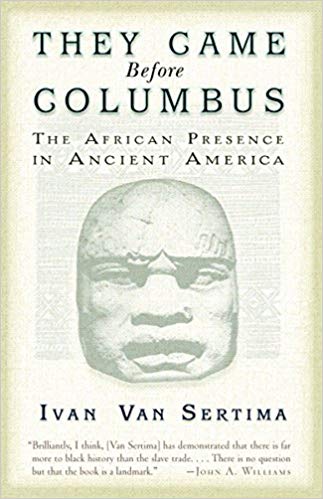
‘They Came Before Columbus, The African Presence in Ancient America’ by Ivan Van Sertima
As I have always said in the past, I truly despise the claim of The New York Times that Africa’s fabric is Dutch. This is simply a case of falsification of history. As I have proven before, African Fabrics and Textiles traditions is large, existent, and real; it is not just VLISCO-based. Below is an account by a European of African dressing in the 1400s! And yes… the Africans he met wore garments.
“They numbered seventeen, of considerable size. Checking their course and lifting up their oars, their crews lay gazing. … We estimated on examination that there might be about one hundred and fifty at the most; they appeared very well-built, exceedingly black, and all clothed in white cotton shirts: some of them wore small white caps on their heads, very like the German style, except that on each side they had a white wing with a feather in the middle of the cap, as though to distinguish the fighting men.
“A Negro stood in the prow of each boat, with a round shield, apparently of leather, on his arm. They made no movement towards us, nor we to them. Then they perceived the other two vessels coming up behind me and advanced towards them. On reaching them, without any other salute, they threw down their oars, and began to shoot off their arrows.”
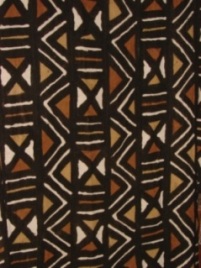
A piece of Bogolan
This encounter between the Portuguese and the boatmen on the Gambia occurred in 1455. It is the only account of West African riverboats documented by Europeans before the coming of Columbus.
G.R. Crone, The Voyages of Cadamosto, London, the Hakluyt Society, 1937, pp. 57-59
Ivan Van Sertima, They Came Before Columbus, The African Presence in Ancient America, Random House, 1976, p.54
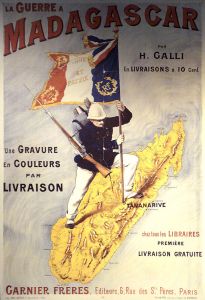
The treaty below with the Queen of Madagascar marked the full possession of Madagascar by France. It also marked the end of the Kingdom of Madagascar, or Merina Kingdom, officially known as Kingdom of Imerina. In essence, Ranavalona III, the last monarch of the Kingdom of Madagascar, tried to stave off the French colonization of her land by strengthening trade and diplomatic relations with the United States and Great Britain throughout her reign; however, French attacks on coastal port towns and an assault on the capital city of Antananarivo ultimately led to the capture of the royal palace in 1895, ending the sovereignty and political autonomy of the century-old kingdom. France officially annexed Madagascar on January 1, 1896.
As you read the treaty below, you could see the beginning of the schemes for the FCFA and the 11 Components of the French Colonial Tax in Africa we talked about a while back. Note that Madagascar was banned from dealing directly economically with foreign powers: everything had to go through France… isn’t this a predecessor to the FCFA?
=====
Queen Ranavalona III of Madagascar
H.E. the Queen of Madagascar, after reading the declaration of possession of the Island of Madagascar by the government of the French Republic, declares to accept the following conditions below:
Article I
The government of the French Republic will be represented to the Queen of Madagascar by a Resident General.
Article II
The government of the French Republic will represent Madagascar in all external relations.
The resident general will be in charge of relations with the agents from foreign powers. Matters of interest to foreigners pertaining to Madagascar will be dealt with by through him.
The diplomatic and consular agents of France in foreign countries will be in charge of the protection of Malagasy subjects and interests.
Article III
The government of the French Republic reserves the right to maintain in Madagascar the military forces necessary for its authority.
Article IV
Ranavalona III conceded defeat to the French in September 1895
The Resident General will control the internal administration of the Island.
H.E. the Queen of Madagascar commits herself to proceed to the reforms that the French government will judge useful for the economic development and the progress of civilization.
Article V
The government of H.E. the Queen of Madagascar is prohibited from contracting any loan without the authorization of the government of the French Republic.
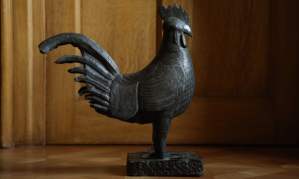
Bronze cockerel ‘Okukor’ at Jesus College in Cambridge (Source: The Guardian)
Another return of an artifact from a Western institution to an African country, which I applaud… but I remain guarded. Why am I skeptical? Well, because if over 50% of artifacts in the great museums of this world (Louvre, British Museum, MET, Tervuren, etc) which generate a lot of money, and knowledge to western schools, researchers, etc, is made up of looted treasures… will the benefactors of the loot willingly return these? And if they return these, who is to say that it is the real thing? One should not expect a thief not to cheat you again! Below are excerpts from the article in The Guardian. Enjoy!
====
Rooster from Benin Kingdom (18th century) at the Metropolitan Museum of Art (the MET)
A bronze cockerel taken by British colonial forces and donated to Jesus College Cambridge is to be returned to Nigeria in an unprecedented step that adds momentum to the growing repatriations movement.
The Okukor, described by the college as a “royal ancestral heirloom”, will be one of the first Benin bronzes to be returned to Nigeria by a major British institution since the punitive expedition in 1897 when thousands of bronzes were stolen from Benin City by British forces.
No specific date for return has been released but the college stated that the bronze cockerel “belongs with the current Oba at the Court of Benin”. The return was recommended by Jesus College’s Legacy of Slavery Working Party (LSWP), a group dedicated to looking at the institution’s connections to slavery, which confirmed the piece was donated in 1905 by the father of a student.
[…] Victor Ehikhamenor, a Nigerian artist and member of the Benin Dialogue Group, said: “No matter how small the gesture may look, it is a huge step towards the realisation of restitution of the works from the Benin Kingdom that were looted by the British. This is very important example, which I hope other Europeans, especially British institutions, will follow without any excuses or delays.”
Dan Hicks, a professor of archaeology at the Pitt Rivers Museum in Oxford and a representative of the Benin Dialogue Group, said: … “In the past, our attention on this matter was focused on national collections like the British Museum and the V&A – but in reality such loot is held in dozens of institutions across the regions: city museums, art galleries and the collections of universities.”
[…] The Jesus College announcement comes almost exactly 12 months after the release of a report commissioned by the French president, Emmanuel Macron, which recommended the return of colonial-era artefacts by France.
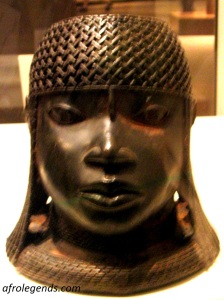
Queen from Benin kingdom (at the MET)
The report’s authors, the Senegalese economist Felwine Sarr and the French art historian Bénédicte Savoy, told the Guardian that the British Museum, which houses a huge collection of the Benin bronzes, was acting like “an ostrich with its head in the sand” by not acting faster on repatriations.
[…] Since the release of the report, Ivory Coast, Senegal and the Democratic Republic of the Congo have made formal requests for the return of artefacts. European countries including France and Germany have committed to handing back objects, with the Rijksmuseum in Amsterdam opening talks with Sri Lanka and Indonesia and describing the Netherlands’ failure to return stolen artefacts as a “disgrace”.
The news comes a week after Open Society Foundations (OSF) announced a $15m initiative aimed at strengthening efforts to “restore cultural objects looted from the African continent”. …
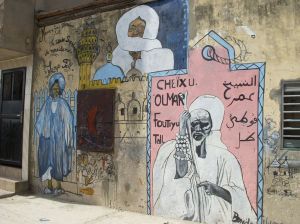
Mural in Dakar showing Omar Tall (Source: Wikipedia)
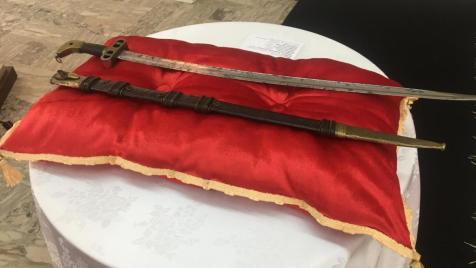
At first I was thrilled by the news that France had returned the sword of the Senegalese hero Omar Tall, … until I read the fine prints! Then I read that this was a temporaryreturn, more like a 5-year loan to Senegal, until the French parliament approves whether to permanently return it or not. Moreover, the sword was already on loan at a Museum in Senegal. Nevertheless, you will notice like me that the media titled it a ‘return.‘ In reality, this is more like a publicity campaign for the French who seemingly appear to be returning looted treasures.
Before delving into the excerpt below from the BBC article, it is good to say a few words about Omar Saidou Tall or Umar Tall, and why he is so venered by Senegalese. Omar Saidou Tall was a religious, political, and military leader who fought against French colonization in the region then known as French Sudan which encompassed Senegal, Mali, and Guinea. He opposed a fierce resistance to the French from 1857 to 1859. Senegalese tend to remember him as a hero of anti-French resistance, while Malian sources tend to describe him as an invader who paved the way for the French by weakening West Africa. We will go deeper into his life and legacy in the next post.
======
France has restored to Senegal a sabre that belonged to a 19thCentury Islamic scholar and ruler.
It is part of a commitment to return to its former West African colonies key items of their cultural heritage.
The artefact originally belonged to the revered west African leader Omar Saidou Tall, who led an anti-colonial struggle against the French.
… Mr Philippe [France’s prime minister] said it was “the first step” in a project aimed at returning more Senegalese artefacts currently in French museums, which hold at least 90,000 artefacts from sub-Saharan Africa.
Their official report states that most of the Africa collection in Paris’ Quai Branly museum – approximately 46,000 pieces – was acquired with some degree of duress [not sure that they will return all these artefacts and leave their museums empty].
“It’s symbolic. It had been lent to us before, but now it is being restored to us,” the head of Dakar’s Museum of Black Civilisations Hamady Bocoum told AFP news agency about the sabre.
The curved iron, brass and wood sword has been kept in its leather sheath in the museum in Senegal’s capital on loan from France. But Sunday’s ceremony saw the item formally returned for a period of five years.
The next stage will be for French MPs to vote on whether to permanently return this and other artefacts.
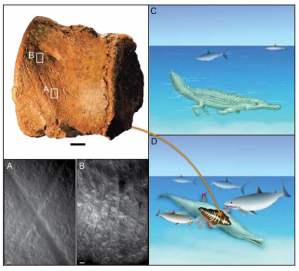
Some of the sea creatures that lived underwater in the location where the Sahara desert is today. (Source: American Museum of Natural History 2019)
Given that Africa is the cradle of humanity, it totally makes sense that it would also be the place where some the world’s largest sea creatures hail from. The excerpt below from the Guardian reveals that the Sahara was home to some of the world’s largest sea creatures. Enjoy!
=====
Scientists reconstruct extinct species using fossils found in northern Mali from ancient seaway
Some of the biggest catfish and sea snakes to ever exist lived in what is today the Sahara desert, according to a new paper that contains the first reconstructions of extinct aquatic species from the ancient Trans-Saharan Seaway.
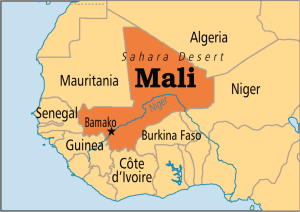
Map of Mali with its capital Bamako
The sea was 50 metres deep and once covered 3,000 sq km of what is now the world’s biggest sand desert. The marine sediment it left behind is filled with fossils, which allowed the scientists who published the study to build up a picture of a region that teemed with life.
Between 100 m and 50 m years ago, today’s arid, boulder-strewn northern Mali “looked more like modern Puerto Rico”; the sun shone on some of the earliest mangroves, and molluscs lined the shallow seabed, according to Maureen O’Leary, the palaeontologist who led the study.
Reconstruction of sharks feeding on a dyrosaurid crocodily form. (Source: American Museum of Natural History 2019)
The study also formally named the geological units, literally putting the area on the geological map for the first time, showing how the sea ebbed and flowed over its 50 m years of existence, and building up information about the K-Pg boundary, the geophysical marker of one of Earth’s five major extinction events, in which the non-avian dinosaurs became extinct.
With 1.6 m catfish, 12.3 m sea snakes and 1.2 m pycnodonts – a type of bony fish – O’Leary and the other scientists developed the idea that in the late Cretaceous and early Paleogene period, the animals were experiencing gigantism.
Evolutionary biologists have long talked about the phenomenon of island gigantism, where species that live on small islands can sometimes develop very large bodies, possibly because they have more resources or there are few predators, or both.
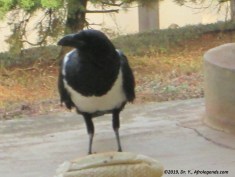
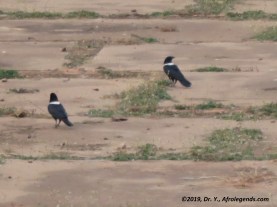
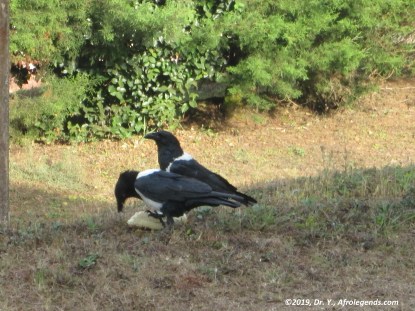
A few years back, my father was visiting Melbourne in Australia, when he heard a bird crowing around. So he asked an Australian lady nearby what bird that was, and she answered the crow… and my dad went on to tell her that in his country, the crow had a white collar, and sounded just like that… so the lady chuckled and said, “so you have a Nike-collar crow in your country.” So meet the Nike-collared Crow.
Crows in Rwanda
When I first moved to the West, I never understood why people taught of the crow as a bad bird, or rather a bird of bad omen. When I asked, they told me because of its black coat, and black feathers, and because of its cry. This sounded totally weird to me… why? Because in African culture, the crow is not a bad bird, or a bird bringing ominous news. It is actually a good bird. Not only that, but the crow is not an all-black bird, but it has a white collar. I was surprised to find this white-collared bird in Cameroon, in Rwanda, and in other places, thus telling me that the white-collared crow is indigenous to Africa.
With the white collar, isn’t your perception of the crow changed?
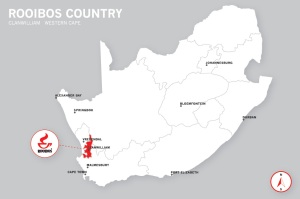
Have you ever heard of rooibos ? Have you ever tasted rooibos tea? Well, as it is named, rooibos stands for red bush in Afrikaans, as denoted by its color. It is very popular in Southern Africa and has been consumed for centuries by the local indigenous Sānand Khoi people. It grows exclusively in South Africa, in the Cederberg mountains north of the city of Cape Town. The leaves are used in a herbal tea, whose color is red like that of hibiscus tea. Traditionally, the local Sānpeople would climb the mountains and cut the fine, needle-like leaves from wild rooibos plants. They then rolled the bunches of leaves and brought them down the steep slopes using donkeys. The leaves were then chopped with axes and bruised with hammers, before being left to dry in the sun. Later on, once the European settlers had taken over the trade, no recognition to the indigenous people knowledge and input was given… until last week! Check out excerpts from the article published on South Africa’s Mail and Guardian below, and do not forget to follow the link for the full article.
=====
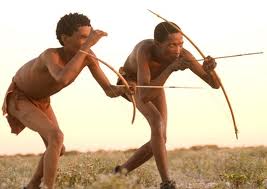
San (Basarwa/Bushmen) hunters
Transformation in the rooibos sector has been slow. The genocide of the indigenous San people and the virtual enslavement of the Khoi people in rooibos-growing landscapes of the Cape centuries ago, coupled with a government-controlled monopoly during the apartheid years, has led to a highly skewed and fractured industry.
Today, this R300-million local enterprise remains in the hands of about 300 white commercial farmers who cultivate 93% of the planted area. About 200 small-scalecoloured farmers — largely confined to the dryer, more marginal parts of the winter rainfall fynbos region — produce only 2% of all rooibos tea.
A benefit-sharing agreement announced today by the minister of environmental affairs — between the rooibos industry and representatives of San and Khoi organisations — could signal the beginning of a change. More than R10-million a year — depending on weather, volumes and the price of rooibos — is likely to be distributed to trusts set up by San and Khoi organisations.
Rooibos region in South Africa (source: rooibosltd.co.za)
If implemented judiciously and strategically, this could well change the face of rooibos in South Africa.
[…] At the agreement’s core is an annual traditional knowledge levy of 1.5% of the price that is paid by processors to farmers per kilogram of harvested rooibos. After being deposited into the government’s bioprospecting trust fund, the levy will be paid in equal parts to the San Council and National KhoiSan Council. “Rooibos indigenous farming communities” — defined as “rural farming communities in rooibos growing areas who consist of descendants of original Khoi-Khoi peoples” — are to receive a portion from the trust set up for the Khoi people although the exact proportion has not yet been determined.
Non-monetary benefits will also be “explored” and could include the creation of employment opportunities, bursaries, development schemes, mentoring and the facilitation of livelihoods.
A cup of rooibos tea (source: MedicalNewsToday)
The agreement is a landmark, not only because it acknowledges the indisputable contribution made by traditional knowledge holders towards the establishment of the industry, but also because it could bring significant material benefits to indigenous San and Khoi people, many of whom remain marginalised and poverty stricken.
That the agreement offers restorative justice is undeniable, but the road ahead is far from smooth. Questions of how exactly benefits will be shared at a local level remain unresolved, and could result in conflicts. The long and troubled history of these oppressed communities has included dislocation, fracturing of family and community structures, and the undermining of people’s own initiatives.
The presence of strong, effective and transparent governance structures and sound external support will be essential to manage conflicting priorities proactively and ethically so that real benefits can be derived by all of the intended beneficiaries. …
Ruins of the Ancient city of Hippo Regius, modern-day Annaba (Source: Wikipedia)
I always loved the name of the city Annaba in Algeria. From the name, one could think that we are talking about a city in subsaharan Africa. I used to think that the origin of its name would be Berber or from somewhere in sub-Saharan Africa.
Annaba is the 4th largest city of Algeria, after Algiers, Oran, and Constantine. It is a coastal city which has grown tremendously, like most cities around the globe, in the 20th century. Present-day Annaba grew up on the site of Aphrodisium, the seaport of the Roman city Hippo Regius. The modern city has since expanded south over Hippo’s ruins as well. Its former names Bôneand Bonaderived from “Ubbo“, a local form of the name Hippo. Its informal name “Land of the Jujubes” derives from that abundance of that fruit in the region.
Bona, Algeria in 1899 (modern-day Annaba)
Annaba, as one of the most ancient cities of Algeria, founded in 1295 BC, has had different names during her life: Ubbo, Hippo Regius, Hippone, Bona, Bled El Aneb, Bône, and nowadays Annaba. It was known as Balad al-Unnab or the “Land of the jujubes” from which the name Annabais derived, because of the abundance of that fruit in the region.
During the rule of France (empire and republics), the city was called Bône. It was one of the main French settlements, and it still has a sizeable minority of the “Pied-Noir” to this day. During World War II in 1943, Bônewas a crucial highway and sea location for the invasion of Tunisia, and thence the driving of the Axis Powers (Germany and Italy) out of Africa in May 1943. Bône remained in Allied hands until the end of the war in 1945, and then it remained a part of French Algeria until the independence of Algeria in 1962.
Bone, Hotel de Ville during the colonial period
The city is an important hub of the world steel industry with the steel complex of El Hadjar, eight kilometres south of the city. It is the largest in Africa. Phosphate and metal industries are also prominent in the area. Other industrial sectors, private, focus on agri-food, metal processing, wood products, and construction.
Annaba is an important centre for tourism, and is one of the major tourist attractions in the western Mediterranean. It is located in the north east of the country, at 536 km east of Algiers and 105 km from the Tunisian border.
Panoramic view of Annaba’s sea front (Source: Wikipedia)
The downtown district of Annaba is on the sea-front, and includes the promenade called the Concours de la Revolution (previously called Le Cours Bertagna) which is a lively area, brimming with arcades and all kinds of covered restaurants, terraced cafes and kiosks. If you visit Annaba, remember to taste the Jujubes and enjoy the sea!!!
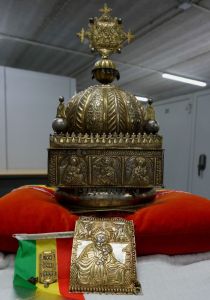
The crown is currently being stored in a highly secured facility in the Netherlands (Source: BBC/AFP/Getty)
This was a good news and had to be shared. Enjoy! It is from the BBC.
=====
An 18th Century Ethiopian crown will finally be returned home after being hidden in a Dutch flat for 21 years.
Ethiopian Sirak Asfaw, who fled to the Netherlands in the late 1970s, discovered the crown in the suitcase of a visitor and realised it was stolen.
The management consultant has protected it until he felt safe to send it back.
“Finally it is the right time to bring back the crown to its owners – and the owners of the crown are all Ethiopians,” he told the BBC.
18th Century Ethiopian crown with depictions of Jesus Christ (Source: SkyNews)
The crown is thought to be one of just 20 in existence. It has depictions of Jesus Christ, God and the Holy Spirit, as well as Jesus’ disciples, and was likely gifted to a church by the powerful warlord Welde Sellase hundreds of years ago.
It is currently being stored at a high security facility until it can be safely returned.
… “I want this crown to be a symbol of unity and togetherness,” Mr Sirak said. “The crown will be celebrated by all of us Ethiopians, even Africans.”
What happens when a colonizer visits the court of an African King in the 19th century? How do the two cultures collide? Below is a description of an audience at the court of the great king Samori Touré, by the French commander Marie Étienne Péroz who even wrote a book later “Au Soudan français : souvenirs de guerre et de mission,” C. Lévy, 1889. As you can see, the European man is in awe at what he sees in court, the arrangement, and most importantly the calm confidence and simplicity emanating from Samori Touré. Also note the importance of Samori’s griot, Ansoumana, “without whom no decision is taken.” Enjoy! The original in French can be found on p. 281 of Les Africains, Vol.1, Editions du Jaguar, 1977. The English translation is brought to you by Dr. Y., Afrolegends.com.
======
The number of important personalities who had been summoned to it [the meeting], the riches and the pomp of the occasion, indicated the importance the almamy attached to it.
We were, ourselves, very impressed by the skill of the décor of which the original setting of the mosque, dungeon, high huts and ramparts of the palace had been done to enhance its brilliance (beauty). We slowly get closer, guided by Karamoko, towards the large canopy which shelters the Almamy and its court.
The Almamy is half lying on an elevated tara where blankets with bright patterns are piled up. He is simply dressed: Moorish boots, a black turban, a dark-colored caftan under which can be seen a white boubou. His headgear, a kind of diadem in finely chiseled gold and a necklace of the same metal deliciously crafted are the only insignia revealing his rank. His entourage, on the contrary, sitting on very low armchairs, brings out the severity of this costume by means of garments in showy colors in which they are clothed: this variegation of colors gives a warm tone to the entire scene. On his left, squatting on the ground and against his tara, Ansoumana, his family griot, without whom no decision is taken: he is wearing a blue boubou, and a black smock. Then, on the same side, Kissi, the head of treasury, whose green boubou constellated with grigris, throws the first happy note.
Samory does not get up when we dismount [from the horse]. We stop in front of him after greeting him and he extends his hand in a very affable way. From all sides explode the raucous accents of the horns, adding into the hum of the tam-tams, and the rumbling of the Almamy’s war drum. […]
Vivid reception at the Almamy’s court (Les Africains, Vol.1 , P. 281, editions Jaguar)
The dreadful noise of instruments of all kinds greeting our arrival prevents at the beginning of all conversation, and covers the words of welcome he addresses us in a veiled tone; thus do we take this reprieve to admire in all sincerity the striking spectacle taking place in front of us.
What strikes us at first sight is the form he affects as a whole: the crescent. Just as his entourage is arranged in such a way which may appear to be the results of chance, but which, in reality, is very skillfully calculated so as to form a happy harmony of colors and forms, just as the security escorts of the different leaders who accompany him form in front of his dais a perfect half-oval, which leaves between him and them a vast place covered with white sands brought in from the river.