It is extremely hot today! When I think that temperatures could go up to 40C… I have a shiver or rather a sweat. This makes me think of having ice cream, African ice cream. Today I am introducing you to a small trade in Cameroon… that of selling ice cream… When we were growing up, we used to call them ‘lapon‘… How did you call them in your country? Enjoy! and cool down!
Aujourd’hui, il fait très chaud! Quand je pense que les temperatures pourraient avoisinner les 40C… je grelotte… oh pardon, je transpire! Mais cela me donne envie d’une bonne glace rafraîchissante, une glace africaine. Aujourd’hui, je vous introduit à un petit métier au Cameroun, celui de vendre de la glace (vente ambulante)… Quand nous étions petits, nous les appellions ‘lapon‘… comment les appelliez-vous chez vous? Savourez! et rafraîchissez-vous!
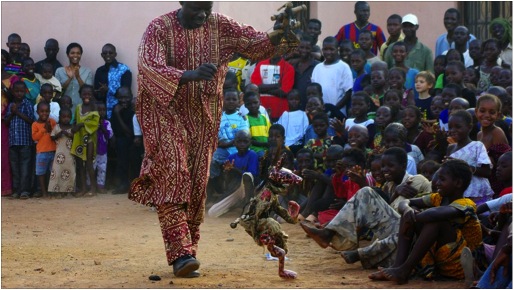
A few days ago, I came across a photo-article on BBC about the life of an African puppeteer. I thought that this fits well with the section ‘Great Art’ of this blog. Indeed, the craft of African puppeteer in Mali, and many other African countries (Niger, Angola, DRC, Togo, South Africa, etc), is passed on from generation to generation. The man interviewed in the BBC photo article, Yaya Coulibaly, said that his family had been African puppeteers since the 11th century. He learned the craft at the age of 12, and greatly cherishes the opportunity to make children and adults laugh in villages across Mali and the world. He has an entire collection of thousands of puppets accumulated over the years, and passed to him by his forefathers. He is not only a puppet master, but an adept storyteller, leaning on centuries of Malian legends, and tales. The puppets are made of wood, and in some areas of Africa, raffia is also used to make the puppets’ dresses. The art of puppeteering was first recorded in 2000 BC in Egypt, where most puppets were painted with natural colors using plants and roots; some puppets made of clay and ivory have been found in some ancient Egyptian tombs. Today, Mr. Coulibaly uses acrylic paint, and covers his puppets with bright colors (his own signature). His performances usually last about 1 h, and as always in African ceremonies, drums play a major part of the show. He has his own puppet company called Sogolon, which employs about 15 people.
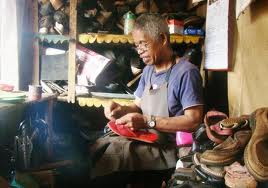
The other day, I realized that my favorite shoe’s sole was falling apart. I thought about taking it to some shoemaker, but my friends said ‘here in the west, there are barely any shoemaker… it will cost you more to repair a pair of shoes than buying… we just throw that shoe away, and then better just buy another one!’ I know in the West, capitalism prevails… but I don’t see the point in throwing away such a rare shoe (out-of-stock) and buying a not-so confortable one. For those with particularly delicate feet, when one finds a good pair of shoes, one tries to hang to it as much as possible. Then I thought about shoemakers back home. Oh, how I wish I was back home. There are shoemakers everywhere! In every neighborhood, there are shoemakers. Today, I will expose you to the small trade of shoemaker in Cameroon (Central Africa). It is actually an art… not everyboday can be a good shoemaker. In Cameroon, there is the static shoemaker who has a shop in almost every neighborhood, and then the mobile shoemaker who just has a tool box and walks around the neighborhoods with his tools. The static shoemaker also makes shoes of his own, usually by using goat skin to make shoes known as ‘Samara‘ or rubber to make those known as ‘tchang shoes‘. It is beautiful to watch them at work. It is really an art! Enjoy this video about the static shoemaker. Next time, it will be the mobile shoemaker.
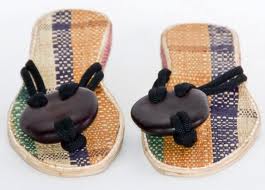
Des Samaras
L’autre jour j’ai realisé que ma paire de chaussures préferée tombait en lambeau. J’ai pensé à l’apporté chez un cordonnier, mais mes amis m’ont dit: ‘Ici en Occident, il y a très peu de cordonniers… ca va te plus coûter cher de reparer ta chaussure que d’acheter une nouvelle… Nous on jette ces paires-là, et on en achete de nouvelles!’ Je sais qu’en occident, le capitalisme prévaut… mais je ne comprends pas pourquoi je devrais jeter une paire de chaussures aussi rare et encore en bon etat, et acheter une autre moins confortable. Pour ceux qui ont les pieds délicats, dès qu’on trouve une bonne paire de chaussures, on essaie de la garder aussi longtemps que possible. Et cela m’a fait pensé aux cordonniers là-bas au pays. Oh combien j’aimerais être au pays! Il y a des cordonniers partout… dans tous les quartiers! Aujourd’hui, je vais vous parler du métier de coordonnier au Cameroun (Afrique Centrale). C’est en fait un art… ce n’est pas tout le monde qui peut être coordonnier. Au Cameroun, il y a le cordonnier statique qui a une boutique ou échoppe et qu’on retrouve dans tous les quartiers, et le cordonnier ambulant qui a juste sa boîte à outils et se promène dans tous les quartiers de la ville avec ses outils. Le cordonnier statique fabrique aussi des chaussures, en utilisant soit la peau de chèvre tannée ou du raffia avec lesquels il fabrique des chaussures communément appelee ‘Samara‘, ou du caoutchouc pour faire celles qu’on appelle ‘tchang-shoes‘. Aujourd’hui, je vous offre de regarder une vidéo sur le coordonnier statique. Le cordonnier ambulant sera pour la prochaine fois!
Le raphia (raffia) est un des nombreux palmiers qui poussent à travers l’Afrique, plus particulièrement en Afrique centrale, et à Madagascar. L’arbre de raphia (raphia farinifera ou raphia ruffia) a de très longues feuilles qui peuvent atteindre jusqu’à 18 m de long. Chaque branche du raphia peut avoir au moins 100 petites feuilles. La fibre de raphia, telle celle de jute, est douce, flexible et robuste. Le raphia est utilisé en Afrique pour diverses utilisations, notamment pour faire des meubles de maison (tabouret, table), pour faire les toitures internes des maisons, les lits (communément appelé lit de bambou de raphia), de longues ficelles pour grimper sur les arbres; mais aussi dans l’industrie vestimentaire, pour faire des chapeaux, des paniers, etc. A Madagascar, la fibre de raphia est aussi utilisée pour concevoir une tenue vestimentaire traditionelle appelée rabanne. Aujourd’hui, la fibre de raphia est exportée à travers le monde! Cherchez bien… vous retrouverez le raphia dans votre maison!
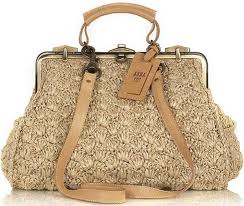
Anna Sui Raffia purse
Dans la video qui suit (du Cameroun), vous assisterez à la fabrication d’un tabouret traditionnel fait à base de bambou de raphia!
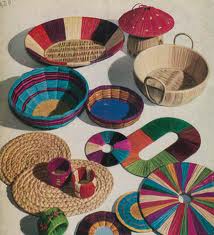
The raphia (raffia) is one of the numerous palm tree species found in Africa, particularly in central Africa and Madagascar. The raffia palm tree (raphia farinifera or raphia ruffia) is made of long leaves that can attain up to 60 ft (18 m) in length. Each raffia palm branch is made of nearly 100 leaflets. The raffia fiber, just like jute, is soft, pliable, and strong. Raffia is used in Africa for various applications such as to make furniture (table, chairs), internal roofs to houses, beds, to make ropes used to tie up plants, and binding together vegetables to be marketed; but also in the clothing industry to make hats, shoes, baskets, and mats.
Raffia baskets
In Madagascar, people use raffia to make a native cloth known as rabanne. Today, the raffia fiber is exported throughout the world. Look carefully,… you might find some raffia lying around the house!
The following video shows the fabrication of a chair using the raffia bamboo, in Cameroon. Enjoy!
Je ne sais pas si vous vous êtes jamais assis pour observer une vendeuse de beignets. L’adresse avec laquelle la vendeuse frappe la pâte entre ses mains avant d’en faire des boules qu’elle jette dans l’huile avec une main d’experte…. Cette adresse est digne des plus grands chefs du monde. Elle jette les boules dans une grosse bassine d’huile chaude, avec une telle agileté, et un de ses arts, tout ça sans jamais se brûler! Rien que la voir à l’oeuvre vous met l’eau à la bouche. Prenez la peine de savourer cette video d’une vendeuse de beignets de Douala, au Cameroun et léchez-vous les babines! Que ce soit des B.H. (beignet-haricot au Cameroun) ou des boflotos (de Côte d’Ivoire), ou des bédoumés (somnifères) Gabonais,… allez-y regalez-vous!
Have you ever taken the time to watch a puff-puff seller in full action. The skill that she displays as she beats the dough in her expert hands before throwing the donuts (puff-puff) in the oil… this skill is comparable to that of the greatest chefs of this world. She throws the donuts in a big basin of hot oil, with such agility and such a great mastery, all of that without ever getting burned! Just looking at her makes your mouth watery. Please take the time to enjoy this video of a puff-puff seller in Douala, Cameroon, and lick your lips with delight! Whether you call it B.H. as in Cameroon, or boflotos in Cote d’Ivoire, or even bédoumés in Gabon, go ahead and enjoy yourself!
Today, I would like to talk about palm wine. Have you ever tasted palm wine? hummmmmh so sweet! So good! so delicious! or rather palmilicious! Palm wine or white wine made in Africa or raffia wine is wine from the sap of the palm or coconut tree. It is actually white in color, not transparent like its European counterpart.
Tapper harvesting palm wine
Palm wine sap is gathered in two ways. The first: A tapper extracts and collects the sap from the tree by making a triangular cut onto the raffia tree just like during the harvest of hevea: a receptacle is attached to the tree where the cut was made, and the sap can thus be collected. The second way involves cutting down the tree and allowing it to lie for two weeks. After, a rectangular well is cut in it. At this stage, a bamboo tube is inserted into the well to drain the sap as it collects. The quantity of sap that is extracted from one palm tree depends on the mode of extraction, the palm species, season and the fertility of the soil. The white liquid that comes out is at first very sweet and non-alcoholic: this is what we as kids would love to drink. Fermentation begins naturally and immediately after collection. After fermentation, the liquid becomes alcoholic and has some sourness and acidity to it. It could sometime happen that we would drink it two – three hours after collection, and it would still be good, but would have a sour after-taste to it. After one day, it is fully alcoholic, and more than one kid has certainly fallen to it!
The Palm Wine Drinkard by Amos Tutuola
In the old days, and at night in the village, children and adults will sit around the fire to hear storytelling from a village elder while enjoying some palm wine, grilled corn or grilled safou! It is drank at celebrations, weddings, etc… Chinua Achebe mentions palm wine in his novel “Things Fall Apart“, and it is the title of the novel by Amos Tutuola “The Palm Wine Drinkard“. In Cameroon, it is harvested from raffia palm tree, and collected into a container communally called ‘dame-jeanne’. The traditional version of this container is also made from raffia or African bamboo wood! Palm wine is often called ‘matango‘ in the Cameroonian slang. What is it called in your country?
Please enjoy this great video about the harvesting of palm wine from Cameroon!
I also liked this lady’s description of her first taste of palm wine: Palm wine drinkards.
When you love greatness… you come across greatness. A couple of years ago, I watched the Oscars, and one of the nominees for international movies was the South African operatic version of Carmen of Bizet. This made me wonder if there was another orchestra on the continent playing the arts of Mozart, Vivaldi, and Beethoven, to name just a few… and what would that be in an African language. Few days ago, I came across an article on the BBC talking about the Kinshasa Symphony Orchestra. I was so proud to see that this orchestra was entirely founded by Congolese themselves. The ‘Chef d’orchestre’ was a Congolese gentleman who had started the orchestra in 1993 (Armand Diangienda)… and kept it throughout the years. He merged two great musical traditions using Western musical instruments to create Congolese classical music. With time, the orchestra grew: in its early days, it started with 5 cellos for 12 people; now the orchestra counts over 100 members! They even compose their own music in Lingala! Isn’t it amazing? Orchestra members come from all works of life: from cooks, teachers, ‘vendeurs a la sauvette’ (bayam-selam), tailors, to journalists, professors, etc… They are from all ages: mothers, parents, singles… etc… So great was my surprise that I had to write this article and leave you with this great video… Enjoy: Symphony orchestra made in Congo, by Congolese people, for all! Delightful !!!
Please also check the official website for the documentary: Kinshasa Symphony
The Obom, in Fang-Beti (Cameroon) language, means tissue of the bark of the Aloa tree. The bark of the “aloa” tree – a widespread tree in the equatorial forest, particularly originating from Cameroon my home country, – was used in former times for the manufacture of loincloths. The Aloa tree has a fibery bark, and is a soft white wood; it grows quite fast, and once at maturity, its flowers drop seeds which grow around the tree. This natural fibre is obtained in Cameroon in traditional ways. The bark layers which have a thickness of 1 to 2 mm, are treated as intact sheets with water steam and are subsequently softened by beating. The full description on how the Obom is extracted can be read in full from the webpage of Etolo Eyah, a Cameroonian artist master of Obom.
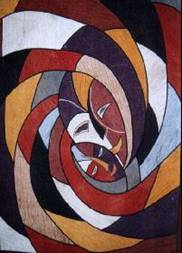
Obom painting by Arlette D. Efang
The originality, beauty, and genuineness of the obom bark in combination with modern fabric and leather confers to any creations a touch of exclusivity, in a very ‘green’ manner, leading to sustainable development and handicraft.
Hat made out of Obom bark
The obom enjoys the reputation of being a material of great value and is therefore often also used as canvas for paintings, in witness of the riches of their owners; there are several Cameroonian painters who particularly use the Obom as canvas. This natural fibre can be machine washable and ironed. The use of the obom bark in modern couture is unique. I can testify of this because I have a hat made up of Obom which I have had for over 12 years! Please check out the websites of several stylists and painters, such as Martial Tapolo, Cornelia Orsucci, Peter Musa, Otheo, and Arlette Dorothee Efang, to name just a few. The video below just shows the processus of harvesting and cleaning the tree bark; the bark shown is not obom!
Le génie incontesté du Zouk Africain n’est plus! J’ai les yeux remplis de larmes, et l’âme fendue, car c’est encore hier que j’écoutais ‘Bane‘, Nge‘, ‘Bijou‘, ‘Chérie‘, ‘Adia‘, et ‘Assombo‘! Oliver N’Goma (affectueusement NOLI) est un artiste Gabonais, dont la voix suave a fait vibrer l’Afrique toute entière au rythme du Zouk en langues Gabonaises. A mon avis, le don d’ Oliver se mesurait par l’amour des choses bien faites, des melodies dansantes, et de la recherche de la perfection! L’on pouvait ressentir dans sa musique les rayons de soleil sur la peau, et la joie de vivre. Beaucoup disent qu’il devait certainement être un grand amoureux, et adorer les femmes… car à travers ses mélodies, l’on se sentait bercer par l’amour et chaque femme se sentait belle et desirée! La chanson ‘BANE‘ sortie en 1989 fait partie des plus grands hits de la musique africaine moderne a l’egal de ‘MARIO‘ de Franco, d’ANCIEN COMBATTANT de Zao, de PATA PATAde Miriam Makeba, ou encore de KWASSA KWASSAde Kanda Bongo Man. Ce titre est marqué par un equilibre entre la richesse mélodique africaine, et une rythmique zoukante très efficace pour la danse. L’album BANE, devient l’une des plus grosses ventes de l’histoire de la musique africaine. Depuis 1990 aucun autre titre n’a réussi à faire ombre à BANE dans les hit-parades comme dans le coeur du public. L’album ‘ADIA‘ qui voit le jour mi-décembre 95, est un melange parfait de sophistication et foisonnement rythmique. En 2001, apparait ‘SÉVA‘, suivit de ‘SAGA‘ en mai 2006. Tous ces titres confirment clairement le status de roi incontesté du Zouk Africain conferé a Oliver N’Goma! Cher Oliver, tu nous manqueras certainement, mais ton oeuvre bercera l’humanité pour les siecles a venir! Si j’etais reine, je te confererais le status de Roi! Love…
Oliver N’Goma, the king of Afro-Zouk is no longer! Hailing from Gabon, Oliver is one of those artists who only come once in a generation, and whose love for perfection make them unforgettable! His title and album ‘BANE‘ has become one of the most sold singles and albums in the history of African music; it combines warm lyrics, suave melody, and dancing rhythms only found in African cultures! Oliver N’Goma’s music transcends age, race, and gender… Oliver’s love of life could be felt in his music. He was a genius, whose music confered love, life, joy, and peace. Oliver, you will sorely be missed, but your music will remain with us forever. Love…
Alphadi is an African stylist from Niger, with Touareg origin who, just like Pathe’O and Chris Seydou, has revolutionized African fashion. Alphadi was born in Timbuktu Mali from parents who were traders. Alphadi’s gift was born from applying makeup on his sisters and mother as a young child. Very young he was fascinated by anything that could enhance feminine beauty. He hails from Niger, a muslim country where fashion and men don’t quite go together, and are not viewed well. However, this has not stopped Alphadi. After studies in tourism, and actually serving as director in the ministry of tourism in Niger, Alphadi finally decided to start his own line. In 1987, he was awarded the price for Best African Designer by the French federation of Couture and Pret-a-porter. In 1998, he won the Prince Claus Award, while in 1999, he won the Kora award for fashion, and in 2001Chevalier de l’Ordre de Merite de la France. Alphadi’s work is recognized everywhere: Niamey, Abidjan, Paris, Brussels, New York, Tokyo, etc…
Alphadi’s creation at a fashion show 2009
To encourage fashion on the African continent, he has also created the International Festival of African Fashion (FIMA) organized in his native country of Niger. Even though this event is viewed by radical muslims in his country as being wrong, and his life was even threatened, Alphadi has decided to continue bringing light to his country’s culture and beauty through his art, inviting stylists (such as Yves Saint Laurent, Ralph Lauren, etc…) and models from all over the world to Niger.
Alphadi’s creation
Alphadi’s originality is founded in the rich traditions of the Songhai, Zarma, Mbororo or Wodaabe, Haoussa and Touareg people. His insolent style allies itself with audacious lines and forms, creating a balance between the desert and western influences where he gathered his first experiences. In 1999, Alphadi widened his label by creating along side of his haute couture line a new, more sportswear line called “Alphadi Bis”. He also created with Wrangler “Alphadi Jeans” for a younger crowd. And in 2000, he launched l’Air d’Alphadi, the very first perfume by an African couturier.



















 African Heritage