A blog about African history, and heritage, through audio and video files.
Author: Dr. Y.
I am an African in love with the history of the world, and particularly that of Africa. I am a child of love, an artist, a scientist, a lover, a friend, a human.
I am in love with nature and beautiful things, art, history, geography, travel, dance, food, science, and technology, and much more.
Celui qui marche sur le fumier, devra se laver les pieds(Proverbe Bahumbu – République Démocratique du Congo (RDC)). – Qui s’y frotte, s’y pique.
Whoever walks on manure, will have to wash his feet (Bahumbu proverb – Democratic Republic of Congo (DRC)). – If you go looking for trouble, you will find it.
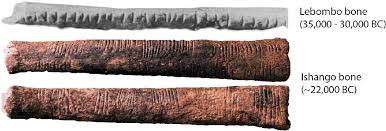
Have you ever heard of the Lebombo Bone? It is even older than the Ishango bone. It is indeed the oldest known mathematical artifact in the world. Discovered in the 1970s in Border Cave, a rock shelter on the western scarp of the Lebombo Mountains in an area near the border of South Africa and Swaziland (now Eswatini). The bone was found on the Eswatini side, and dates from 35,000 BC. It consists of 29 distinct notches that were deliberately cut into a baboon’s fibula.
The bone is between 44,200 and 43,000 years old, according to 24 radiocarbon datings. This is far older than the Ishango bone with which it is sometimes confused. Other notched bones are 80,000 years old but it is unclear if the notches are merely decorative or if they bear a functional meaning.
According to The Universal Book of Mathematics, the Lebombo bone’s 29 notches “may have been used as a lunar phase counter, in which case African women may have been the first mathematicians, because keeping track of menstrual cycles requires a lunar calendar.” However, the bone is clearly broken at one end, so the 29 notches may or may not be a minimum number. In the cases of other notched bones since found globally, there has been no consistent notch tally, many being in the 1–10 range. The Lebombo bone resembles a calendar used by the early men of the area, coming from the San clans of Namibia; this way of making tallies is still used by the San people today.
Top image: Lebombo bone. Bottom: Ishango bone with prime numbers engraving (J.D. Loreto and D.H. Hurlbert Smithsonian)
According to The Universal Book of Mathematics, the Lebombo bone’s 29 notches “may have been used as a lunar phase counter, in which case African women may have been the first mathematicians, because keeping track of menstrual cycles requires a lunar calendar.” However, the bone is clearly broken at one end, so the 29 notches may or may not be a minimum number. In the cases of other notched bones since found globally, there has been no consistent notch tally, many being in the 1–10 range. This resembles a calendar used by the early men of the area, coming from the San clans of Namibia. These represent the earliest unambiguous evidence for modern human behavior. An article in the Proceedings of the National Academy of Sciences (PNAS) on recent archaeological discoveries, “Early evidence of San material culture represented by organic artifacts from Border Cave, South Africa” , has shown that bone tools were already present 75,000 years ago and were used in San culture.
To anyone who ever doubted it, Africa is indeed the cradle of humanity… and women (if it is indeed a lunar tool) were quite advanced mathematicians 35,000 years ago, using calculators to make lunar calendars!
Les eaux stagnantes sont mangeuses d’hommes (Proverbe Luba – République Démocratique du Congo (RDC), Zambie, Angola). Méfiez-vous des gens qui ne disent rien.
Stagnant waters are man eaters (Luba proverb – Democratic Republic of Congo (DRC), Zambia, Angola). Beware of people who do not say anything.
For this year’s Mother day, I decided to post Lesline’s rendition of “Sweet Mother” by Prince Nico Mbarga. As I told you in my past post, Mbarga’s ‘Sweet Mother‘ is the most loved and most popular African song of all times. Enjoy Lesline’s rendition of this African classic on The Voice Afrique Francophone season 1, and remember to love and pamper your mother this Sunday! Happy Mother’s day.
Below is the translation of a letter in which the Kings and Chiefs of Little Popo and Grigi in Togoland (actual Togo) are asking for their lands to be placed under the protection of the German Imperial Majesty the Kaiser, i.e. to be placed under German protection, or rather placing (not knowing the full extent) their lands under German protectorate. This was signed on March 5th of 1884. Remember that Little Popo is now known as Aného in Togo. Grigi might have been the town of Glidji.
====
Map of Togoland in 1885
I. We, the signatories, Kings and chiefs of Little Popo and Grigi, express our gratitude to Your Majesty for having assisted us in upholding peace in our land.
II. There would be no threat and no uncertainty, if the British government would refrain from interference in the affairs of our lands, which it desires, while we desire her not to have it.
III. We ask Your Majesty to provide us with protection and to avoid such an annexion.
IV. We implore Your Majesty to come to our aid, as we have placed ourselves fully under your protection.
V. We humbly request to take quick action.
signed King Aiaushi Agbanor of Little Popo and Grigi, Caboceer Quadjovi, chief Pedro Quadjo and 11 other signatures
Today, I present to you the text of the treaty signed between King Mlapa– the King of Togo, or rather his representative Chief Plakko or Plakkou, and the Consul General Gustav Nachtigal thereby placing his land under German protectorate. This is the famous July 5th 1884 treaty which marks the beginning of the German protectorate in Togoland and the birth of this German colony in West Africa. As you read it, remember that Porto Seguro is now Agbodrafo and Bagida is Baguida in Togo. Note also that when it is said ‘King of Togo,’ Togo in this case refers to the area around Togoville, the village which gave its name to the entire country. As always, European colonizers used one main treaty in one area of the country (mostly coastal) to claim ownership over the rest of the country. The original in German can be found in Geschichte der deutschen kolonien by Horst Gründer, UTB (2018) p. 91-92
The Consul General for the German Reich, Dr. Gustav Nachtigal, in the name of His Majesty the Kaiser of Germany, and Mlapa, King of Togo, represented for himself, his heirs and his chiefs by Plakkou, carrier of King Mlapa’s stick, have come to the following agreement :
Article 1 King Mlapa, desiring to protect legitimate trade, which mostly is carried out by Germans, and to grant the German merchants full security for their lives and property, requests the protection of His Majesty the German Kaiser, so that he is enabled to uphold the independence of his territory, which stretches from Porto Seguro‘s eastern border to the western border of Lomé or Bey Beach. His Imperial Majesty grants such protection, with the reservation of legitimately acquired rights of third parties.
Article 2 King Mlapa will cede no part of his lands and sovereignty rights to any foreign country of person, and he will not sign any treaty with any foreign power without the previously given approval of His Imperial Majesty.
Lome, Togo: loading of cotton bales, early 1900s
Article 3 King Mlapa grants protection and free trade to all German subjects who live in his land, and promises never to grant merchants of other nations privileges, preferential treatment or protection beyond what is granted to the Germans. King Mlapa, without His Imperial Majesty’s approval, will refrain from collecting tariffs other than those presently collected, which are 1 Shilling for every ton of palm kernels 1 Shilling for every barrel of palm oil which are to be paid to the chief of the respective location.
Article 4 His Majesty the German Kaiser will respect all trade treaties previously signed by King Mlapa and others, and will in no way place burdens upon free trade in King Mlapa‘s land.
Map of Togoland in 1885
Article 5 His Majesty the German Kaiser will not interfere in the manner the tariff so far has been collected by King Mlapa and his chiefs
Article 6 The signatory parties reserve matters of mutual interest, not included in this treaty, for future agreements.
Article 7 This treaty takes force immediately, reserved ratification by the German government. In order to testify, we have signed in the presence of the witnesses which have signed
Witnesses
Painting of Togoland in 1908 (R. Hellgrewe)
J.J. Gacher, J.B. Ahpevon, interpreters H. Randad Josua Lenze Mandt, Lt. at sea Dr. Max Buchner Chief Plakko Chief Adey of Lomé or Bey Coodaycee Hadji, 2nd chief of Bey Okkoo Nukoo King Garsa of Bagida
1 Translator’s footnote : Here a text originally written in English, and printed in German translation in the RTA, has been re-translated into English. Thus it might differ slightly in diction from the original text.
Zack Mwekassa, Former World Champion of Boxing and Kick Boxing (Source: Glory KickBoxing)
Je vous remercie mon Dieu, de m’avoir créé Noir, … Je suis content de la forme de ma tête faite pour porter le Monde, Satisfait de la forme de mon nez Qui doit humer tout le vent du Monde, Heureux de la forme de mes jambes Prêtes à courir toutes les étapes du Monde.
I thank you God, for making me black, I am happy with the shape of my head shaped to carry the world, Satisfied with the shape of my nose which has to smell all the scents of the world, Happy with the shape of my legs ready to run all the steps of the world.
Bernard Binlin Dadié. The poem above is titled “I Thank you God” or “I thank you my God,”












 African Heritage