A blog about African history, and heritage, through audio and video files.
Author: Dr. Y.
I am an African in love with the history of the world, and particularly that of Africa. I am a child of love, an artist, a scientist, a lover, a friend, a human.
I am in love with nature and beautiful things, art, history, geography, travel, dance, food, science, and technology, and much more.
Reblogging this all-time favorite poem on the African Heritage Blog.
A few questions for the readers: what do you like the most about this poem by Sandile Dikeni? What is special? And what made you connect to it? What in this poem describes your country or is there something in it which describes your country?
In the past I have always wished that we, Africans, could be patriotic. I came across this beautiful poem ‘Love poem for my country‘ by South African writer Sandile Dikeni. I really enjoy the way the author describes his country, the valleys, the birds, the ancient rivers, and its beauty. He feels the peace, the wealth, and the health his country brings. He is one with hiscountry.He is at home! His country is not just words or food, or friends, or family, it is more, it is his essence! That is true patriotism, the bond that links us to the bone to our motherland. Enjoy!
My country is for love so say its valleys where ancient rivers flow the full circle of life under the proud eye of birds adorning the…
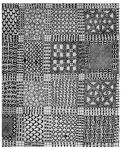
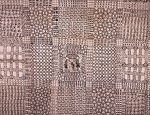
This is another all-time favorite… The second-most popular post on Afrolegends.com: the history of Adinkra symbols and the Rich Akan culture of the Akan people of Ghana and Côte d’Ivoire. Enjoy!
As we revisit this favorite, please let us know if there are other things you would like to learn on the topic, and we will try to add more.
The Adinkra symbols are believed to originate in Gyaman, a former kingdom in modern day Côte d’Ivoire. According to an Ashanti (Asante) legend, Adinkra was the name of a king of the Gyaman kingdom, Nana Kofi Adinkra. King Adinkra was defeated and captured in a battle. According to the legend, Nana Adinkra wore patterned cloth, which was interpreted as a way of expressing his sorrow on being taken to Kumasi, the capital of Asante. He was finally killed and his territory was annexed to the kingdom of Asante. The Asante people, around the 19th century, took to painting of traditional symbols of the Gyamans onto cloth, a tradition which has remained to this day.
Nobel laureate and Pulitzer Prize-Winning Author Toni Morrison, the first Black woman to win a Nobel prize in literature, has passed away at the age of 88. I have read some of her books: “The Bluest Eye” which was part of my Dad’s collection and which I devoured, “Beloved” (I saw the movie, and was left with a ‘What just happened?’ feeling at the end of it), “Song of Solomon,” and “Sula“… I have to admit that I started “Jazz” but never finished it for lack of time. To be honest, Toni Morrison and I did not jive… I read the books, but I always felt like I needed to read them more than once to actually understand them. I believe that was her signature: her books were no cookie-cutter type-literature, but profound, heartbreaking, and conscience shakers; they had this earth-shattering effect, where you really walked a mile in the protagonist’s shoes. They also always had this musical and poetic feel to them, … maybe that’s why I kept coming for more?
‘Beloved’ by Toni Morrison
Toni Morrison had an outstanding career. She started late as a writer at age 39 and was editor of textbooks at Random House before fiction: she was the first African American editor there. She then became one of the world acclaimed writer, and professor at some of the best universities in the world: Cornell University and Princeton University. She won the Nobel laureate in Literature in 1993, thereby becoming the first and only Black woman to win it to date. She was even on the cover of Time Magazine in 1998, only the second female writer of fiction and second black writer of fiction to appear on one of the most significant U.S. magazine covers of the era. And … she of course, benefited from the Oprah effect!
“Her writing was not just beautiful but meaningful — a challenge to our conscience and a call to greater empathy,” President Obama wrote Tuesday on his Facebook page. “She was as good a storyteller, as captivating, in person as she was on the page.”
“Narrative has never been merely entertainment for me,” she said in her Nobel lecture. “It is, I believe, one of the principal ways in which we absorb knowledge.”
She also said, “If there is a book that you want to read, but it hasn’t been written yet, you must be the one to write it.” So get ready… it’s your turn to carry Toni Morrison’s torch!
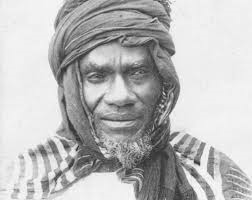
This post on Samori Touré has been an all-time favorite post on Afrolegends.com . I am reblogging it here, because on this 10-year anniversary of the African Heritage Blog, it has been the most viewed and loved article. As you know, Samori Touré, grandfather to the African president Sekou Touré (another resistant to French imperialism – Guinea: the country who dared say ‘NO’ to France), was a leader and ruled over a vast empire which spanned big areas of West Africa from Guinea all the way to modern-day Côte d’Ivoire. He was a strong fighter to France imperialism in Africa, and opposed a great resistance to the French several times. This is to one of Africa’s great kings, warriors, and resistant.
One of the great kings, and fighters of African freedom was the great Samori Touré. Over 100 years ago, Samori Touré was captured by the French and deported to Gabon where he died of pneumonia.
But who was Samori Touré?
Well, Samori Touré was born in 1830 in Manyambaladugu (some texts mentionSanankoro instead), a village southeast of Kankan in present-day Guinea. Samori was a great warrior who fought imperialism in the 19th century such as many leaders today. He refused to submit to French colonization and thus chose the path of confrontation using warfare and diplomacy.
Until the age of 20, Samori was a trader. After his mother was captured in a slave raid by the king Sori Birama, he offered to serve in his army and excelled by his military prowess and skills.
Samori Touré had a vision of unity for the Malinké people, and…
Yesterday, August 1, the African Heritage blog passed the 2 million views cap. This is particularly moving, and coincidental with the fact that this August will also mark a significant milestone: the 10 years anniversary of blogging on Afrolegends.com, the African Heritage blog. Time flies! Goodness Gracious, time flies! It has been a fun and tough 10-years ride. I could fill another blog just to tell you how these past 10-years have been, but I will spare you the details for now. All I can tell you is that YOU, the readers and subscribers, have made it possible with your constant support, comments, corrections, and contributions. This is truly a celebration to you, and to your readership! A big thanks to all of you.
I have always been stunned by the beautyof the flower below (growing up, I was always enthralled by its beauty) because of its vibrancy, its distinction, its determination, and above all its uniqueness… so in upcoming years, this will be our motto here on Afrolegends. As we embark on this new journey, we promise to bring you more good content and stories, and of course capture great memories for the African continent. As you know, the past 10 years have been tough years for Africa, but they have also been years of learning, growth, and rebirth. Like always, “A luta continua e la vitoria e certa.”
To celebrate this milestone, for the month of August, we will feature the top articles on the blogfor the past 10 years, and bring out the all-time favorites.
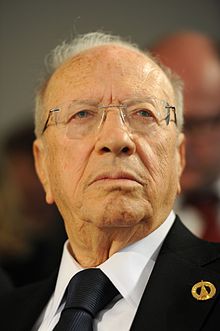
This past Saturday, July 28 2019, millions of Tunisians bid farewell to their first democratically elected president Mohamed Béji Caïd Essebsi at a state funeral attended by numerous foreign leaders including French President Emanuel Macron, Qatari EmirSheikh Tamim bin Hamad Al Thani, Palestinian President Mahmoud Abbas and Felipe VI of Spain. Essebsi passed away this past Thursday, July 25 at 92 years old. His was a great life of public service, and determination to serve the Tunisian people to the best of his ability.
Essebsi was a seasoned politician whose career spanned over six decades. His first involvement in politics started in 1941, when he joined the Neo Destour youth organization in Hammam-Lif. He was known for his integrity, exceptional public service, and served under Tunisia’s first president Habib Bourguiba, at different positions, including chief of the regional administration, general director of the Sûreté nationale, Interior Minister, Minister-Delegate to the Prime Minister, Defense Minister, and then Ambassador to Paris. The coincidence of him dying on the anniversary of the republic reminded people of the role he played in nation-building since independence.
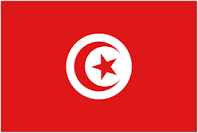
Flag of Tunisia
In recent years, Essebsi rose to prominence after the overthrow of veteran autocrat Zine El Abidine Ben Ali, which was followed by “Arab Spring” revolts against authoritarian leaders across the Middle East and North Africa, including in Libya and Egypt. He was seen as a unifying figure. He founded the Nidaa Tounes political party, which won a plurality in the 2014 parliamentary election. In December 2014, he won the first regular presidential election following the Tunisian Revolution, becoming Tunisia’s first freely elected president.
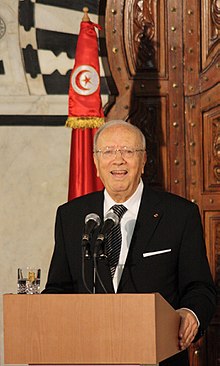
Essebsi in 2011 (Wikipedia)
Hours after Essebsi’s death, parliament speaker Mohamed Ennaceur was sworn in as interim president in line with the constitution in a smooth transition of power. The presidential election is scheduled for Sept. 15, as stated in the constitution which gives 90-days after the death of the president for new elections to take place; this comes two months earlier than scheduled.
The interim President stated, “[Mohamed Beji Caid Essebsi] spent his life in the service of Tunisia, preserving its gains and defending its values.” “He was a man of consensus, dialogue and national unity.” Don’t we all need dialogue and national unity?
Please take some time to read the good article The Arab Weekly wrote on the life of this great man who always put the interest of the Tunisian people first.
Alvin Zhakata in Khartoum, Sudan (Source: Alvin Zhakata)
What would you do for the love of football? How far would you go for a chance to watch the biggest continental football event of the year? Will you cross mountains, rivers, plains, and valleys? Well, Alvin Zhakata, a Zimbabwean man, trekked 10,000 km to cheer for the Zimbabwean warriors at the Africa Cup of Nations 2019 in Cairo this past month. He traveled from Cape Town to Cairo by road enduring visa delays, internet blackouts and revolutionary protests all for the love of football. It took him a total of 44 days; he missed his team who were eliminated in the first round, but the CAF president gave him a VVIP ticket to the final between Algeria and Senegal last Friday.
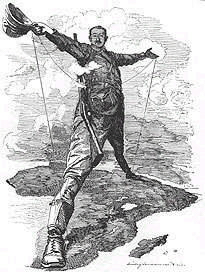
Cecil Rhodes with his transafrican train project from Cairo to Cape Town – the most imperialist ever
What Zhakata did, is no simple feat. He did what even the infamous Cecil Rhodes could not achieve: go from Cape Town at the tip of Africa, to Cairo at the very top of the continent. For those who do not know: the words Cape to Cairo immediately bring to mind the European Scramble for Africa, Cecil Rhodes and his ambition for Great Britain to control the whole of Africa from Cape to Cairo, and of course to link all British colonies via the Cape to Cairo Railway crossing Africa from south to north by rail. The Cape to Cairo Road was also planned to roughly connect the same countries; however, it is not praticable today, and has remained more of a dream or rather a possibility, which needs revamping.
What Zhakata did is not just a show of undying love of a fan for football, but also a political statement to all African leaders: we need roads to connect each other; we need better visa system, or rather a borderless Africa for better and safer travel, increased trade among each other: we need a united Africa. Zhakata’s statement is one of Unity,… African Unity. Enjoy the excerpt below from BBC.
====
Africa Cup of Nations 2019 in Cairo, Egypt
A Zimbabwean nurse travelled from Cape Town to Cairo by road enduring visa delays, internet blackouts and revolutionary protests all for the love of football.
Alvin “Aluvah” Zhakata had intended to make it to Egypt for the opening match of the Africa Cup of Nations on 21 June, when Zimbabwe’s Warriors took on the hosts.
But he missed the match because his epic journey took much longer than expected.
Yet thanks to those following his adventures on Twitter, he has now become a celebrity – and the African football boss has presented him with a ticket to this Friday’s final between Algeria and Senegal.
When the 32-year-old arrived in the Egyptian capital last week, completing his 44-day10,000km (6,200-mile) trip, he said it was well worth it despite some nerve-wracking experiences.
Cape to Cairo (Source: BBC)
His other more sobering discovery was that “Africa is not friendly to Africans” – in terms of visas and borders. “And some of the visa fees for African countries, they are actually more expensive than visa fees when you want to go to Europe – and the waiting period takes too long. “I believe we need a borderless Africa.”
The journey began on 27 May on a route passing through South Africa, Zimbabwe, Zambia, Tanzania, Kenya, Ethiopia, Sudan and Egypt.
CAF president recognizing Alvin Zhakata for his feat, and presenting him with a VVIP ticket to the AFCON 2019 final
[…] His one disappointment has been the performance of the Warriors, who crashed out in the first round – amidst rows over pay.
But he says his achievement – which has become one of the biggest stories of this Africa Cup of Nations tournament – shows it pays to “dare to dream“.
“If you have a passion for something, go for it. Pursue it until you get it. It may be delayed, but delay is not denial – be patient and be strong, because the harder the battle, the sweeter the victory,” he says.
The Fennecs of Algeria celebrate winning AFCON 2019 (The Guardian)
This past Friday, the Fennecsof Algeria defeated the Lions of Teranga of Senegal1-0 to become Africa’s new champions. This was their second title since 1990. Even though the final was not the desert foxes’s best game, they clearly were the best team of the tournament. Baghdad Bounedjah‘s early goal propelled Algeria to a first Africa Cup of Nations title in 29 years with a fiery 1-0 victory over Senegal in Friday’s final in Cairo.
Algeria’s coach Djamel Belmadi and Senegal’s coach Aliou Cisse
I would like to salute both coaches. The 2019 Africa Cup of Nations was the first time in over 20 years when both finalists were led by African coaches: Algeria by Djamel Belmadiand Senegal by Aliou Cissé. This should be the norm, rather than the exception. Coincidentally, both coaches grew up in the same suburb of Paris, are the same age only separated by one day, and played against each other at youth level. They came head-to-head in a league game between Marseille and Paris Saint-Germain in February 2001, and then with their national teams two months later. Again African teams should be led by Africans… No wonder Egypt performed so poorly at the AFCON 2019 (this is the first time, they were not led by a local).
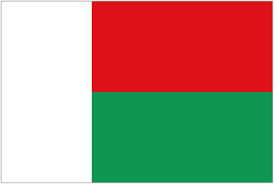
Flag of Madagascar
The revelation of this tournament was the Bareaof Madagascar which for their first participation ever to the African Cup of Nations, performed extremely well, and went as far as the quarter finals. For their successful performance, their country’s president knighted the whole team.
Overall, AFCON 2019 brought us a lot of joy and tears, and we applaud the winners of this year’s tournament Algeria.


 An antelope at dusk in the African Savannah





 Yesterday, August 1, the









 African Heritage