A blog about African history, and heritage, through audio and video files.
Author: Dr. Y.
I am an African in love with the history of the world, and particularly that of Africa. I am a child of love, an artist, a scientist, a lover, a friend, a human.
I am in love with nature and beautiful things, art, history, geography, travel, dance, food, science, and technology, and much more.
As we saw on Monday, Francis Bebey’s poem ‘Je suis venu chercher du travail’ / ‘I Came to Look for Work’ is the story of many immigrants, living their homes, families, friends and countries, to journey to far-away lands in search of a better living.
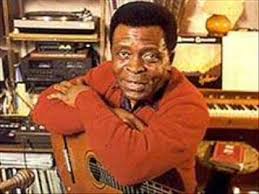
More than a writer, Francis Bebey was also a musician. Below is a video where Francis Bebey introduces the viewer to the one-note flute, and the communication system invented by the pygmy peoples of Central Africa to converse with each other using that instrument. As I told you earlier, Francis Bebey headed the music department at the UNESCO‘s office in Paris, where he focused on researching and documenting African traditional music. Enjoy a lesson from the maestro!
Today, as states and countries are slowly reopening after the shelter-in-place due to the coronavirus pandemic, many have been left jobless, and are looking for a job now or in the near future. I think the poem ‘Je suis venu chercher du travail / I came to look for work‘ by the great Cameroonian writer and musician Francis Bebey is very appropriate. The poem below is the story of many immigrants traveling to a foreign land in search of a job, a better life, leaving all behind: families, friends, and country. This poem is very simple, yet so deep as it details the losses taken today, in hope for a better tomorrow. As you think about the immigrants dying in the Mediterranean sea, or those crossing the Mexico-US border, or all the countless faces in the world, take a moment to imagine families torn apart, lives in peril, and possibly no light at the end of the tunnel.
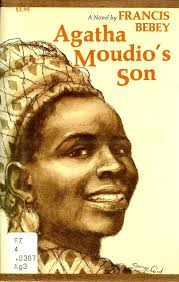
‘Agatha Moudio’s Son’ by Francis Bebey (Amazon)
Francis Bebey was sort of a genius: in his early years, he studied mathematics, before going into broadcasting. He was called to Ghana by President Kwame Nkrumah, where he served as a journalist. He began his literary career as a journalist in the 1950s and worked in Ghana and other African countries for the French radio network, Société de radiodiffusion de la France d’outre-mer (SORAFOM) and Radio France International. Later, he wrote novels, poetry, plays, tales, short stories, nonfiction works, and established himself as a musician, sculptor, and writer. His first novel, Le Fils d’Agatha Moudio (Agatha Moudio’s Son), was published in 1967 and awarded the Grand prix littéraire d’Afrique noire in 1968; it remains his best-known work to this day. He also headed the music department at the UNESCO‘s office in Paris, where he focused on researching and documenting African traditional music.
Enjoy ‘Je suis venu chercher du travail‘ by Francis Bebey, published in Anthologie africaine: poésie, Jacques Chevrier, Collection Monde Noir Poche, Hatier 1988. Translated to English by Dr. Y. Afrolegends.com.
Thanks to my blogging friend petrel41, of The Dear Kitty. Some Blog blog, for the Vincent Ehindero Blogger Award! It is a new award for me. I ‘d like to say “a big thank you” for the consideration and kindness. Please check out The Dear Kitty. Some Blog for amazing images and videos of wildlife and more…
The RULES of this award are:
Thank the blogger who nominated you and provide a link to their blog.
Post the award logo.
Post the rules.
Nominate up to 20-30 other bloggers and notify them.
After notifying Vincent, he’ll check out your blog, follow and give you your unique award for the good work on your blog.
Like Kim said in her original post, we’re not sure if we are supposed to add a list of questions the nominees are supposed to answer, but I guess I’ll do it.
Here are petrel41’s questions and my answers:
1. Do you have long or short hair? At the moment, short.
2. Fantasy or Historic Fiction? fantasy.
3. What book do you like a lot, but you dislike the author, because of background, etc.
Not sure…
4. Have you ever watched a movie that was better than the story that it was based on?
No.
5. If you could visit one place in the world right now where would it be?
Greenland – I don’t understand how a country which is covered in ice half of the year can be called ‘green land’. Apart from that, I would love to visit each of the countries of my many blogging friends.
My questions to my nominees are the same as petrel41’s questions.
My nominees are: I have so many bloggers’ friends and I am sure I might have left out some… but below are some of the few, and there is no particular order… ultimately, I would like to nominate all my friends here on WordPress. So I’ll welcome any blogger who wants to participate on this Award. Please answer the same questions above.
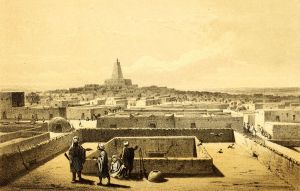
View of Timbuktu in 1858 by explorer Heinrich Barth
As you all know Timbuktu was a great center of knowledge in search for for many centuries starting at least in the 12th century. It was visited by people from around the world, in search of knowledge.
Timbuktu was one of the world’s first and oldest thriving universities! Students came from all over the world to study at Timbuktu. Imagine that, students from the middle east, and Europe coming to study in Africa! There are over 700,000 manuscripts at the great Sankore University in Timbuktu, and many more at other libraries including the Ahmed Baba Institute, Al-Wangari Library, and others.
Enjoy this documentary about the lost libraries of Timbuktucommented by the Scottish/Sierra Leonean writer Aminatta Forna. Enjoy, and discover with me the treasures of Africa.
Meet John Amanam, the Nigerian artist/engineer building super-realistic prostheses for Africans in Africa. I really liked his work: this is a self-thought man who used to work in the Nollywood industry, with no real training in prostheses, but a love of sculpture and most importantly of his fellow human being. After noticing family members who had lost limbs, he set out to make realistic-looking and affordable limbs with ebony, or mahogany shades, the shades of his fellow brothers and sisters. In essence, he is giving back confidence to those who have lost limbs. Enjoy!
Not the greatest Master can go even one step for his disciple; in himself he must experience each stage of developing consciousness. Therefore he will know nothing for which he is not ripe (Ancient Egyptian proverb).
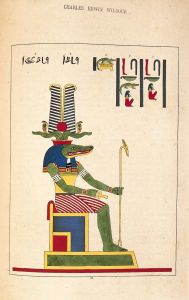
I really enjoyed this photojournal on The Guardian‘s website about crocodiles and the ancient art of crocodile raising in Nubia. Taming crocodiles was a part of the culture of ancient Nubia; and it is still done today in Nubia (northern Sudan /part of Southern Egypt). One of the deities of ancient Egypt was Sobek, who was represented with a human body and a crocodile head. He was associated with the Nile crocodile or the West African crocodile. Sobek was also associated with pharaonic power, fertility, and military prowess, but served additionally as a protective deity with apotropaic qualities, invoked particularly for protection against the dangers presented by the Nile, or intended to turn away harm or evil influences.
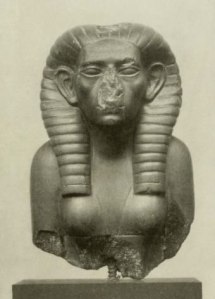
Head of ruling Pharaoh Sobekneferu
The strength and speed of the crocodile was thought to be symbolic of the power of the Pharaoh, and the word “sovereign” was written with the hieroglyph of a crocodile. It was thought that Sobek could protect the Pharaoh from dark magic. Coincidentally, when the cult of Sobek took off during the Twelfth and Thirteenth Dynasties, a number of rulers incorporated him in their coronation names, including the first fully attested female pharaoh – Sobekneferu. To learn more about Sobek and other deities of ancient Egypt, check out Wilkinson, Richard H.,The Complete Gods and Goddesses of Ancient Egypt. (2003).
In ancient times, tamed crocodiles were kept in a sacred pool and hand fed choice cuts of meat and honey cakes and adorned with precious jewels. The pratique has not changed much over the centuries as you will see in the photojournal on The Guardian‘s website. Enjoy!
Quand les herbes envahissent une parcelle, c’est que le propriétaire est absent (Proverbe Bahumbu – République Démocratique du Congo (RDC)). Une fois parti, on ne pense plus à vous.
When weeds take over a parcel of land, that means that the owner is absent (Bahumbu proverb – Democratic Republic of Congo (DRC)). – Once gone, nobody thinks about you anymore.



 People







 Not the greatest Master can go even one step for his disciple; in himself he must experience each stage of developing consciousness. Therefore he will know nothing for which he is not ripe




 African Heritage
