A blog about African history, and heritage, through audio and video files.
Author: Dr. Y.
I am an African in love with the history of the world, and particularly that of Africa. I am a child of love, an artist, a scientist, a lover, a friend, a human.
I am in love with nature and beautiful things, art, history, geography, travel, dance, food, science, and technology, and much more.
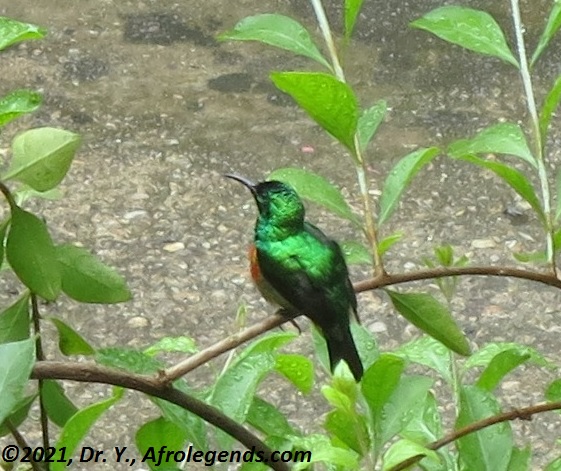
Wouldn’t it be nice to be a bird? To take off and fly away, carefree? What comes to mind when observing a bird: a great sense of freedom; freedom to come and go, freedom to sing, no worries for tomorrow, and freedom to just be. Beauty also comes to mind, but liberty always prevail as one of the main descriptors. I recently stumbled upon this poem by Cameroonian author Claude-Joseph M’Bafou-Zetebeg, ‘The Free Bird’ which describes so well that sense of freedom which most of us aspire to. The author focuses on a bird, and describes the freedom the bird enjoys, the lightness, which is greater than all fortunes. I present here ‘L’Oiseau en Liberté‘ by Claude-Joseph M’Bafou-Zetebeg, published in Anthologie Africaine: Poésie Vol2, Jacques Chevrier, Collection Monde Noir Poche, 1988, and translated to English by Dr. Y.Afrolegends.com . Enjoy!
‘L’Oiseau en liberté’ / ‘The Free Bird‘ de Claude-Joseph M’Bafou Zetebeg
A Young Pele at Santos FC smiling at the camera (Source: Daniel Edwards, Goal.com)
Football has played an integral part to the lives of many around the globe. The 2022 Qatar FIFA World Cup this past November is a testimony to that. The legend Edson Arantes do Nascimento, often known as Pelé, believed by many to be the greatest player that ever lived, passed away at the end of last year. Three-time World Cup winner, Pelé managed to score 757 goals in 831 games throughout his 20 year career although his club Santos claims his tally was closer to one thousand. Pelé was deeply loved in Africa; he was a gifted Black Brazilian footballer, among the first of African heritage to receive such international acclaim, no wonder that in the African independence era, Africans identified with him. His story with Africa was a great love story. To Black Brazilians, he was key in carving out space and recognition for black people in Brazilian football, acclaimed by the masses, without being directly involved in the fight against racism. To Africans and multitudes in the world, he was simply Pelé, the king. Below are excerpts from the BBC article. Enjoy!
====
Being one of the very first young black sporting superstars of the television era, Pelé drew the love and affinity of Africans across the continent.
As decolonisation movements swept across Africa in the late 1950s and early 1960s, Pelé was invited by newly independent countries to play in prestigious friendlies with his club Santos FC and the Brazilian national team.
In his autobiography, Pelé said that the following decades and subsequent repeated trips to the African continent, “changed not only my view of the world, but also the way the world perceived me“.
The author of the Almanac of FC Santos, Guilherme Nascimento, correctly pointed out that the African trips were “so full of stories that there is no clear boundary between legend and fact“.
His time in Algeria, for instance, was like something out of a film. In 1965, the 24-year-old arrived while film director Gillo Pontecorvo was shooting The Battle of Algiers. As a result, it was perfectly normal to see battle tanks shuttle across Algiers from downtown to the Casbah. Algeria’s football-loving President Ahmed Ben Bella scheduled two friendly matches for the occasion – one in Oran on 15 June, and one in the capital, Algiers, four days later. However, on 17 June, Ben Bella’s own Minister of Defence Houari Boumediene carried out a coup d’etat, deposing the president and cancelling the second match. Some credible journalists and historians believe that Boumediene may have used the commotion around Pele’s arrival as a distraction in order to carry out his coup.
… Pele’s trips to Nigeria and the Democratic Republic of Congo have also become shrouded in lore. During both trips, he was apocryphally credited with instilling peace in the country that was hosting him. The Nigerian Civil War raged from 1967-1970, yet when Pele visited in 1969 to play in an exhibition match versus the Nigerian national team, there were claims that a 48-hour ceasefire had been declared. “I’m not sure it’s completely true,” Pelé said in his book. “But the Nigerians certainly made sure the Biafrans wouldn’t invade Lagos while we were there,” he said, recalling a huge military presence. There was never much of a chance of that happening though, as the Biafran separatists were at least 500km (310 miles) away and being pushed back by the army.
Readers, friends, I wish you a beautiful and prosperous year 2023! There were so many joys and losses in 2022, and we hope for the best in 2023. May this new year mark the beginning of new endeavors, the continuation of current ones, and/or the end of old ones. 2022 was quite a year, and many are hoping for something better. Let us turn the 2022 chapter, and start 2023 ready to take off for this new year, never losing altitude during this flight, and trusting for better. May it be filled with health, prosperity, joy, love, happiness, abundance, harmony, and peace!
Happy 2023
The top 6 posts of the year 2022 are listed below: an old-time favorite “Love Poem for my Country” by Sandile Dikeni took first place as the most read post of the year, while another favorite poem “My Name” by Magoleng wa Selepe took second place. The surprise of the year was the post “Why the Name: Morocco ?” which came in, in fifth position, no doubt thanks to Morocco’s outstanding performance at the 2022 Qatar FIFA World Cup where Morocco made Africa proud by becoming the first African country to reach the semi-finals in the history of the World Cup. We, at Afrolegends.com, would like to express our profound gratitude for your constant support, as your readership has carried us forward. Keep trusting, reading, sharing, commenting, reblogging, and liking. We wish you a full and amazing new year, rich in blessings and greatness. Keep your heads up, and may your year bring in new fruits, bright fruits, that stem from unity as beautiful as the fruits in the picture! I love this picture because not only does it symbolize unity, it only symbolizes growth, and beauty! As always, like Agostinho Neto said, “A luta continua … a vitória é certa!”
Une grande lumière a rejoint les étoiles. Sa Majesté, Jean Paul Yitamben, Roi du Village Batcheu au Cameroun, a changé de dimensions et maintenant s’est élèvé au rang d’ancêtres qui guidera nos pas. Grand économiste, professeur, historien, père, frere, époux, il s’en est allé. Comme Behanzin avant et beaucoup d’autres rois, il a consacré sa vie au service de sa communauté et son peuple. La bataille a changé ! Les rois locaux ne sont plus deportés, mais des royaumes et cultures sont toujours fragmentés, écrasés sous le poids du « faux » modernisme assisté par des administrations (excroissance du colonialisme) qui sont au service de forces exterieures qui continue le travail de l’annihilation et/ou de la spoliation de l’identité Africaine.
Descendants de grands rois avant lui, Jean Paul Yitamben était un avide historien et un perfectionniste qui recherchait inlassablement la perfection dans tout ce qu’il faisait. Méticuleux à la lettre, il ne tolérait pas le travail à moitié fait. Avec son épouse, entrepreneur sociale de renommée internationale, Gisèle Yitamben, il a travaillé sans relâche pour permettre aux femmes d’avoir accès à la micro-finance, aux jeunes moins privilégiés de trouver des emplois dans nos économies locales difficiles, et plus important encore, il a affecté la vie d’innombrables autres personnes en dehors de son propre village, communauté, ville, et au-delà. Le projet avorté de palmeraie d’huile de palme et de développement indigène du village de Kugwe dans la région du Nord-Ouest du Cameroun en est un exemple clair.
Le soleil / The sun
Yitamben était très méthodique. Il avait beaucoup de projets! Il a travaillé pour amener l’énergie solaire dans son village, a envoyé des villageoises locales se former en Inde pour devenir des ingénieures solaires à une époque où ce n’était pas encore courant. Il a envoyé d’autres en Australie et au Danemark, et fut le premier dans la région à organiser la «quinzaine»: deux semaines de compétitions sportives pour encourager la fierté locale et distribuer des prix aux gagnants, encourageant les enfants à s’appliquer pour leur éducation; l’attribution de bourses aux jeunes et de prix aux mères et grands-mères. Il était en avance sur son temps, en Afrique subsaharienne où des millions de personnes ont un faible accès à l’électricité, le bois de chauffage et le charbon de bois sont la principale source d’énergie pour la cuisson des repas, représentant les trois quarts de la demande énergétique totale ; Yitamben a apporté les foyers améliorés qui sont plus efficaces et meilleurs pour l’environnement. Il a fait venir des collaborateurs internationaux parce qu’il voulait élever son village et son peuple à une place formidable. Prennons exemple sur sa force et son courage!
Libye, la proie de l’Occident
Son plus grand combat était celui de son village. La colonisation ne s’est pas arrêtée en 1884, or en 1960 avec l’avènement des pseudo-indépendances, elle est bien vivante et s’intensifie de plus belle. La bataille n’est pas frontale, mais comme en Libye en 2011 ou au Mali aujourd’hui, le but est toujours de fragmenter, de diviser et de conquérir; briser en mille morceaux et piller les richesses locales tout en écrasant l’esprit des populations indigènes. L’objectif global est toujours la destruction des initiatives locales pour s’accaparer les terres et ressources ; Ça n’a pas changé.
La bataille au niveau du village de Roi Yitamben est un ample microcosme de ce qui arrive à l’échelle nationale et continentale en Afrique : quand une terre est riche, ou lorsque l’ennemi convoite une zone, il promeut la division entre les frères (Ethiopie – Erythrée, Soudan – Sud Soudan), division sur les frontières (Cameroun – Nigeria sur Bakassi, Tanzanie – Malawi sur le Lac Nyassa/Malawi), et division sur les ressources (RDC – Rwanda).
Behanzin, Roi du Dahomey
Rappellez-vous que du temps de Béhanzin, après sa déportation, la tactique utilisée avait été l’installation de Agoli-Agbo comme marionette; un qui n’avait pas été choisi par les traditions du terroir, mais par les Européens dans le but d’affaiblir et éradiquer les traditions, et promouvoir les divisions (Côte d’Ivoire ou Alassane Ouattara avait été installé par les chars Français en 2011).
Flash infos…
Les combats qui ont eu lieu plus de 100 ans dans le royaume du Dahomey, ou d’autres parties de l’Afrique, sont toujours en cours, bien qu’à petite échelle (et à grande échelle également). Les villages sont divisés, fragmentés et les institutions locales affaiblies. Les gouvernements qui, dans la plupart des pays africains ne servent pas les locaux mais les forces étrangères, sont complices de la destruction des traditions et des institutions africaines. Yitamben croyait qu’il était possible de changer le cours du temps, en réveillant au moins son propre peuple contre la division. Il s’est battu sans relâche pour l’unité et contre la division ; refusant catégoriquement la fragmentation orchestrée par une partie de son peuple aidé par une administration complice aux pulsions coloniales. Il ne pouvait pas comprendre comment son peuple pouvait se laisser utiliser pour détruire sa propre terre. Il était une force de la nature. Il avait une force titanesque; mais c’est un combat difficile.
Fier Guerrier, tu as placé les briques sur la foundation, et la tâche sera achevée. Tu t’es donné inlassablement pour cela. La bataille continue. O grand Guerrier! Ton héritage perdure.
Lorsque nous avons perdu un leader, nous devons regarder vers l’avenir et construire pour les générations futures. Yitamben avait une forte présence, était charismatique, et généreux dans le partage de son temps, ses ressources, et ses connaissances.
A bientot frère, père, époux, ami, … que tes graines portent beaucoup de fruits. Je me souviendrai de ton rire, de ton grand sourire, de ton intelligence, de ton combat pour la perfection, et surtout de tes enseignements. J’ai eu le privilège de te connaître, et de recevoir tes enseignements. Tu nous as montré le chemin. Maintenant nous devons porter ta lumière plus haut.
A great light has joined the stars. His Majesty, Jean Paul Yitamben, King of the Batcheu people, in Cameroon, has changed dimensions, and now graduated to be an ancestor to guide our paths. A great Economist, Teacher, Historian, Father, Brother, Husband, Friend, has moved on. Like Behanzin, before and many other kings, he devoted his life to the service of his community and his people. The fight has changed! Local kings are no longer deported, but kingdoms and cultures are still fragmented, crushed under the load of ‘fake’ modernism assisted by “administrations” (excrescence of colonialism) which are at the service of foreign forces to continue the work of the annihilation and/or spoliation of the African identity.
Descendant of great kings before him, Jean Paul Yitamben was an avid historian and a perfectionist who tirelessly sought perfection in everything he did. Meticulous to a letter, he did not tolerate half-done work. With his wife, world-renowned social entrepreneur, Gisele Yitamben, he worked tirelessly to empower women in micro-finance, less-privileged youth to find jobs in our tough local economies, and more importantly he affected the lives of countless others outside of his own village, community, city, and beyond. The aborted Kugwe village Palm oil and indigenous development project in the North West Region of Cameroon is a clear example.
Le soleil / The sun
Yitamben was very methodical. He had so many great projects! He worked to bring solar power to his village, sent local village women to be trained in India on how to become solar engineers at a time when it was not yet common. He sent others to Australia and Denmark, and was the first in the area to organize the ‘quinzaine’: two weeks of sports competitions to encourage local pride, and distribute prizes to the winners, encouraging children to strive in education; awarding scholarships to youths, and prizes to mothers and grandmothers. He was ahead of his time, in sub-Saharan Africa where millions of people have low access to electricity, firewood and charcoal are the main source of energy for cooking meals, representing three quarters of total energy demand; Yitamben brought in improved households (foyers améliorés) which are more efficient and better for environmental protection. He brought in international collaborators because he sought a great place for his village and his people. Let us build on Yitamben’s strength!
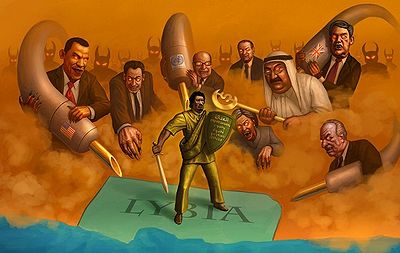
Libya, the Prey of the West
His biggest fight was that of his village. See, colonization did not stop in 1884, or in 1960 with the advent of pseudo-independences, it is well and alive and waxing on even stronger than before. The fight is not open, but like in Libya in 2011 or Mali today, the goal is still to fragment, to divide and conquer; to break into thousand pieces and loot local wealth while crushing the spirits of the indigenous populations. The overall objective is still the destruction of local initiatives to take the land and resources; it has not changed.
The fight at the level of King Yitamben’s village is an ample microcosm of what happens at the national or continental level in Africa: when a land is rich, or when the enemy covets the area, he promotes in-fighting among brothers (Ethiopia – Eritrea, Sudan – South Sudan), division over boundaries (Cameroon – Nigeria over Bakassi, Tanzania – Malawi over Lake Nyasa/Malawi), and division over resources (DRC – Rwanda).
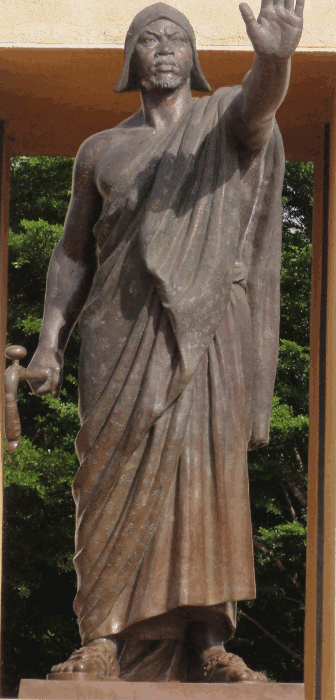
Behanzin, king of Dahomey
Remember that in the time of Behanzin, after his deportation, the tactic used was to install Agoli-Agbo as a puppet King; one who was not chosen by the traditions of the land, but by Europeans to help in weakening and eradicating traditions, and promoting divisions (Côte d’Ivoire where Alassane Ouattara was installed by French war tanks in 2011).
Flash news…
The fights that occurred over 100 years ago in Dahomey kingdom, or other parts of Africa, are still ongoing, albeit on a smaller scale (and big scale as well). Villages are divided, fragmented, and local institutions weakened. The governments which, in most African countries do not serve the locals but foreign forces, are complicit in the destruction of African traditions and institutions. Yitamben believed that it was possible to change the tides of time, by at least awakening his own people against division. He fought tirelessly for unity, and against division; adamantly refusing the fragmentation orchestrated by some of his people helped by a complicit administration with colonial instincts. He could not understand how his people could let themselves be used to destroy their very own land. He was a force to reckon with. He had a titanic strength; but it is a difficult fight.
Proud warrior, you have placed the bricks on its foundation, and the task will be completed. You tirelessly gave yourself for it. The fight continues. O great warrior! Your legacy lives on!
When we have lost a leader, we need to look forward, and build for future generations.Yitamben had a strong presence, was so confident, and so generous in sharing his time, resources, and knowledge.
So long brother, father, husband, friend, … May your seeds bear lots of fruits. I will remember your laughter, your big smile, your intelligence, your fight for perfection, and above all your teachings. I feel so privileged to have had you in my life, and received your teachings. You showed us the way. Now we have to carry on your light.
Sourou-Edjareyo Malazouwe with the prime minister Victoire Tomégah-Dogbé (Source: LaUneTogo.info)
A while back, I introduced you to the Kantanka: a 4×4 AWD Made in Ghana by Ghanaians for Ghanaians which was the brainchild of Dr. Kwadwo Safo, and whose work had been featured on the BBC, Forbes, and Al-Jazeera. Today, I would like to introduce you to a young Togolese inventor in Togo who made his own homemade 4×4 AWD with all recycled materials, all by himself in a year. We salute his creativity, and wish for more great inventions and sponsoring of the youth by our governments and private sectors. Africa needs her sons and daughters to partake in her development, and creativity should be supported. Excerpts below are from AfricaNews. Enjoy!
====
A young Togolese inventor is making waves with his self-made 4X4 car, constructed using mostly recycled materials.
Sourou-Edjareyo Malazouwe, 25, is a self-taught engineer with a passion for sports cars. But as he could not afford to buy one himself, he decided his only option was to build one himself.
‘I finished secondary school in 2016 and after that, I started my own business, selling and repairing mobile phones and computers. It’s because of that that I could afford to build this car,’ he said.
Work got underway about a year ago in his workshop in the Forever district of the capital, Lomé, and the first model has been out on the road for some time now. The young inventor has named the car the ‘RAF-X Raptor’, a play on his own nickname, Raouf.
‘I used a lot of recycled parts. I paid for a few new ones. In this box you can see parts from Titan buses, from motorcycles, from cars, it depends. I get the parts from everywhere which is how I manage,’ he says.
Malazouwe says there are plenty of people who are impressed by the car and he has received several orders for one, …
In the meantime, he is the pride of Togo. In May, he met with the country’s Prime Minister, Victoire Tomégah-Dogbé Dogbé, who later tweeted that she was amazed and charmed by his genius.
‘I told him how proud we were and reiterated the government’s commitment to support him,’ she said, adding that her government was proud to help develop the enormous potential of Togo’s youth.















 African Heritage