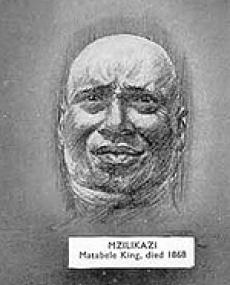
Mzilikazi (meaning The Great Road), was a Southern African king who founded the Matabele kingdom (Mthwakazi), Matabeleland, in what became Rhodesia and is now Zimbabwe. He was born ca. 1790 near Mkuze, Zulu Kingdom (now part of South Africa). The son of Matshobana whom many had considered to be the greatest Southern African military leader after the Zulu king, Shaka. In his autobiography, David Livingstone referred to him as the second most impressive leader he encountered on the African Continent. He was also the father of Lobengula.
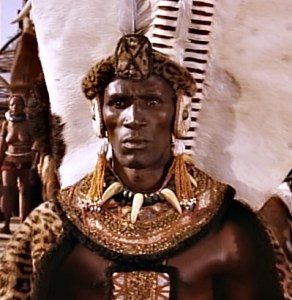
King Shaka
The territory of the Northern Khumalo was located near the Black Umfolozi River, squeezed between the lands of two strong rival groups: the expanding Mthethwa empire of Dingiswayo and the land of the equally ambitious and much more ferocious Zwide of the Ndwandwe. Mzilikazi’s boyhood was spent in the household of his grandfather Zwide. Inevitably, as he grew to manhood he observed the less powerful Khumalo being drawn into the conflict between Dingiswayo and Zwide.
Bayethe! Ndebele Nation! You are the knobkerrie that menaced Tshaka. You are the big one who is as big as his father Matshobana. You are the string of Mntinti and Simangele Simangele son of Ndaba. You are the string of Mntitni and Ndaba The string they made until they wet tears You are the sun that rose from the ear of the elephant, It rose where upon the birds announced to each other. You are the son of Simangele who was kicked! Who was kicked by long feet and by the short ones. You refused to eat the gift of meat in Bulawayo. You are the fighter who has marks of fighting, You are the cattle that opened the closed pen with their horns, Because they opened the Ngome forests and left. You are the moon the people said had set Yet it was just rising; It rose in the year of Mpeyana. You are the cow that showed its face from the crowd. You are the log from which the Zulus cut firewood until they left it. You are the cow that, while it was just emerging made progress.
Last month, we talked about the griot tradition of West Africa. This African tradition of long lineages of storytellers, historians, and history repositories of the society, extends beyond West Africa, to all over the continent. For the Ndebele of Zimbabwe, the griot is known as the imbongi.
Below is a praise poem celebrating the Ndebele King Lobengula. The poem was recited in Ndebele by imbongi(griot/poet) Mtshede Ndhovu to T.J. Hemans around c.1970. Mtshede Ndhlovu was born when Mzilikazi (Lobengula’s father) was still on the throne, that is, before 1868, making him some 105 years old. His son, Bova Ndhlovu, acted as interpreter, assisting Hemans with the translation.
For the entire poem, with the Ndebele version, please check out African Poems .
====
King Lobengula of Matabeleland
Praise Poem for Lobengula
It roared like a calf. (1) He who has books is at the river crossing. (2) The cumulus cloud which rains from overcast sky. (3) The words of a mountain, King of Mgabi Ndwandwe. (4) The bird that builds with its beak pointing to a pool of water, some say catch it some say leave it that it the way it builds. (5) The black lion of Mabindela. Grass does not burn in the Kalahari, some burns and bends. (6) He was furious and then the tribes and commissioners were angry. (7) Spoor of the leopard that disappears in rivers. (8) The bush buck that strikes with its hooves and damaged the stones. (9) Watch him, the destroyer, because he destroyed the commoners. (10) He who is food they feed from for many many years, when he dies where will they feed from, they will eat jackals and roots. He whose majesty is like that of his father Matshobana. Cattle have popularity, they are lowing and attract afar. He whose path is winding like that of ants. The small bird of the spear, so small it can sit on the spear.
Praises Given to the Kings of the Amandebele, T.J. Hemans, Nada X, 3 (n.p., 1971).
The Ruud Concession
(1) This praise-poem was recorded c.1970, when a new war for Zimbabwe was in progress. Lobengula is contrasted with Mzilikazi for failing to protect the nation. He is a calf compared to a bull and his roaring is not impressive.
(2) Lobengula signed the Rudd Concession in 30 October 1888, granting mining rights to the British South African Company. He assumed the miners would accept his kingship, but it was soon evident that the BSA were coming as colonizers. He who has books is Charles Rudd, the treaty bearer, and the river crossing is the Limpopo, the southern border to Ndebele territory.
(3) A reference to Lobengula’s responsibility as rainmaker. Later in praise [line] 12, he comes food they feed from.
(4) Unlike Mzilikazi, Lobengula drew his legitimacy as chief from his ancestry. See also praises 6 and 13.
(5) Lobengula’s succession was controversial, and his performance as king was disputed.
(6) Mzilikazi was called the tall grass in the Kalahari desert that will burn with men’s leather loin cloths (praise 6). Lobengula is the grass that does not burn.
King Shaka of the Zulu people
(7) The signing of the Rudd Concession led to anger on all sides, culminating the war of 1893.
(8) Lobengula’s policies were difficult to follow. See also praise 15, where his course iswinding like that of ants.
(9) Again, this contrasts with Mzilikazi, the bush buck that steps carefully on the rocks, implying diplomatic skills such as wariness.
(10) Mzilikazi’s victories, starting with Shaka, were against enemies of stature. Lobengula is credited with no military virtues and his anger is directed at commoners.
Here is a documentary about Robert Mugabe and his history, his life, and his leadership. This video talks about him, the fight for independence, the loss of his first son while imprisoned by the British in Rhodesia, and the renaming of the country from Rhodesia to Zimbabwe, after the Great Zimbabwe Empire. I only recently found out that Mugabe had been influenced by Kwame Nkrumah: African Visionary and Ghana’s First President. He had lived and trained at the Takoradi Teacher Training College in Ghana, where he met his first wife Sally Hayfron Mugabe. It is sort of a short biography.
I had to share this video which talks about the Rudd Concession and how the British stole Zimbabwe, by tricking King Lobengula, and other local chiefs. Enjoy!
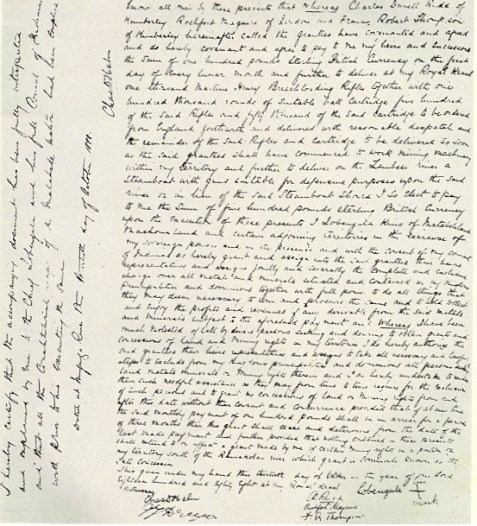
Below is the text for the Treacherous Rudd Concession which granted exclusive mining rights in Matabeleland, Mashonaland, and surrounding areas between King Lobengula of the Matabeleland, and James Rudd (representing Cecil Rhodes). This eventually paved the way for the colonization of then-Rhodesia (Zimbabwe). As you can see, the concession: (1) forbade Lobengula from signing further concessions with other European powers without the consent of Cecil Rhodes/ BSAC; (2) No more than ten Europeans were to enter Lobengula’s territory at any given time; (3) Gave Cecil Rhodes and the BSAC mining monopoly in Matabeleland; (4) In return, Lobengula would get (i) A monthly payment of $ 100, (ii) 1000 rifles and ammunition, (iii) A gun boat to patrol the Zambezi... which he mostly did not get, and the terms were never respected by the British (what else is new)!!!
===========
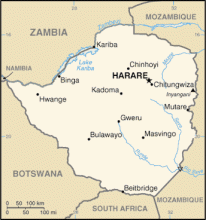
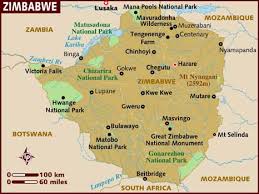
Map of Zimbabwe
Know all men by these presents, that whereas Charles Dunell Rudd, of Kimberley; Rochfort Maguire, of London; and Francis Robert Thompson, of Kimberley, hereinafter called the grantees, have covenanted and agreed, and do hereby covenant and agree, to pay to me, my heirs and successors, the sum of one hundred pounds sterling, British currency, on the first day of every lunar month; and further, to deliver at my royal kraal one thousand Martini-Henry breech-loading rifles, together with one hundred thousand rounds of suitable ball cartridge, five hundred of the said rifles and fifty thousand of the said cartridges to be ordered from England forthwith and delivered with reasonable despatch, and the remainder of the said rifles and cartridges to be delivered as soon as the said grantees shall have commenced to work mining machinery within my territory; and further, to deliver on the Zambesi River a steamboat with guns suitable for defensive purposes upon the said river, or in lieu of the said steamboat, should I so elect, to pay to me the sum of five hundred pounds sterling, British currency. On the execution of these presents, I, Lobengula, King of Matabeleland, Mashonaland, and other adjoining territories, in exercise of my sovereign powers, and in the presence and with the consent of my council of indunas, do hereby grant and assign unto the said grantees, their heirs, representatives, and assigns, jointly and severally, the complete and exclusive charge over all metals and minerals situated and contained in my kingdoms, principalities, and dominions, together with full power to do all things that they may deem necessary to win and procure the same, and to hold, collect, and enjoy the profits and revenues, if any, derivable from the said metals and minerals, subject to the aforesaid payment; and whereas I have been much molested of late by divers persons seeking and desiring to obtain grants and concessions of land and mining rights in my territories, I do hereby authorise the said grantees, their heirs, representatives and assigns, to take all necessary and lawful steps to exclude from my kingdom, principalities, and dominions all persons seeking land, metals, minerals, or mining rights therein, and I do hereby undertake to render them all such needful assistance as they may from time to time require for the exclusion of such persons, and to grant no concessions of land or mining rights from and after this date without their consent and concurrence; provided that, if at any time the said monthy payment of one hundred pounds shall be in arrear for a period of three months, then this grant shall cease and determine from the date of the last-made payment; and further provided that nothing contained in these presents shall extend to or affect a grant made by me of certain mining rights in a portion of my territory south of the Ramaquaban River, which grant is commonly known as the Tati Concession.
(signed by Lobengula, Rudd, Maguire, Thompson, Helm and Dreyer)
I hereby certify that the accompanying document has been fully interpreted and explained by me to the Chief Lobengula and his full Council of Indunas and that all the Constitutional usages of the Matabele Nation had been complied with prior to his executing the same.
One treacherous treaty signed by the British in Africa is the Rudd Concession, a written concession for exclusive mining rights in Matabeleland, Mashonaland and other adjoining territories in what is today Zimbabwe, signed between King Lobengula of Matabeleland and Charles Rudd, James Rochfort Maguire and Francis Thompson, three agents acting on behalf of the British imperialist South African-based politician and businessman Cecil Rhodes, on 30 October 1888. Despite Lobengula’s retrospective attempts to disavow it, it proved the foundation for the royal charter granted by the United Kingdom to Rhodes’s British South Africa Company in October 1889, and thereafter for the Pioneer Column‘s occupation of Mashonaland in 1890, which marked the beginning of white settlement, administration and development in the country that eventually became Rhodesia, named after Rhodes, in 1895.
King Lobengula of Matabeleland
In reality, the Rudd Concession was a deceitful perfidious trick played by the British on King Lobengula to: 1) take his lands, and 2) appropriate the entire country then Rhodesia (now Zimbabwe) from local chiefs who of course knew no English (or very little of it), with translators who very often were also cheating the kings of their lands.
The fact that Lobengula was a force to reckon with is not to be ignored. Cecil Rhodes himself confided to Rothschild saying, “I have always been afraid of the difficulty of dealing with the Matabele King. He is the only block to central Africa, as, once we have his territory, the rest is easy … the rest is simply a village system with separate headmen …” So trickery was the only way to go for Rhodes in order to get Lobengula.
Charles Rudd
Moreover, when you read the concession itself, it’s written on a piece of common paper, as in a 6th grader homework sheet, not legible even by those days’ standards, let alone by a non-native speaker such as Lobengula. It was not a colonial treaty of sovereignty, but a written concession awarding exclusive mining rights in Matabeleland, Mashonaland, and surrounding areas between King Lobengula of the Matabeleland, and James Rudd (representing Cecil Rhodes). For example, King Lobengula never ever discussed nor negotiated a single term in the fraudulent Rudd Concession with the British. Typical of European colonization in Africa!
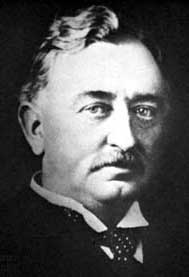
Cecil Rhodes
This was signed on 30 October 1880. As early as 1889, King Lobengula tried to disavow the treaty, after realizing that he had been tricked. Once King Lobengula grasped the extent of this treachery (I mean, who would think that by talking to some people, ‘putting an X’ – signing some documents you don’t even understand, you are giving your entire land, sovereignty, humanity, inheritance, burial grounds, and people?), he sent a delegation to talk to the ‘White’ queen, Queen Victoria (similar to delegations sent by other African Kings, Prempeh, Behanzin to France, Duala Kings in Kamerun to Germany, etc) about the misappropriation, but his delegation was made to linger in London and was eventually never received, all while the British occupied the lands.
Cecil Rhodes was so happy about the Rudd Concession that he said, it is “so gigantic it is like giving a man, the whole of Australia”… OUTRAGEOUS!!!
Many cities around the globe have had their names changed during colonization times (by Europeans colonizers) and were made to carry names foreign to the local people, as denoted in Bombay (Mumbai), Léopoldville (Kinshasa), and Canton (Guangdong) to name just a few. Ever since independence, many of these cities and countries have been renamed to reflect the local culture. Harare is one such city. Harare, the capital of Zimbabwe (which used to be Rhodesia during colonial times), used to be named Salisbury.
So what’s in a name? Well, a name is everything, and characterizes who you are, and your connection to the place. So why shouldn’t Bombay remain Bombay…. Why the need to change it back to Mumbai after over a century as Bombay? Well simply because Mumbai or Guangdong is the way the local people call it, and these cities and their names should be seen through their eyes and not those of a foreigner who oftentimes loathes the local people, and sees them as inferior.
Harare’s skyline today (Wikipedia)
Back to Harare… During the time that the British with the infamous Barbarian Cecil Rhodes ‘colonized’ the place, it was known as Fort Salisbury. The city was founded in 1890 by the Pioneer Column, a small military force in the service of the British South Africa Company, and named Fort Salisbury after the British Prime Minister Lord Salisbury. It retained the name Salisbury until 1982, when it was renamed Harare on the second anniversary of Zimbabwean independence.
So Harare, the most populous, and capital city of Zimbabwe owes its present-day name to a local Shona chief by the name of Ne-Harawa, whose name meant “He who does notsleep.” The name of the city was changed to Harareon 18 April 1982, taking its name from the village near Harare Kopje of the Shona chief Ne-Harawa. Prior to independence, “Harare” was the name of the black residential area (indigenous area where the Black locals where allowed to live) now known as Mbare. It used to also be known as the Sunshine City.
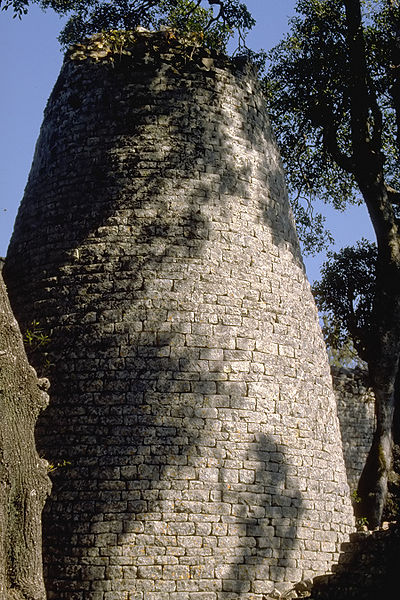
A Conical tower at Great Zimbabwe
Situated at an elevation of 1,483 metres (4,865 feet) above sea level, Harare’s climate falls into the subtropical highland category. Administratively, Harare is a metropolitanprovince. It is Zimbabwe’s leading financial, commercial, and communications centre, and a trade centre for tobacco, maize, cotton, and citrus fruits. Manufactured goods include textiles, steel and chemicals, and gold is mined in the area.
National Heroes Acre (ZimbabweTourism.org)
My Dad visited Harare in the early 90s and loved every part of it. So if you ever visit Harare, remember that its name is for “He who does not sleep”, and enjoy its streets full of Msasa trees which color neighborhoods wine red in late August, and other streets filled with Jacaranda and Flamboyant trees. If you love colonial architecture, you will have your fill. If you are in search of African arts, visit the National Gallery (a side note, if you ever visit the Atlanta airport, one of the transition corridors is filled with Zimbabwean Shona sculptures); for flora lovers, the botanic garden is full of species only found there. The Mukuvisi Woodlands reserve is not too far, and you can visit the Shona village of Chapungu Kraal, as well as check out the Epworth rocks, the National Archives, and the Heroes Cemetery.
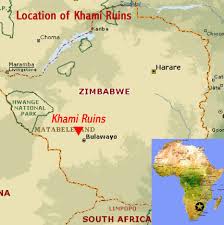
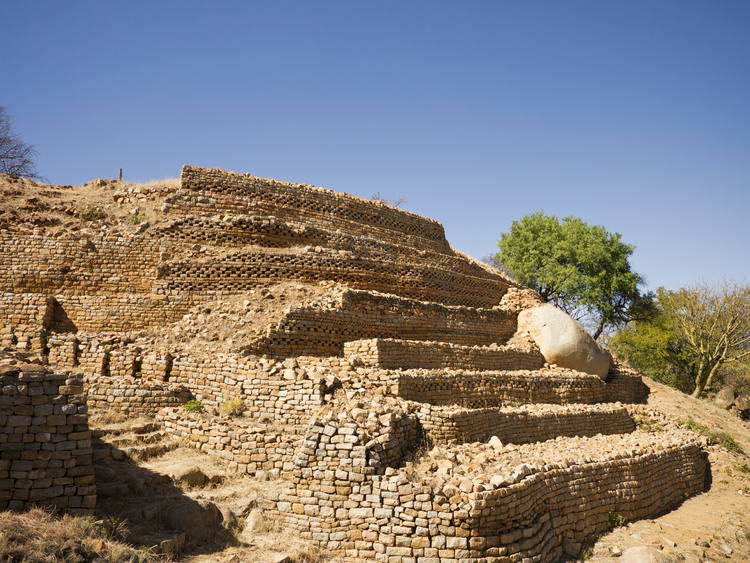
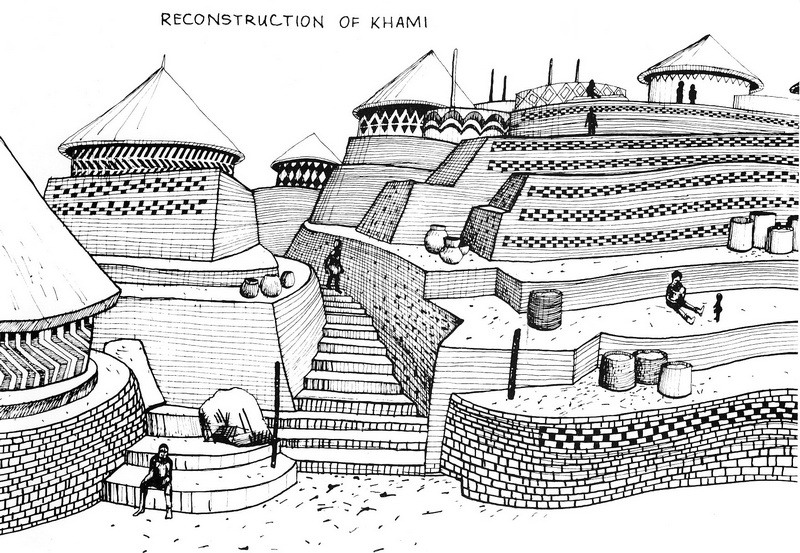
Today, the site of the Khami ruins is a national monument and a UNESCOWorld Heritage Site since 1986. The site is dominated by a series of terraced stone ruins, often highly decorated. It reveals seven built-up areas occupied by the royal family with open areas in the valley occupied by the rest of the population. The complex comprises circular, sometimes terraced, artificial platforms encased by dry stone walls. The beautifully decorated 6m-high by 68m-longretaining wall of the Precipice ruin bears a checkerboard design along its entire length. The imposing front façade marked the main entrance. The Precipice Ruin was a ritual center with the longest decorated stonewall of its kind in the entire sub-region. Nearby are the Cross Ruin with its mysterious stone Dominican Cross, believed to have been placed by a contemporary missionary, and the Northern Platform once used to process gold. The nearby Passage Ruin consists of two adjoining semicircular platforms accessed by a narrow passageway. The platforms, rising 2-7 m above ground, carried clay huts and courtyards where the rest of the populations lived. The remnants of cattle kraals and huts for ordinary people can be seen from the Hill Complex. The ruins include a royal enclosure forming the Hill Complex located on higher grounds, stone walls and hut platforms. There are also ruins on the eastern side of the Khami River.
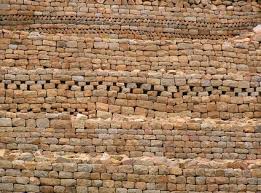
A wall at the Khami site showing the herringbone and checkerboard patterns
To build the structures at Khami required engineering and architectural feats, since the stone found at Khami (laminar granite) was different from that found in other areas of Zimbabwe (biotite). This stone was harder to quarry and produced shapeless building stone; over 60% of the stone produced at these quarries would not have been of building quality. The building blocks thus needed to be shaped, but even then the stones were not suitable for building free-standing dry stone walls. The builders of Khami thus made an innovation and produced retaining walls instead. Moreover, building platforms made the houses cooler than those in the open areas below. Khami’s architecture conforms to that of Great Zimbabwe in a number of archaeological and architectural aspects but it possesses certain features particular to itself and its successors such as Danangombe and Zinjanja. Retaining walls and elaborate decorations were first expressed in the architectural history of the sub-region at Khami.
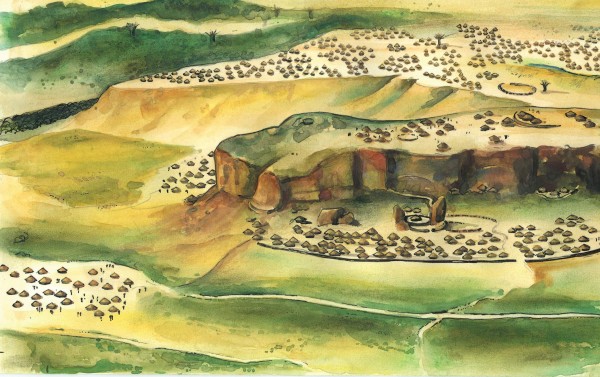
Artist rendition of what the city of Khami would have looked like (historum.com)
Archaeological finds include 16th century Rhineland stoneware, Ming porcelain pieces which date back to the reign of Wan-Li (1573-1691), Portuguese imitations of 17th-century Chinese porcelain, 17th-century Spanish silverware, etc. These indicate that Khami was a major centre of trade, presumably linked (like Mapungubwe and Great Zimbabwe before it) to the Swahili ports on the East Africa coast.
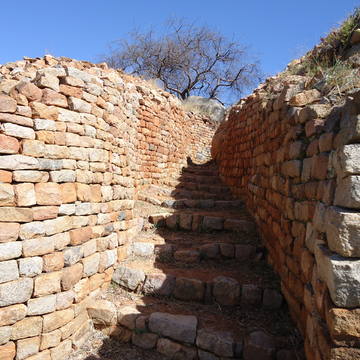
A passageway at Khami (WHC-UNESCO website)
Unfortunately, Khami was invaded by Changamire Dombo, around 1683, who led a Rozwi army from the Mwenemutapa (Monomotapa) state. The Rozwi made Danangombe (Dhlo-Dhlo) another area of the Khami site as the new capital of their empire, the Rozwi Empire. In the 1830s, Ndebele raiders displaced the Rozwi from Khami. A small site museum provides useful background information to the site itself. If you are ever in the vicinity, do not forget to visit this amazing site, remnant of a great stone civilization.
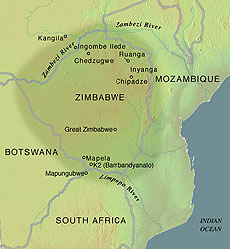
Map of the area including the Kingdom of Mapungubwe and Great Zimbabwe to the north- and the whole Kingdom of Zimbabwe (sahistory.org.za)
After talking about the origin of the name of the country Zimbabwe, named after Great Zimbabwe, the capital of the Kingdom of Zimbabwe which flourished in southern Africa from the 13th to 17th century, I thought it only wise to talk about some of the kingdoms that flourished in that area, starting with the Kingdom of Mapungubwe, a predecessor to the Kingdom of Zimbabwe. The Kingdom of Mapungubwe was a rich iron age civilization that flourished in the area of modern-day Zimbabwe, Botswana, and South Africa, from the 10th to the 13th century AD. It was a pre-colonial state located at the confluence of the Shashe and Limpopo rivers. The kingdom’s development culminated in the creation of the Kingdom of Zimbabwe in the 13th century, as a normal evolution of itself, and with gold trading links to Rhapta and Kilwa Kisiwani on the African east coast.
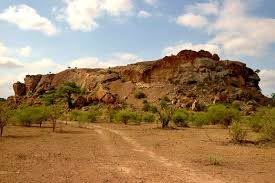
Mapungubwe Hill (Wikipedia)
From archaeological searches, the people of Mapungubwe were of the Venda and Kalanga people ancestry, and were attracted to the Shashe-Limpopo area because of its fertile soils for agriculture, and also because it was an area rich with elephants, thus rich with ivory. The area of Mapungubwe was also rich in gold, and the people traded in gold and ivory, snail shells, pottery, wood, and ostriches’ eggs (eggshells), with places as far as Egypt, Persia, India, and China.
An artist impression of Mapungubwe (Source: newhistory.co.za)
Stone walls were used to demarcate important areas, and important residences were built with stone and wood. Life in Mapungubwe was centered around family and farming. The kingdom, as well as the way people lived, was divided into a three-tiered hierarchy, with the commoners inhabiting low-lying sites, district leaders occupying small hilltops, and the kingdom’s elites residing at the capital at Mapungubwe hill as the supreme authority. Important men maintained prestigious homes on the outskirts of the capital.
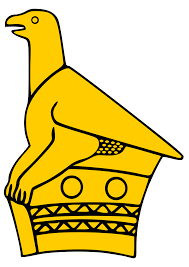
Bateleur Eagle on the flag of Zimbabwe
The kingdom was named after its capital city, the city of Mapungubwe. Several theories have been put forward for the meaning of the name itself. For some, Mapungubwe means “place of Jackals,” or “place where jackals eat,” or “hill of jackals.” In Shona, the language spoken by the majority of people in Zimbabwe, Mapungubwe means “rocks of the Bateleur eagle,” a bird which has deep spiritual connotations in the Shona culture (ma= many; pungu=suffix for chapungu= bateleur eagle, the massive bird which once graced the entrance of the royal complex of Great Zimbabwe; bwe= diminutive for ibwe= stone).
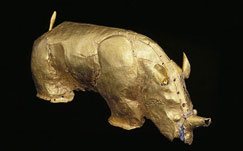
Mapungubwe’s famous gold foil rhinoceros (Source: Univ. of Pretoria)
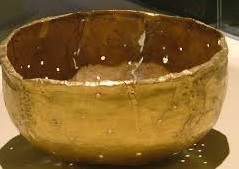
The site was rediscovered in 1932. At the top of Mapungubwe, they found many golden objects: bangles, beads, nails, miniature buffalo, rhino, a skeleton, and gold anklets, about 2.2 kg of gold and many other clay and glass artifacts. Between 1933 and 1998, the remains of about 147 individuals were excavated from the Mapungubwe Cultural Landscape. These findings were kept quiet for a long time, as they provided contrary evidence to the racist ideology of black inferiority underpinning apartheid.
Golden bowl found at Mapungubwe (golimpopo.com)
So any time you think about southern Africa only being populated by pastoralists, nomadic peoples, think again. There were very rich, and strong empires, such as the kingdom of Mapungubwe which was the first major iron age kingdom in Southern African, and traded with places as far as Egypt, Persia, India and China. For more information, check out the very rich Mapungubwe National Park website, South Africa.info, the Metropolitan Museum (MET) article, South African History Online, the Mapungubwe Kingdom website, and the UNESCO World Heritage website as Mapungubwe is listed. Enjoy the video below!
One of my very first articles on this blog was on Great Zimbabwe, the capital city of the Kingdom of Zimbabwe, a kingdom which flourished from approximately 1220 to about 1420 in Southern Africa. The modern-day country of Zimbabwe is named after this great kingdom, and it is only befitting that we explore together the origin of its name. Why would a country which was named Southern Rhodesia change its name to Zimbabwe? Why bother changing names?
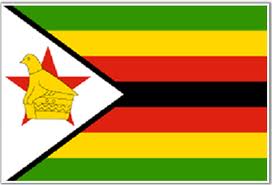
Flag of Zimbabwe
Well, for starters, I find it a bit sad for a country to only be known as ‘Southern something’ without no real name of its own… I know, … things happen (like countries splitting apart). Secondly, Rhodesia was named after Cecil Rhodes, the British man who committed the greatest atrocities in Southern Africa, while establishing British rule over the different African countries in the late 19th century. Therefore, once the people of Southern Rhodesia became independent from British rule, it was only normal to claim a name that was theirs, and not the name of some foreign oppressor who committed the worst atrocities in their country. It’s like seeing yourself through someone else’s lens; you only become free once you can look through your own lens, and appreciate and value yourself.
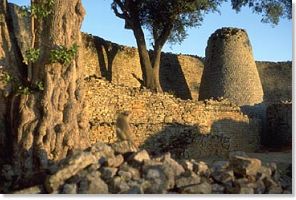
Great Zimbabwe ruins
Thus the name Zimbabwe was chosen. The name “Zimbabwe” is a Shona term for Great Zimbabwe, an ancient ruined city in the country’s south-east whose remains are now a protected site, in the modern-day province of Masvingo. There are two theories on the origin of the word. The first theory holds that the word is derived from dzimba–dza–mabwe, translated from the Karanga dialect of Shona as “large houses of stone” (dzimba= plural of imba, “house“; mabwe= plural of bwe, “stone“). The second theory claims that “Zimbabwe” is a contracted form of dzimba-hwewhich means “venerated houses” in the Zezuru dialect of Shona, and is usually applied to chiefs’ houses or graves. In your opinion, which of these two theories is closer to the truth?
A Conical tower
Zimbabwe was formerly known as Southern Rhodesia (1898), Rhodesia (1965), and Zimbabwe Rhodesia (1979). The first recorded use of the name “Zimbabwe” as a term of national reference was in 1960, when it was coined by the black nationalist Michael Mawema, whose Zimbabwe National Party became the first to officially use the name in 1961. According to Mawema, black nationalists held a meeting in 1960 to choose an alternative name for the country, and the names Machobana and Monomotapa were proposed before his suggestion, Zimbabwe, prevailed. I am so glad the name Zimbabwe was chosen. Enjoy this video about Zimbabwe, the country which held the great civilization of stones. I will talk about the different great kingdoms and civilizations that flourished in the area in later posts.










 So
So 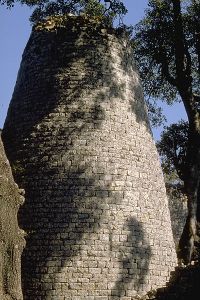





 African Heritage