In 2024, we said goodbye to many people and things in Africa. Below are a few:
President Hage Geingob (Source: TheHealthSite)
In February, the 3rd president of Namibia, Hage Geingob, passed away in Windhoek, Namibia, from cancer. As a strong freedom and anti-apartheid activist, in his early years, he fought to set the international stage for the South West Africa People’s Organization (SWAPO) and the Namibian fight for independence from South Africa; we remember his years of service and sacrifice for the nation of Namibia, and Southern Africa as a whole. So Long Hage Geingob, Third President of Namibia – African Heritage
In February, Kenyan athlete Kelvin Kiptum and his coach died in a car crash in their home country. Kiptum epitomized athletic brilliance. His record-breaking marathon performances catapulted him into global recognition, with contributions extending beyond the track. In his hometown, Kiptum established programs that provided sports training and education for underprivileged youth, ensuring that his success translated into broader societal impact.
Democratic Republic of Congo (DRC) mineral map (Source: Atlas du continent africain, Jeune Afrique et editions Jaguar, 2000)
In February, the European Union (EU) agreed to discuss the price of minerals coming from the DRC with Rwanda. Unheard of!!! Such a preposterous agreement! The EU and Rwanda signed a Memorandum of Understanding (MOU) to strengthen Rwanda’s role in fostering sustainable development and resilient value chains for critical raw materials MOU on Sustainable Raw Materials Value Chains between the EU and Rwanda. Since then, several mineral-rich Congolese cities have been captured by the M23, a rebellious movement backed by Rwanda. The town with one of the biggest coltan reservoirs in the world, Rubaya was captured by the M23 rebels. Kanyabayonga, Kirumba, Shasha, Vuvano, Kiuli, and Mbwambaliro are other cities that were captured by the M23 this year. Rubaya is rich in coltan, tantalum, cobalt; north Kivu, gold, tin, and of course diamond. Coincidence or Not? Coltan-rich Town Captured – African Heritage
‘Segu’ by Maryse Conde
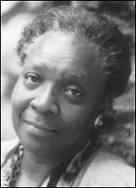
In April, Maryse Condé, the grande Dame of Caribbean literature left us, aged 90. Condé’s work has touched so many throughout the world, as it was a literary bridge between Africa, the Caribbean, and Europe. Her best work, Segu, is a great favorite. My first encounter with Maryse Condé’s work, was when I read her book “La Belle Créole.” Then I read Segu, and really that was it! I was sold… It was unforgettable, strong, and vivid. Maryse Conde: The Grande Dame of Caribbean Literature is no more – African Heritage
In June, the African National Congress (ANC) of South Africa suffered a historic defeat. The ANC, the party which brought the end of the apartheid regime, lost its parliamentary majority in a historic election on June 1. This puts South Africa on a new political path for the first time since the end of the apartheid system of white minority rule 30 years ANC flag
In August, the longest-serving president of the Confederation of African Football (CAF), the Cameroonian Issa Hayatou joined his ancestors this year. Hayatou was a legend who transformed African football into a powerhouse. His visionary leadership expanded Africa’s presence at the FIFA World Cup from two teams in 1982 to 3, 5, and eventually 10 by 2026. He relentlessly lobbyied for the place of Africa in the world of football, including the dream of an African country hosting the world cup, which materialized with South Africa as a host in 2010. He also expanded the Africa Cup of Nations (CAN), increasing participating teams from 8 to 24, creating more opportunities for African nations to compete on the global stage. His legacy in African football is unmatched.
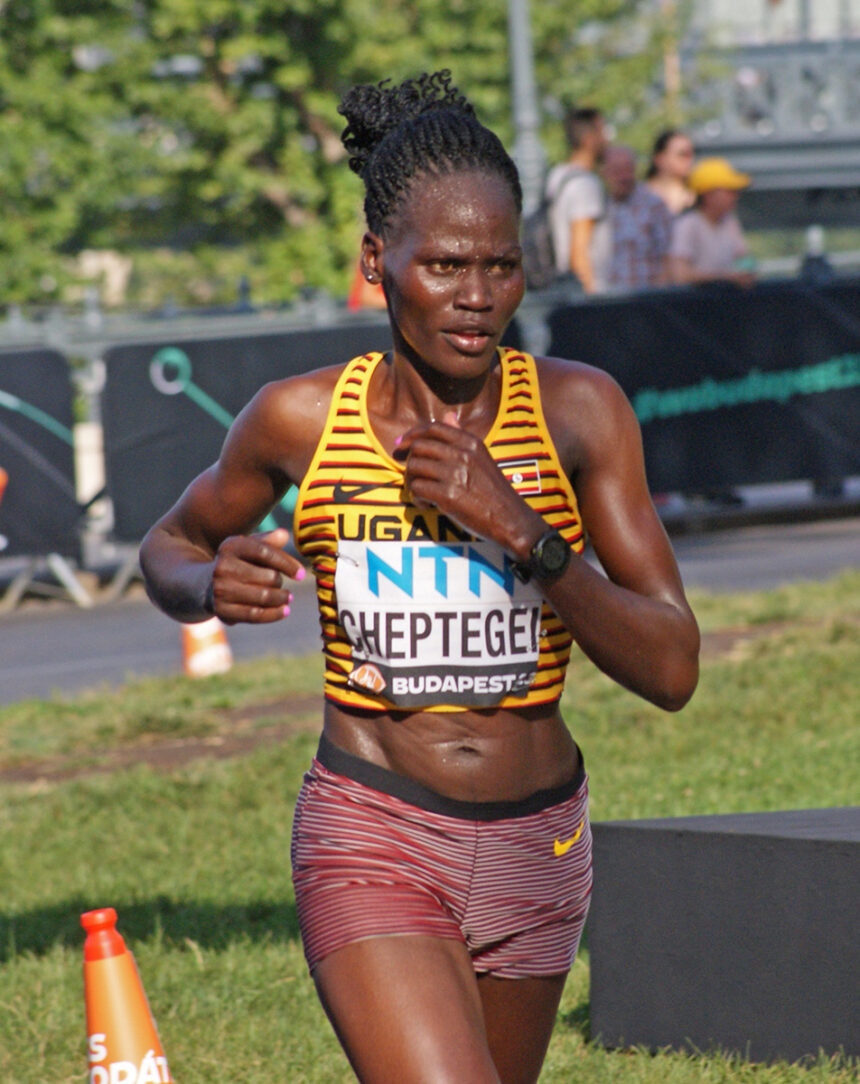
Rebecca Cheptegei (Source: swiftsportsug.com)
In September, talented Ugandan cross-country, long-distance, and marathon runner Rebecca Cheptegei was set ablaze by her former boyfriend who doused her with petrol over a land dispute in northern Kenya; she died of sustained injuries from the fire. As an athlete, her accomplishments included Olympic gold medals, and she was also a member of the Ugandan armed forces. Her death highlighted the domestic violence issues against women in Kenya which has been a big public problem this year with several marches against it.
In October, Hama Amadou, a former prime minister of Niger who consistently pushed for governance grounded in accountability and transparency left us. Despite facing imprisonment and exile due to his political stances, Amadou remained committed to justice and the dream of a prosperous West Africa. He was given all honors for his funerals by the current Nigerien government. His story reflects the perseverance required to navigate political adversity, leaving a legacy of resilience and hope for future reformers.
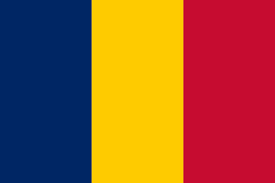
Flag of Chad
Bye bye to French military bases in Chad. France began withdrawing its Mirage fighter jets from Chad on December 10, 2024. Two Mirage 2000-D fighters departed from a French base in N’Djamena and returned to France. This move is part of a larger French military withdrawal from Chad, following the end of the defense cooperation agreement between the two countries on Nov. 29, 2024 when Chad and Senegal Ordered French Military Bases Out of their Territories. While the Chadian president has remained strong in his decision, the Senegalese president has since corrected, saying that it was just the start to start the discussion.
Cyclone Chido’s path of destruction (Source: blog.thegovernmentrag.com)
On December 14, 2024, the island of Mayotte was hit by the cyclone Chido which left total devastation behind. 80% of the island, which is a French overseas department, was destroyed when the cyclone brought winds exceeding 200 km/h (124 mph) and gusts over 225 km/h (140 mph). The current death toll is 35, (French PM says only dozens killed not thousands) but all expect it to be significantly higher in the thousands, given that majority of the population is Muslim (and thus bury their dead within 24 hours), and many were illegals thus had no papers due to the huge illegal migration to that island. Moreover, cyclone Chido also caused significant damage in Mozambique, causing more deaths, making it likely that the numbers given by the French authorities should be significantly higher. During his visit, the French president Emmanuel Macron had the gull to insult the bereaved populations, handing out moral lessons. Our hearts and prayers go out to our brothers and sisters of Mayotte and Mozambique.
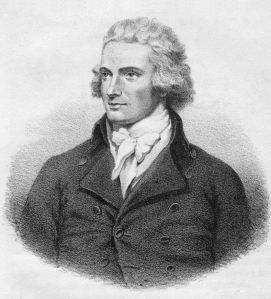
Below is a description of the great city of Ségou (pronounce Segu) in Mali by the Scottish explorer Mungo Park in 1795. Here he describes the city’s population density, dynamism, architecture, and even their ways of life. He amply describes the roominess and surprised sturdiness of Ségou’s canoes which could host 4 horses. Mungo Park is simply astounded by the greatness of the civilization he encounters there, and concludes, “the crowded population and the cultivated state of the surrounding country, formed altogether a prospect of civilization and magnificence, which I little expected to find in the bosom of Africa.” Note that the city is surrounded by high mud walls probably similar to the Tata of Sikasso: an African Fortifying Wall.
=====
The Mosque in Segou at the beginning of the 20th century
Sego, the capital of Bambarra, at which I had now arrived, consists, properly speaking, of four distinct towns ; two on the northern bank of the Niger, called Sego Korro, and Sego Boo and two on the southern bank, called Sego Soo Korro and Sego See Korro. They are all surrounded with high mud walls ; the houses are built of clay, of a square form, with flat roofs ; some of them have two storeys, and many of them are whitewashed.
Entrance to Ahmadu’s palace in Segou-Sikoro published in the 1868 edition of the book by Eugene Mage Voyage dans le Soudan occidental (Sénégambie-Niger), Paris: Hachette
Besides these buildings, Moorish mosques are seen in every quarter ; and the streets, though narrow, are broad enough for every useful purpose, in a country where wheel-carriages are entirely unknown. From the best enquiries I could make, I have reason to believe that Sego contains altogether about thirty thousand inhabitants. The king of Bambarra constantly resides at Sego See Korro ; he employs a great many slaves in conveying people over the river, and the money they receive (though the fare is only ten cowrie shells for each individual) furnishes a considerable revenue to the king in the course of a year. The canoes are of a singular construction, each of them being formed of the trunks of two large trees, rendered concave, and joined together, not side by side, but end ways ; the junction being exactly across the middle of the canoe ; they are therefore very long and disproportionably narrow, and have neither decks nor masts ; they are, however, very roomy ; for I observed in one of them four horses, and several people crossing over the river. When we arrived at this ferry, with a view to pass over to that part of the town in which the king resides, we found a great number waiting for a passage ; they looked at me with silent wonder, and I distinguished, with concern, many Moors among them. There were three different places of embarkation, and the ferrymen were very diligent and expeditious ; but, from the crowd of people, I could not immediately obtain a passage ; and sat down upon the bank of the river, to wait for a more favourable opportunity The view of this extensive city ; the numerous canoes upon the river ; the crowded population and the cultivated state of the surrounding country, formed altogether a prospect of civilization and magnificence, which I little expected to find in the bosom of Africa.
*The four cities mentioned here are actually on the southern shore, but there are on the northern shore some neighborhoods to which Mungo Park attributed excessive importance.
Je voulais partager avec vous ce rare bijou: une interview de la grande écrivain Maryse Condé dans laquelle elle discute de son livre Ségou, le premier roman épique africain.
——–
Dear All,
I just wanted to show you this rare jewel: an interview of the great writer Maryse Conde where she talks about her book Segu, the first epic African novel. Enjoy!
Maryse Condé is a Guadelopean/ French writer. She was married to a Guinean actor, and as such has always kept the patronym ‘Condé’ which hails from Guinea. She is a strong writer, and in my opinion, one of the best female writers of African descent. Her writing is deep, and encompasses a mixture of creole ancestry, and African culture. She has had a distinguished career as a writer and has taught at several prestigious universities in the US and France: Columbia University, University of California Berkeley, Harvard University, UCLA, University of Maryland, University of Virginia, Sorbonne, and Nanterre.
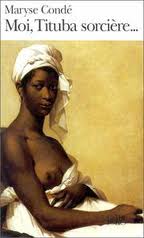
She tends to write historic fiction where she focuses on racial, gender, and cultural issues. I am an avid reader of Condé’s books. In I, Tituba: Black Witch of Salem [Moi, Tituba Sorciere] she explores slavery, and black presence during the Salem witch trials (until I read this book, it had never crossed my mind that there could be Blacks in Salem at that time).
‘Segu’ by Maryse Conde
One of the best novels ever written on an African kingdom was that of the capital of the Bambara EmpireSegu [Ségou] by Maryse Condé, which is deep and resurrects a very well-known kingdom in Mali, as well as slavery at that time, tribal warfare, the advance of islam in West Africa, the clash of cultures between muslims and animists, as well as muslims and Christians later on, and finally the presence of the white colons and the start of European imperialism in Africa. Through her novel, one finds strong historical facts, such as the battle between Fanti and Ashanti people in Ghana divided between French and English (An African version of the French-Indian war), the presence of Yoruba people in Sierra Leone, the presence of slave communities of Yoruba descent in Brazil and Jamaica, the different historic places such as the Gold coast, the Slave coast, the Grain coast, the weakening of the Bambara by the Islamic conquest which left them vulnerable to any advance by the French colonizers, etc… The depth of this book makes it one of the best African epic novel. For anybody craving for a history of Africa in the 18th/19thcentury, Segu is the best out there!
Moi, Tituba Sorciere
Asked about the meaning of her writing, Condé says: Je ne suis pas un ‘écrivain à message.’ J’écris d’abord pour moi, pour m’aider à comprendre et supporter la vie. En racontant des histoires que j’espère signifiantes, je souhaite aussi aider les autres, ceux de mon peuple en particulier, à comprendre et à la supporter à leur tour. [I am not a ‘writer of messages’. I write first for myself, to help me understand and bare life. By telling stories that I deem meaningful, I hope to help others also, particularly my people, to understand and bare life as well.]
Condé has received several awards, including the Prix Liberatur (Germany) for Segu, the Grand Prix Littéraire de la Femme for I, Tituba, Black Witch of Salem, the Prix Carbet de la Caraïbe for Desirada, the Prix Marguerite Yourcenar for Le Coeur À Rire et À Pleurer (1999, Tales from the Heart: True Stories from my Childhood), and Le Grand Prix du roman métis for En Attendant la Montée desEaux (2010). In 2001 she was ordained Commandeur dans l’Ordre des Arts et des Lettres de la France and in 2004 she was made Chevalier de la Légion d’Honneur. Please help me acclaim one of the greatest writers of African descent!!! Enjoy this interview given by Maryse Conde to Elizabeth Nunez on Grioo.com The website “ile-en-ile” provides a complete bibliography of her work. You will find a detailed biography of Condé on Kirjasto, and this interview of Maryse Conde where she discusses her book Victoire: My Mother’s Mother, about her grandmother.












 African Heritage