I found this Jacobin article which focuses on Rosa Luxemburg, a Polish Jewish revolutionary activist who exposed Germany’s genocide in what was then German South West Africa. She said, in her essay “Proletarian Women” (1912):
The workshop of the future requires many hands and hearts. A world of female misery is waiting for relief. The wife of the peasant moans as she nearly collapses under life’s burdens. In German Africa, in the Kalahari Desert, the bones of defenseless Herero women are bleaching in the sun, hunted down by a band of German soldiers and subjected to a horrific death of hunger and thirst. …
Three years later, she again recalled the litany of colonial crimes in her famous Junius Pamphlet:
The present world war is a turning point in the course of imperialism . . . The “civilized world” that has stood calmly by when this same imperialism doomed tens of thousands of Hereros to destruction; when the desert of Kalahari shuddered with the insane cry of the thirsty and the rattling breath of the dying . . . when in Tripoli the Arabs were mowed down, with fire and swords, under the yoke of capital while their civilization and their homes were razed to the ground.
Please check out the article on the Jacobin website to read more about this woman activist who at a time when very few could talk, she denounced the genocide perpetrated by German forces in Africa, particularly in Namibia. She pointed out that the “civilized world” stood by when atrocities were committed in Namibia… it seems like history has repeated itself around the globe for the past century with atrocities perpetrated in many places, while the civilized world or international community has stood by doing nothing or sometimes lending a hand to those perpetrating it. Like Rosa Luxemburg, let’s not turn a blind eye… let’s be part of the solution, and not the problem.
A few weeks ago, the Namibian government then represented by President Hage Geingob issued one of the strongest expressions of solidarity to the Palestinians facing the blows of Israel’s ongoing destruction of Gaza on January 13, in support of South Africa’s case bringing the charge of genocide against Israel to the International Court of Justice. It issued the following statement in response to the German government’s decision to officially support Israel’s denial of these charges [Namibia criticizes Germany]:
Namibia rejects Germany’s support of the genocidal intent of the racist Israeli state against innocent civilians in Gaza. Germany committed the first genocide of the twentieth century in 1904–1908, in which tens of thousands of innocent Namibians died in the most inhumane and brutal conditions . . . President [Hage] Geingob appeals to the German Government to reconsider its untimely decision to intervene as a third-party in defense and support of the genocidal acts of Israel before the International Court of Justice.
The German Government is yet to fully atone for the genocide it committed on Namibian soil…
We have discussed the first genocide of the 20th century, committed by Germany in … Namibia, on African soil. We are not talking about World War II, but instead the real first genocide of the 20th century which almost wiped out all the Herero and Nama people of Namibia, Germany in Namibia: the First Genocide of the 20th Century. It was a campaign of racial extermination and collective punishment that the German Empire undertook in German South-West Africa (modern-day Namibia) against the Herero and Nama people, which took place between 1904 and 1907 during the Herero Wars. Today it is known as the Namibian genocide or the Herero and Namaqua genocide. It was cruel, gruesome, and yet today, many Germans don’t even know that their country had a colonial past! Hello? Germany had 4 colonies in Africa, Togoland (Togo), Kamerun (Cameroon), German East Africa (Tanzania), and German South-West Africa (Namibia), and in most of them great atrocities were committed, yet, it is as if the history annals of the world have refused to acknowledge the humanity of the countless Africans who died. Recently, a German movie producer made a movie to reintroduce the German society to its colonial heritage. Recently, Germany agreed to pay Namibia €1.1bn over historical Herero-Nama genocide, while recognizing the actions as genocide, yet falling short of calling it reparations. Excerpts below are from the Guardian. You will also hear of the painful requests of many families for the return of their ancestors’ skulls (why on earth are these museums still holding onto people’s skulls?) Germany Returns Skulls of Namibians Genocide Victims, Germany Returns Artifacts Stolen From a Namibian Freedom Fighter.
=====
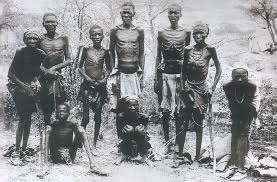
Survivors of the Herero genocide (Wikimedia)
It was one of the darkest eras in German history, and the first genocide of the 20th century: the mass killing of tens of thousands of people in German South West Africa after a rebellion against colonial rule by the Herero and Nama tribes.
More than 100 years later, a feature film about the violence perpetrated by Germany in what is now Namibia explores that brutal colonial past for the first time. Its director hopes Measures of Men will bring the calamitous episode to the attention of ordinary Germans.
“Germany has denied its colonial past for 120 years,” Lars Kraume said, in advance of the film’s domestic release on Thursday. “Most people are unaware Germany even had a colonial past, let alone anything about the brutality of it – it is not even taught in schools.” [Aren’t Africans humans too? are their deaths meaningless?]
… Measures of Men, filmed mainly on location in Namibia using local crew and expertise, tells the story of Alexander Hoffmann – played by Leonard Scheicher – a young, idealistic but wide-eyed ethnologist who questions the evolutionist racial theories of the time, according to which sizes and shapes of skulls determined intelligence. His attempts to rebut the pseudoscientific legitimisation of the superiority of white people over people from the colony of south-west Africa leads him to take first an intellectual and then a romantic interest in Kezia Kambazemi, the interpreter of a delegation of Nama and Herero people who are shipped to Berlin to participate in the Kaiser’s “Völkerschau”, or human zoo exposition.
Despite studying history for his final exams in Germany, Kraume became aware of Germany’s colonial past only when he visited Namibia in the early 1990s, immediately after its independence from South Africa. …
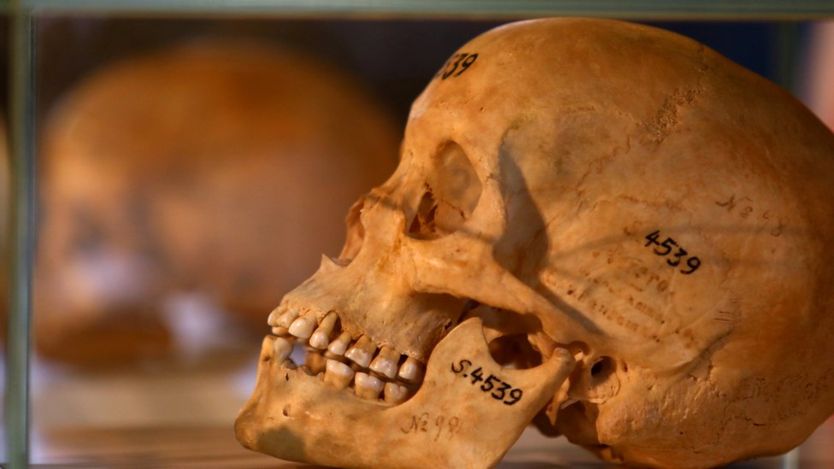
Namibian skulls (Reuters)
Kraume was particularly shocked by the existence of thousands of skulls of people murdered by Germans, which were gathered and shipped to Germany in large quantities and still exist in museums across the country.
“I cannot comprehend the fact that we have these skulls, like artefacts, stored in ethnological museums,” he said. “I cannotunderstand why they are still being kept and have not been given back.
“You ask yourself: ‘Why were the skulls collected in the first place, and why have we not seen fit to give themback?’”
… The film’s relevance to the present day, Kraume said, is also in its depiction of how those in power choose to ignore scientific facts and truth for political gain and in order to maintain the status quo. …
This is historic, late and probably not enough compared to the loss in human lives… yet it is historic nonetheless! Germany has agreed to pay 1.1 billion Euros over the Herero-Nama genocide [Germany in Namibia: the First Genocide of the 20th Century]. This will be paid in existing aid programs over 30 years. I am always skeptical of these aid programs, because countries and companies usually get their money back that way…; plus there are probably billions worth of Namibian diamonds or cobalt mines that will profit German companies in the fine prints. Anyways, for the first time, Germany called the atrocities ‘genocide‘, but fell short of calling the arrangement ‘reparations’ and ‘compensation’ [Have Germans finally acknowledged the Namibian Genocide?]. It is a step forward, we acknowledge it, and recognize the progress. Enjoy! Excerpts below are from the Guardian.
=====
Germany calls atrocities ‘genocide’ but omits the words ‘reparations’ or ‘compensation’ from a joint statement.
Germany has agreed to pay Namibia €1.1bn (£940m) as it officially recognised the Herero-Nama genocide at the start of the 20th century, in what Angela Merkel’s government says amounts to a gesture of reconciliation but not legally binding reparations.
Tens of thousands of men, women and children were shot, tortured or driven into the Kalahari desert to starve by German troops between 1904 and 1908 after the Herero and Nama tribes rebelled against colonial rule in what was then named German South-West Africa and is now Namibia.
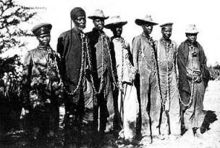
Chained Herero men
Since 2015, Germany has negotiated with the Namibian government over what it calls an attempt to “heal the wounds” of historic violence.
“Our aim was and is to find a joint path to genuine reconciliation in remembrance of the victims,” the German foreign minister, Heiko Maas, said in a statement. “That includes our naming the events of the German colonial era in today’s Namibia, and particularly the atrocities between1904and 1908, unsparingly and without euphemisms.
“We will now officially call these events what they were from today’s perspective: a genocide.”
On Thursday, official circles in Berlin confirmed reports in Namibian media that after nine rounds of negotiations the two sides had settled on the text of a joint declaration and a sum of €1.1bn, which will be paid separately to existing aid programmes over 30 years.
Of the overall sum, more than a billion euros will go towards projects relating to land reform, rural infrastructure, water supply and professional training. Communities of Herero and Nama descendants, which form ethnic minorities in all of the seven affected regions, are meant to be involved in the development of the specific projects.
Flag of Namibia
… The text of the joint declaration calls the atrocities committed by German troops a “genocide” but omits the words “reparations” or “compensation” – a move borne out of fear that such language could set a legal precedent for similar claims from other nations.
A spokesman for the Namibian president, Hage Geingob, described German’s acknowledgment of genocide “as the first step” in the right direction. “It is the basis for the second step, which is an apology, to be followed by reparations,” the spokesman said.
Some of the numerous groups that make up the descendants of the genocide’s survivors have been critical of the framing of the negotiations from the outset and have declined to back the Namibian government’s stance. ….
It is no secret that the first genocide of the 20th century was committed by Germany in Namibia [Germany in Namibia: the First Genocide of the 20th Century]… yet to this day Namibians have never gotten reparations, nor an apology. This terrible page of history is usually absent from history books, and all people know is the genocide against the Jews who were compensated. So to hear now that Germany is planning to “offer aid and an apology” is outrageous! Germany says it does not want to set a precedent… yet for Auschwitz there was no question of setting precedents right? They are probably afraid that more genocides will be uncovered, not just for them, but for all those European countries which took part in the scramble for Africa, and they will all be forced to pay… so now they want to give aid… no one wants their aid! After 400 years of slavery, and almost 100-200 years of colonization and neo-colonization, there is a reason why Africa is on its knees… so we do not want “AID,” plus usually this “aid” always comes as “poisoned cakes” with so many clauses and more debts to be repaid… Remember how Germany wanted to pay the Namibian government 10 million Euros [Namibia Rightfully Rejects 10 million Euros Compensation for Genocide]? while Greece is asking for 289 billion Euros? Excerpts from the article below is from the Guardian.
=====
Flag of Namibia
Germany has categorically ruled out financial reparations forming part of a planned formal apology to Namibia for colonial atrocities at the start of the 20th century, amid fears such payments could set a legal precedent for further claims.
… The talks are nearing completion, with broadcaster Deutschlandfunk reporting this week on plans for the president, Frank-Walter Steinmeier, to ask for forgiveness for the genocide in front of the Namibian parliament.
As part of the reconciliation agreement, which has been submitted to both governments, Germany is also to make additional aid payments towards infrastructure, healthcare and job-training programmes in areas of Namibia populated by the descendants of the Herero and Nama tribes.
… “Reparations or individual compensations are not subject of the negotiations,” the report says. “After 100 years they would be unprecedented. The definition of injustice set up by the 1948 convention on the prevention and punishment of genocide does not apply retrospectively and cannot be the basis for financial claims.”
… Yet countries such as Greece and Poland, which were not part of the 1990 agreement, have since repeatedly reiterated their demands to be compensated for economic and human losses sustained at the hands of German forces in the first half of the 20th century.
Namibian skulls (Reuters)
The Greek government of the conservative prime minister, Kyriakos Mitsotakis, most recently repeated its wish for negotiations relating to damages worth €289bnon the 80th anniversary of Nazi Germany’s invasion of Greece this April.
Many of the descendants of the Herero and Nama victims continue to reject structural aid and demand direct reparations from Germany. In a joint statement issued this week, the Ovaherero Traditional Authorities and Nama Traditional Leaders Association called the reconciliation agreement a “public relations coup by Germany and an act of betrayal by the Namibian government”. …
Even though 2020 was quite a “different” year for a lot of people, there were still a lot of things to celebrate in Africa. Let’s do a review of some of the things we celebrated this year in 2020! There are many more, of course, but I selected 10. Enjoy!
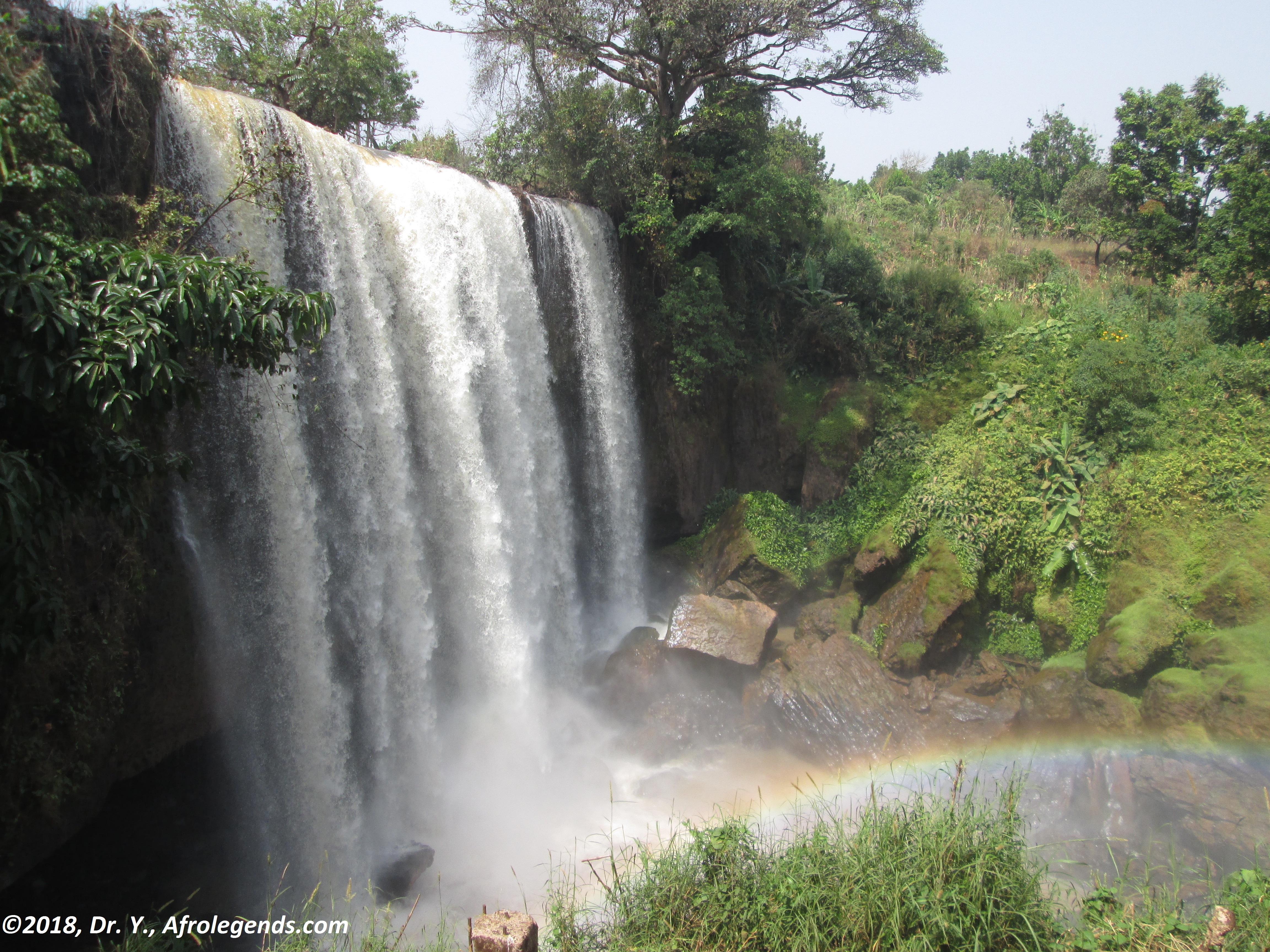
Metche Waterfalls in Cameroon was the site of French genocide there
France returned skulls of Algerian fighters in August, as a first step towards recognition of their wrongdoings (genocide) in Algeria. What is it with these people and skulls is beyond me! As a flashback, Algeria obtained its independence from France after 7 years of a bloody war with France. During that time, France perpetrated a genocide in Algeria… For the first time, a French president, Emmanuel Macron, acknowledged that the colonization of Algeria was a “crime against humanity.” We are now awaiting for recognition of France’s crimes against humanity in Cameroon, and Madagascar, and countless others [French President Acknowledges French Genocide in Cameroon, Fossi Jacob: A Cameroonian Hero and France’s Genocide in Cameroon].
In Tanzania, Saniniu Laizer, a small-scale miner, became an overnight millionaire in June when he found and sold two rough Tanzanite stones valued at $3.4 millions, and then sold another gem in August for $2 millions. This was the biggest ever found in Tanzania, not sure for the world. These are major records!
Flag of South Africa
Black South Africans who fought in World War II were finally recognized! This is great… but at the same time sad… why did it take 80 years for their recognition? We all know that African soldiers were key to the liberation of France during World War II, and yet when it came time for the parade on the Bastille, their uniforms were given to their white counterparts for the parade… after all, it should not be read in the annals of history that Africans liberated France! [Thiaroye: A French Massacre in Senegal, ‘Thiaroye Massacre’ by Ousmane Sembene]
There is strong excitement to the countdown to the African trade. The trading phase under the African Continental Free Trade Area (AfCFTA) by 54 of the 55 countries in Africa, and initially set to begin in July 2020, but now will start on January 1, 2021 [Nigeria signs African Free Trade Area Agreement]. This is a big news for the African continent as it will now allow for free trade across the continent, increasing trade among countries which should have always traded between themselves. This is what was envisioned by Kwame Nkrumah, all the independence fathers, and more recently by Muammar Kadhafi (Africans and the Trap of Democracy) at the AU.
Angelique Kidjo (Source: World Music Central)
The world-renowned singer singer-songwriter Angélique Kidjo from Benin kicked off the year 2020 with a monumental performance at the 62nd Grammy Awards in January. She snatched her 4th Grammy award for Best World Album, and rocked the Los Angeles Staples Center. As always (I have had the honor of attending one of her concerts), she brought the true spirit of Africa to the stage as she told all that African music is the bedrock of all music.
Amid the strong racial justice movements that rocked the world this year, the country of Benin has decided to renovate the fort of Ouidah, in Ouidah which was a key city in the slave trade for many centuries; this is a bid to promote tourism in the country, and to honour the suffering and celebrate the overcoming Africans who were captured and inhumanely shipped abroad from the main port of this coastal town [Benin restores the Fort of Ouidah]. Similarly, Somalia has also made a move to culturally reinforce its lands as it signed in February an education and heritage support deal with UNESCO aimed at strengthening efforts to preserve the country’s culture, education, and history.
Djaili Amadou Amal (Source: Wikipedia)
This year, there was a good news for African writers. Cameroon’s Djaïli Amadou Amal won this year’s prestigious French Literary Award Goncourt des Lycéens for her novel ‘Les Impatientes‘ — inspired by her personal experiences in a South Sahel patriarchal society; later that week in December she won the Choix Goncourt de l’Orient. Two African authors were shortlisted for the Booker Prize of fiction: Ethiopian Maaza Mengiste, and Zimbabwean Tsitsi Dangarembga. Nigerian author Chimamanda Ngozi Adichie whose novel ‘Half of a Yellow Sun‘ — set during her the Biafra civil war, was voted the best book to have won the Women’s Prize for Fiction in its 25-year history.
Master KG and Nomcebo Kizode in Jerusalema (Africanews.com)
“Jerusalema”, the South African song by DJ Master KG featuring Nomcebo Kizode has taken over the world and has gone viral on social media… Jerusalema has become a global phenomenon, even inspiring its own dance challenge. What is even more amazing, is the hit took over the world, and is a Gospel song which talks about God always being close, saving us, and never letting go of us.. The Gospel hit has undoubtedly marked Africa as the soundtrack of the year [South Africa National Heritage Day, The story behind MasterKG’s ‘Jerusalema,’ one of the most …].
The guts of these people sometimes! How can Germany after killing, and exterminating the Herero and San people of Namibia, thus perpetrating the First Genocide of the 20th Century, dare offer 10 million Euros for compensation to the Namibian government? Such an insult! Germany must really think that Namibians, Africans, are nobodies, below sub-humans… because it is quite unbelievable! They have almost eradicated an entire race, and to this day, Namibia is struggling because of this. And they give 10 million Euros? 10 millions Euros for torturing, killing, raping, destroying, displacing for years? Do you think they could have dared to make such an offer if the Namibians were Jews? This money is not even what they give as compensations to victims (and sometimes only one) during lawsuits against big companies. I clap for the Namibian government, and hope that they stand their ground; the rest of Africa is watching them! Excerpts below are from an article on the Guardian.
====
Flag of Namibia
Namibia has rejected a German offer of compensation for the mass murder of tens of thousands of indigenous people more than a century ago.
German occupiers in Namibia almost destroyed the Herero and Nama peoples between 1904 and 1908 as they consolidated their rule in the new colony in south-west Africa. Some historians have described the bloodshed as the first genocide of the 20th century.
The two countries have been discussing an agreement on an official apology from Germany and an increase in development aid, but the talks appear now to be running out of momentum.
Namibia’s president, Hage Geingob, said on Tuesday that the most recent offer “for reparations made by the German government … is not acceptable” and needed to be “revised”.
Chained (by German forces) Herero men
No details were provided on Berlin’s proposal, but unconfirmedmedia reportshave referred to a sum of €10m.
…. Other countries in Africa are watching the negotiations between Namibia and Germany closely as they consider launching their own efforts to gain compensation for the violence and theft of decades of European rule.
I know this dates from last August, 2018, but I had to share. Note that out of the hundreds of skulls taken by Germany, only a bit over 25 were returned; if the German racial study has been discredited, why not return all of them? The excerpt below is from the BBC; for the full article, go to the BBC. As a reminder, the first genocide of the 20th century occurred in Namibia, on African soil. It was perpetrated by Germans on the Herero and Nama people of Namibia. It was extremely brutal and almost wiped out all Herero people. It was a campaign of racial extermination and collective punishment that the German Empire undertook in German South-West Africa (modern-day Namibia) against the Herero and Nama people. It took place between 1904 and 1907 during the Herero Wars. Today it is known as the Namibian genocide or the Herero and Namaqua genocide.
======
Namibian skulls (Reuters)
Germany has handed back the human remains of indigenous people killed during a genocide in colonial Namibia (German South-West Africa) more than 100years ago.
… The bones had been sent to Germany for now-discredited research to prove the racial superiority of white Europeans.
Tens of thousands of Herero and Nama people were murdered in response to an anti-colonial uprising.
Their descendants are still waiting for an apology from the German government.
The genocide began in 1904 after a Herero and Nama rebellion in response to the German expropriation of their land and cattle.
The head of the military administration in what was then known as German South West Africa, Lothar von Trotha, issued an extermination order in October 1904.
Chained Herero men
The Herero and Nama were forced into the desert and any who were found trying to return to their land were either killed or put into concentration camps.
There is no agreed figure of how many died but some estimates have put it as high as 100,000.
It is thought that 75% of the Herero population and half of the Nama population died.
… There are thought to be hundredsof Namibian skulls in Germany and on Wednesday more than 25 remains were handed back.
Skulls from Germany’s other African colonies, including modern day Cameroon, Tanzania, Rwanda and Togo, were also used in the discredited studies.
In 2016, Germany said it was prepared to apologize in principle but it is still negotiating with the Namibian government over the form of the apology and how to deal with the legacy of the genocide. [Funny how, when it was time to kill, they never negotiated]
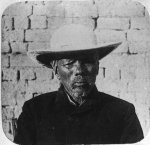
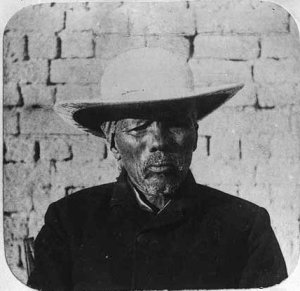
Hendrik Witbooi, Namaqua Chief and freedom fighter
… Germany has argued that it has given Namibia millions of dollars in development aid to support all people in the country. [They forget to tell you that they are still benefiting from the mines and resources of Namibia]
… But descendants of the victims are angry that there has been no apology and no agreement of reparations.They are also unhappy that they are not part of the negotiations. …
At last, Germany is returning artifacts back to Namibia which it had stolen some 126 years ago from a Namibian freedom fighter, Hendrik Witbooi. This is a good step forward, as they also returned the human remains of people they had killed via committing a genocide, last August. As a flashback, the First Genocide of the 20th Century was committed by Germany on the Nama and Herero people of Namibia. During that time, it is estimated that Germany wiped out at least 75% of the Herero and 50% of the Nama population (the Namibian genocide or the Herero and Namaqua genocide). The skulls and bones of the people they decimated had been sent to Germany to study the racial superiority of Europeans. To that effect, tens of thousands of Nama and Herero people were murdered. There are thought to be hundreds of Namibian skulls in Germany and last August about 25 remains were handed back. Their descendants are still waiting today for an apology from the German government, as well as reparations. Skulls from Germany’s other African colonies, including modern day Cameroon, Tanzania, Rwanda and Togo, were also used in these now discredited studies.
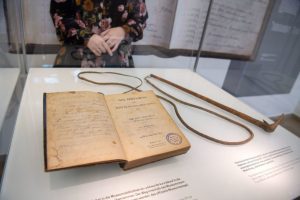
A bible and a whip from the estate of Hendrik Witbooi. (Getty images)
The German city of Stuttgart will return artifacts looted from the country’s colony in what is now Namibia on March 1 during a ceremony with Namibian president Hage Geingob.
German state minister for science Theresia Bauer will travel to Namibia to hand over a whip and bible from the collection of Stuttgart’s Linden Museum that once belonged to Namibian national hero Hendrik Witbooi, a leader in the fight for independence against the German colonizers during the Nama-Herero uprising.
“The restitution of these objects is for us the beginning of a reappraisal of German-Namibian colonial history,” Bauer said in a statement published on the Linden Museum website.
The ceremony is taking place in Witbooi’s hometown of Gibeon, where a museum is being built and will eventually house the items. In the meantime they will be safeguarded by the state.
Chained Herero men
German soldiers stole the artifacts during an attack on Witbooi’s stronghold of Hornkranz in 1893. Colonial troops in former German southwestern Africa launched a brutal crackdown on Witbooi’s people after the leader refused to sign a protection treaty to cede territory to the colonizers. In response, German troops ransacked the village, took livestock, burnt huts, and looted possessions.
Both the whip and bible were donated to the Linden Museum in 1902, according to the German art magazine Monopol.
The German imperial empire colonized parts of Namibia from 1884 to 1915. Germany officially [recognized] the Nama-Herero genocide in 2004, in which an estimated 65,000 members of the Nama and Herero tribes were murdered in response to the uprising.
Survivors of the Herero genocide
In November 2018, the Minister President of Baden-Württemberg said that the German state “is aware of its historical responsibility and is ready to take action. Sending an important message and signaling an important step in the process of reconciliation.”
Today Witbooi is revered as a national hero in Namibia and one of the most important chiefs of the Nama tribes. He is honored by numerous monuments across the country and his portrait is printed on numerous paper bills.












 African Heritage