In 2024, we said goodbye to many people and things in Africa. Below are a few:
President Hage Geingob (Source: TheHealthSite)
In February, the 3rd president of Namibia, Hage Geingob, passed away in Windhoek, Namibia, from cancer. As a strong freedom and anti-apartheid activist, in his early years, he fought to set the international stage for the South West Africa People’s Organization (SWAPO) and the Namibian fight for independence from South Africa; we remember his years of service and sacrifice for the nation of Namibia, and Southern Africa as a whole. So Long Hage Geingob, Third President of Namibia – African Heritage
In February, Kenyan athlete Kelvin Kiptum and his coach died in a car crash in their home country. Kiptum epitomized athletic brilliance. His record-breaking marathon performances catapulted him into global recognition, with contributions extending beyond the track. In his hometown, Kiptum established programs that provided sports training and education for underprivileged youth, ensuring that his success translated into broader societal impact.
Democratic Republic of Congo (DRC) mineral map (Source: Atlas du continent africain, Jeune Afrique et editions Jaguar, 2000)
In February, the European Union (EU) agreed to discuss the price of minerals coming from the DRC with Rwanda. Unheard of!!! Such a preposterous agreement! The EU and Rwanda signed a Memorandum of Understanding (MOU) to strengthen Rwanda’s role in fostering sustainable development and resilient value chains for critical raw materials MOU on Sustainable Raw Materials Value Chains between the EU and Rwanda. Since then, several mineral-rich Congolese cities have been captured by the M23, a rebellious movement backed by Rwanda. The town with one of the biggest coltan reservoirs in the world, Rubaya was captured by the M23 rebels. Kanyabayonga, Kirumba, Shasha, Vuvano, Kiuli, and Mbwambaliro are other cities that were captured by the M23 this year. Rubaya is rich in coltan, tantalum, cobalt; north Kivu, gold, tin, and of course diamond. Coincidence or Not? Coltan-rich Town Captured – African Heritage
‘Segu’ by Maryse Conde
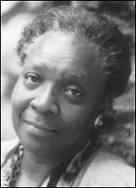
In April, Maryse Condé, the grande Dame of Caribbean literature left us, aged 90. Condé’s work has touched so many throughout the world, as it was a literary bridge between Africa, the Caribbean, and Europe. Her best work, Segu, is a great favorite. My first encounter with Maryse Condé’s work, was when I read her book “La Belle Créole.” Then I read Segu, and really that was it! I was sold… It was unforgettable, strong, and vivid. Maryse Conde: The Grande Dame of Caribbean Literature is no more – African Heritage
In June, the African National Congress (ANC) of South Africa suffered a historic defeat. The ANC, the party which brought the end of the apartheid regime, lost its parliamentary majority in a historic election on June 1. This puts South Africa on a new political path for the first time since the end of the apartheid system of white minority rule 30 years ANC flag
In August, the longest-serving president of the Confederation of African Football (CAF), the Cameroonian Issa Hayatou joined his ancestors this year. Hayatou was a legend who transformed African football into a powerhouse. His visionary leadership expanded Africa’s presence at the FIFA World Cup from two teams in 1982 to 3, 5, and eventually 10 by 2026. He relentlessly lobbyied for the place of Africa in the world of football, including the dream of an African country hosting the world cup, which materialized with South Africa as a host in 2010. He also expanded the Africa Cup of Nations (CAN), increasing participating teams from 8 to 24, creating more opportunities for African nations to compete on the global stage. His legacy in African football is unmatched.
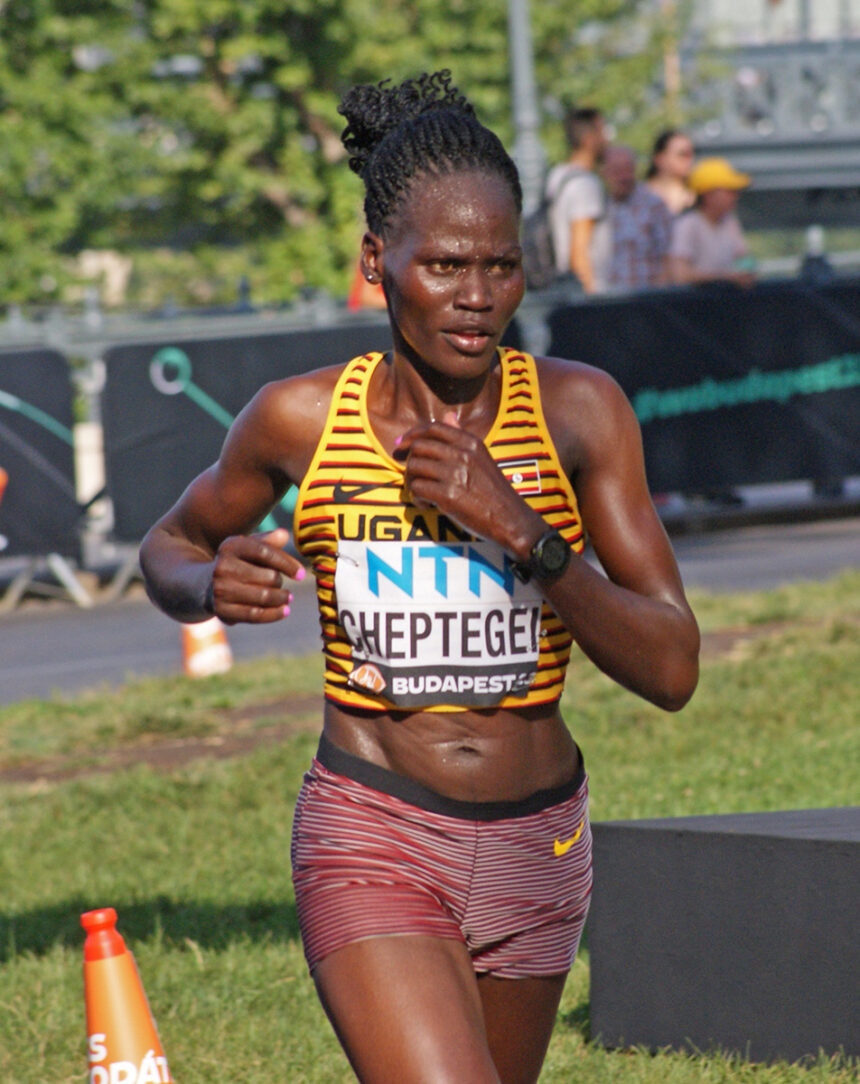
Rebecca Cheptegei (Source: swiftsportsug.com)
In September, talented Ugandan cross-country, long-distance, and marathon runner Rebecca Cheptegei was set ablaze by her former boyfriend who doused her with petrol over a land dispute in northern Kenya; she died of sustained injuries from the fire. As an athlete, her accomplishments included Olympic gold medals, and she was also a member of the Ugandan armed forces. Her death highlighted the domestic violence issues against women in Kenya which has been a big public problem this year with several marches against it.
In October, Hama Amadou, a former prime minister of Niger who consistently pushed for governance grounded in accountability and transparency left us. Despite facing imprisonment and exile due to his political stances, Amadou remained committed to justice and the dream of a prosperous West Africa. He was given all honors for his funerals by the current Nigerien government. His story reflects the perseverance required to navigate political adversity, leaving a legacy of resilience and hope for future reformers.
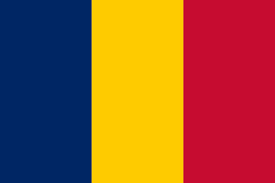
Flag of Chad
Bye bye to French military bases in Chad. France began withdrawing its Mirage fighter jets from Chad on December 10, 2024. Two Mirage 2000-D fighters departed from a French base in N’Djamena and returned to France. This move is part of a larger French military withdrawal from Chad, following the end of the defense cooperation agreement between the two countries on Nov. 29, 2024 when Chad and Senegal Ordered French Military Bases Out of their Territories. While the Chadian president has remained strong in his decision, the Senegalese president has since corrected, saying that it was just the start to start the discussion.
Cyclone Chido’s path of destruction (Source: blog.thegovernmentrag.com)
On December 14, 2024, the island of Mayotte was hit by the cyclone Chido which left total devastation behind. 80% of the island, which is a French overseas department, was destroyed when the cyclone brought winds exceeding 200 km/h (124 mph) and gusts over 225 km/h (140 mph). The current death toll is 35, (French PM says only dozens killed not thousands) but all expect it to be significantly higher in the thousands, given that majority of the population is Muslim (and thus bury their dead within 24 hours), and many were illegals thus had no papers due to the huge illegal migration to that island. Moreover, cyclone Chido also caused significant damage in Mozambique, causing more deaths, making it likely that the numbers given by the French authorities should be significantly higher. During his visit, the French president Emmanuel Macron had the gull to insult the bereaved populations, handing out moral lessons. Our hearts and prayers go out to our brothers and sisters of Mayotte and Mozambique.
“How true! Life’s problems are like trees. We see the trunk, we see the branches and the leaves. But we can’t see the roots, hidden deep down under the ground. And yet it is their shape and nature and how far they dig into the slimy humus to search for water that we need to know. Then perhaps we would understand.”
The great Guadeloupean writer, the Grande dame of Caribbean literature, Maryse Condé has transitioned to the land of our ancestors at the age of 90. Condé’s work has touched so many throughout the world, as it was a bridge between Africa, the Caribbean, and Europe. Her best work, Segu, has been one of my favorites. My first encounter with Maryse Condé’s work, was when I read her book “La Belle Créole.” Then I read Segu, and really that was it! I was sold… It was unforgettable, strong, and vivid. This book might actually be among the first historical fiction books written by a person of African descent on one of the ancient African kingdoms spanning several decades. Set in the 18th century, it followed the life of Dousika Traore, a royal adviser in an ancient historical kingdom based in Segu in modern-day Mali, torn apart by the arrival of the slave trade and Islam. It reminded me of the Alex Haley’s Kunta Kinte or Roots saga. It was deep, rich, and truly captivating.
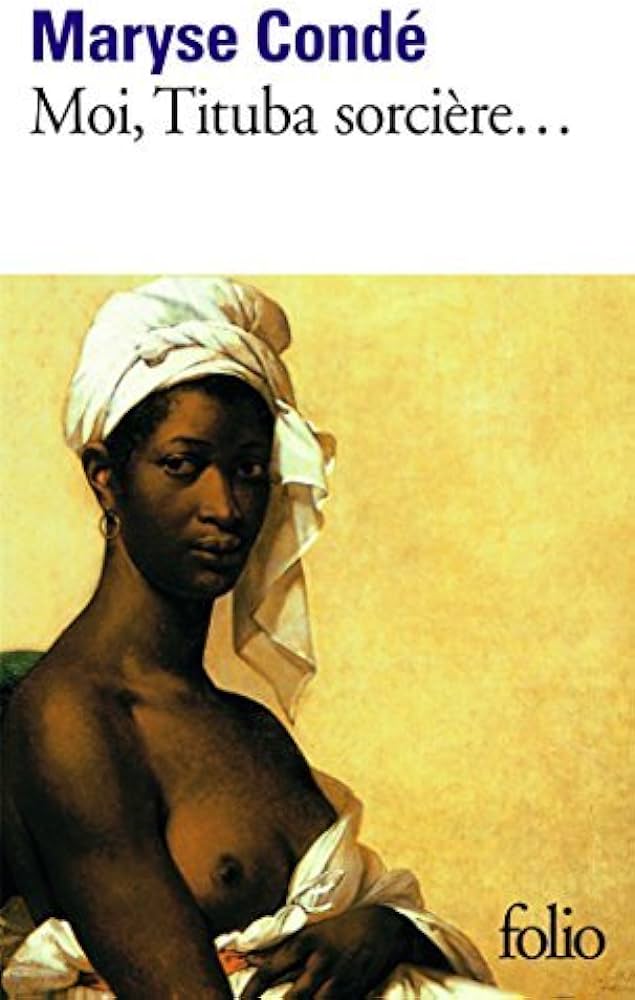
Moi, Tituba Sorciere de Maryse Conde
In “I, Tituba: Black Witch of Salem,” Condé told the story of a slave who was one of the first women to be accused of witchcraft during the 1692 Salem witch trials. It was based on the story of an American slave who was tried for witchcraft. Honestly, up until then, I could not fathom that a Black woman could have been on trial back then in the United States; but in reality, given how Africans were uprooted from the continent, and their religion, and spirituality, it should not have come as a surprise.
I read her other book, The last of the African Kings which is a fictional account following King Behanzin’s offsprings and entourage when he was in exile in Martinique, and their lives in the caribbeans and then the United States, after the French deported him there. It skillfully intertwined the themes of exile, memory, hope, loss, with Africa always in the background.
The Last of the African Kings, by Maryse Condé
After that, I read her other books A Season in Rihata, The Crossing of the Mangrove, La Vie Scélérate (Tree of Life: A Novel of the Caribbean), Desiderada.
Her themes always embraced motherhood, femininity, race relations, slavery, the Caribbeans, and Africa. Her novels drew upon African and Caribbean history. She has written over 20 novels,
Throughout her life, she was awarded France’s Legion of Honour in 2004, and twice nominated for the International Booker Prize – first for her entire body of work in 2015, then in 2023 for her final novel, The Gospel According to the New World. In 2018, she won an award set up in place of the Nobel Prize in Literature, which was engulfed in scandal. Condé was the first and remains the only winner of the New Academy Prize in Literature, whose judges praised the way she “describes the ravages of colonialism and post-colonial chaos in a language which is both precise and overwhelming“.
… Born Maryse Boucolon in Guadeloupe in 1934, the youngest of eight children, Condé described herself as a “spoilt child … oblivious to the outside world”. Her parents, she told the Guardian, never taught her about slavery and “were convinced France was the best place in the world”. She went to Paris at 16 for her education, but was expelled from school after two years: “When I came to study in France I discovered people’s prejudices. People believed I was inferior just because I was black. I had to prove to them I was gifted and to show to everybody that the colour of my skin didn’t matter – what matters is in your brain and in your heart.”
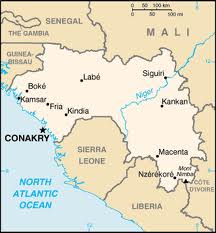
Guinea-Conakry
Studying at the Sorbonne, she began to learn about African history and slavery from fellow students and found sympathy with the Communist movement. She became pregnant after an affair with Haitian activist Jean Dominique. In 1958, she married the Guinean actor Mamadou Condé, a decision she later admitted was a means of regaining status as a black single mother. Within months their relationship was strained, and Condé moved to the Ivory Coast, spending the next decade in various African countries including Guinea, Senegal, Mali and Ghana, mixing with Che Guevera, Malcolm X, Julius Nyerere, Maya Angelou, future Ivory Coast president Laurent Gbagbo and Senegalese film-maker and author Ousmane Sembène.
Map and Flag of Ghana
Unable to speak local languages and presumed to hold francophile sympathies, Condé struggled to find her place in Africa. “I know now just how badly prepared I was to encounter Africa,” she would later say. “I had a very romantic vision, and I just wasn’t prepared, either politically or socially.” She remained outspoken until she was accused of subversive activity in Ghana and deported to London, where she worked as a BBC producer for two years. She eventually returned to France and earned her MA and PhD in comparative literature at Paris-Sorbonne University in 1975.
Her debut novel, Hérémakhonon, was published in 1976, with Condé saying she waited until she was nearly 40 because she “didn’t have confidence in myself and did not dare present my writing to the outside world”. The novel follows a Paris-educated Guadeloupean woman, who realises that her struggle to locate her identity is an internal journey, rather than a geographical one. Condé later recalled the Ghanaian author Ama Ata Aidoo telling her: “Africa … has codes that are easy to understand. It’s because you’re looking for something else … a land that is a foil that would allow you to be what you dream of being. And on that level, nobody can help you.” “I think she may have been right,” Condé later wrote.
… She gainedprominence as a contemporary Caribbean writer with her third novel, Segu, in 1984. The novel follows the life of Dousika Traore, a royal adviser in the titular African kingdom in the late-18th century, who must deal with encroaching challenges from religion, colonisation and the slave trade over six decades. It was a bestseller and praised as “the most significant novel about black Africa published in many a year” by the New York Times.












 African Heritage