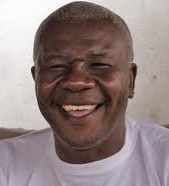
Lapiro de Mbanga in his own words

Lapiro de Mbanga
Lapiro de Mbanga

I decided to make a compilation of some of Lapiro de Mbanga’s words in his interviews.  The full interview to Daniel Brown from Freemuse can be found here; for the interview Lapiro gave to Le Messager, click here; and lastly the interview to Phoenix Gauthier can be found on RFI.  The video below shows Lapiro de Mbanga’s proudly expressing himself at the Oslo Freedom Forum in 2013.  Enjoy!!!

============

About life in prison: … There is no hygiene here and we must share our most intimate moments with the other cellmates. … I should have been taken to hospital for a consultation but my status as a political prisoner has meant I have not been allowed to go once in these two years. I somehow survived the typhoid attack in December by taking the antibiotics my wife Louisette brought me. It’s fortunate she comes every few days. It’s a five-hour round trip from Mbanga, it’s taking a toll on her, too. …  I wake at 7 to 8 every morning …. I keep informed about the outside world thanks to TV5 [France’s international station] or Radio France International. I eat, chat with the others in the cell, play Ludo, scrabble, draughts. It’s impossible to compose in such an atmosphere. I need calm, serenity. Here, I cannot concentrate and write the thoughtful songs people expect of me.
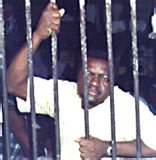
Pius Njawe in jail
Pius Njawe, a Cameroonian journalist and martyr in jail

We have penal rations twice a day. At 1pm we are given boiled corn and at 5pm there’s rice in some warm water. It’s the same every day. It’s way below minimum requirements. My wife brings me food every two days, I couldn’t survive otherwise. I’ve seen people die of hunger. It happens every day in Cameroonian prisons.

Normally, I should have no contact with the outside world. Telephones are illegal here. I’m speaking to you because we have to scheme like common crooks. In prison there are all kinds of trafficking going on, including this one. You pay guards to turn a blind eye. You know, in Cameroon you can buy everything. This country has been world champion in terms of corruption.  It’s everywhere and filters down to here. (Source: Daniel Brown, Freemuse)

On being scared for his life because of his outspokenness: It’s all part of my struggle. If I was the scared type I would never have started singing in 1985. I’m not going to start getting scared after all these years. My struggle has always been to denounce inequalities and danger is part of that mission. The only thing that has changed for me since 1985 is I’m at the head of a family with six children. I can guarantee my own security, but not theirs. I’m scared for them. But I have no choice. If you start such a struggle, somebody must pay. Still, my family is unhappy with such risk taking. That’s why I think if I don’t go into exile after this prison term, I won’t survive very long out therethey’ll kill me. Because it’s obvious people in charge don’t want to be confronted with somebody who stops them from just getting on with things. (Source: Daniel Brown, Freemuse)

On going to exile: For starters, I am not in exile; I am political refugee in the USA. I needed a social security and an insurance for the future of my children; I refuse to manufacture unemployed people full of diplomas who will retire without ever having worked.  [Pour commencer, je ne suis pas en exil; je suis réfugié politique aux USA. J’avais besoin d’une sécurité sociale et d’une assurance pour le futur de mes enfants; je refuse de fabriquer des chômeurs bardés de diplômes qui vont aller à la retraite sans avoir jamais travaillé.] (Source: Le Messager 04 April 2013)
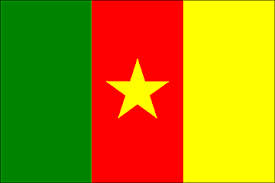
Flag of Cameroon
Flag of Cameroon

About the way he spends his days now in the US: I dedicate myself to my children’s education. I have, during 3 decades, focused my life on my struggle, the fight against social inequalities, forgetting that I was first a head of family. Despite what the Um [Nyobé], Ouandié, Moumié, and all the known and unknown freedom fighters have done, nobody knows what has become of their offspring. For me, it is very serious. It is as if they had fought for nothing. [Je me consacre à l’éducation de mes enfants qui sont ici avec moi. J’ai pendant 3 décennies focalisé ma vie sur mon combat, à savoir la lutte contre les inégalités sociales oubliant que j’étais d’abord un chef de famille. Malgré tout ce que les Um, Ouandié, Moumié et tous les autres combattants connus et inconnus ont fait, personne aujourd’hui ne sait ce que sont devenues leurs progénitures, Pour moi, c’est très grave. C’est comme s’ils ont combattu pour rien …].  (Source: Le Messager 04 April 2013)

About his rupture with Biya and Fru Ndi: Paul Biya, even if he listens to my songs, does not count on my very short list of friends. So no need to break up with him even though I never voted neither for him, nor for Ahidjo’s party which he hijacked in Bamenda in 1985. Fru Ndi, whom I now call “CHIENMAN” and not Chairman, has ceased to be worthy of my respect, given his multiple reversals and changes. … I cannot be in good terms with an individual who plots against the people, it is as simple as that.  [Paul Biya même s’il écoute mes chansons, ne compte pas sur la liste très restreinte de mes amis. Donc pas besoin de rompre avec lui encore que je n’ai jamais voté ni pour lui-même, ni pour le parti de Ahidjo qu’il a détourné à Bamenda en 1985. Fru Ndi que j’appelle désormais “CHIENMAN” et non Chairman, a cessé depuis bien longtemps d’être une personne ayant droit à mon respect, compte tenu de ses multiples virements, revirements et retournements de veste. … Je ne peux pas être en bon terme avec un individu qui complote contre le peuple, c’est aussi simple que cela]. (Source: Le Messager 04 April 2013)

On his dream for Cameroon? I dream of a Cameroon where the power will belong to the people.  Where the wealthy will not use the misery of the poor by giving them some rice, fish, beer and 1000 FCFA to stay in power and plunder the country’s resources.  [Je rêve d’un Cameroun dont le pouvoir appartiendra au peuple. Où les riches ne vont pas se servir de la misère des pauvres en donnant aux démunis du riz, du poisson, de la bière et 1000f pour aller au pouvoir piller les ressources du pays.] (Source: Le Messager 04 April 2013)
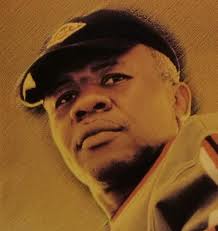
Lapiro de Mbanga
Lapiro de Mbanga

On his struggle: The fight continues. I got out of jail only three months ago. And I need to continue the fight at a greater level. … You have seen my environment. Here in Mbanga, it is 7:30PM and it is already dark everywhere. Without electricity, you can be attacked. Yet, there are people who fight at work all day. And at the end of the day, there is no light, no health, the children cannot go to school. There is no escape. That is my fight, my struggle. It is for that Cameroon that I am fighting. And I want the Americans and Europeans to understand. I come to tell them: thank you for fighting for Lapiro de Mbanga [release] , but there are 20 millions of Lapiro de Mbanga in Cameroon who experience the martyr daily. Wake up and do something. [Le combat continue. Je suis sorti de prison il y a seulement trois mois. Et je dois continuer le combat au niveau des grandes instances. … Vous avez vu mon environnement. Ici à Mbanga il est 19h30 et partout il fait noir. Sans électricité vous pouvez être agressé ici. Pourtant, il y a des gens qui se battent au travail toute la journée. Et, à la fin, il n’y a pas de lumière, ni de santé, les enfants ne peuvent pas aller à l’école. Il n’y a pas d’issue. C’est ça mon combat. C’est pour ce Cameroun-là que je me bats. Et je veux que les Américains et les Européens comprennent. Je viens leur dire par ma voix : merci d’avoir combattu pour Lapiro de Mbanga, mais il y a 20 millions de Lapiro de Mbanga au Cameroun qui subissent le martyr au quotidien. Réveillez-vous et faites quelque chose.] (Source: RFI, P. Gauthier, 12/07/2011)

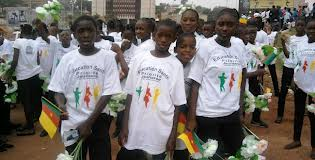
11 Feb 2014 : Cameroon’s National Youth Day

Flag of Cameroon
Flag of Cameroon

Today happens to be the Cameroonian National Youth Day.  I have been thinking about the true meaning of a youth day.  For as long as I can remember, it has always been a speech from the President, and marches/parades from children across the nation.  But is that really what the National Youth Day is all about?  Well, for starters, I must admit that growing up, I was always really proud of marching on that day.  It was as if somehow, I suddenly mattered to the country… as if, from my child’s world, I could somehow influence changes in my country: bring clean water, stop the electricity cuts, build bridges, make better roads, build airports, etc.  It was as if, by marching, I had a say in the direction of my country, I was important; I mattered!  11 February was not just a day off to watch the parade on TV, it was a special day, a day dedicated to me, to my needs as a youth, to my well-being, to my inner desires, and to my potentials.

Youths during the parade celebrating Cameroon's National Youth Day
Youths during the parade celebrating Cameroon’s National Youth Day

As a teenager, the thought started to thaw a little bit, was 11 February only about the President’s speech?  was it just a time to cajole me as a youngster into thinking that I was important? that there was light at the end of the tunnel? that I was the future of the country, when around me, adults were feeling like the future had been beaten out of them? How was I supposed to make changes, when looking at big brothers ahead, I could only see unemployment looming in the horizon?  How was I supposed to concentrate into doing well in school or achieving all these great things I was asked to, when the future looked so grim?  What was the future going to look like with me in the picture?

Today, I see that it was actually necessary to acquire all this education, to read, and to focus, because in reality, even if the president’s speeches were empty words… I have the obligation, no the duty, to think of my elders: Ruben Um Nyobe, Felix Moumié, Abel KinguéOsendé Afana (who was Cameroon’s first PhD in economics), Ernest Ouandié, and countless others who sacrificed themselves so that I could be better.  Yes… it sounds so easy, but to think about it should bring fire, no, rage into our hearts.  Just thinking about all the great minds we have, all this great potentials, talented musicians who influence the world (like Ekambi Brillant who produced Angélique Kidjo who is now a world star), footballers, writers (Mongo Beti), comedians, doctors, scientists, journalists (Pius Njawe), who live and die like paupers, should give extra, ten times, 100 times more fire into our hearts, and really make us realize that we are the indeed the future of our country, and nobody else will build it for us, not even 80 years-old ministers.  I live you here with K’naan hymn to the youth which was sung during the 2010 FIFA World Cup: “Out of the darkness, I came the farthest, … Learn from these streets, it can be bleak.  Accept no defeat, surrender, retreat.  So we struggling, fighting to eat, And we wondering when we’ll be free ... we patiently wait for that fateful day… it is not far away… when I get older, I will be stronger, they’ll call me freedom just like a waving flag“.

Cameroun: Autopsie d’une Pseudo-Independance

Pour continuer sur la même lancée, je voudrais vous faire part de cette vidéo: “Cameroun: Autopsie d’une pseudo-indépendence” par Gaëlle Le Roy et Valérie Osouf.  Cette vidéo porte sur les années noires du Cameroun, les années de repression, les années du maquis, les années du génocide en pays Bamiléké, et les techniques utilisées par Roland Pré, alors Haut-commissaire muté au Cameroun en 1954.  Pour en savoir un peu plus, visiter le site: Kamerun-leSite qui fait état de cette guerre cachée qui sévira au Cameroun pendant plus de 20 ans et qui fera plus de 300,000 morts.

The Principal Reasons why Osende Afana was defeated

Castor Osende Afana
Castor Osende Afana

Castor Osendé Afana‘s maquis suffered a major defeat, and a final blow with the murder and decapitation of its leader on 15 March 1966.  Here are some of the principal reasons of the defeat of the Boumba-Ngoko maquis in the south east corner of Cameroon.  These reasons had been identified by Osendé Afana himself before his death, and by his some of his followers later on.

1 – The Boumba-Ngoko region (or Moloundou region) had not been exposed to any revolutionary movement, or any influx of political ideas about the liberation of Cameroon since the end of the second world war, like the populations of the West, Littoral, Center or Southern provinces.  The populations there being mostly Bakas pygmies and poor Bantous peasants and illiterate had almost never led major economic or political struggles against the exploitation and domination of the colonial and neocolonial forces.  Their political awareness was quite low, and they had very little experience fighting.

2 – The region was sparsely populated, which forced the guerilleros, who were supposed to move around the people as fish in the sea, to fight practically in the open against a very powerful enemy.

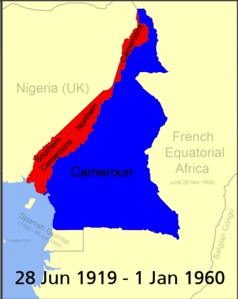
Map of Cameroon from 1919 to 1960, including both Cameroons (French in Blue, and British in red)

3 – The low number in Afana’s group which kept decreasing due to several desertions.  It was also very difficult to recruit among the local people.

4 – No members of the initial group were originally from that region, and thus had little knowledge of the field, the language, and customs of the local populations.

5 – The maquis’ entrance from Congo-Brazzaville had happened without much discretion, and all their subsequent movements in the region did not go unnoticed.  This made it easy for the colonial forces to trace them.

6 – No prior ground study had been done.

7 – The government of Congo, while giving their support to Afana, were opposed to any military action on their borders.

8 – Several tactical differences persisted within the group, with Osendé Afana, being more political and anxious of respecting the Congolese wishes, and with Fosso Francois, who was more military-centered.

9 – No prior contact/communication had been established with the Western maquis led by Ernest Ouandié.  This could have ensure some help.

10 – An incorrect assessment of the colonial forces, their tactics, their capacity of enrolment, and the political activity of the masses on the national scale.

11 – Lastly, too big a reliance on external help.

For more information, visit afrohistorama.com to learn more about these critical events in the history of Cameroon.

Castor Osendé Afana: A Cameroonian National Hero

Castor Osende Afana
Castor Osende Afana

Brilliant economist, Castor Osendé Afana is considered a national hero in Cameroon, however he is not as well-known as Ruben Um Nyobé, or Felix-Roland Moumié, or even his alter ego on the western front of Cameroon, Ernest Ouandié.  Like those three, he was also assassinated, and paid with his life for his passion for the freedom of Cameroon, and Africa from colonialism.  So who was Castor Osendé Afana?

Well, Castor Osendé Afana was born in 1930 in Ngoksa near Sa’a, in the Centre Region of Cameroon.  In 1948 he was admitted to the seminary at Mvolyé, in Yaoundé, where he became a strong friend of Albert Ndongmo, the future Bishop of Nkongsamba.  He was excluded from the seminary in 1950 because of his critical and rebellious character.  It is as a ‘candidat libre’ that he successfully passed the first part of the Baccalauréat.  He then started in philosophy at the Lycée Leclerc where he headed student manifestations demonstrating against the poor food service there.  He nonetheless went on to successfully pass the 2nd part of the baccalauréat in 1952.

Later, Osendé Afana obtained a full scholarship to study Economics in Toulouse, France.  By 1956, he was a vice-president of the Black African Students Federation in France (Fédération des étudiants d’Afrique noire en France – FEANF), and was managing director of the FEANF organ L’Etudiant d’Afrique noire.   As a UPC militant he ensured that the issues of Cameroon were well-covered in the magazine.  In 1958, Osendé Afana was named General Treasurer of FEANF, as well as being responsible for the UPC in France.

UPC Leaders (L. to R.) front row: Castor Osende Afana, Abel Kingué, Ruben Um Nyobé, Felix Moumié, and Ernest Ouandié

After the French government dissolved the UPC by decree on 13 July 1955,  most of the UPC leaders moved to Kumba in the British-administered Southern Cameroons to avoid being jailed by the colonial power.  In July 1957, under pressure from the French, the British authorities in western Cameroon deported the leaders of the UPC to Khartoum, Sudan.  They moved in turn to Cairo, Egypt, to Conakry, Guinea and finally to Accra, Ghana, where they were hosted by President Nkrumah.  In 1958, after Ruben Um Nyobé’s death, Osendé Afana decided to abandon his thesis and rejoin the leadership of the UPC, proposing himself as a candidate for the new Secretary General.  Nyobé’s successor, Félix-Roland Moumié, told him “There is no longer a Secretary General.  There was one, he is dead, that is it.”  However, Osendé Afana was designated UPC representative at the Afro-Asian People’s Solidarity Conference in Cairo in December 1957 – January 1958.  After Cameroon’s independence in 1960, the UPC continued to fight the government of President Ahmadou Ahidjo whom they considered a puppet of the French colonial power. Continue reading “Castor Osendé Afana: A Cameroonian National Hero”

Abel Kingué, Short but rising Tall for the Independence of Cameroon

UPC Leaders (L. to R.) front row: Castor Osende Afana, Abel Kingué, Ruben Um Nyobé, Felix Moumié, and Ernest Ouandié

Today, I will be talking about an almost forgotten leader of the UPC (Union des Populations du Cameroun), its vice president, Abel Kingué.  Who was Abel Kingué?

Well, Abel Kingué was born Abel Kegne, in Fokoue near Bamendou (in the Menoua department) in 1924, into a polygamous household.  Soon, he would live his home and move to the city of Dschang where he worked as a tennis ball boy for a while before getting spotted and given a chance to attend school.  After school in Dschang, Bafang, and Nkongsamba, he went on to attend the Nursing school of Ayos.  In 1947, he moved to Douala, and work in a big commercial center.

In April of 1950, Abel entered the direction of the UPC directly after its first congress in Dschang.  He entered the spotlight when, despite his short height, he publicly denounced the political embezzlement of prince Ndoumbe Douala Manga Bell.  Not only was Abel Kingué a great orator, but he also showed great firmness, great organization skills, great work ethics, and kindness.

Flag of the UPC
Flag of the UPC

He was re-elected vice president of the UPC during its 2nd congress in Eséka, in September 1952.  He was also chief editor of the ‘Voix du Kamerun‘ (Voice of Kamerun), UPC’s main organ of expression.  In december 1953, he went to the United Nations, to represent the JDC (Jeunesse Démocratique Camerounaise – Cameroonian Democratic Youth) of which he was a founding member.  On his return, while touring the country to share his report with others, he was attacked in Mbouroukou, near Melong, and was seriously injured and left for dead.

The crackdown on the UPC movement intensified dramatically in 1954 with the arrival of the new French High Commissioner, Roland Pré. Roland Pré said in one of his interviews about his crackdown on the UPC that he implemented techniques he had learnt in nazi concentration camps to crush UPC’s leaders in Cameroon… One just shivers while imagining the brutality and atrocity that our courageous independence fighters had to face.  On April 14th 1954, Kingué ran for elections into the ATCAM (Assemblée territoriale du Cameroun – Territorial Assembly of Cameroon), and despite his huge popularity, will be declared a loser by the colonial administration. Click here to Continue reading “Abel Kingué, Short but rising Tall for the Independence of Cameroon”

Remember Ruben: A Rare Video Biography of Ruben Um Nyobé

UPC Leaders (L. to R.) front row: Castor Osende Afana, Abel Kingué, Ruben Um Nyobé, Felix Moumié, and Ernest Ouandié

After my article on one of Africa’s greatest freedom fighter, the Cameroonian leader, Ruben Um Nyobé, I thought that this small rare video with pictures of Um Nyobé would be very fit to add to our knowledge.  Ruben Um Nyobé with the UPC in 1948 were the first in Africa to ask for the independence of their country, Cameroon.  He was murdered by the French colonial administration, and his story was totally buried for many years: it was as if he had had no impact on the lives of Cameroonians, and Africans as a whole.  It is just amazing to realize that, 50 years later, he had spoken at the United Nations tribune three times for the independence and reunification of Cameroon in 1952, 1953, and 1954.  It is amazing to think that in Cameroon, there was someone of the caliber of N’Krumah, Lumumba, and Nyerere… Yes… Ruben Um Nyobé’s place should be at the Pantheon (if it existed) of African legends.  Enjoy!!!

Ruben Um Nyobé: Fighting for the independence of Cameroon

Ruben Um Nyobé
Ruben Um Nyobé

With presidential elections taking place this Sunday October 9th in Cameroon, with its plethora of opposition candidates, and no real organization, I thought that a trip down memory lane to the time of the 1940s-1960s when there was a real opposition in Cameroon will be very appropriate. I would like to talk about one of Cameroon’s greatest opposition fighters and freedom fighters: Ruben Um Nyobé, the real father of Cameroon’s independence.

Ruben Um Nyobé was a Cameroonian freedom fighter, and an anti-imperialist leader. Born in Song Mpeck in 1913, Um Nyobé was a stellar student raised in a modest family of farmers.  Initiated to the culture of the Bassa by his father who was well-versed, Um noticed early all the crimes committed by the colonial administration on the indigenous people, crimes such as indentured servitude, forced labor, dehumanization, spanking, beating etc…  This made him later write: “la colonisation, c’est l’esclavage ; c’est l’asservissement des peuples par un groupe d’individus dont le rôle consiste à exploiter les richesses et les hommes des peuples asservis“( “Colonization is slavery; it is an enslavement of the populations by a group of individuals whose role is to exploit the riches and the men of the enslaved populations.”)

Flag of the UPC
Flag of the UPC

On April 10th, 1948, the Union des Populations du Cameroon (Cameroon People’s Union or UPC) was founded and was first led by Leornard Bouli, and later Um Nyobé  was elected general secretary. The main goal of the party was the independence and reunification of both (British and French) Cameroons.  Its symbols were a red flag with a black crab on it: red for the blood of patriots who lost their lives, the crab as a reference to the reunification of Kamerun, and black to symbolize the color of the Black continent, Africa, the cradle of humanity.

The party was at first the Cameroonian branch of the RDA, of which Um Nyobé became one of its vice presidents in 1949.  However, the RDA of Houphouet-Boigny choose to cooperate with the French colonial administration, while UPC of Um Nyobé  refused to join in this treason and choose to continue the fight for the immediate recognition of the nation of Cameroon (independence), and its reunification.  Um Nyobé, the leader of UPC, was particularly charismatic, courageous, and a very good orator.  For the Cameroonian intellectual youth of those days, he was without any doubt the leader which embodies Cameroonian patriotism, and for the masses,  he was the hero who will bring a new dawn.  His aura was such that his name travelled into the country in rural areas.  He was affectuously known as “Mpodol” or “celui qui porte la voix ou qui défend la cause“, “the one who carries the demands.” He was particularly active, wrote political articles, held  meetings where as much as tens of thousands could be seen, met the masses, and moved across the country.

Ruben Um Nyobé with his family

As the charismatic leader of the UPC, Ruben Um Nyobé (1913-1958), defended three times (1952, 1953, and 1954) the cause of Cameroon at the United Nations tribune in New York.  On 22 April 1955, the UPC published the “Proclamation commune(Common proclamation), which was considered as a unilateral declaration of independence and a provocation by the French authorities.  On 19 May, Um Nyobé went underground and on 22 May, the French gendarmes dispersed UPC meetings and the party announced it would no longer recognize French authority. Following violent riots, the UPC and its branches were banned by the French authorities on 13 July 1955.  Since the UPC was then the main political party in Cameroon, the French authorities decided to support other, less provocative parties, to try to divide-and-conquer. In December 1956, the UPC which was banned from participating in the general elections, set up an armed branch called the “Comité National d’Organisation” (Organization National Committe or CNO) and started an armed struggle. A pacification campaign was performed by the French army which was actually a genocide perpetrated on the people of Cameroon, and culminated with the assassination of Um Nyobé on 13 September 1958.  He was murdered by the French army, near his natal village of Boumnyebel, in the department of Nyong-et-Kéllé in the maquis Bassa. Um Nyobé ‘s death set in motion events that totally decapitated the UPC (even to this date) as the strongest opposition party of Cameroon.  In essence, his murder allowed the French to set a neo-colonial state in Cameroon, which today still lives as a puppet state serving Western interests.  At the time, however, his fierce fight forced the French colonial power to abuse of its powers, commit a genocide (still not well-documented almost 50 years later) in the Western highlands, and Bassa maquis, and finally forcing them to award independence to Cameroon.

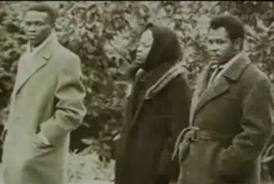
Ernest Ouandié, Marthe Moumié, and Abel Kingue in Geneva after Felix Moumié's death
L-R: Ernest Ouandié, Marthe Moumié, and Abel Kingue in Geneva after Felix Moumié's death

The independence of Cameroon, under complete French control, was proclaimed on 01 January 1960 and some leaders of the “legal UPC” rallied President Ahidjo.  However, others in the UPC continued with the struggle within the country and abroad.  Félix Moumié, Um Nyobé ’s successor, was poisoned with thallium on 3 November 1960 in Geneva by a French secret agent (William Bechtel).  Abel Kingue died in Algeria in 1964, while Osende Afana was arrested and decapitated in 1966. A post-colonial struggle by UPC rebels opposing the new Cameroon army (trained and armed by France) continued until August 1970 when the last battalion of the UPC, commanded by Ernest Ouandié, was arrested.  Ouandié was sentenced to death and was shot by a death squad in a market on 15 January 1971, in Bafoussam.  The civil war, resulting in the destruction of villages and use of napalm is estimated to have resulted in at least 30,000 to 500,000 deaths.  It has been conveniently removed from official history, both in Cameroon and in France.

In his book, Richard A. Joseph says: He [Ruben Um Nyobé ] was undoubtedly one of the most brilliant political thinkers and organizers to emerge after the Second World War in Africa. Had he survived to lead his country to independence, he would most certainly be ranked today on the same level as Julius Nyerere, and the late Kwame Nkrumah and Patrice Lumumba.” 

Remember Ruben de Mongo Béti
'Remember Ruben' by Mongo Béti

Check out the website Grioo.com where there is a good biography on Ruben Um Nyobe’s life. Don’t forget to check out the website of Dibussi Tande. The great Cameroonian writer Mongo Béti wrote the book Main basse sur le Cameroun, autopsie d’une décolonisation (about the Cameroonian resistance led by the UPC) which was banned in France in the 70s, which led to him to write Remember Ruben in honor of Ruben’s memory.  As leader of the UPC, Um Nyobé  made several trips to the United Nations headquarters in New York where he spoke in favor of an independent Cameroon. I leave you here with the rare footage, the only footage of Um Nyobé speaking at the UN tribune.  This is the only audio and visual record of Um Nyobé  found to date. Enjoy hearing Mpodol speak!!!  It is a real treasure!!!

Félix Moumié: Un independantiste Camerounais

Felix Moumie
Felix Moumie

Charité bien ordonnée commence par soi-même!” Il est enfin temps que je parle d’un des pères de la nation camerounaise, d’un unique indépendantiste qui s’est battu pour la libération de son pays, et qui a été lâchement assassiné en Suisse (empoisonné) par les services secrets Français: Felix-Roland Moumié! C’est en 2006, que nous decouvrons pour la première fois, l’histoire ou plutôt un bref sommaire relatant les derniers jours de cet indépendantiste à travers un documentaire intitulé “L’assassinat de Felix Moumié- L’Afrique sous contrôle,” réalisé par Frank Garbely.

Les leaders de l'UPC: Ruben Um Nyobe, Felix Moumie, et Ernest Ouandie
Les leaders de l’UPC: Ruben Um Nyobe, Felix Moumie, et Ernest Ouandie

Felix Moumié, médécin de formation (chirurgien d’ailleurs), deviendra le leader de l’Union des Populations du Cameroun (UPC) après l’assassinat de Ruben Um Nyobé. Il menera bien le parti et sera assassiné à son tour, empoisonné dans un restaurant de Genève en Suisse. Dans le documentaire que vous verrez ci-dessous, faites attention de ne pas etiquetter Moumié. La chose qui me fait vraiment mal quand je vois ce documentaire, c’est sa veuve, Marthe Ekemeyong Moumié qui pleure et réclame que lumière soit faite sur la mort de son mari, et surtout que son corps lui soit remis afin qu’il puisse être enterré dans son pays natal, le Cameroun.

Marthe Ekemeyong Moumie

La chose qui me fait encore plus mal, c’est de savoir que cette dame qui s’est battue pour que la mémoire de son mari soit célébrée fut violée et assassinée au début de l’année (Janvier 2009) à Ebolowa!  Pourquoi ce crime ignoble? Qu’est-ce-qu’une pauvre dame inoffensive peut-elle faire à qui que ce soit? Comme quoi il y a encore certaines choses qui méritent d’etre déterrées, et il est important que les Camerounais connaissent leur histoire. Une chose est sûre et certaine, je lève mon chapeau à cette dame qui mérite de faire partie des annales des femmes fortes du continent Africain.

N’oubliez pas de regarder les parties suivantes 2 et 3 (Felix Moumie Part 2, Felix Moumie Part 3)

N’oubliez pas d’aller contribuer sur Wikipedia… la page sur Moumié est presque vide! Felix Moumié sur Wikipedia