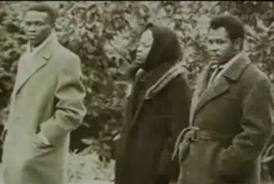
UPC Leaders (L. to R.) front row: Castor Osende Afana, Abel Kingué, Ruben Um Nyobé, Felix Moumié, and Ernest Ouandié
Today, I will be talking about an almost forgotten leader of the UPC (Union des Populations du Cameroun), its vice president, Abel Kingué. Who was Abel Kingué?
Well, Abel Kingué was born Abel Kegne, in Fokoue near Bamendou (in the Menoua department) in 1924, into a polygamous household. Soon, he would live his home and move to the city of Dschang where he worked as a tennis ball boy for a while before getting spotted and given a chance to attend school. After school in Dschang, Bafang, and Nkongsamba, he went on to attend the Nursing school of Ayos. In 1947, he moved to Douala, and work in a big commercial center.
In April of 1950, Abel entered the direction of the UPC directly after its first congress in Dschang. He entered the spotlight when, despite his short height, he publicly denounced the political embezzlement of prince Ndoumbe Douala Manga Bell. Not only was Abel Kingué a great orator, but he also showed great firmness, great organization skills, great work ethics, and kindness.
Flag of the UPC
He was re-elected vice president of the UPC during its 2nd congress in Eséka, in September 1952. He was also chief editor of the ‘Voix du Kamerun‘ (Voice of Kamerun), UPC’s main organ of expression. In december 1953, he went to the United Nations, to represent the JDC (Jeunesse Démocratique Camerounaise – Cameroonian Democratic Youth) of which he was a founding member. On his return, while touring the country to share his report with others, he was attacked in Mbouroukou, near Melong, and was seriously injured and left for dead.
The crackdown on the UPC movement intensified dramatically in 1954 with the arrival of the new French High Commissioner, Roland Pré. Roland Pré said in one of his interviews about his crackdown on the UPC that he implemented techniques he had learnt in nazi concentration camps to crush UPC’s leaders in Cameroon… One just shivers while imagining the brutality and atrocity that our courageous independence fighters had to face. On April 14th 1954, Kingué ran for elections into the ATCAM (Assemblée territoriale du Cameroun – Territorial Assembly of Cameroon), and despite his huge popularity, will be declared a loser by the colonial administration. Click here to Continue reading “Abel Kingué, Short but rising Tall for the Independence of Cameroon”→
Le lion du Boulkiemdé, Boukary Kaboré raconte ses derniers jours avec le capitaine, Président du Faso, le Che Africain, Thomas Sankara, et la largesse d’esprit de ce grand homme. Proche de Thomas Sankara durant la révolution, le capitaine Boukary Kaboré dirigeait une des 4 regions militaires.
Dans les jours qui suivirent l’assassinat de Thomas Sankara, il refusa de faire allégeance à Blaise Compaoré. Il refusa d’organiser une montée sur Ouagadougou arguant du fait qu’il ne voyait pas qui pouvait diriger le pays. Ce sont finalement des militaires proches de Blaise Compaoré qui vont assaillir la ville de Koudougou procédant à un véritable massacre des militaires restés fidèles au Lion. Il réussira à s’enfuir de justesse pour se réfugier au Ghana.
Boukary Kaboré
Il revient longuement sur tous ces évènements. ll raconte aussi combien il a tenté vainement de protéger Thomas Sankara qui ne voulait pas de protection (il dit si bien en parlant de Thomas: ‘comment protéger un président qui aime se déplacer à vélo?‘), les tentatives pour le convaincre de démissionner afin d’éclaircir la situation politique, comment était organisée la sécurité de la présidence, comment on a acheté un des fidèles, etc…
Regardez, écoutez, et que ceci vous apporte un élément de clarté sur la mort de notre héros, et grand ‘Che’ africain, Thomas Sankara.
January 20th marks the anniversary of the death of Amilcar Cabral, the father of the independence of Guinea Bissau and Cape Verde. As such, I just thought about leaving you with some of his most famous quotes. Enjoy!
“A people who free themselves from foreign domination will be free culturally only if, without complexes and without underestimating the importance of positive accretions from the oppressor and other cultures, they return to the upward paths of their own culture, which is nourished by the living reality of its environment, and which negates both harmful influences and any kind of subjection to foreign culture. Thus, it may be seen that if imperialist domination has the vital need to practice cultural oppression, national liberation is necessarily an act of culture.” Amilcar Cabral, “National Liberation and Culture” Lecture delivered on February 20 at Syracuse University as part of the Eduardo Mondlane Memorial Lecture Series. Eduardo Mondlane was the first President of the Mozambique Liberation Front (FRELIMO) who was assassinated by Portuguese agents on Feb. 3, 1960. historyisaweapon.com
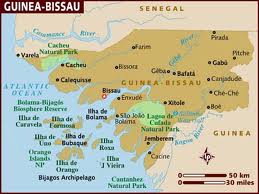
Map of Guinea Bissau
“We must practice revolutionary democracy in every aspect of our Party life. Every responsible member must have the courage of his responsibilities, exacting from others a proper respect for his work and properly respecting the work of others. Hide nothing from the masses of our people. Tell no lies. Expose lies whenever they are told. Mask no difficulties, mistakes, failures. Claim no easy victories…” Amilcar Cabral: tell no lies, claim no easy victories
“Educate ourselves; educate other people, the population in general, to fight fear and ignorance, to eliminate little by little the subjection to nature and natural forces which our economy has not yet mastered. Convince little by little, in particular the militants of the Party, that we shall end by conquering the fear of nature, and that man is the strongest force in nature.” Amilcar Cabral: Tell no lies, claim no easy victories
With presidential elections taking place this Sunday October 9th in Cameroon, with its plethora of opposition candidates, and no real organization, I thought that a trip down memory lane to the time of the 1940s-1960s when there was a real opposition in Cameroon will be very appropriate. I would like to talk about one of Cameroon’s greatest opposition fighters and freedom fighters: Ruben Um Nyobé, the real father of Cameroon’s independence.
Ruben Um Nyobé was a Cameroonian freedom fighter, and an anti-imperialist leader. Born in Song Mpeck in 1913, Um Nyobé was a stellar student raised in a modest family of farmers. Initiated to the culture of the Bassa by his father who was well-versed, Um noticed early all the crimes committed by the colonial administration on the indigenous people, crimes such as indentured servitude, forced labor, dehumanization, spanking, beating etc… This made him later write: “la colonisation, c’est l’esclavage ; c’est l’asservissement des peuples par un groupe d’individus dont le rôle consiste à exploiter les richesses et les hommes des peuples asservis“( “Colonization is slavery; it is an enslavement of the populations by a group of individuals whose role is to exploit the riches and the men of the enslaved populations.”)
Flag of the UPC
On April 10th, 1948, the Union des Populations du Cameroon (Cameroon People’s Union or UPC) was founded and was first led by Leornard Bouli, and later Um Nyobé was elected general secretary. The main goal of the party was the independence and reunification of both (British and French) Cameroons. Its symbols were a red flag with a black crab on it: red for the blood of patriots who lost their lives, the crab as a reference to the reunification of Kamerun, and black to symbolize the color of the Black continent, Africa, the cradle of humanity.
The party was at first the Cameroonian branch of the RDA, of which Um Nyobé became one of its vice presidents in 1949. However, the RDA of Houphouet-Boigny choose to cooperate with the French colonial administration, while UPC of Um Nyobé refused to join in this treason and choose to continue the fight for the immediate recognition of the nation of Cameroon (independence), and its reunification. Um Nyobé, the leader of UPC, was particularly charismatic, courageous, and a very good orator. For the Cameroonian intellectual youth of those days, he was without any doubt the leader which embodies Cameroonian patriotism, and for the masses, he was the hero who will bring a new dawn. His aura was such that his name travelled into the country in rural areas. He was affectuously known as “Mpodol” or “celui qui porte la voix ou qui défend la cause“, “the one who carries the demands.” He was particularly active, wrote political articles, held meetings where as much as tens of thousands could be seen, met the masses, and moved across the country.
Ruben Um Nyobé with his family
As the charismatic leader of the UPC, Ruben Um Nyobé (1913-1958), defended three times (1952, 1953, and 1954) the cause of Cameroon at the United Nations tribune in New York. On 22 April 1955, the UPC published the “Proclamation commune” (Common proclamation), which was considered as a unilateral declaration of independence and a provocation by the French authorities. On 19 May, Um Nyobé went underground and on 22 May, the French gendarmes dispersed UPC meetings and the party announced it would no longer recognize French authority. Following violent riots, the UPC and its branches were banned by the French authorities on 13 July 1955. Since the UPC was then the main political party in Cameroon, the French authorities decided to support other, less provocative parties, to try to divide-and-conquer. In December 1956, the UPC which was banned from participating in the general elections, set up an armed branch called the “Comité National d’Organisation” (Organization National Committe or CNO) and started an armed struggle. A pacification campaign was performed by the French army which was actually a genocide perpetrated on the people of Cameroon, and culminated with the assassination of Um Nyobé on 13 September 1958. He was murdered by the French army, near his natal village of Boumnyebel, in the department of Nyong-et-Kéllé in the maquis Bassa. Um Nyobé ‘s death set in motion events that totally decapitated the UPC (even to this date) as the strongest opposition party of Cameroon. In essence, his murder allowed the French to set a neo-colonial state in Cameroon, which today still lives as a puppet state serving Western interests. At the time, however, his fierce fight forced the French colonial power to abuse of its powers, commit a genocide (still not well-documented almost 50 years later) in the Western highlands, and Bassa maquis, and finally forcing them to award independence to Cameroon.
L-R: Ernest Ouandié, Marthe Moumié, and Abel Kingue in Geneva after Felix Moumié's death
The independence of Cameroon, under complete French control, was proclaimed on 01 January 1960 and some leaders of the “legal UPC” rallied President Ahidjo. However, others in the UPC continued with the struggle within the country and abroad. Félix Moumié, Um Nyobé ’s successor, was poisoned with thallium on 3 November 1960 in Geneva by a French secret agent (William Bechtel). Abel Kingue died in Algeria in 1964, while Osende Afana was arrested and decapitated in 1966. A post-colonial struggle by UPC rebels opposing the new Cameroon army (trained and armed by France) continued until August 1970 when the last battalion of the UPC, commanded by Ernest Ouandié, was arrested. Ouandié was sentenced to death and was shot by a death squad in a market on 15 January 1971, in Bafoussam. The civil war, resulting in the destruction of villages and use of napalm is estimated to have resulted in at least 30,000 to 500,000 deaths. It has been conveniently removed from official history, both in Cameroon and in France.
In his book, Richard A. Joseph says: “He [Ruben Um Nyobé ] was undoubtedly one of the most brilliant political thinkers and organizers to emerge after the Second World War in Africa. Had he survived to lead his country to independence, he would most certainly be ranked today on the same level as Julius Nyerere, and the late Kwame Nkrumah and Patrice Lumumba.”
'Remember Ruben' by Mongo Béti
Check out the website Grioo.com where there is a good biography on Ruben Um Nyobe’s life. Don’t forget to check out the website of Dibussi Tande. The great Cameroonian writer Mongo Béti wrote the book Main basse sur le Cameroun, autopsie d’une décolonisation (about the Cameroonian resistance led by the UPC) which was banned in France in the 70s, which led to him to write Remember Ruben in honor of Ruben’s memory. As leader of the UPC, Um Nyobé made several trips to the United Nations headquarters in New York where he spoke in favor of an independent Cameroon. I leave you here with the rare footage, the only footage of Um Nyobé speaking at the UN tribune. This is the only audio and visual record of Um Nyobé found to date. Enjoy hearing Mpodol speak!!! It is a real treasure!!!
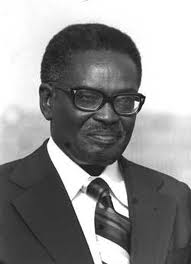
Agostinho Neto was the first president of Angola, and served from 1975 to his death in 1979. He was born in a Methodist family (his father was a Methodist pastor), attended high school in Luanda, and studied medicine in Lisbon (specializing in gynecology). In Lisbon, he befriended future political leaders such as Amilcar Cabral (Guinea Bissau and Cape Verde) and Marcelino dos Santos (Mozambique). He combined his academic life with covert political activities.
In 1948 he published his first volume of poetry and was arrested for the first time. There followed a series of arrests and detention, which interrupted his studies. He joined the Movimento Popular da Libertação de Angola (MPLA, People’s Movement for the Liberation of Angola) when it formed in 1956. He was released from detention and allowed to complete his studies in 1958, retuning shortly afterwards to Angola (1959), where he set up a private medical practice.
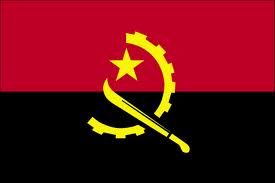
Flag of Angola
On 6 June 1960, Agostinho Neto was arrested at his practice as a result of his campaigning against the Portuguese colonial administration of Angola. When patients, friends, and supporters marched in demonstration for his release, the police opened fire and 30 were killed, 200 more injured. This became known as the Massacre de Icolo e Bengo (his birthplace). Neto was exiled to and held in captivity initially in Cape Verde and then in Portugal, where he wrote his second volume of poetry. After international pressures, the Portuguese government put him under house arrest, where he escaped to Morocco and later to Zaire (Congo).
He became president of the MPLA in 1962, and looked for support in the American government against Portugal, but was turned down. He received the support of Cuba and the Soviet Union for the fight for the freedom of the people of Angola from Portuguese imperialism.
After the Revolução dos Cravos (Carnation Revolution) in 1974 in Portugal, which took down the government by a military coup, Portugal’s foreign policy changed in its African colonies. On 11 November 1975, Angola became independent, and Neto was proclaimed president on that day. The country was effectively held under the rule of three independence movements, with the MPLA holding the central section and the capital.
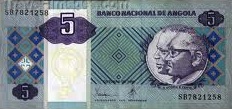
Agostinho Neto & Jose Eduardo dos Santos
Neto’s rule was marked by armed conflict with Holden Roberto’s FNLA (supported by Mobutu of Zaire, and the US) and Jonas Savimbi‘s UNITA which had military support from South Africa. While Neto enjoyed the help and support of the Soviet Union and Cuba, he still encouraged Western investment in the country – especially in oil production. He died of cancer on September 10th, 1979 in Moscow. After his death, the civil war in Angola lasted for over a quarter of a century opposing Jose Eduardo dos Santos (his successor) and Jonas Savimbi.
Agostinho Neto was not only Angola’s first president, he was also a medical doctor, and a poet; he is actually one of Angola’s most acclaimed writer and poet. Please check out the website of the Fundação António Agostinho Neto, which has done a brilliant work in presenting Neto’s writings, debates, and comments by other leaders on Neto. Now I leave you with his great saying: “A luta Continua … A Vitória é certa!”
Today I will be talking about Sylvanus Olympio, the first president of Togo, a small country in West Africa, which was once a German colony, and later became a French and British protectorate. The story of Togo is a little bit like that of my country Cameroon which was once a German colony but was later divided between France and Great Britain as protectorates (this will be a story for another day).
Sylvanus Olympio really embodies what the singer Tiken Jah Fakoly said in one of his songs “They [Europeans] divided the world among themselves, nothing amazes me anymore: part of the Mandinka empire found its way in the Wolof empire, part of the Mossi empire found its way in the Ghana empire, part of the Soussou empire found its way into the Mandinka empire and part of the Mandinka empire found its way into the Mossi’s empire …” what do I mean by this? Sylvanus Olympio was from Dahomey (current day Benin) of Afro-Brazilian ancestry, born in Kpando in actual Ghana, and became president of Togo! How was this possible? well because of the balkanization of Africa or rather the scramble for Africa which took place at the Berlin Conference in 1884 where Europeans split Africa among themselves dividing entire empires, people, villages, nations. One of these people were the Ewe people in West Africa who found themselves split among three countries: Gold Coast (Ghana), Togoland (Togo), and Dahomey (Benin).
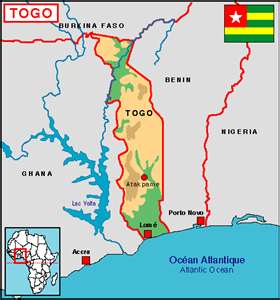
Map of Togo
Sylvanus Olympio believed that the Ewe people should be reunited under one flag…. unfortunately he could never come to agreement with Kwame Nkrumah, his Ghanaian counterpart, and other powers at play. Olympio tried to unite and educate the people about their new nation, and the needs for development. From what a Togolese friend of mine once said, he used to ride a bike from villages to villages talking to people in their languages and educating them about politics, development, and patriotism, at a time when there was no radio (1950s) in most places.
Togo — A History
Sylvanus Olympio barely had a chance to execute anything politically. He was assassinated in a military coup in the US embassy compound in Lomé in 1963, two years after Togo’s independence and his investiture as president. The presidential palace was just next to the US embassy in Lomé. When Olympio heard gunshots, he sent his family to safety, and climbed the wall that separated him to the American embassy. Once there, he knocked at the door of the embassy to seek refuge… Unfortunately, the embassy was closed. Sylvanus hid in one of the cars in the American compound. The American Ambassador comes back to the compound and finds Olympio in the car who explains everything; the ambassador claimed not to have the keys to open the door… and asked him to wait while he would go find the keys. Rumors says that the American ambassador probably called his French counterpart who then contacted the gunmen and sent them to the American compound. Sylvanus was found in the car, and gunned by Eyadéma, one of Africa’s worst dictators backed by the West. The Time magazine wrote an article on that day entitled Togo: Death at the Gate; JFK also had a statement about his death. The journalist, Alain Foka, of RFI did a piece on Olympio.
Many wonder what Togo would have become under someone with such love, brilliance, and vision for his country. No one will ever know. Please enjoy this rare footage of an interview of Sylvanus Olympio to NBC in the US.
With this week’s event in Egypt, I thought that a trip down memory lane would be more than appropriate! One of the greatest political figures of modern Arab history and third world politics is the Egyptian president Gamal Abdel Nasser. Nasser was a pure political genius, and had great love and vision for his country, the Arab world, and developing countries in general. He was a strong player in the battle against imperialism in Africa, and in the Arab world. It was in Egypt that Um Nyobe and the UPC sought refuge to keep on working on Cameroon’s independence (this will be a story for another day).
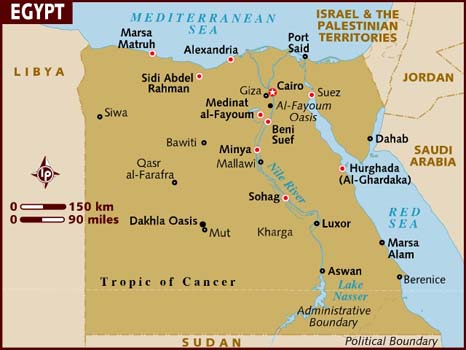
Map of Egypt
He was the first to negotiate the ownership/nationalization of the Suez Canal by Egyptians themselves. At its construction, as in most African countries, it belonged to the British since Egypt had been a British colony. Heled the Egyptian Revolution of 1952 which overthrew the monarchy of Egypt and Sudan, and started a new period of modernization and socialist reforms. He was determined to wean Egypt of its dependency on Western Economies. He was one of the few leaders in the world to declare his neutrality in the Cold War, which was considered very ‘gutsy‘. He moved Egypt toward a socialist economic system and instituted huge land, education and health reforms. As president, he was determined to modernize and improve Egyptians’ standard of living.
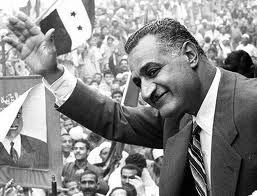
Nasser
After the humiliating Egyptian defeat during the Six-Day war against Israel, Nasser took responsibility for the debacle and resigned from the presidency (but thousands took to the street to demand that he returns to power). In his resignation speech he said: “I have taken a decision with which I need your help. I have decided to withdraw totally and for good from any official post or political role, and to return to the ranks of the masses, performing my duty in their midst, like any other citizen. This is a time for action, not grief…. My whole heart is with you, and let your hearts be with me. May God be with us—hope, light and guidance in our hearts.” You can read the entire speech on Al-Ahram Weekly. He died a couple of years later from a heart attack… many believe that the Six-day war defeat was a precursor. More than 5 million people attended his funeral. Nasser always wanted the best for his people!
Flag of Egypt
I wish more presidents, like Hosni Moubarak, in Africa could have the guts to resign from power, and could love their people so much as to want them to have the best. During an assassination attempt on Nasser’s life at a rally in Alexandria during the celebration of the British withdrawal from the Suez Canal, Nasser proclaimed: “If Abdel Nasser dies… Each of you is Gamal Abdel Nasser… Gamal Abdel Nasser is of you and from you and he is willing to sacrifice his life for the nation.” Moubarak today should learn from the past… like Dr. Zahi Hawass (world-renowned director of Egyptian Antiquities) said in a recent interview to BBC: “What will stay here after many years is Egypt… People will die, but Egypt will stay!” Moubarak should thus ask: “What would I be remembered by: those past few days of protests, or the love for my country?” If his answer is the second one, then he knows that he needs to pack his bags, and uphold Egypt’s liberty!
This Monday marked the 50 year anniversary of the assassination of the great African giant Patrice Lumumba. How could I pass on such an occasion to talk about him? 50 years later, his speech and his vision still ring true. Lumumba dared to defy the Belgian King Baudouin by telling him on independence day what he saw as the Belgian hold on Congo. He was blunt! He spoke the truth! He was not malleable… He could not be manipulated by Europeans! He was a menace because he was a free man proud to be Congolese.
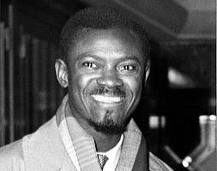
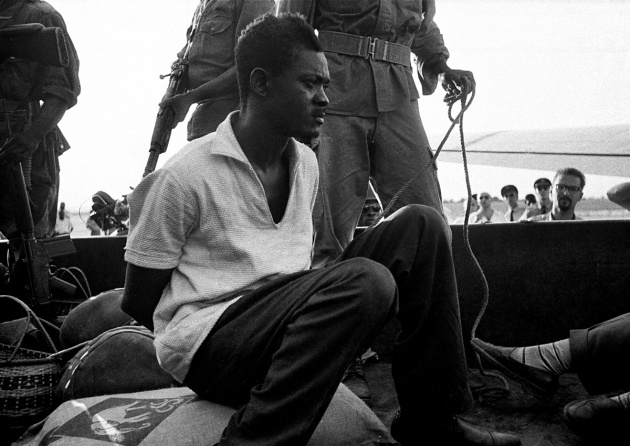
Lumumba detained
I always wondered what would have happened if Lumumba had not been so open about his ambitions for his country? What would have happened if he had played their game, and hidden his cards? Then we, Africans, would have never had our African hero! Someone had to say what we all felt: oppressed, hated, enslaved, diminished,… someone had to make us proud of being Congolese/African again… someone had to re-establish our dignity! That someone happened to be Patrice Emery Lumumba! Patrice died because he had great ideals, and because he trusted others. For the problem in the Katanga province, he went to the United Nations; he trusted that establishment to resolve the conflict peacefully, and to help solve the Katanga secession…. Instead they, with all the interests they represented (US, Belgium,France, etc…), refused to help him… the US of Kennedy refused to help him out, and thus he turned to the USSR to keep his country united. With the USSR, he was able to solve the rebellion in the Katanga and Kasai provinces… but the Americans and Belgians were mad that he had been helped by the Soviets; they decided to have him murdered after this affront (they used Mobutu, and Tshombe)! Once again, we Africans sold our own brother… I wonder where the Maurice Tshombe, or Kibwe, or the Joseph Mobutu are today… History will remember them as tyrants, dictators, and puppets of the West! Isn’t it interesting that history keeps repeating itself? Today the United Nations are starting a war in Ivory Coast in the name of installing a puppet-president in a soveraign country… Have you ever seen the UN so vehemently ask for war in a country? Only in Africa could this be possible… I used to dream that this was a peace organization! Actually, it is an organization to impose the will of the West on third world resource-rich countries.
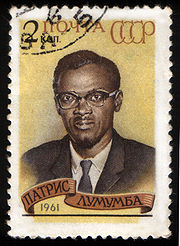
Lumumba on a USSR commemorative stamp in 1961
The following documentary will tell it all: how the Belgians did not like Lumumba because he was not a puppet, how they started the Katanga secession and supported it; how Lumumba went to the UN for help in keeping his country united and was refused help; how Lumumba went to the US to ask for help, and was not even received by president Kennedy; how he turned to the USSR to solve his problem in the Katanga and Kasai provinces; how that event precipitated his end. 50 years later, Lumumba’s ideals and vision are still actual. Lumumba is the symbol of aspirations of an entire continent. His spirit lives on, and his pride is ours!
Lumumba (2000)
I live you with an excerp from a letter he sent to his wife before his death: “… the future of the Congo is beautiful and [I] expect for each Congolese, to accomplish the sacred task of reconstruction of our independence and our sovereignty; for without dignity there is no liberty, without justice there is no dignity, and without independence there are no free men.” You can find the Integral version of this letter on AfricaWithin.com, as well as his famous 30 June 1960 independence day speech. Please don’t forget to check out: Wikipedia, The Guardian which deemed the assassination of Lumumba as the most important of the 20th century, The Daily Nation of Kenya deemed Lumumba the bright spark in a land of despair, and The New York Times which called it an assassination’s long shadow. At last, the movie Lumumba (2000) is what finally got the Belgian admitting their part in the assassination of Lumumba.
Thomas Isidore Sankara, notre héros africain, mort pour ses convictions et son amour de son peuple, et de sa patrie. Ce grand héros a fait l’un des plus beau discours que j’ai jamais entendu sur la dette africaine! Quelle éloquence mon Dieu! Quelle vérité! et quel humour! Je suis d’accord avec lui que la dette africaine ne peut pas être entièrement payée… et que les pays membres qui ne vont pas aux réunions de l’UA ne devraient pas recevoir les mêmes faveurs que ceux qui y assistent assidûment. De plus, il parle de consommer africain: toute sa délégation était habillée par des tisserands Burkinabés. Regardez, écoutez, et célébrez avec moi l’un des plus grands hommes qui ait foulé le sol du continent africain.
Burkina Faso
Thomas Isidore Sankara, our African hero, killed for his convictions, love of his people and his country. This great hero gave one of the greatest speech I have heard about the problem of African debt. Such an eloquence! Such Truth my Lord! Such humour! I do agree with him that the African debt cannot be entirely paid… and that the African nations who do not show up at the UA summit should not have favors extended to them the same as those who attend the meetings. Moreover, he talks about living and breathing African: his delegation and himself were entirely dressed by Burkinabes tailors with cotton from Burkina Faso. Please watch, listen, and celebrate one of the greatest man the African continent has ever seen!
Affectionately known as KK, Kenneth Kaunda was the first president of Zambia.
Kenneth Kaunda with Nelson Mandela
While president of Zambia, Kenneth Kaunda nationalized the copper mines, and also worked towards freeing all the Black people of Southern Africa from white supremacy. He supported freedom fighters in the Portuguese colonies of Angola and Mozambique, in Southern Rhodesia (today’s Zimbabwe), Namibia, and South Africa. He even met with Pieter Botha and B.J. Vorster to solve the issue of apartheid in South Africa, but got no results. Being so close to all these countries and seeing what his fellow brothers were going through made him want to fight. He played a crucial part in the liberation of all of southern Africa from white supremacy. Zambia paid a price for its backing of those countries by being bombed by the Apartheid government.
KK on a Zambian currency note
One thing I remember clearly is the day KK went on national television to sensibilize the Zambian people about the danger of AIDS. He had just lost his son to AIDS, and he was on tears, and urged the people of Zambia to take precautions. I was impressed! How many presidents do you see doing that? or at least how many African presidents do that?
Please enjoy this interview given by Kenneth Kaunda to CNN African voices. One other special plus… Kenneth Kaunda is a great singer!
Don’t forget to watch Part 2 and 3 of the interview.


















 African Heritage