The Griot, the Preserver of African Traditions

Senegal_Wolof griot 1890
Wolof griot in Senegal, c 1890

Africa has a strong, deep, and rich oral tradition. In many countries across West Africa, this tradition is often preserved by the griots, who are historians, storytellers, praise singers, poets, and/or musicians. Often, the griot is the preserver of the history of a family, a clan, and sometimes of the nation. This is done by narrating how the family/clan/tribe/nation was founded and its outstanding achievements. In essence, the griot is a repository of the oral tradition, and is often seen as a societal leader due to his or her traditional position as advisor to kings and leaders.  The griot’s praises centers around the leader of the clan, of the tribe, and of the nation. Thus, great kings throughout history had griots: Sundiata KeitaKankan Musa, and many others.

The Mali Empire (Malinke Empire), at its height in the middle of the 14th century, extended from central Africa (today’s Chad and Niger) to West Africa (today’s Mali and Senegal). The empire was founded by Sundiata Keita, whose exploits remain celebrated in Mali today. In the Epic of Sundiata, King Naré Maghann Konaté offered his son Sundiata a griot, Balla Fasséké, to advise him in his reign. Balla Fasséké is considered the founder of the Kouyaté line of griots that exists to this day.

MALI_empire
Mali Empire (Wikipedia)

Each aristocratic family of griots accompanied a higher-ranked family of warrior-kings or emperors, called jatigi. Moreover, most villages and prominent clans also had their own griot, who told tales of births, deaths, marriages, battles, hunts, affairs, and hundreds of other things.

The Cameroonian author Francis Bebey writes about the griot in his book African Music, A People’s Art (Lawrence Hill Books): “The West African griot … knows everything that is going on… He is a living archive of the people’s traditions… The virtuoso talents of the griots command universal admiration. This virtuosity is the culmination of long years of study and hard work under the tuition of a teacher who is often a father or uncle. The profession is by no means a male prerogative. There are many women griots whose talents as singers and musicians are equally remarkable.

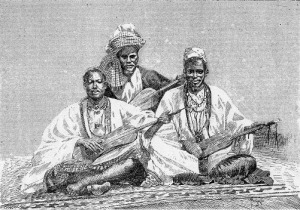
Mali_Griots of Sambala king of Medina Fula people 1890
Griots of Sambala with the King of Medina (Fula people of Mali) c.1890

In Mande society, the jeli was an historian, advisor, arbitrator, praise singer (patronage), and storyteller. Essentially, these musicians were walking history books, preserving their ancient stories and traditions through song. Their inherited tradition was passed down through generations. Their name, jeli, means “blood” in Mandinka language. They were said to have deep connections to spiritual, social, or political powers as music is associated as such. Speech is said to have power as it can recreate history and relationships.

Youssou NDour_1
Youssou N’Dour (Source: fanart.tv)

In addition to being singers and social commentators, griots are often skilled musicians. Their instruments include the kora, the khalam (also spelled xalam), the goje (called n’ko in the Mandinka language), the balafon and the ngoni.

Griots can be found throughout Africa and bear different names from country to country. A world-renowned singer and grammy award winner descending from a family of griots is Senegalese singer, Youssou N’Dour. Below is the trailer to the movie Griot. Enjoy!

The Bad Friends

crocodileCrocodile and Dog are good friends. They meet and help each other. On a party day, Dog invites Crocodile to share a good meal of beans.

  • Beans! I will gladly accept to share them with you, says the crocodile.

The female Dog, the spouse of Dog, presents the host with a good plate well garnished. But before eating the dog says:

  • It is a custom where I come from: to eat, the guest must sit down.

But Crocodile cannot sit down. He tries, but unfortunately, tired, and humiliated, he goes home to his place, leaving Dog and his wife, very happy, eating the beans without him.

Chien1
Dog

Crocodile, then, prepares a good couscous for his birthday and invites his friend Dog. Dog arrives early with his wife. The smell of the sauce fills the entire household.

  • It smells good, says the dog.
  • Yes, very soon we will sit down, but start by drying your noses, because to eat this birthday meal, you must be clean!

Unfortunately, Dog always has a wet nose. Dog and female Dog go outside to dry their noses under the sun. But nothing changes. In the evening, they still have a wet nose. Then Crocodile enjoys his delicious meal alone.

Angry, Dog leaves his friend swearing: « Beware if I ever find you outside the water! »

Crocodile answers Dog: « Beware if I ever meet you near my waters! »

« Are we friends, or are we enemies? »

The French original can be found on Ouologuem Blog. Translated to English by Dr. Y., Afrolegends.com

Proverbe Africain sur la non-Interférence et la place de chacun/ African Proverb on Non-Interference and Everyone’s Place

Barbe3
Barbe / Beard

La barbe ne raconte pas de vieilles histoires au cils (Proverbe Ehwe – Ghana, Togo).

The beard does not tell old stories to the eyelashes (Ewe proverb – Ghana, Togo).

cils1
Cils / Eyelashes


Reconnecting with Your Royal Heritage: the Story of a Ghanaian Family in London

Kente cloth
Kente cloth

Imagine stumbling across your history, and learning that you are the descendant of a very powerful king? Imagine that all your life, you have lived a tough life, unconscious of your heritage, doing things, and just knowing that somehow, somewhere things should be different? Well, in 2013, during a trip to Ghana, Promise Adamah who has lived in England for over 50 years, found out that her grandfather was a very prominent Ewe King in Ghana, King Togbui Adamah II. She was handed a lot of papers in plastic bag by her aunt, and when she got home, opened it, and found out the truth about herself, and her family. Her family then decided to donate over 100 old letters and papers, official and personal documents, dating as far back as the 1880s to the Black Cultural Archives (BCA) in Brixton, London. These give a snapshot into the life for an Ewe Fia (king). Togbui Adamah II was a paramount Ewe Fia of Some in south eastern Ghana. The findings are believed to be the first of its kind to be found in such quantity and entirety in the Ewe community. Promise Adamah’s rich family history is now exposed at the Black Cultural Archives of London, it is Family Ties – The Adamah Papers exhibition. Enjoy the video below from the BBC.

Happy Mother’s Day 2018

For this year’s Mother’s Day celebration, I introduce you to another African classic: Elvis Kemayo – Mama. Elvis Kemayo hails from Cameroon, and is particularly well-known for this song, and ‘Cameroun, berceau de mon enfance (Cameroon, craddle of my childhood)’ Enjoy ‘MAMA’, and do remember to cherish your mother!


Comorian Proverb on Beauty / Proverbe Comorien sur la beaute

20170627_143645Il faut souffrir pour être belle (proverbe Comorien – Comores).

Nyanga no di hurt (Cameroonian say in pidgin).

You must suffer to be beautiful (Comorian proverb – Comoros).


African Joke: Copied to Perfection

The professor collects the students’ homework:

Toto says to his friend John:

    • Thank you John, one more homework not done, and the professor was going to call my parents!
    • Yup. I don’t really like this. I hope you did not copy word-for-word?
    • You can be certain that I copied everything to perfection! and when I say everything, I mean everything!

The professor returns the homework, looks, and all of a sudden says:

  • Toto, how come I do not have your homework? and how come I have two copies from John?


Ethiopians urge Britain to return bones of ‘stolen’ prince after 150 years

Ethiopia_Prince Alemayehu
Prince Alemayehu, son of Emperor Tewodros II, as photographed in 1868 by Julia Cameron

Here is another outrageous article about British looting in Africa, and particularly in Ethiopia. The remains of Prince Alemayehu, son of the Emperor Tewodros II are still in Great Britain 150 years after his death. How preposterous is this! When the Ethiopian government asks, the British say that they cannot identify his bones, when in this day and age the remains of King Richard III of England have been identified 500 years after his death (Body found under parking lot is King Richard III, scientists prove). This makes you wonder: After King Mkwawa, and Prince Alemayehu, how many African kings, princes, and queens’ remains are still stuck in Europe?

Below are snippets of the article; for the full version, go to: The Guardian.

=====

For 150 years, Ethiopians have been asking when Prince Alemayehu will come home. The orphan prince, a descendant of Solomon, was taken to England – some say “stolen” – after British soldiers looted his father’s imperial citadel following the Battle of Magdala in 1868The fortress was looted and razed to the ground. It is said to have taken 15 elephants and 200 mules to remove the loot.

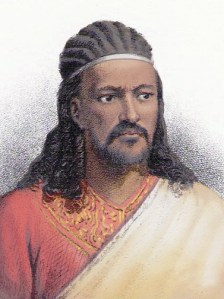
Téwodros_II_-_2
Emperor Tewodros II

He died at the age of 18, after an unhappy childhood, and was buried at St George’s Chapel at Windsor Castle at the request of Queen Victoria. Now, as discussions take place with the Victoria & Albert Museum about the return of royal treasures taken by British forces during the battle, the Ethiopian government told the Observer it is “redoubling” its efforts to finally bring back the prince’s remains. Last week there were celebrations in Addis Ababa to commemorate the life of the prince’s father, Tewodros II, on the 150th anniversary of his death in the battle. A selection of the objects in the V&A’s possession went on display last week.

[The poet Lemn Sissay said:]The first corrupt theft of an Ethiopian child was this one in 1868,” Sissay said. “He was taken from his family. He deserves, too, for his remains to go back to Ethiopia, back to where he was stolen from.”

In the aftermath, as the British forces carried off crowns, scrolls and fine clothing, a war artist cut a lock of Tewodros’ hair. The lock of hair is now at the National Army Museum in London. Sissay and others believe that a DNA test could establish whether any of the remains in the grave match it. …

After the sacking of Maqdala, a British officer named Tristram Speedy took the prince and his mother, the Empress Tiruwork Wube, to Britain. The empress died on the way and before the party was due to embark on a ship from Alexandria in Egypt, the officer ordered all the other Ethiopians to return. …

The intensity of feeling among Ethiopians is growing, according to the Ethiopian embassy. “Ethiopians revere Prince Alemayehu as a young prisoner of war – he was only seven years old when taken hostage,” it said in a statement. “Prince Alemayehu remains the son of a hero, who chose to end his own life, rather than surrender to foreign soldiers. Ethiopians view the Prince with the same level of affection and respect.”

Proverbe Angolais sur la tâche journalière / Angolan Proverb on the Daily Task

Soleil
Le soleil / The sun

Il n’y a pas qu’un jour, demain aussi le soleil brillera (Proverbe Andonga – Angola). – Ne pas vouloir faire tout en un jour.

There is not only one day, tomorrow too the sun will shine (Andonga proverb – Angola). Do not try to do everything in one day.

Não há apenas um dèia, amanhã também o sol vai brilhar (provérbio Andonga – Angola). Não quero fazer tudo em um dia.

Why the Name: Huambo?

Angola
Map of Angola

As you travel around Africa, have you ever wondered about the name of the second largest city of Angola, Huambo ?

Previously called Nova Lisboa (New Lisbon) after the capital of Portugal, Huambo got its name from Wambu, one of the 14 old Ovimbundu kingdoms of the central Angolan plateau. The Ovimbundu, an old tribe of Angola, which originally arrived from Eastern Africa, had founded their central kingdom of Bailundu as early as the 15th century. Wambu was one of the smaller kingdoms and was hierarchically under the King of Bailundu, though it enjoyed, as the other kingdoms, a considerable degree of independence.

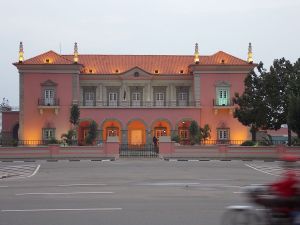
Angola_Huambo,_Palácio_do_Governador
The House of the Governor in Huambo (Source: Wikipedia)

Situated in the Angolan central highlands, Huambo is located near the headwaters of the Kunene River. It was founded in 1912 by Portuguese colons and was called Nova Lisboa until 1975, when it resumed its name of Huambo. It is located 600 km southeast of the capital Luanda, and 220 km east of Benguela; it is at high altitude, on a plateau 1800 m above sea level. Huambo is a main hub on the Caminho de Ferro de Benguela (CFB) (the Benguela Railway), which runs from the port of Lobito in Angola, to the Democratic Republic of the Congo‘s southernmost province, Katanga. It is the second industrial city of the country, and a big agricultural center.

If you ever visit Huambo, as you tour its neighborhoods, and get on the Caminho de Ferro de Benguela, remember that it was once an old Ovimbundu kingdom, Wambu, and reconnect with the feel of this ancient kingdom!