German Protectorates on the West Coast of Africa: 1884 – 1890

Last week I published a poem by  Sarah Anyang Agbor about the Anglophone plight in Cameroon, and the fact that Anglophones as any other children of Cameroon are treasured children of the nation and also ‘sing Cameroon’. Given that the history of Cameroon is so intertwined with that of the European colonizer: first becoming a German colony, then after Germany lost World War I, being divided into 2 and shared between France and Great Britain (the spoils of war, I guess), I have decided to publish here a few notes on German protectorates on the West Coast of Africa from 1884 to 1890. Note below that Cameroons, in the Ambas Bay section, refers to Cameroons Town which was the name for present-day Douala, Criby refers to the city of Kribi, while Victoria refers to present-day Limbe in the country CameroonPorto Seguro is now Agbodrafo and Little Popo is now known as Aného in Togo. South-Western Africa refers to present-day Namibia.

=====

NOTES on German Protectorates on the West Coast of Africa 1884—1890, Map of Africa by Treaty vol 2, P. 694.

Togoland_1908
Togoland in 1908 (R. Hellgrewe)

Togoland.

On the 5th July, 1884, an Agreement was signed between Germany and Togo, by which the territory of the King of Togo, situated on the West Coast of Africa, from the Eastern frontier of Porto Seguro to the Western frontier of Lome or Bay Beach was placed under the Protectorate of Germany.

Cameroons. Togoland. Slave Coast, &c.

On the 12th July, 1884, a German Protectorate was proclaimed over the whole of the Cameroons District, and on the 15th October of the same year†, the following official communication was made by the German Government to the principal Powers of Europe and to the United States Government, notifying the exact extent of territory on the West and South-West Coasts of Africa which had been placed under the protection of the German Empire :—

Baron von Plessen to Earl Granville.

(Translation.)                                                                       German Embassy, 15th October, 1884.

Nachtigal
Gustav Nachtigal

“The Government of His Majesty the Emperor, with a view to insure more effectually German commercial interests on the West Coast of Africa, has taken certain districts of this coast under its protection. This has been effected in virtue of Treaties which have been in part concluded by Dr. Nachtigal, the Consul-General dispatched to West Africa, with independent Chiefs, and partly in virtue of applications for protection made by Imperial subjects, who have acquired certain tracts by covenants with independent Chiefs.

“Accordingly, the Togo tract, with the harbours of Lome and Bageida, the districts of Bimbia, with the Isle of Nicol, Cameroons, Malimba, to its northern extremity, Little Batanga, Plantation, and Criby, on the Slave Coast, and the tract of coastland between Cape Frio and the Orange River, with the exception of Valvisch (Walfish) Bay, in South-Western Africa, have been placed under the protection of His Majesty the Emperor. This has been notified by hoisting the Imperial military standard and planting frontier poles, and the engagement at the same time announced that all demonstrable existing rights of third parties are to be respected.”

Ambas Bay, Victoria.
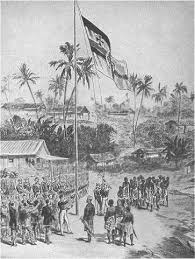
cameroon_kamerun-12-juillet-1884
German flag on the Joss plateau in Cameroons Town (Douala) on 14 July 1884

On the 19th July, 1884, a British Notification was issued announcing the assumption of British sovereignty over Ambas Bay,* but this territory was transferred to Germany on the 28th March, 1887, since which date it has formed part of the German Protectorate over the Cameroons. 

Mahin and Mahin Beach.

On the 29th January, 1885, Mahin was sold by the King of Mahin to a German subject, Herr G. L. Gaiser ; and on the 11th March, 1885, a Treaty was signed by the King of Mahin with the German Commissioner and Consul-General for the West Coast of Africa, Dr. Nachtigal, for extending a German Protectorate over Mahin and Mahin Beach, but it was not ratified by the German Emperor ; and on the 24th October following, both Mahin and Mahin Beach were ceded to Great Britain. 

Bight of Biafra, Slave Coast (Togoland, Little Popo, and Porto Seguro), Senegambia, and Southern Rivers Districts.

On the 24th December, 1885, a Protocol was signed between France and Germany, for defining their respective rights of Sovereignty or Protectorate in the Bight of Biafra, on the Slave Coast (Togoland, Little Popo, and Porto Seguro), on the Coast of Senegambia, and in the Southern Rivers Districts. 

British and German Limits.

On the 1st July, 1890, an Agreement was entered into between the British and German Governments defining their respective spheres of influence in East, West, and South-West Africa. With respect to the West Coast, the line of boundary was marked between the British Gold Coast Colony and the German Protectorate of Togo, the Volta Districts, and the Rio del Rey

† “ National Zeitung,” 15th February, 1885. S.P., vol. lxxvi, p. 756,

*H.T., vol. xvii, p. 57.

Proverbe Bamiléké sur le paresseux / Bamileke Proverb on the Lazy One

path_cheminLe paresseux est toujours sur la route de la chefferie pour aller quémander auprès du chef (et rapporter) (Proverbe Bamiléké – Cameroun)!
The lazy one is always on the road to the palace to go beg in front of the king (and tattle) (Bamileke proverb – Cameroon)!

“Cameroon: I too, Sing Cameroon” by Sarah Anyang Agbor

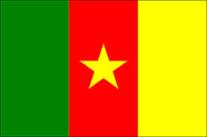
Cameroon_flag
Flag of Cameroon

A few years ago, I came across this poem by  Sarah Anyang Agbor, and thought I will share it with you today.  It focuses on the Anglophone issues of Cameroon: institutionalized divisions rooted in colonial legacies.  As the Anglophone crisis persists in Cameroon, as the current Cameroonian government persists in trying to split its own country into further little pieces of the pie, under the politics of divide-and-conquer, I had to share this. Where other countries and governments fight to stay one, fight to remain united, fight to serve their compatriots, this 36-year-old Biya regime indulges in tribalism, division, blindness, mismanagement, embezzlement, violence, repression, incompetence, dilapidation of public goods, nepotism, stupidity, cronyism, … and the list is so long.

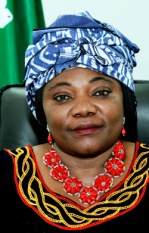
Sarah Anyang Agbor1
Sarah Anyang Agbor (Source: Science Forum South Africa)

Agbor’s poem is inspired by the great American Renaissance author Langston Hughes‘ poem ‘I, Too‘ , whose first sentence is I, too, sing America, in which he expresses the Afro-Americans’ experiences of prejudice and discrimination. In ‘I too, sing Cameroon‘, I love the way she manages to say it all in a few words: “I am the ninth and tenth provinces … I too can feel … .” I love the strength in her words. In reality, what she says can also be applied to other provinces and peoples of Cameroon. The 36-year-old regime has not been good to the majority of its population: no roads, no hospitals, no jobs, destruction of the social net, destruction of the educational system, desolation, ruins, nothing good at all, and all should unite to see it gone forever for it is a total failure. Enjoy! The author also read her poem on the BBC Poetry postcards in 2014.


“I too, Sing Cameroon” by Sarah Anyang Agbor

I too sing Cameroon.
I am the ninth and tenth provinces
Or is it regions?
I just want to be human,
Not superhuman
Accepted as a person

I know how you perceive me:
“Traitor”, “Opposition”, BamiAnglo2
A figment of your own imagination.
Why do you see an Anglophone and you hear-
“Gunshots!? Crisis!? Protests!? Grumblings!?
You got criminals! We’ve got criminals!”

I too can feel
I too can dream
I too can lead.
But you look down on me
And call me “Anglofou”3
You say you are the top dog
And I the underdog.
Now I am the country nigger “Anglofou”
Now I am the house nigger.

Tomorrow
When the stakes are down
Will it be my turn to look down at you?
Will I call you “Franco Fool?”
Or will I call you brother?
That tomorrow will surely come
No one will dare say to me:
“Anglofou”4; “Parlez Anglais”5
“Les Anglos-la”6

Besides, I have walked up the ladder
With the virus of bilingualism
And I will sit at the table
And you will see the good in me.

I too, sing Cameroon!


1 Inspired by the talk on Harlem Renaissance, DVC series at the American Embassy in Yaoundé on 28-09-2007.
2 A Bamiléké who has grown up with English as a second language, hence, such a person is a Bamiléké from predominantly French-speaking Cameroon by origin and Anglophone by culture.
3 Anglophone fool; crazy English-speaking person
4 An abusive term, most often used by Francophones, to denigrate Anglophones.
5 Speak English
6 Those Anglophones

“On Adapting the Fight to One’s Realities” by Amilcar Cabral

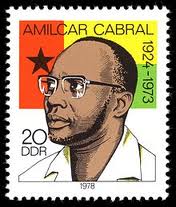
Amilcar Cabral on a stamp with the flag of Guinea Bissau

It so happens that in our country the Portuguese colonialists did not expropriate the land; they allowed us to cultivate the land. They did not create agricultural companies of the European type as they did, for instance, in Angola, displacing masses of Africans in order to settle Europeans. We maintained a basic structure under colonialism – the land as co-operative property of the village, of the community. This is a very important characteristic of our peasantry, which was not directly exploited by the colonisers but was exploited through trade, through the differences between the prices and the real value of products. This is where the exploitation occurs, not in work, as happens in Angola with the hired workers and company employees. This created a special difficulty in our struggle – that of showing the peasant that he was being exploited in his own country.

Map of Guinea Bissau

Telling the people that “the land belongs to those who work on it” was not enough to mobilise them, because we have more than enough land, there is all the land we need. We had to find appropriate formulae for mobilising our peasants, instead of using terms that our people could not yet understand. We could never mobilise our people simply on the basis of the struggle against colonialism-that has no effect. To speak of the fight against imperialism is not convincing enough. Instead we use a direct language that all can understand:

Flag of Cape Verde
Flag of Cape Verde

Why are you going to fight? What are you? What is your father? What has happened to your father up to now? What is the situation? Did you pay taxes? Did your father pay taxes? What have you seen from those taxes? How much do you get for your groundnuts? Have you thought about how much you will earn with your groundnuts? How much sweat has it cost your family? Which of you have been imprisoned? You are going to work on road-building: who gives you the tools? You bring the tools. Who provides your meals? You provide your meals. But who walks on the road? Who has a car? And your daughter who was raped-are you happy about that?”

Amilcar Cabral on the need to personalize, and adapt the fight to his country’s realities.

Tourism in Africa: The Difficulty for Africans to obtain Visas in Africa to Visit African Countries

THE-MOST-POWERFUL-AFRICAN-PASSPORTS-TO-HAVE-GHANA-MEDIA-WORLD
Some African passports

Traveling in Africa is not easy, particularly for Africans. Yes… you read it well: it is difficult to travel within Africa if you are African! Why is that, you might ask? Because as African, you will need a visa to almost all the countries on the continent! Not only are the visa fees colossal, but the time to wait for some of these are pretty long, the long lines, the information for the visa changes almost every month (South Africa, I am looking at you) but also there are not that many airlines servicing those countries, especially after the now defunct Air Afrique went bust. Nowadays Ethiopian Airlines, Asky Airlines, RwandAir, Kenya Airways and others are ramping up to help with these, but it is not easy.

Dangote
Aliko Dangote

Imagine that as a citizen of African country X, I need a visa to visit almost all countries on the continent (except those in the same economic region as mine), and those visa fees are pretty hefty. On top of that, I need a visa to visit all other countries in the world as well. Africa’s richest man, Aliko Dangote, a Nigerian (better passport than mine), expressed the same frustration as mine when he said in 2016, that he needed 38 visas to travel within the continent, while European nationals just waltz into most African countries without visa! How fair is that? And talk about the service at some of those consulates? Or the cost of sending your documents or traveling to a neighboring country because there is no diplomatic representation in yours just to apply for a visa! Moreover, even though you are paying for these visas, and it will benefit the visited country, some of these consulate representatives act as if you were asking them for a favor.

1000 FCFA (BCEAO)
1000 FCFA (BCEAO)

It also costs more to fly to many of these neighboring African countries from within Africa, than to fly to Europe, or Asia, or even America from Africa. It is as if, the contact with other Africans was purposely discouraged so as to make sure that Africans never unite, never learn from past mistakes, remain secluded, and never trade with each other (this, in addition to that slave currency FCFA: France’s Colonial Tax on Africa). For indeed, what could justify that it costs more to fly to Liberia from Ghana than to fly to the UK from Ghana, but a clear wish to stop Liberians from communicating with Ghanaians and realizing that they could trade with each other, instead of the Europeans who are farther away. O Africans, when are you going to wake up and be in charge of your destiny?

Proverbe sur le manque / Proverb on Lack

Leopard_6
Leopard

Si le léopard mange des feuilles, c’est que vraiment il n’y a pas de gibier (Proverbe Lari, Mfinu – Congo Brazzaville).

If the leopard eats leaves, that means there is really no game (Lari, Mfinu proverb – Congo Brazzaville).

‘Les lignes de nos mains’ / ‘The Lines of Our Hands’ by Bernard Dadié

Bernard Dadie
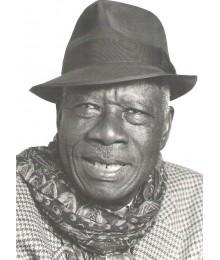
Bernard Dadie (Source: Presence Africaine)

One of Côte d’Ivoire’s most prolific writer is, without a doubt,  Bernard Binlin Dadié, the maestro. Some of his poems have been translated in many languages, while others have been set to music for movies, such as “Dry your tears” which was set to music for the Steven Spielberg movie Amistad. Bernard Dadié is a man whose work and versatility have blessed countless people around the globe.

Please enjoy ‘Les lignes de nos mains / The Lines of Our Hands‘ which was published in La Ronde des Jours, Edition Pierre Seghers, 1956. The English translation is by Dr. Y., Afrolegends.com.


Les Lignes de nos mains‘ /  ‘The Lines of Our Hands‘ by Bernard Dadié

Les lignes de nos mains

Ne sont point des parallèles

des chemins de montagnes

des gerçures sur troncs d’arbres

des traces de luttes homériques.


Les lignes de nos mains

ne sont point des longitudes

des boyaux en tranchées

des sillons dans des plaines

des raies en chevelures

des pistes dans la broussaille


Elles ne sont point

des ruelles pour les peines

des canaux pour les larmes

des rigoles pour les haines

des cordes pour pendus

ni des portions

ni des tranches

ni des morceaux

        De ceci… de cela…


Les lignes de nos mains

        ni Jaunes

        Noires

        Blanches

ne sont point des frontières

des fosses entre nos villages

des filins pour lier des faisceaux de rancoeurs.


Les lignes de nos mains

sont des lignes de Vie

       de Destin

       de Coeur

       d’Amour.

de douces chaînes

qui nous lient

les uns aux autres,

Les vivants aux morts.


Les lignes de nos mains

        ni blanches

        ni noires

        ni jaunes,


Les lignes de nos mains

Unissent les bouquets de nos rêves.

The Lines of Our Hands

Are not parallels

Of mountain paths

Cracks on tree trunks

Traces of Homeric battles.


The lines of our hands

Are not longitudes

Of trench casings

Furrows in plains

Rays in hair

Paths in the bush


They are not

Alleys of pain

Channels of tears

Channels of hate

Strings for hanged /lynching/hanging

Nor portions

Nor slices

Nor parts

       Of this… of that…


The lines of our hands

        Not yellow

        Black

        White

Are not boundaries

Pits/ditches between our villages

Ropes to bind rancor bundles.


The lines of our hands

Are life lines

       Destiny lines

       Heart lines

       Love lines.

Soft chains

Which bind (link) us

One to the other,

The living to the dead.


The lines of our hands

        Not white

        Not black

        Nor yellow,


The lines of our hands

Unite the bouquets of our dreams.

Proverbe sur la détermination et la persévérance / Proverb on Dedication and Perseverance

cameleon2
Caméléon / Chameleon

Ne fais pas attention à la façon de marcher d’un caméléon; là où il veut arriver, il arrivera (Proverbe Basuto – Lesotho, Afrique du Sud, Botswana). Il est déterminé.

Do not mind the way the Chameleon walks; where he wants to get to, he will get to (Sotho proverb – Lesotho, South Africa, Botswana). He has a sense of purpose.


Ancient Lost African City Uncovered Thanks to Laser Technology

South Africa_Kweneng
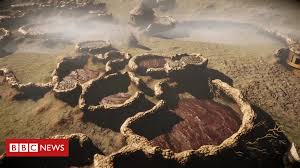
The Ancient city of Kweneng, in South Africa (Source: BBC)

A few days ago, the ancient lost city of Kweneng in modern-day South Africa was uncovered using LIDAR (light detection and ranging) technology. LIDAR is a surveying method that measures the distance to a target by illuminating the target with pulsed laser light and measuring the reflected pulses with a sensor. Differences in laser return times and wavelengths can then be used to make digital 3-D maps of the targeted area. A few months back, scientists and archaeologists had unearthed an ancient Mayan megalopolis the size of New York City or Mexico City (Hidden Kingdoms of the Ancient Maya Revealed in a 3-D Laser Map),  buried under Central American jungles using LIDAR.

Now, Archaeologists using the same technology have rediscovered the ancient city of Kweneng, just outside Johannesburg in South Africa. The settlement dates back to the 15th Century, and was home to up to 10,000 people from the Tswana ethnic group. This is an amazing step forward, and I am sure many more ancient cities around the globe, and in Africa in particular, will be uncovered!

Proverbe Seychellois sur les vrais amis / Seychelles Proverb on True friends


Dirty face
Charlize Theron with a dirty face

Il n’y a que vos vrais amis qui vous diront quand votre face est sale (Proverbe Seychellois).


Only your true friends will tell you when your face is dirty (Seychelles proverb).