Poule couvant ses oeufs et entouree de ses petits / Hen sitting on its eggs and surrounded by chicks
Quand une poule couve ses oeufs, une autre ne peut se mettre à sa place (Proverbe Bassa – Cameroun). – Si vous êtes dans la détresse, votre frère ne peut se mettre à votre place.
When a hen sits on its eggs, another one cannot take its place (Bassa proverb – Cameroon). – If you are in distress, your brother cannot put himself in your place.
View of Douala from the airs: on the other side of the bridge (not shown) is Bonabéri, old Hickory Town
I never thought that bombing, grenades, and warships had been used in wars in Africa prior to the 20th century. Little did I know that it had been in use in the 19th century, during the European invasion of Africa that is known as the scramble for Africa. Today we will talk about the first bombings on Cameroonian soil which occurred on 22 December 1884, when Germans on warships SMS Bismarck and SMS Olgabombed Hickory Town (Bonabéri) in Cameroons Town (modern-day Douala). What might have caused these bombings by German forces on Cameroonian soil, long before the area was ever known as Kamerun?
Kum’a Mbappé, Bonaberi 1884 Liberte by Enoh Meyomesse
Well, when the 12 July 1884Germano – Duala Treaty was signed between the representatives of the Jantzen & Thormählen firm and some of the Douala kings, King Ndumbé Lobé Bell and King Akwa, it was not a unanimous choice among the locals. As a matter of fact, most of the population was against the treaty, and sided with Kum’a Mbappé also known as Lock Priso, King of Hickorytown. The other kings had signed treaties ceding their lands to the Germans without consulting with the others. Kum’a Mbappé refused to sign the treaty. On that fateful day, when the Germans raised their flag in Hickory Town, after raising it in Joss Town, Kum’a Mbappé reacted by writing to the German consul: “Pull that flag down. No man buy we. They want to give us plenty dash, we tell them no. Leave us free and not make us plenty trouble.” The Germans, of course, did not heed the warning, and Kum’a Mbappé ordered the flag to be taken down and the mast ripped apart, a German merchant was killed in the fightings that ensued.
Eduard Knorr, in 1884
Kum’a Mbappé and his people courageously resisted and defeated the German army. The Germans were outnumbered. After this defeat, German consul Max Buchner wrote to Germany to send troops with real armament, cannons, bombs, grenades, in order to level out Hickory Town and kill Kum’a Mbappé who was a thorn on his side.
Opposition to German rule followed the annexation of July 1884. Lock Priso still favored the British and staged a rebellion in December 1884. Around this same time, King Bell faced off against his own people, who were largely opposed to the German rule. Bell then found himself up against the other Duala chiefs in the Duala War, which was fought over the killing of a Bonabéri Duala and Bell’s alleged refusal to share his profits with the other sub-lineages. Germans played the competitors against one another – this is a classic technique used by Europeans: divide-and-conquer. They supported the weaker King Bell to counter the powerful KingAkwa.
SMS Olga during the shelling of Hickory Town on December 21, 1884
From December 20th – 22nd, Commander Eduard von Knorr sent by Berlin decided to intervene immediately, and sent ashore a landing party of some three hundred men from warships SMS Bismarck and SMS Olgato arrest the leaders of the anti-German tribes and destroy their villages. The troops from SMS Bismarck that went ashore and landed north of Hickorytown, while the men from SMS Olgawent ashore south of the village. The Germans fought their way into the town, forcing the local forces to retreat into the mangrove forest, where they could not easily be pursued. While this operation was underway, Knorr received word that other hostile locals had attacked the trading post operated by Jantzen & Thormählen in Joss Town and had captured the company’s local manager. Knorr sent SMS Olgaupriver to shell enemy positions, and on 22 December, the landing parties returned to their ships, having lost one man killed aboard SMS Olgaand eight men wounded between the two ships. German sailors descended on Bonabéri, and burnt the city down; the deluge of fire was endless and lasted several days. They also stole the princely bow or Tangué from Kum’a Mbappé’s ship, considered the symbol of the Belé-Belé people (people of Hickory-Town): the Tangué is a sort of a bow, carved and personalized, sort of a pennant that identifies a king among the people of these water tribes. The German consul Max Buchner wrote in his war diary,
Max Buchner
“Lock Priso’s palace is plundered, a colorful and striking image. We set it on fire. But I have asked all the houses to be inspected before to find ethnographic treasures. My main booty is a great wooden carved work, the princely bow (tangué) of Lock Priso, which will be sent to Munich.” [“Le palais de Lock Priso est mis à sac, une image colorée et saisissante. Nous y mettons le feu. Mais j’ai demandé avant d’inspecter toutes les maisons pour trouver des trésors ethnographiques. Mon butin principal est une grande œuvre sculptée en bois, la proue princière (tangué or tangu’a bolo, in Duala language) de Lock Priso, qui sera envoyée à Munich.”]
The bow, Tangué, of Kum’a Mbappé at the Ethnographic Museum of Munich (Wikipedia)
After several days of fighting, the German army won because of their superior arms, and also the help sent by other Duala kings. Negotiations went on, and a peace treaty (i.e. a treaty acknowledging defeat) was finalized on 13 January 1885, forcing Kum’a Mbappé to accept German rule in Hickory Town. This hero of Cameroonian resistance, passed away in 1916.
The symbol of the Belé-Belé people, the Tangué, was only returned over 100 years later, after tireless work from one Kum’a Mbappé’s grandsons, Prince and professor Kum’a Ndumbe III and others. To learn more, please read the book Kum’a Mbappé Bonabéri 1884 Liberté! by Enoh Meyomesse, and visit the website of this proud descendant of Kum’a Mbappé, Prince Kum’a Ndumbe III at AfricAvenir.
During a marriage ceremony, the pastor asks the famous question: “if anyone can show just cause why this couple cannot lawfully be joined together in matrimony, let them speak now or forever hold their peace!”
All of a sudden, a pregnant woman rises up. She is holding the hand of a 5-year-old child. The flies stop buzzing. The bride faints. The groom is sweating profusely. The pastor is wondering why on earth he had to ask that question…
Pregnant woman
The pregnant woman starts walking down the aisle with her 5-year-old. All the hearts are pounding. Once in front of the pastor, she says, “It is hard to hear anything at the back… so I had to come to the front!”
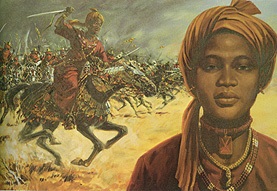
A few years ago, I wrote about Queen Amina of Zazzau: the Great Hausa Warrior born to Rule, the woman remembered today in Nigeria as ‘Amina, rana de Yar Bakwa ta San’ (Amina, daughter of Nikatau, woman as capable as a man). Crowned queen of Zazzau in 1576, Amina expanded her kingdom’s boundaries down to the Atlantic coast; she founded several cities, and personally led an army of 20,000 soldiers to numerous battles. During her 34-year reign, she commanded the construction of a defensive mural around each military camp that she established. Later, those camps evolved into prosperous cities within those walls, and some can still be seen today in northern Nigeria. Those cities are known as walls ‘ganuwar of Amina’ or ‘Amina’s walls‘.
Queen Amina’s achievement was the closest that any ruler had come in bringing the region now known as Nigeria under a single authority.Enjoy this trailer for the movie Aminaby Izu Ojukwu and the website for it: AminaQueenOfZazzau.com; the BBC also made a cartoon about her. With Hollywood’s recent lack of imagination and appropriation of other people’s culture, I would not be surprised that they copy her story to bring it onto big screen. However, Africans should put forward their own stories and value them… not wait for some imagination-hungry entity to come grab it, to all of a sudden value their own history (Black Panther).
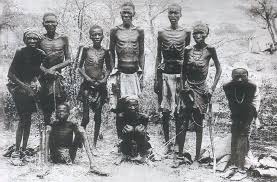
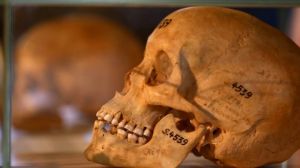
I know this dates from last August, 2018, but I had to share. Note that out of the hundreds of skulls taken by Germany, only a bit over 25 were returned; if the German racial study has been discredited, why not return all of them? The excerpt below is from the BBC; for the full article, go to the BBC. As a reminder, the first genocide of the 20th century occurred in Namibia, on African soil. It was perpetrated by Germans on the Herero and Nama people of Namibia. It was extremely brutal and almost wiped out all Herero people. It was a campaign of racial extermination and collective punishment that the German Empire undertook in German South-West Africa (modern-day Namibia) against the Herero and Nama people. It took place between 1904 and 1907 during the Herero Wars. Today it is known as the Namibian genocide or the Herero and Namaqua genocide.
======
Namibian skulls (Reuters)
Germany has handed back the human remains of indigenous people killed during a genocide in colonial Namibia (German South-West Africa) more than 100years ago.
… The bones had been sent to Germany for now-discredited research to prove the racial superiority of white Europeans.
Tens of thousands of Herero and Nama people were murdered in response to an anti-colonial uprising.
Their descendants are still waiting for an apology from the German government.
The genocide began in 1904 after a Herero and Nama rebellion in response to the German expropriation of their land and cattle.
The head of the military administration in what was then known as German South West Africa, Lothar von Trotha, issued an extermination order in October 1904.
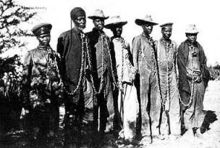
Chained Herero men
The Herero and Nama were forced into the desert and any who were found trying to return to their land were either killed or put into concentration camps.
There is no agreed figure of how many died but some estimates have put it as high as 100,000.
It is thought that 75% of the Herero population and half of the Nama population died.
… There are thought to be hundredsof Namibian skulls in Germany and on Wednesday more than 25 remains were handed back.
Skulls from Germany’s other African colonies, including modern day Cameroon, Tanzania, Rwanda and Togo, were also used in the discredited studies.
In 2016, Germany said it was prepared to apologize in principle but it is still negotiating with the Namibian government over the form of the apology and how to deal with the legacy of the genocide. [Funny how, when it was time to kill, they never negotiated]
Hendrik Witbooi, Namaqua Chief and freedom fighter
… Germany has argued that it has given Namibia millions of dollars in development aid to support all people in the country. [They forget to tell you that they are still benefiting from the mines and resources of Namibia]
… But descendants of the victims are angry that there has been no apology and no agreement of reparations.They are also unhappy that they are not part of the negotiations. …
“Les lignes de nos mains sont des lignes de Vie, de Destin, de Coeur, d’Amour. De douces chaînes qui nous lient les uns aux autres, Les vivants aux morts.”
“The lines of our hands Are life lines Destiny lines, Heart lines, Love lines. Soft chains Which bind us One to the other, The living to the dead.”
Bernard Dadié in ‘Les lignes de nos mains’ published in La Ronde des Jours, Edition Pierre Seghers, 1956. The English translation is by Dr. Y., Afrolegends.com. [Note: punctuation was added to write in one line the first sentence].
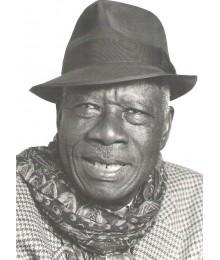
It is with great sadness that I learned of the passing of the great Ivorian writer Bernard Binlin Dadié. Bernard Dadié was a Baobab of African literature, and he was 103 years of age at the time of his passing. On his 100th-year birthday, he had complained of not being able to write as much anymore, given that he still had so much to say! Dadié was a literary virtuoso who brilliantly explored many genres from poetry, to fiction, to theater.
Many have wondered what was the secret of his longevity, and “his children always thought that Dadié was able to surmount all those obstacles and live so long because he was deeply in love with his wife,” said Serge Bilé [« Ses enfants ont toujours pensé qu’il a pu traverser toutes ces épreuves et vivre si longtemps car il était amoureux de sa femme » Jeune Afrique] writer, journalist, and whose mother was a cousin of Assamala Dadié (Dadié’s wife).
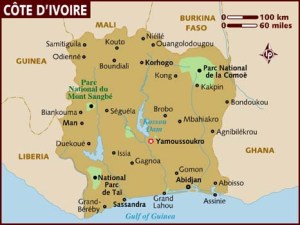
Dadié was born in Assinie, Côte d’Ivoire, and attended the local Catholic school in Grand Bassam and then the Ecole William Ponty. He worked for the French government in Dakar, Senegal. Upon returning to his homeland in 1947, he became part of its movement for independence: he denounced colonialism and neo-colonialism. Before Côte d’Ivoire‘s independence in 1960, he was detained for sixteen months for taking part in demonstrations that opposed the French colonial government.
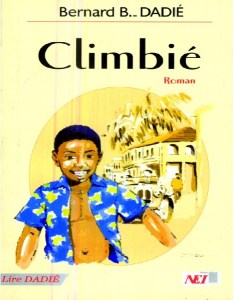
Climbié by Bernard Dadié
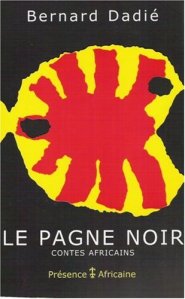
Climbié, his most well-known novel was published in 1956, and was the first Ivorian fiction. With his theater piece The cities (Les Villes), played in Abidjan in April1934, Dadié gave Francophone Africa its first drama piece. I am sure there were others played in the olden ancestral days, but this was the first one written in Molière’s language. He was also the first to win the great literary price of Black Africa (le grand prix littéraire de l’Afrique noire) twice in 1965 with Boss of New York (Patron de New York, Présence Africaine, 1964), and The City where No One Dies (La Ville où nul ne meurt, Présence Africaine, 1969) in 1968. His other big novels are: Le Pagne noir – Contes africains (1955), Un Nègre à Paris (Présence Africaine, 1959), Les voix dans le vent (1970), Monsieur Thôgô-Gnini (1970) ou les poèmes du recueil La rondes des jours(1956). In recent years, his poem “Dry Your Tears Afrika” (“Seche Tes Pleurs” de Bernard Binlin Dadié / “Dry your Tears Afrika” by Bernard B. Dadié) was set to music by American composer John Williams for the Steven Spielberg movie Amistad. Lastly, a street bears his name in Abidjan.
Le Pagne Noir – Contes Africains by Bernard Dadié
Among many other senior positions, starting in 1957, he held the post of Minister of Culture in the government of Côte d’Ivoire from 1977 to 1986. As a twist on fate, next week will come out in Côte d’Ivoire, a book titled 100 writers pay tribute to Dadié (100 écrivains rendent hommageà Dadié) in the Éburnie éditions. Bernard Dadié is the symbol of Côte d’Ivoire‘s deep and rich culture, marking a literary resistance to colonialism and neo-colonialism, and a strong love for his people, continent, and race.


 Même la nuit le lait est blanc





 African Heritage