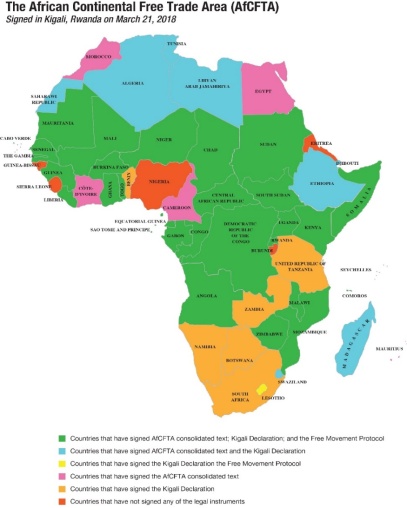
The African Continental Free Trade Area (AfCFTA; source: African Union (A.U.))
This is a big news for the African continent as it will now allow for free trade across the continent, increasing trade among countries which should have always traded between themselves. This is what was envisioned by Kwame Nkrumah, all the independence fathers, and more recently by Muammar Kadhafi (Africans and the Trap of Democracy) at the AU: so it is high time it took place. I just pray that this actually works, and that it is not just a way for European goods which already go through some African countries without any tax or control (French speaking Africa), to flood Africa’s biggest economies. The excerpt is from the BBC; to read the full article go to the link.
=====
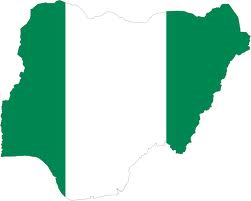
Flag and map of Nigeria
African superpower Nigeria has signed an agreement which aims to increase trade between African countries….
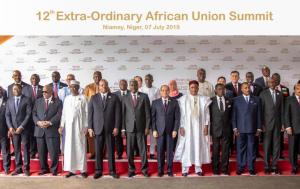
Nigerian President Muhammadu Buhari signed the landmark agreement at the African Union (AU) summit in Niger. The first step is to cut tariffs for goods from countries within the bloc but the timeframe to do this is yet to be announced.
The AU says that the African Continental Free Trade Area – called AfCFTA – will create the world’s largest free trade area. It also estimates that implementing AfCFTA will lead to around a60% boostin intra-African trade by2022.
At the moment some of that intra-Africa trade ranges from fresh fish from the Seychelles to petrol from Angola.
African Union Summit group photo in Niamey, Niger on 07 July 2019 (Source: African Union (A.U.))
[…]Nigeria is Africa’s biggest economyand has long been a regional leader […]
Nigeria has a lot to gain from increasing access to its goods and services to a wider African market. But many of those consulted also feared increased regional integration would lead to unfair competition for jobs and the goods they produce.
With Nigeria signed up, AfCFTA’s dream of increasing intra-Africa trade, which currently lags behind the volume of trade the continent does with Europe, is now one step closer.
Now that AfCFTA can offer access to the enormous Nigerian market, they are in a much stronger position to negotiate with regional bodies in other parts of the world.
For the celebration on 30 June 1960 of the independence of Congo, we will do a trip down memory lane with this speech Patrice Lumumba addressed to the Congolese youth in August of 1960. In 1960, Patrice Lumumba was elected the first prime minister of the Democratic Republic of the Congo (DRC). Assassinated by Belgian colonialists and the CIA in 1961, Lumumba was a founding member of the Movement National Congolais (MNC), which led Congo to independence. Today, Patrice Lumumba is the symbol of aspirations for an entire continent, and he continues to serve as an inspiration to contemporary Congolese and African politicians. His message here to the Congolese youth is really a message to the African youth. Enjoy! The full speech can be found in Patrice Lumumba: Fighter for Africa’s Freedom, Moscow, Progress Publishers, 1961, p 33-36, by Patrice Lumumba (transcribed by Thomas Schmidt) here.
=======
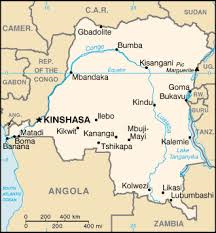
Map of the DRC
Today I am addressing the youth, the young men and women of the Republic of the Congo.
In speaking to them, I am addressing these words to future generations because the future of our beloved country belongs to them.
We are fighting our enemies in order to prepare a better and happier life for our youth.
If we had been egoists, if we had thought only about ourselves we would not have made the innumerable sacrifices we are making.
I am aware that our country can completely liberate herself from the chains of colonialism politically, economically and spiritually only at the price of a relentless and sometimes dangerous struggle. Together with the youth of the country, we have waged this struggle against foreign rule, against mercantile exploitation, against injustice and pressure.
Flag of the Democratic Republic of Congo
Young people who have been inactive and exploited for a long time have now become aware of their role of standard-bearer of the peaceful revolution.
The young people of the Congo have fought on our side in towns, villages and in the bush. Many of our young men have been struck down by the bullets of the colonialists. Many of them left their parents and friends in order to fight heroically for the cause of freedom. The resistance that the young people offered the aggressors in Leopoldville on January 4 and in Stanleyville on October 30, 1959, deserves every praise.
With deep emotion I bow in memory of these courageous patriots, these fighters for African freedom.
The time is not far distant when large numbers of young men and women were driven out of schools by their white teachers and instructors on the suspicion of having nationalist ideas. Many brilliantly gifted young people turned down the opportunity to receive a higher education for the simple reason that they no longer wished to be indoctrinated by the colonialists, who wanted to turn our young men and women into eternal servants of the colonial regime.
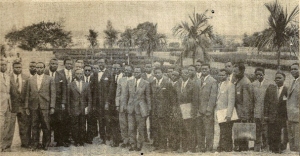
Patrice Lumumba (center left) with his first government after his investiture outside the Palais de la Nation, 23 June 1960
During the heroic struggle of the Congolese nationalists, the young people, even those who were still sitting at school desks, resolutely opposed all new forms of colonialism, whether political, social, spiritual or religious.
Their only dream was national liberation. Their sole aim was immediate independence. Their only resolve was to wage an implacable struggle against the puppets and emissaries of the colonialists.
Thanks to the general mobilisation of all the democratic youth of the Congo, the Congolese nationalists won independence for the nation. We received this independence at the price of a grim struggle, at the price of all sorts of privations, at the price of tears and blood.
After independence was solemnly proclaimed on June 30, 1960, the colonialists and their black emissaries started a barbarous war in the young Republic of the Congo. They began this perfidious aggression because the nationalist Government now in power did not want them to continue exploiting our country as they did prior to June 30, the historic day when the people of our country said Adieu to the Belgian colonialists.
Not having any support whatever, particularly among the working class, who have had their fill of colonial exploitation, the colonialists and their henchmen now want to force certain sections of the youth to serve them in order to be able to propagandise the revival of colonialism. That is why a certain part of the youth, luckily not a very numerous part, have plunged into national defeatism.
Happily, the vast majority of the young people saw through this last attempt of the imperialists, who are turning into account the dissatisfaction of some malcontents, of those who failed in the elections because they did not have the confidence of the people.
This nationalist youth recently held demonstrations in various towns in the Republic to show their absolute and total opposition to imperialist intrigues.
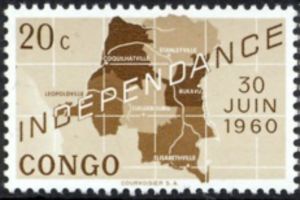
Stamp commemorating the independence of Congo on 30 June 1960
Young people, I salute you, and congratulate you on your civic and patriotic spirit. Young people, specially for you I have created a Ministry for Youth Affairs and Sports under the Central Government. It is your Ministry. It is at your disposal. Many of you, without any discrimination, will be called upon to direct this Ministry, its different services and activities.
Today, in the free and independent Congo we must not have a Bangala, National Unity Party, Association of Bakongo, Mukongo, Batetela or Lokele youth but a united, Congolese, nationalist, democratic youth. This youth will serve the social and economic revolution of our great and beloved country.
You must energetically combat tribalism, which is a poison, a social scourge that is the country’s misfortune today. You must combat all the separatist manoeuvres, which some of the preachers of the policy of division are trying to pass off to young and inexperienced people under the name of federalism, federation or confederation.
In reality, young people, these names are only a new vocabulary brought by the imperialists to divide us in order the better and more conveniently to exploit us. Your entire future will be threatened if you do not oppose these manoeuvres, this new, disguised colonisation.
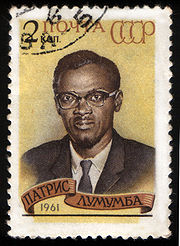
Lumumba on a USSR commemorative stamp in 1961
You must be proud that you belong to a great nation, a great country, a mighty power. This power, which the imperialists envy today, is embodied in national unity. This unity must be the heritage that you, in your turn, shall leave to your children.
The Government will soon send 300 young people to study in the U.S.A., 150 in the Soviet Union and 20 in Guinea, not to mention other countries.
The Congo is no longer a national reservation, a national park, a zoo which we could not leave. Tomorrow you shall go everywhere to study, to learn a speciality, and to get to know the world. Workers, working people will have an equal share in these study missions.
You shall go everywhere, to all the parts of the world. These contacts with the outside world, this direct confrontation with the reality of life will make you experienced people, whom the free and independent Congo needs today.
You will go there not as representatives of Association of Bakongo, National Unity Party, Congo National Movement or African Regroupment Centre youth. You will be Congolese citizens, simply Congolese. And by your behaviour, devotion, intelligence and political maturity you must be a credit to your Congolese motherland.
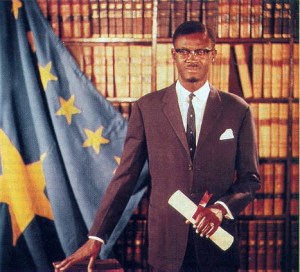
Official portrait of Patrice Lumumba
Young people, the Congo belongs to you. The national Government, the people’s Government will do everything in its power to prevent the Congo from being torn away from you.
Methodist Girls’ High School at Mamfe Akuapem in the Eastern Region (Source: Africa.com)
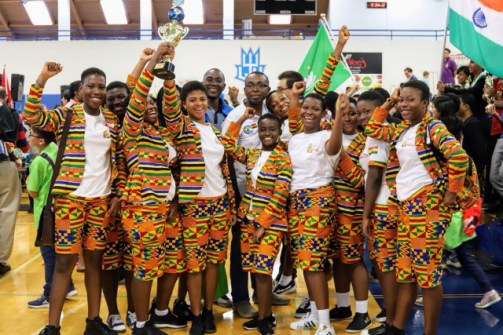
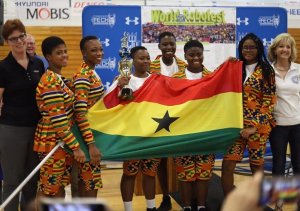
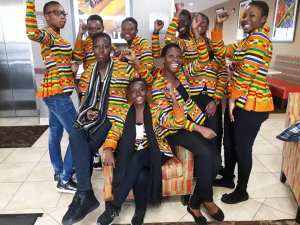
A few weeks ago, an all-girls team from Ghana won the World Robofest 2019 Championship in the US, defeating teams from the United States, Mexico, Japan, China, Korea, South Africa, etc. The 20th edition of World Robofest championship competition took place in the state of Michigan, in the United States. I join myself in applauding this outstandingly great feat by the all-girls Ghanaian team from the Methodist Girls’ High School at Mamfe Akuapem in the Eastern region of Ghana: we are very proud of them.
Enjoy the excerpt below from Face2FaceAfrica, and join us in congratulating these girls as well as their coaching staff. For the full article, go to Face2FaceAfrica.
=======
All-girls robotics team from Ghana (Team Acrobot) – Photo: Ghana Robotics Academy Foundation
Ghana presented an all-girls robotics team for the senior division of the World Robofest Championship in the United States and they won the topmost position by beating teams from the United States, Mexico, Egypt, South Korea and dozens of others.
Named Team Acrobot, thenine girls from the Methodist Girls’ High School in the Eastern Region of Ghana dominated the 10 broad and challenging categories of the championshipheld from May 16 to 18 at the Lawrence Technological University (LTU), Southfield, Michigan.
[…]The team from Ghana was able to build a robot that arranged boxes according to a binary number they were given during the competition. They also completed their missions successfully.
Team Acrobot – Photo: Ghana Robotics Academy Foundation
Team Acrobot was not the only team from Ghana. The West African country also presented a team for the junior division called Team Cosmic Intellect. The team of five boys from the Mikrobot Academy in Ghana came 6th out of the overall 52 teams in the division.
[…] The Ghana Robotics Academy Foundation was founded by Dr. Ashitey Trebi-Ollennu, the Ghanaian robotics engineer at NASA and the chief engineer and technical group leader for the mobility and manipulation group at the Jet Propulsion Laboratory. He is one of the lead engineers behind NASA’s Mars Rover and InSight projects. […]
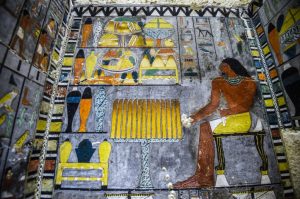
This picture taken on April 13, 2019 shows a view inside the newly-dicovered tomb of the ancient Egyptian nobleman “Khewi” dating back to the 5th dynasty (24942345 BC), at the Saqqara necropolis, about 35 kilometres south of the capital Cairo. (Photo credit should read MOHAMED EL-SHAHED/AFP/Getty Images)
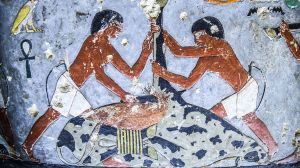
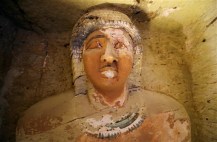
As I read the article about the discovery of this 4,300 years-old Egyptian tomb bursting with colors, I was stunned to see that NO article stated the obvious conclusion: Ancient Egyptians were Black! NO articles stated it: they wonder who the nobleman, Khewi, in whose tomb this was found is, what his link to the Pharaoh is, … they ask a thousand other questions, instead of addressing the reality! This reinstate what we already knew and what the great Cheikh Anta Diop always said, that Ancient Egyptians were black and that their descendants are today’s Subsaharan Africans! One of the statues found inside the tomb beautifully shows its very broad nose, clear symbol of its Black-ness/African-ness, and of course its skin color. Enjoy! Below are excerpts; for the full article, please go to Fox News.
=====
A view inside the newly discovered tomb of the ancient Egyptian nobleman “Khewi” dating back to the 5th dynasty at the Saqqara necropolis, about 35 kilometers south of Cairo. (Photo by Mohamed el-Shahed / AFP)
Egyptianofficials announced astunning discoveryover the weekend: a 4,000-year-old tomb of a dignitary bedazzled in colorful paintings and inscriptions.
Egypt’s Ministry of Antiquitiesunveiled Saturdaythe ancient resting place of the senior official named “Khuwy, [Khewi in other sources]” noting that he served during the reign of King Djedkare, a pharaoh who ruled Egypt during the Fifth Dynasty — from the late 25th century to early 24th century BC. The next day, the Egyptian government released footage that showcased what it called “exceptionally painted” limestone walls.
“The remarkable well-preserved colours on the inscriptions are considered royal colours,” the ministry said in an originalvideo posted online.
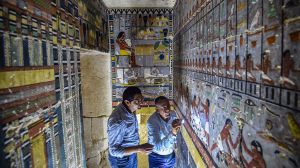
Mohamed Mujahid, head of the Egyptian mission that discovered the tomb of the ancient Egyptian nobleman “Khewi,” inspects the tomb’s walls inside the Saqqara necropolis on April 13. (Photo by Mohamed el-Shahed / AFP)
[…] “The L-shaped Khuwy tomb starts with a small corridor heading downwards into an antechamber and from there a larger chamber with painted reliefs depicting the tomb owner seated at an offerings table,” Mohamed Megahed, who led a team of archaeologists in digging up the tomb,told the Egyptian newspaper.
Every inch of the tomb is covered in markings, which archaeologists are carefully studying. So far, the inscriptions have raised questions about Khuwy’s impact on the ancient community as well as his specific relationship with the pharaoh — whose elaborate tomb sits just “a stone’s throw away,” per the ministry.
[…] Mostafa Waziri, secretary general of the Supreme Council of Antiquities, called the burial “one of a kind in the last decades.”
Statue inside the tomb. (Photo by Mohamed el-Shahed / AFP)
“The color is almost intact even though the tomb is almost4,400 years old,” Waziri said in a statement at the time.
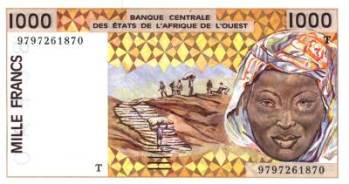
I recently read the national anthem of São Tomé and Príncipe, and thought of how much it represents the aspirations of the entire African continent, especially for French speaking countries which are still under that awful nazi currency system called FCFA through which France has been siphoning over 500 billion dollars every year for free! What do I mean by free? Well, because the FCFA (France’s Colonial Tax on Africa) is a currency of servitude and is a colonial tax paid by African countries to France (Africa is funding Europe!). 14 african countries (15 if you count also the Comoros whose currency is not called the same, but is nonetheless pegged to France) are obliged by France, through a colonial pact, to put 50% (it used to be85%, then 65%, …) of their foreign reserves into France’s central bank under the French minister of Finance control. As we speak today in 2019, Senegal and about 13 other African countries still have to pay colonial debt to France.African leaders who refuse are killed or victim of a coup. To learn more, also read The 11 Components of the French Colonial Tax in Africa.
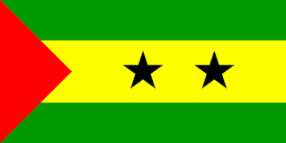
Flag of Sao Tome and Principe
The national anthem of São Tomé and Príncipe, rightfully titled Independência total (Total Independence), was written by Alda Neves da Graça do Espírito Santo, the celebrated Sao Tomean poet and writer who was a minister on several occasions and also the president of the national Assembly. Her poem for the national anthem was adopted in 1975. As you read it, wherever you see Sao Tome and Principe, replace by Africa, African continent and claim the total independence: “Warriors in the war without weapons, Live flame in the soul of the people, Congregating the sons of [Africa], Around the immortal Fatherland, Total independence, total and complete.” Enjoy!
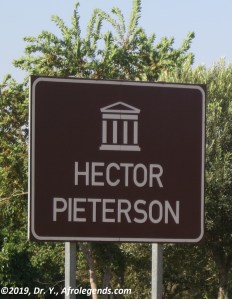
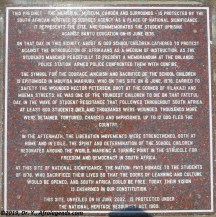
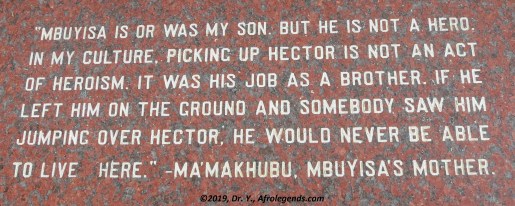
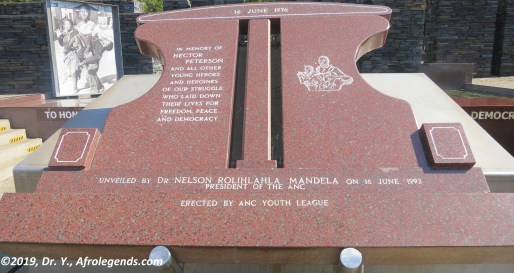
I recently visited the Hector Pieterson Memorial and Museum, memorial dedicated to one of the first students to be shot dead during the 16 June 1976 Soweto Massacre. This was 13-year-oldHector Pieterson, who became the symbol of the Soweto Uprising. The picture of his dead body being carried away by another student, Mbuyisa Makhubo, while his sister Antoinette Sitholeran beside them in tears, was captured by news photographer Sam Nzima, and made it worldwide. When Hector was shot, he fell on the corner of Moema and VilakaziStreets, he was picked up by Mbuyisa Makhubo who together with Hector’s sister, Antoinette (then 17 years old), ran towards Sam Nzima‘s car. They bundled him in, and the journalist Sophie Tema drove him to a nearby clinic where he was pronounced dead. Mbuyisa and Nzima were harassed by the police after the incident and both went into hiding.
Visiting the museum brought some odd images, because it shows the brutality of the apartheid government against children… Imagine that: an entire government unleashing dogs, police officers, and guns on children! 1500 heavily armed police patrolling the area overnight with automatic rifles, stun guns, and carbines; driving in armored vehicles with helicopters, while the South African army was ordered on standby… for repression on school children. Such barbary!
Well, I am glad there is an entire monument dedicated to the memory of Hector Pieterson, and above all to all those children who lost their lives on 16 June 1976, and who triggered the end of apartheid.
Ne faites pas vos besoins sous un arbrisseau; un autre peut y chercher de l’ombre (Proverbe Zulu – Afrique du Sud, Zimbabwe). – Ne médire de personne, on aura peut-être besoin de lui.
Do not relieve yourself under a shrub; another could look for shade under it (Zulu proverb – South Africa, Zimbabwe). – Do not badmouth anyone, you may need him.


 De grands feux commençèrent par de petites étincelles









 I recently visited the
  Visiting the museum brought some odd images, because it shows the brutality of the apartheid government against children… Imagine that: an entire government unleashing dogs, police officers, and guns on children!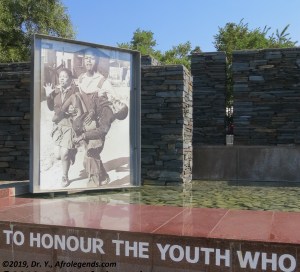


 African Heritage