An eminent nobleman found one morning that his house had been broken into and all his belongings stolen.
Instead of sounding alarms, he gathered his wives and children in the courtyard, and without saying anything, took place in their midst, calmly smoking his pipe.
Towards the middle of the morning, two young men arrived. They found the family gathered in silence, and thinking that they were mourning the theft that they had perpetrated the night before, they spread in compassion:
We were out of the village for several days, said one to the nobleman. Back this morning, we were informed of what has happened to you, and we could not leave without coming to commiserate with you.
For all answer, he had them arrested and tied, before telling them what he had been victim of. The young men confessed.
It is since this story that there is an adage which says that we catch the animal by the paw and the man by the word.
Fables des Montagnes de Patrice Kayo, Collection Les CLES de l’avenir, Editions CLE, Yaounde, p. 39 (1998). Translated to English by Dr. Y., Afrolegends.com
I still don’t understand how a people can hold onto another people’s ancestors’ skulls, refuse to return it, and talk of partnership, friendship, among the people. Isn’t it ludicrous? Many of our ancestors’ skulls are still in museums in Europe, and to this date, Europeans refuse to return them, yet they talk of partnership. The information below shows all the obstacles met to find King Mkwawa’s skull, a skull which was included in the Treaty of Versailles, and return it, … As you read about all the hurdles, you wonder how hard it will be for the regular commoners. The excerpts below are from the article written by Dr. J. Desplat at the National Archives. For the full article, please go to the The National Archives, and see some of the correspondence quoted here, as well as the ones mentioning that the skull was said to have magical powers..
“ARTICLE 246. Within six months from the coming into force of the present Treaty, … Germany will hand over to His Britannic Majesty’s Government the skull of the Sultan Mkwawa which was removed from the Protectorate of German East Africa and taken to Germany.”
====
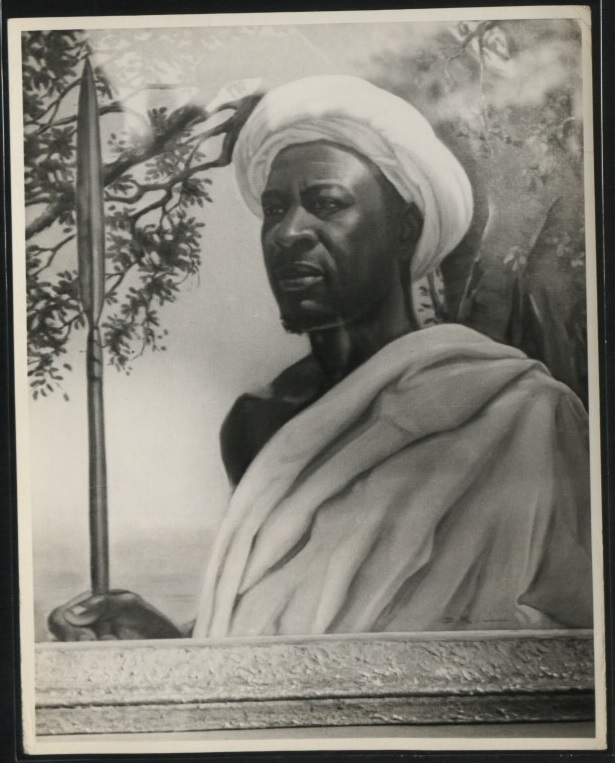
King Mkwawa was the king of the Uhehe tribe in German East Africa (modern-day Tanzania), and was opposed to German rule. In 1895, he declared that ‘rather than submit to German rule he would fight them to the utmost limit, and rather than surrender he would die by his own gun’.
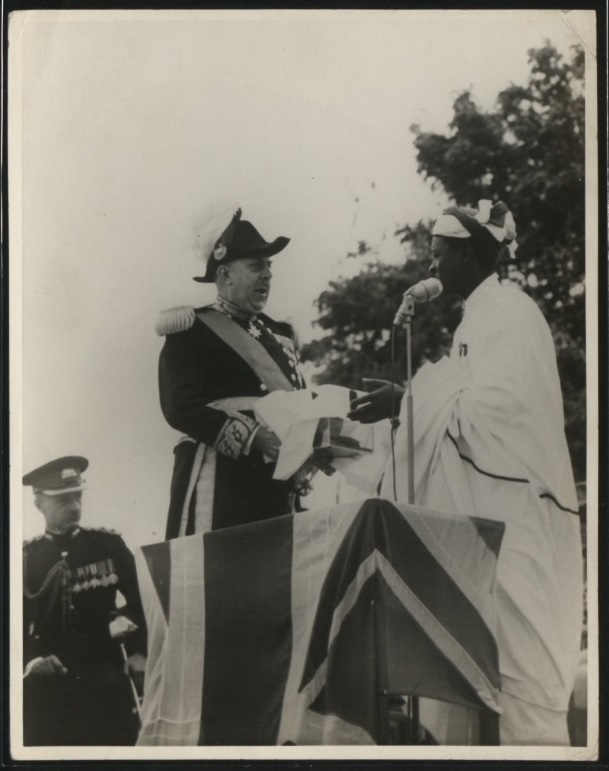
Sir Edward Twining returning King Mkwawa’s skull
In 1898, a bounty was placed on his head, which led to a manhunt. On 19 July, Sergeant Major Merkl and his party closed in on Mkwawa. Merkl reported that they heard a shot and hurried towards the camp, where they found ‘two natives lying down by the camp fire’. One of them was identified as Mkwawa himself. Merkl wrote: ‘I thought they were asleep, halted at about thirty yards and then fired. The bodies did not move. On reaching the spot, we found both men dead and cold (…). I ordered my askari to cut off Mkwawa’s head to take along to camp.’ (CO 822/770) …
[It took almost 40 years after the Treaty of Versailles to find the skull] … The [British] government of Tanganyika wasn’t too bothered. ‘This government does not now attach much importance to the question of Mkwawa’s skull’, they wrote, … The head mentioned was highly unlikely to be the right one as, by all accounts, it had been skeletonised rather than embalmed, but the German Foreign Ministry was asked to investigate again… The British embassy in Berlin commented: ‘it is of course possible that the German Government have made no very serious effort either to find out what truth there is in the story or to trace the skull.’ (CO 691/124/2)
… In January 1953, however, the German Foreign Ministry suddenly announced the skull might be among the large collection of the Museum für Völkerkunde in Bremen. As several skulls seemed to fit the description, they asked whether the skull had any marks by which it could be identified.
Twining [the Governor of Tanganyika, Sir Edward Twining] reported from Tanganyika that ‘nobody could be found still alive who remembered the Sultan’ (and if people had still been alive, they might have found it difficult to identify Mkwawa by simply looking at his skull anyway!) but Mkwawa’s cephalic index could be compared to that of his grandson Chief Adam Sapi, an apparently unusual 71%.
In June, Twining himself travelled to Bremen to identify the skull. Accompanied by the consul and the vice-consul, he went to the Museum.
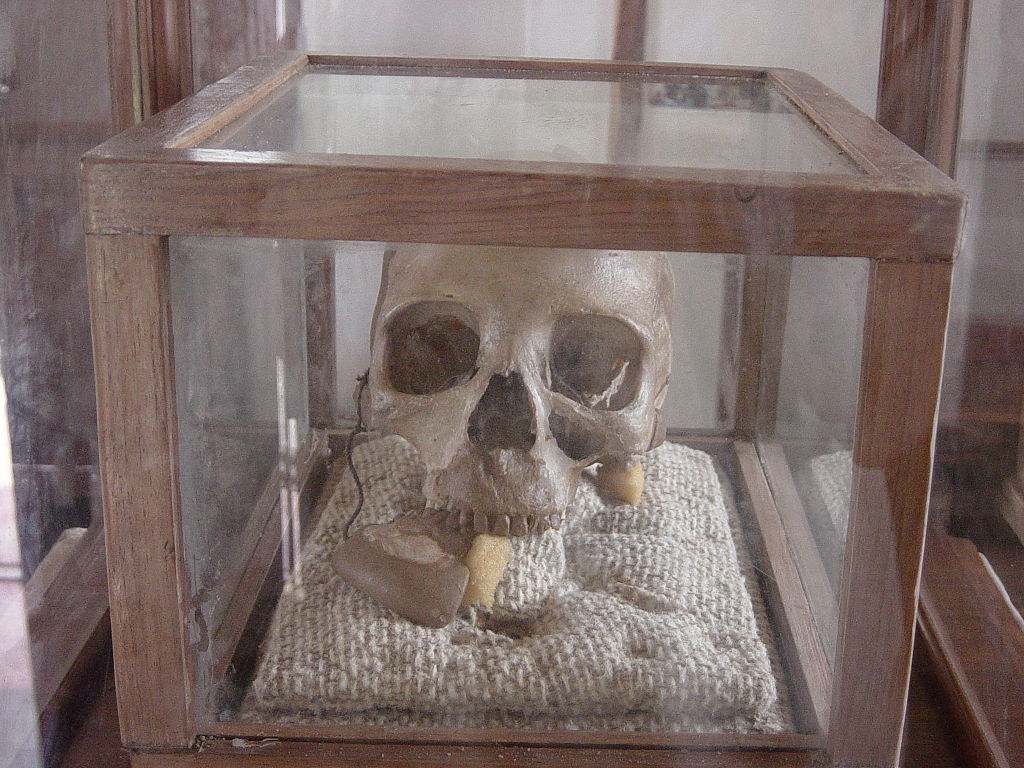
Skull on display at the Mkwawa Memorial Museum
‘They went to a storeroom where there was a large cupboard full of skulls, and it was arranged for those which had originated in German East Africa to be put together on a table and for their cephalic indexes to be measured. There were two in the 71 group which were selected, and one of these had a hole where a bullet had entered towards the back of the head and come out in front.’ (CO 822/566)
Twining had this skull examined by a German police surgeon who confirmed the hole was consistent with a 25mm rifle of the typed used by German troops in East Africa. Besides, Twining explained, ‘the skull was bleached, which probably happened when they boiled the meat off it’ – someone at the Colonial Office noted in the margin: ‘Ugh!’
…
[On the return trip], Twining’s irritation might actually have been due to the skull itself which ‘continued to behave very badly’[it was reportedly said to have magical powers]. He reported: ‘We had a series of mishaps which cannot otherwise be accounted for. Our poor old Bandmaster, Gulab Singh, died on the train. My A.D.C. collected a sinus and had to go to hospital. The head boy had a soda water bottle burst in his face, and the cook was struck in the face by a flying saucer. We all got hay fever and we all got very irritable!’ (CO 822/770)
A recent case has had my head spinning with this fundamental question: how do we keep going when the movement has been decapitated? Or when the leader is no longer fit to lead? I do not claim to have the answers as this is a crucial question, but it is worth pondering.
Thomas Sankara
I recently read “The Cost of Sugar” by Cynthia McLeod, where she talks about the fight of the Maroons or Boni or Alukus of Surinam for freedom. Surinam was a Dutch colony, and so the Dutch crown sent troops to fight the rebellious slaves; they also hired local slaves to whom they promised liberty and land in return for fighting the Maroons. The Maroons never gave up! They were well organized, even though they had very little and were under-armed, and lived in the bush. Their leaders were very often killed, but they kept the fight… they were fighting for their freedom: men, women, and even children contributed to the fight. Yes… they terrorized the planters for many years, they were defeated, and fled to neighboring French Guyana, but kept the fight. Why? Because the prize of freedom is too great to lay on the shoulders of one man, one leader, or a few… the fight must continue in spite of some men (betrayers and others)… we do not follow men, we follow ideas… we are not fighting for men, we are fighting for our right to dignity, our right to humanity, our liberty.
Amilcar Cabral on a stamp with the flag of Guinea Bissau
We have to keep the fight. Yes, it is okay to cry, it is okay to fall, feel discouraged, but we have to rise up, and keep up the fight. We might be disappointed by the so-called leaders who may turn their backs on us and betray us [“The Cancer of Betrayal” by Amilcar Cabral, J.J. Rawlings in His Own Words: African Identity, Betrayal, and More], or we might get discouraged when our leaders and hopes have been killed, but we have to keep the fight. We rise up! Dust off ourselves, and keep on fighting! The enemy will try many tactics to distract us from our goals, because the enemy lives on our ignorance, the enemy flourishes on our divisions, our disappointments, and discouragements. We cannot afford to cry too long! When a leader no longer matches our ideals, we put him to the side and keep on fighting. We are not fighting for ourselves, we are fighting for our ancestors who died fighting, we are fighting for our children who should not be beggars on their own lands while the enemy feasts on it. We fight because it is more than just us. Dignity, freedom, is a divine right, and it is ours… we need to claim it!
It took 100 years for China to reclaim Hong Kong and Macao from the British… China was able to do so because its leaders kept telling them how Great Britain made them sign treacherous treaties and stole their lands, they did not hide it from their people like many African leaders do [Did You Know about the 999-year Lease granted to Europeans in Kenya ?]. As a result, 100 years later, the Chinese leaders went to the British, and said “time is up, give us back our lands”. The leaders who were forced to sign these treaties 100 years prior were no longer alive, but the history, the preparation, the muscling up, the battle continued!… so we have to plan over decades, generations, to ensure continuity in the battle, implying education, real knowledge of our history (our triumphs as well as our defeats and the causes), the stakes, and keeping a living memory of our history. It may take years, decades, even a century like China with Macao, but we have to grow, know, and muscle up… we cannot keep crying.
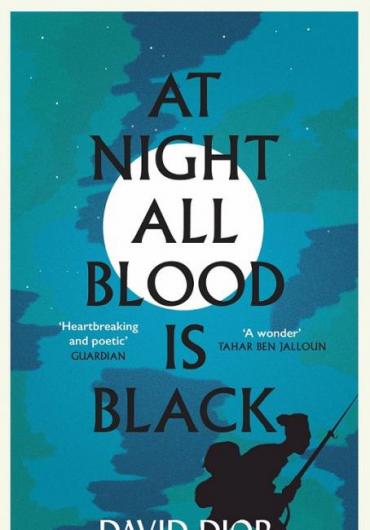
It is hard to keep up with the news, but this is one that we should celebrate. The Franco-Senegalese author David Diop won the International Booker Prize 2021 for his book, “At Night All Blood is Black“. I know, it is hard to keep up with all the different prizes, Man Booker Prize, International Booker Prize, and countless others. This one is nonetheless important because first of all, David Diop is the first African to win the prestigious prize, but also because his book “At Night All Blood is Black” talks about all those African soldiers who helped to free France, and yet were never recognized, and instead were insulted, laughed at and more. The book, originally published in French in 2018 under the title “Frères d’âme” or Soul Brothers, weaves the history of World War I with the history of colonialism. The novel describes the experiences of Senegalese Tirailleurs fighting for France in the trenches. The main character, Alfa Ndiaye, descends into madness following the death of his childhood friend Mademba Diop who had also been recruited as a tirailleur, and inflicts extreme brutality upon his German enemies. Diop was inspired to write the book by his French great-grandfather’s service during the war. Diop stated “He never said anything to his wife, or to my mother, about his experience. That is why I was always very interested by all the tales and accounts which gave one access to a form of intimacy with that particular war.”
As a side note, “tirailleur” was the name given by the French Army to indigenous infantry recruited in the various French colonies. They were not all Senegalese, even though the name always said “tirailleur senegalais,” but rather came from all over Africa. They served for France in a number of wars, including World War I, World War II, and several others. The name “Tirailleur” is a link of two words “tir ailleurs” to laugh and denigrate the indigenous troops by saying that the soldiers were not capable to shoot on target, more like to mean “shoot off target”; it could be translated as skirmisher.
It is also good to note that there is no family link between the great Senegalo-Cameroonian poet David Mandessi Diop [Afrique de David M. Diop / Africa by David M. Diop] and this David Diop… We applaud the success of both namesakes. So good to have such a an illustrious namesake and walk in his path.
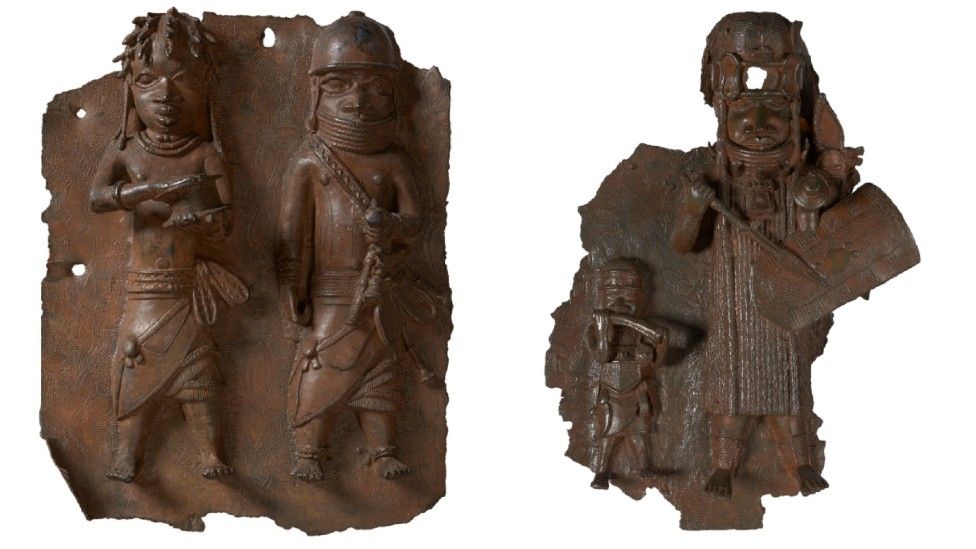
Benin City Bronzes at Horniman Museum (Source: Horniman Museum)
Yet another one! Isn’t it odd that there seems to be an avalanche of “proposals” to return looted artifacts? Is it real? Are these museums really going to relinquish these artifacts? or is it just a publicity stunt? Excerpts below are from an article on the BBC website. The article dates from April, but it is still worth mentioning. Enjoy!
=====
A London museum will consider [seriously?] returning artefacts obtained by “colonial violence” – including Benin Bronzes – to their countries of origin.
Since 2017, the Benin Dialogue Group, which brings together the current Oba (state leader of Edo), the Nigerian government and museums across Europe, has been working on a plan for some Benin Bronzes to return to Nigeria. If returned, Nigeria plans to house repatriated bronzes in the Edo Museum of West African Art set to open in 2025.
Campaign group Topple the Racists recently added the Horniman to an interactive map detailing the statues in the UK that have links to colonialism.
The Horniman’s collection includes 15 Benin Bronze plaques depicting Obas (kings) and legendary figures, a brass cockerel called an Ebon which would be placed on the altar of a dead Lyoba (queen mother), and a ceremonial paddle called an Ovbevbe used by priests to ward off evil.
A brass bell, typical of those worn around the necks of Benin’s warriors, is also in the collection, along with an ivory staff of office.
Last Thursday, the first president of Zambia, Kenneth Kaunda, changed dimensional plane to join his ancestors. At 97 years old, he was one of Africa’s last surviving liberation leaders. To a generation of Africans, and to many of us, Kenneth Kaunda epitomized the African struggle for independence.
Born into a family of 8 children in Lubwa in the north of then Northern Rhodesia (now Zambia), Kaunda was the last born of parents who immigrated from Nyasaland (Malawi). He trained as a teacher, then became involved in politics, first as secretary of the local young men’s farming association and later as a founding member of the Northern Rhodesian African National Congress in 1949. In 1955, both him and Harry Nkumbula, party president were imprisoned for 2 months. Later Kaunda broke away from the ANC, to found his own party, the Zambian African National Congress (ZANC) in October 1958 which was short-lived. In March 1959, the ZANC was banned and Kaunda was sentenced to 9 months‘ imprisonment, which he spent first in Lusaka, then in Salisbury When he was freed from prison in 1960, he joined the principal nationalist party, the United National Independence Party (UNIP), which campaigned and fought against British colonial rule. He was influenced by Martin Luther King Jr. and Kwame Nkrumah, both of whom he met on different occasions. On 24 October 1964 he became the first president of an independent Zambia.
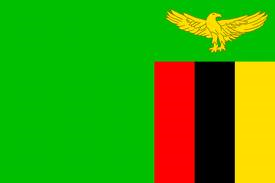
Zambian flag
Kaunda started with the great advantage of leading an African state with a stronger economic base than any of its neighbors but there was a shortage of native Zambians who had the skills and training to run the country [similar to so many African colonies… the Europeans were there to pillage and exploit the resources of the countries, and not build their local forces!]. The policy of sanctions imposed by the British government on the breakaway country proved at least as damaging to the Zambian economy (similar to what they did to Zimbabwe under Mugabe– Is Zimbabwe the New Haiti?) over the years, probably as punishment for his support for the liberation of his neighbors.
Affectionately known as KK, or Mzee, Kaunda worked tirelessly towards to the freedom of the whole of Southern Africa from white rule; he supported the fight of other countries against repressive, racist regimes in South Africa, Namibia, Angola, Mozambique and Southern Rhodesia (Why the name: Zimbabwe?). It took several years, but his support never faltered.
As a testimony, President Hage Geingob of Namibia said in a statement “Africa lost“a giant of a man. …Kenneth Kaunda was a generous, affable, and a resolute leader who freed our region from colonialism.”
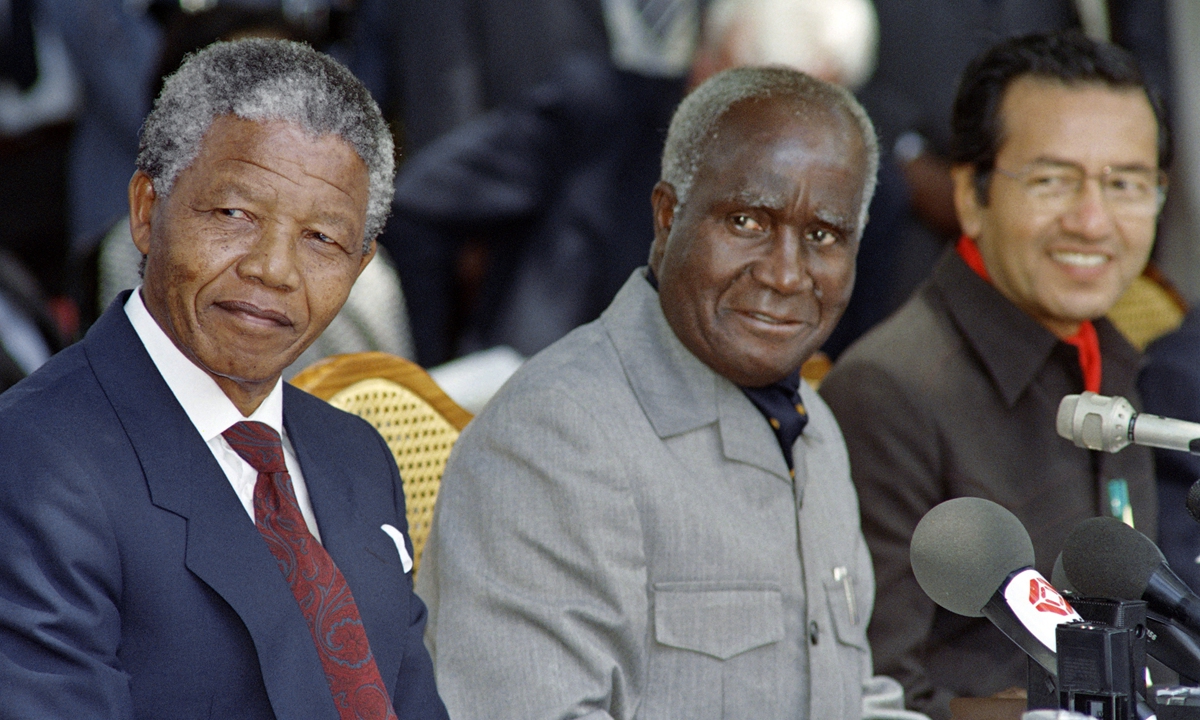
Photo taken on February 28, 1990 showing Zambia’s president Kenneth Kaunda (Center) and South Africa’s African National Congress (ANC) leader Nelson Mandela (L) attending a press conference at the Presidential House in Lusaka. (Source: AFP)
South Africa’s President Cyril Ramaphosa described Kaunda as a “rightfully revered father of African independence and unity… Under his leadership, Zambia provided refuge, care and support to liberation fighters who had been forced to flee the countries of their birth.” “He stood alongside the people of South Africa at the time of our greatest need and was unwavering in his desire for the achievement of our freedom. We will never be able to repay the debt of gratitude,” Ramaphosa added.
“For our founding father, it was not enough for his country Zambia to be liberated when the region and the African continent remained bonded in the shackles of colonialism and apartheid,” current Zambian President Edgar Lungu told mourners at Kaunda’s house in Lusaka … “[Kaunda] soldiered on to seek freedom for humanity.”
Please enjoy articles on the Al-Jazeera and the very good article by the Global Times [With love and respect, Chinese people cherish memory of Zambia’s Kaunda, ‘an old and good friend’]. Please watch the video I posted a few years ago on the great Kenneth Kaunda, Zambia’s first president.
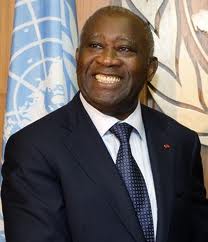
Joy and tears were mixed in my heart yesterday as I saw our president, Laurent Gbagbo, the blessed child of Gagnoa, the former president of Cote d’Ivoire, land back in his homeland. 10 years of imprisonment, over 20 years of persecution, acquitted by the International Court of Justice at the Hague [Laurent Gbagbo and Charles Ble Goude: Totally Acquitted and Free at Last, Laurent Gbagbo, Former President of Cote d’Ivoire, Acquitted of War Crimes], and finally allowed to go home to the land of his ancestors. Gbagbo’s only crime has been to love his country and his people too much, and want dignity for them! Laurent Gbagbo is really like those of our kings, heads of state, leaders, who have been deported by the oppressors, the French colonizer, in this case via its puppet Ouattara [Deportation of African Heads of States]. We have fought, cried, and tirelessly worked for his freedom. Africa is proud of her son, Laurent Gbagbo. Just look at how many people took to the streets to welcome him home! Then Ouattara sent his troops to beat the people who came to welcome their president home, in the name of trying to prevent troubles. Such a coward! Our president is back! It does not matter what the future holds, today we are happy… we have made progress… Africa’s son is back… tomorrow will take care of itself. 10 years ago, when I watched as the presidential palace was being bombed by French troops, when I watched our president and wife being paraded on TV all over the world [Laurent Gbagbo: No to a complicit silence!], I could not have imagined today! I knew we needed to work hard, but today I will savor this victory. Why don’t these international media who yesterday felt no shame to show our president or his wife being paraded by the rebels on broad TV, why are they not showing his triumphal return today? why are they not placarding it the way they did when he was dragged out? Because it would show that they lost! Shame on the Mainstream Media, shame on them… shame on France… today we stand tall as our son is back. Today, we stand!
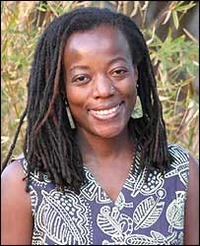
Tsitsi Dangarembga, the Zimbabwean author of Nervous Conditions, was awarded the 2021 PEN Pinter prize last week. As a background, Dangarembga’s debut novel, Nervous Conditions, was the first novel published in English by a Black woman from Zimbabwe. Remember that before independence, Zimbabwe was known as Rhodesia, and was under white rule. Coincidentally, I just bought her final book in the trilogy “This Mournable Body” which was a finalist for the Man Booker prize last year. Dangarembga is an author, a playwright, and a filmmaker. She was also arrested last year. Her first novel was named by the BBC in 2018 as one of the top 100 books that have shaped the world. Excerpt below are from the Guardian. Please check out the article also on AfricaNews.
=====
Author, who was arrested last year in Harare while protesting against corruption, is hailed by judges as a ‘voice of hope we all need to hear’
Tsitsi Dangarembga, the Booker-shortlisted Zimbabwean writer who was arrested last year in Harare while protesting against corruption, has been awarded the PEN Pinter prize, praised for her “ability to capture and communicate vital truths even amidst times of upheaval”.
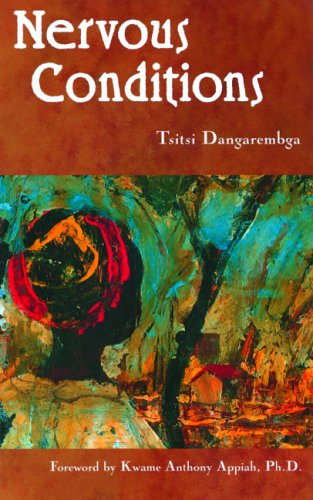
Nervous Conditions by Tsitsi Dangarembga
The prize is given by free speech campaigners English PEN in memory of the Nobel laureate Harold Pinter. It goes to a writer of “outstanding literary merit” who, as Pinter put it in his Nobel speech, shows a “fierce intellectual determination … to define the real truth of our lives and our societies”. Previous winners include Chimamanda Ngozi Adichie, Margaret Atwood and Linton Kwesi Johnson.
Dangarembga is the author of Nervous Conditions, which she wrote when she was 25, and which was described by Doris Lessing as one of the most important novels of the 20th century. The story of a village girl called Tambudzai, it was followed by The Book of Not, about Tambu’s teenage years, and the Booker-shortlisted This Mournable Body, the third part of the trilogy, set in the postcolonial Zimbabwe of the 1990s. …
“I am grateful that my casting – in the words of Harold Pinter – an ‘unflinching, unswerving gaze’ upon my country and its society has resonated with many people across the globe and this year with the jury of the PEN Pinter prize,” said Dangarembga. “I believe that the positive reception of literary works like mine helps to prove that we can unite around that which is positively human.”
















 African Heritage