Ruben Um Nyobé: Fighting for the independence of Cameroon

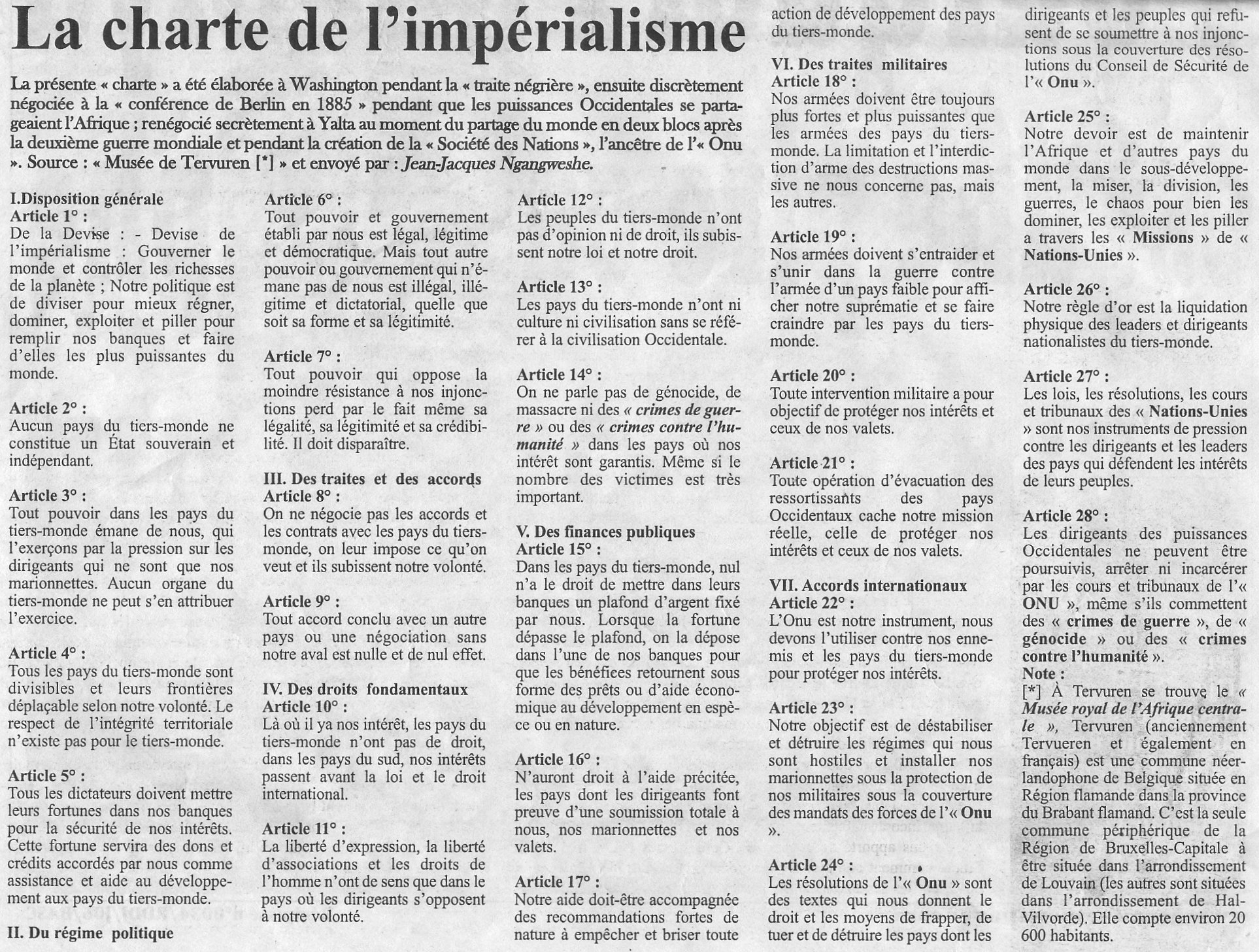
Ruben Um Nyobé
Ruben Um Nyobé

With presidential elections taking place this Sunday October 9th in Cameroon, with its plethora of opposition candidates, and no real organization, I thought that a trip down memory lane to the time of the 1940s-1960s when there was a real opposition in Cameroon will be very appropriate. I would like to talk about one of Cameroon’s greatest opposition fighters and freedom fighters: Ruben Um Nyobé, the real father of Cameroon’s independence.

Ruben Um Nyobé was a Cameroonian freedom fighter, and an anti-imperialist leader. Born in Song Mpeck in 1913, Um Nyobé was a stellar student raised in a modest family of farmers.  Initiated to the culture of the Bassa by his father who was well-versed, Um noticed early all the crimes committed by the colonial administration on the indigenous people, crimes such as indentured servitude, forced labor, dehumanization, spanking, beating etc…  This made him later write: “la colonisation, c’est l’esclavage ; c’est l’asservissement des peuples par un groupe d’individus dont le rôle consiste à exploiter les richesses et les hommes des peuples asservis“( “Colonization is slavery; it is an enslavement of the populations by a group of individuals whose role is to exploit the riches and the men of the enslaved populations.”)

Flag of the UPC
Flag of the UPC

On April 10th, 1948, the Union des Populations du Cameroon (Cameroon People’s Union or UPC) was founded and was first led by Leornard Bouli, and later Um Nyobé  was elected general secretary. The main goal of the party was the independence and reunification of both (British and French) Cameroons.  Its symbols were a red flag with a black crab on it: red for the blood of patriots who lost their lives, the crab as a reference to the reunification of Kamerun, and black to symbolize the color of the Black continent, Africa, the cradle of humanity.

The party was at first the Cameroonian branch of the RDA, of which Um Nyobé became one of its vice presidents in 1949.  However, the RDA of Houphouet-Boigny choose to cooperate with the French colonial administration, while UPC of Um Nyobé  refused to join in this treason and choose to continue the fight for the immediate recognition of the nation of Cameroon (independence), and its reunification.  Um Nyobé, the leader of UPC, was particularly charismatic, courageous, and a very good orator.  For the Cameroonian intellectual youth of those days, he was without any doubt the leader which embodies Cameroonian patriotism, and for the masses,  he was the hero who will bring a new dawn.  His aura was such that his name travelled into the country in rural areas.  He was affectuously known as “Mpodol” or “celui qui porte la voix ou qui défend la cause“, “the one who carries the demands.” He was particularly active, wrote political articles, held  meetings where as much as tens of thousands could be seen, met the masses, and moved across the country.

Ruben Um Nyobé with his family

As the charismatic leader of the UPC, Ruben Um Nyobé (1913-1958), defended three times (1952, 1953, and 1954) the cause of Cameroon at the United Nations tribune in New York.  On 22 April 1955, the UPC published the “Proclamation commune(Common proclamation), which was considered as a unilateral declaration of independence and a provocation by the French authorities.  On 19 May, Um Nyobé went underground and on 22 May, the French gendarmes dispersed UPC meetings and the party announced it would no longer recognize French authority. Following violent riots, the UPC and its branches were banned by the French authorities on 13 July 1955.  Since the UPC was then the main political party in Cameroon, the French authorities decided to support other, less provocative parties, to try to divide-and-conquer. In December 1956, the UPC which was banned from participating in the general elections, set up an armed branch called the “Comité National d’Organisation” (Organization National Committe or CNO) and started an armed struggle. A pacification campaign was performed by the French army which was actually a genocide perpetrated on the people of Cameroon, and culminated with the assassination of Um Nyobé on 13 September 1958.  He was murdered by the French army, near his natal village of Boumnyebel, in the department of Nyong-et-Kéllé in the maquis Bassa. Um Nyobé ‘s death set in motion events that totally decapitated the UPC (even to this date) as the strongest opposition party of Cameroon.  In essence, his murder allowed the French to set a neo-colonial state in Cameroon, which today still lives as a puppet state serving Western interests.  At the time, however, his fierce fight forced the French colonial power to abuse of its powers, commit a genocide (still not well-documented almost 50 years later) in the Western highlands, and Bassa maquis, and finally forcing them to award independence to Cameroon.
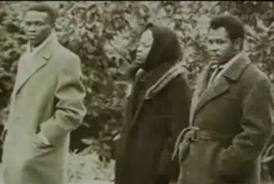
Ernest Ouandié, Marthe Moumié, and Abel Kingue in Geneva after Felix Moumié's death
L-R: Ernest Ouandié, Marthe Moumié, and Abel Kingue in Geneva after Felix Moumié's death

The independence of Cameroon, under complete French control, was proclaimed on 01 January 1960 and some leaders of the “legal UPC” rallied President Ahidjo.  However, others in the UPC continued with the struggle within the country and abroad.  Félix Moumié, Um Nyobé ’s successor, was poisoned with thallium on 3 November 1960 in Geneva by a French secret agent (William Bechtel).  Abel Kingue died in Algeria in 1964, while Osende Afana was arrested and decapitated in 1966. A post-colonial struggle by UPC rebels opposing the new Cameroon army (trained and armed by France) continued until August 1970 when the last battalion of the UPC, commanded by Ernest Ouandié, was arrested.  Ouandié was sentenced to death and was shot by a death squad in a market on 15 January 1971, in Bafoussam.  The civil war, resulting in the destruction of villages and use of napalm is estimated to have resulted in at least 30,000 to 500,000 deaths.  It has been conveniently removed from official history, both in Cameroon and in France.

In his book, Richard A. Joseph says: He [Ruben Um Nyobé ] was undoubtedly one of the most brilliant political thinkers and organizers to emerge after the Second World War in Africa. Had he survived to lead his country to independence, he would most certainly be ranked today on the same level as Julius Nyerere, and the late Kwame Nkrumah and Patrice Lumumba.” 

Remember Ruben de Mongo Béti
'Remember Ruben' by Mongo Béti

Check out the website Grioo.com where there is a good biography on Ruben Um Nyobe’s life. Don’t forget to check out the website of Dibussi Tande. The great Cameroonian writer Mongo Béti wrote the book Main basse sur le Cameroun, autopsie d’une décolonisation (about the Cameroonian resistance led by the UPC) which was banned in France in the 70s, which led to him to write Remember Ruben in honor of Ruben’s memory.  As leader of the UPC, Um Nyobé  made several trips to the United Nations headquarters in New York where he spoke in favor of an independent Cameroon. I leave you here with the rare footage, the only footage of Um Nyobé speaking at the UN tribune.  This is the only audio and visual record of Um Nyobé  found to date. Enjoy hearing Mpodol speak!!!  It is a real treasure!!!

Madam President wins the Nobel Peace Prize

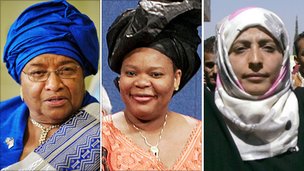
Nobel Peace Prize winners (L to R): Ellen Johnson-Sirleaf, Leymah Gbowee, and Tawakkul Karman
Nobel Peace Prize winners (L to R): Ellen Johnson-Sirleaf, Leymah Gbowee, and Tawakkul Karman (source: BBC)

Wow… such was my surprise and joy when I woke up this morning to find out that Madam President, Mrs. Ellen Johnson-Sirleaf had won the Nobel peace prize this year with another fellow Liberian lady Leymah Gbowee, and a lady from Yemen Tawakkul Karman.  I just thought that you would want to re-read the post I wrote almost two years ago on this proud African Iron Lady, and watch the video on her first 52 weeks in power.  Enjoy!!! (Just a spin: why is it that for women they had to put all three of them together? couldn’t the Nobel committee have acknowledged Madam president this year, and then the other two next year? or Madam president and the fellow Liberian lady this year, and the other one next year? So sad that when it comes to women, the world, even the Nobel committee is still sexist!)

Le Chef Poltron

Village africain
Village africain

Autrefois, au plus profond d’une profonde forêt, se trouvait un gros village appelé Ganda. Le chef de ce village s’appelait Kanomba et son épouse Okorou. Ils avaient un fils nommé Aba-soko.

Le chef tenait à avoir une bonne réputation. Quand il avait trois cauris, il en donnait un à sa femme et un à son fils. Il gardait le troisième pour lui. Il voulait se faire passer pour un homme généreux, mais c’était le roi des avares. Aucune richesse, aucun pagne, aucune pièce d’or, aucun grain de riz ne sortait de chez lui pour aider un pauvre ou un orphelin.

Le chef parlait toujours de son courage et donnait des leçons à tous de son courage et donnait des leçons à tous sur la façon de se battre, de se comporter en brave. Mais jamais il n’avait cherché l’occasion de montrer son courage. Quand  l’occasion se présentait, il était malheureusement malade. Or ce chef n’était qu’un poltron, et voilà comment on l’a appris.

Régime de banane plantain

Un soir, Kanomba revient de son champ plus tard que d’habitude. Marche courbé en boitant. Son œil gauche est jonglé et à moitié fermé.  Il paraît très fatigué.  Tous les villageois qui le rencontrent l’interrogent, mais il répond en bredouillant :  Je suis tombé d’un arbre, ou je me suis cogné à une branche ou des guêpes m’ont piqué.  Il ment certainement! Que s’est-il donc passé? Quand il arrive chez lui, le chef Kanomba se laisse tomber sur un tabouret bas et fait appeler sa voisine:  Gbré! Gbré! vient vite, le chef veut te parler !

Voila donc la femme qui abandonne sa marmite et qui se présente devant le chef. Celui –ci lui dit :  Gbré, j’ai décidé de te récompenser. Demain tu iras dans ma plantation et tu pourras couper le plus gros régime de banane plantain que tu trouveras, je te le donne.  N’oublie pas de prendre ta meilleure machette et de l’aiguiser soigneusement. Continue reading “Le Chef Poltron”

African Small trades: the Mobile Shoemaker/ Les Petits métiers africains: le Cordonnier Ambulant

African shoemaker
African shoemaker

As a follow up to my previous article on the static shoemaker, today I will be discussing the work of the mobile shoemaker. Have you ever found yourself with a fallen shoe sole, or heel, on your way to work or home, with no idea how to walk home since one of the heels on your shoe has fallen out? or have you ever found yourself with a torn shoe due to some sudden movement? What do you do in such cases? Well, in Africa, and particularly in Cameroon, people call a mobile shoemaker. A mobile shoemaker is a shoemaker who has a toolbox strapped to his shoulder (like a purse), and walks around the neighborhoods with his tools in a rectangular wooden box about 50 cm long, and perhaps 20 cm wide. In his toolbox can be found: needlles of different sizes, a small hammer, some shoe soles, different kinds of strong glue, threads, pieces of leather, a sharp knife, pieces of rubber, a brush, a sponge, small nails with magnet, and shoe polish of different colors (red, brown, black, neutral). His small hammer will not only be used to repair shoes, but also to knock on his toolbox hitting a particular note/rhythm making it resound such as to announce his presence to the entire neighborhood. No need to shout: this way of hitting the box announces his arrival. Any passerby could stop him; sometimes, inhabitants of neighborhoods can be seen rushing outside their homes looking for the one they just heard afar. Once stopped, he will either sew the shoe, or stitch/ glue the sole to the shoe itself. He works quite fast, and moves to the next neighborhood or house block. This is very similar to the work of a shoe shiner, where the work is well-done but in an expedited manner. The mobile shoemaker is particularly special to people’s heart because it’s like having a personal shoemaker who comes to your house to beautify your shoes. It is beautiful to watch them at work. It is really an art! Enjoy this video about the mobile shoemaker dealing with a customer in the streets of Douala, the economic capital of Cameroon.

Douala
Douala

En suite à mon article antécédent sur le cordonnier statique, aujourd’hui je vais vous parler du travail du cordonnier ambulant. Avez-vous jamais perdu la semelle de votre chaussure, ou un talon, quand vous rentriez du travail ou alliez au travail ? Vous êtes-vous jamais retrouvés avec une chaussure déchirée à cause d’une course folle ou d’un mouvement brusque ? Que faites-vous dans ces cas ? En Afrique, et en particulier au Cameroun, on appelle un cordonnier ambulant. Un cordonnier ambulant est un cordonnier qui possède une boîte à outil accrochée en bandoulière à son épaule, et se déplace  à travers les quartiers de la ville avec tous ses outils contenus dans une boîte rectangulaire en bois d’environ 50 cm de longueur et à peu près 20 cm de largeur. Dans sa boîte à outils, on peut y trouver : des aiguilles de différentes tailles, un petit marteau, quelques semelles, différentes qualités de colle forte, du fil, des morceaux de cuir, un couteau très tranchant, quelques pièces de caoutchouc, une brosse, une éponge, des petits clous armés d’aimant, et du cirage de différentes couleurs (rouge, marron, noir, neutre). Son marteau ne lui sert pas seulement à arranger les chaussures, mais aussi à battre en cadence sa boîte à outil, la faisant résonner  de manière à annoncer son arrivée dans tout le voisinage. Nul besoin de crier, cette façon de frapper sa boîte  annonce son arrivée. N’importe quel passant peut l’appeler ; il arrive de voir des habitants du quartier ouvrir leur portail et se ruer vers l’extérieur à la recherche du cordonnier qu’ils ont entendu au loin. Une fois arrêté, il coudra la semelle ou la collera à la chaussure ; dans certains cas, il devra raccommoder la chaussure. Il travaille très vite, et ainsi peut aller chercher sa clientèle ailleurs. C’est très similaire au travail du cireur, dont le travail est bien fait, et exécuté rapidement. Le cordonnier ambulant occupe une place très spéciale dans le coeur des gens, car c’est comme si on avait son cordonnier personnel appelé à faire resplendir nos chaussures. C’est vraiment beau de les voir travailler. C’est tout un art ! Amusez-vous à regarder cette vidéo sur un cordonnier ambulant et son client dans les rues de Douala, la capitale économique du Cameroun.

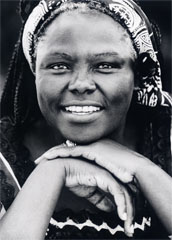
Wangari Maathai, first African Woman Nobel Peace Prize Laureate

Wangari Maathai
Wangari Maathai

I once took a class in environmental and social changes, where I studied the work of Dr. Wangari Maathai.  Her boldness and her stand for truth made her a great role model for many African women, and Africans in general.  She was bold! “Wangari Maathai was known to speak truth to power,” said John Githongo, an anticorruption campaigner in Kenya who was forced into exile for years for his own outspoken views.  “She blazed a trail in whatever she did, whether it was in the environment, politics, whatever.”  Indeed, Wangari Maathai was one of the most widely respected women on the continent, where she played many roles: environmentalist, politician, feminist, professor, human rights advocate, and head of the Green Belt Movement which she started in 1977. She was scoffed at by the Kenyan Forestry department who thought that uneducated women could not fight the desert.  She told them ‘We need millions of trees and you foresters are too few, you’ll never produce them. So you need to make everyone foresters.’ I call the women of the Green Belt Movement foresters without diplomas.

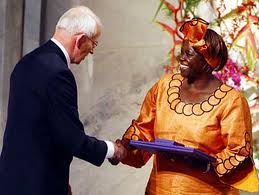
Wangari Maathai receiving the Nobel Peace Prize

As a star student after high school, she won a scholarship to study biology in Kansas (US), and went on for a Masters of Science at the University of Pittsburgh, and later a doctorate degree in veterinary anatomy at the University of Nairobi where she later taught and became chair of the department in the 1970s.  Wangari’s work started with the Green Belt Movement with the mission of planting trees across Kenya to fight erosion, stop desertification, create firewood for fuel, provide jobs for women, and empower the women of Kenya.  According to the United Nations’ data, her organization has planted over 45 million trees in Kenya, helped 900,000 women, and inspired similar projects in other African countries.  “Wangari Maathai was a force of nature,” said Achim Steiner, the executive director of the United Nations’ environmental program.  He likened her to Africa’s ubiquitous acacia trees, “strong in character and able to survive sometimes the harshest of conditions.

Maathai planting a tree

Her work was illustrated in one of my secondary school English textbook.  The government of Arap Moi was trying to build a skyscraper in one of Nairobi’s only parks, and she brought women who protested until the government abandoned the project.  She was beaten by police until she faintedWangari was not one to back down from her beliefsShe would go to jail for what she believed in.  For instance, her husband divorced her because he said she was too strong-minded for a woman.  When she lost her case in court, she criticized the judge and told him her mind, and was thus thrown to jail.

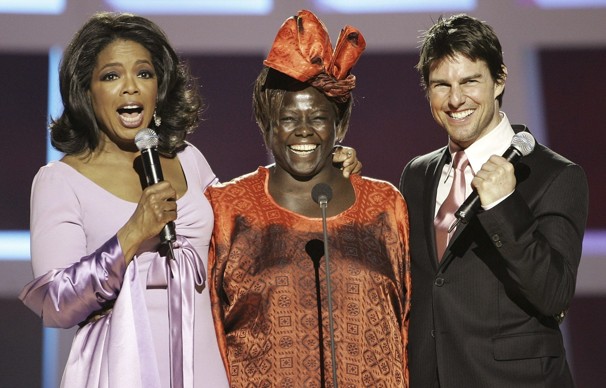
Oprah Winfrey and Tom Cruise congratulating Wangari Maathai on her Nobel Peace Prize

In presenting her with the Peace Prize, the Nobel committee hailed her for taking “a holistic approach to sustainable development that embraces democracy, human rights and women’s rights in particular” and for serving “as inspiration for many in the fight for democratic rights.”  Wangari Maathai has received many honorary degrees, including an honorary doctorate from the University of Pittsburg, her alma mater.  Check out articles by the BBC, CNN, her Interview on NPR, and the Huffington Post whose article is entitled “Wangari Maathai and the Real Work of Hope .”  Don’t forget to click also on the The Green Belt Movement website, and the movie “Taking Root: The Vision of Wangari Maathai.”   She once said that ‘we should all be hummingbirds‘: doers, and not spectators, even in the face of great challenges; do the best you canGoodbye Wangari, your work is not over, for Africa has been blessed with millions of Wangari Maathais who will continue your outstanding work.

La charte de l’impérialisme

La présente « charte » a été élaborée à Washington pendant la « traite négrière », ensuite discrètement négociée à la « conférence de Berlin en 1885 » pendant que les puissances Occidentales se partageaient l’Afrique ; renégociée secrètement à Yalta au moment du partage du monde en deux blocs après la deuxième guerre mondiale et pendant la création de la « Société des Nations », l’ancêtre de l’« ONU ».  Source : « Musée de Tervuren ».

La charte de l'imperialisme telle publiee dans le journal "La Nouvelle Expression"
La charte de l’imperialisme telle publiee dans le journal “Germinal “

I. DISPOSITION GÉNÉRALE

Article 1° :
De la Devise : – Devise  de  l’impérialisme : Gouverner le monde et contrôler les richesses de la planète ; Notre politique est de diviser pour mieux régner, dominer, exploiter et piller pour remplir nos banques et faire d’elles les plus puissantes du monde.

Article 2° :
Aucun pays du tiers-monde ne constitue un Etat souverain et indépendant.

Article 3° :
Tout pouvoir dans les pays du tiers-monde émane de nous, qui l’exerçons par la pression sur les dirigeants qui ne sont que nos marionnettes. Aucun organe du tiers-monde ne peut s’en attribuer l’exercice.

Article 4° :
Tous les pays du tiers-monde sont divisibles et leurs frontières  déplaçable selon notre volonté. Le respect de l’intégrité territoriale n’existe pas pour le tiers-monde.

Article 5° :
Tous les dictateurs doivent mettre leurs fortunes dans nos banques pour la sécurité de nos intérêts. Cette fortune servira des dons et crédits accordés par nous comme assistance et aide au développement aux pays du tiers-monde.

II. DU RÉGIME  POLITIQUE

Article 6° :
Tout pouvoir et gouvernement établi par nous est légal, légitime et démocratique. Mais tout autre pouvoir ou gouvernement qui n’émane pas de nous est illégal, illégitime et dictatorial, quelle que soit sa forme et sa légitimité. Continue reading “La charte de l’impérialisme”

Agostinho Neto by Chinua Achebe

Agostinho Neto
Agostinho Neto

In remembrance of Agostinho Neto (Sept. 17 1922 – Sept. 10th 1979), great leader and first president of Angola, I will leave you with a poem written by the great Nigerian writer Chinua Achebe in honor of Agostinho Neto. Enjoy!!!

———————

AGOSTINHO NETO

by Chinua Achebe

Agostinho, were you no more
Than the middle one favored by fortune
In children’s riddle; Kwame
Striding ahead to accost
Demons; behind you a laggard third
As yet unnamed, of twisted fingers?

No! Your secure strides
Were hard earned. Your feet
Learned their fierce balance
In violent slopes of humiliation;
Your delicate hands, patiently
Groomed for finest incisions,
Were commandeered brusquely to kill,
Your gentle voice to battle-cry.

Perhaps your family and friends
Knew a merry flash cracking the gloom
We see in pictures but I prefer
And will keep that sorrowful legend.
For I have seen how
Half a millennium of alien rape
And murder can stamp a smile
On the vacant face of the fool,
The sinister grin of Africa’s idiot-kings
Who oversee in obscene palaces of gold
The butchery of their own people.

Neto, I sing your passing, I,
Timid requisitioner of your vast
Armory’s most congenial supply.
What shall I sing? A dirge answering
The gloom? No, I will sing tearful songs
Of joy; I will celebrate
The man who rode a trinity
Of awesome fates to the cause
Of our trampled race!
Thou Healer, Soldier and Poet!

Compère Lièvre et les Ignames

Azui, compère Lièvre

Les hommes de la savane savent tout qu’Azui, le lièvre, est le plus astucieux des animaux. Mais ils sont si vaniteux qu’ils sont sûrs, eux, d’être plus intelligents que compère lièvre et disent tous : Moi, homme, je ne peux pas être dupé par un animal, même par le
plus rusé de tous !

Voici pourtant ce qui est arrivé un jour. Dans la forêt, et dans la savane voisine, il n’y avait presque plus rien à manger cette année-là .Les animaux, affamés, sortaient de la brousse et venaient rôder autour des villages, cherchant sur le sol le moindre grain de mil oublié. Azui s’était caché dans un fourré, non loin du chemin que suivaient les paysans pour aller cultiver leurs champs.  Il a observé un homme qui tous les soirs, s’en revenait chez lui, portant de grosses ignames sur la tête.  Que faire pour s’en
emparer?  Le lendemain, un peu avant le passage de l’homme sur le chemin, Compère lièvre s’y étend sans bouger, contrefaisant le mort.  L’homme arrive près de lui, voit : Voilà un lièvre qui n’est pas mort depuis bien longtemps, se dit-il.  Je vais aller déposer mes ignames près de la hutte, à la lisière de la forêt, et je vais revenir chercher cet animal.

Des ignames
Des ignames

Puis il se remet en marche.  Dès qu’il a disparu, Compère lièvre se relève et court par un raccourci, en direction de la hutte.  Quand il y arrive, il trouve les ignames que l’homme a déposées avant de revenir sur ses pas chercher le lièvre qu’il croit mort.

Azui ramasse les ignames, les charge sur son dos et file à toute vitesse vers sa maison, tout content d’avoir à manger pour
plusieurs jours.  Quand à l’homme, bien entendu, il ne trouve pas le lièvre mort sur le chemin …pas plus que les ignames, quand il est de retour à la hutte.  Il comprend alors un peu tard qu’il a été dupé par le rusé animal.  Ah oui ! Vraiment, on peut dire que compère lièvre est le plus astucieux de tous les êtres vivants de la savane !

Conte tiré de “Contes des Lagunes et Savanes,” Collection ‘Fleuve et Flamme,’ édition Edicef, 1975.

Celebrating 2 years of blogging

Thank you!
Thank you!

Dear all,

21,200 blog views, and over 100,000 youtube views, I would like to thank all my fellow readers, and writers, for stopping by my blog. If 2 years ago, someone had told me that I will be blogging and having an active blog life, I would have never believed it. I am extremely grateful for the support of all of you my readers, and grateful for your trust. I hope to keep you updated, and keep up with the great work.

Once again THANK YOU!

Africans and the Trap of Democracy

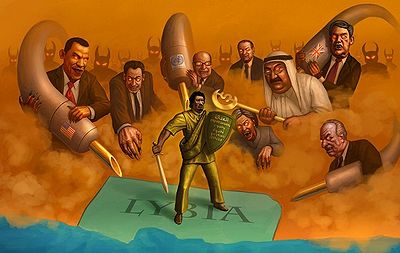
Libya, the Prey of the West

With the bombing of the presidential residence in Cote d’Ivoire by French forces for over a week, followed by the arrest of president Laurent Gbagbo, with the current intense bombing of Libya by NATO for the past 6 months, I cannot help but try to answer some of the same justifications used by Africans to approve the bombings by foreign troops on their neighbors’s countries, and ultimately on African soil. Any African who claimed and accepted that Cote d’Ivoire should be bombed by the French, shame on you! Any African who thought that the bombing of Libya was correct… shame on you! Any African who uses the same stupid phrase used by the West to abuse us: “… well Gbagbo had his day, he was in power for 10 years!… or Kadhafi was there 42 years!” Well my friend… Shame on you! Should democracy be imposed using bombs? Should democracy be imposed using warplanes, and Apache helicopters? Is it democracy to bomb the people you plan to help? Is it democracy to deliberately bomb civilian targets, hospitals, state televisions, homes, etc… to, like NATO said “protect civilians”? Was there not a peaceful solution? Was it so hard to re-count the votes in Cote d’Ivoire? Was it so hard to organize elections as Kadhafi asked? Why bomb? Why bomb? Why bomb?…

Libyan flag
Libyan flag

Now tell me, you, African who live in the west, are you in a democracy? When government increases taxes… do they ask you? When airline companies increase the price of air ticket, do they ask you? When school tuition goes up by 15%, have you been asked? Continue reading “Africans and the Trap of Democracy”