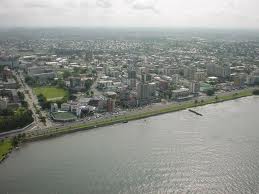
Two capitals in Africa share the same name: Freetown in Sierra Leone, and Libreville in Gabon; one in English, the other in French. I always knew that Freetown was named the way it was because it was a city founded in 1792 by freed African American Slaves also called Nova Scotian who had fought on the side of the British during the American Revolutionary war. The land was named Freetown as a land for freed slaves.
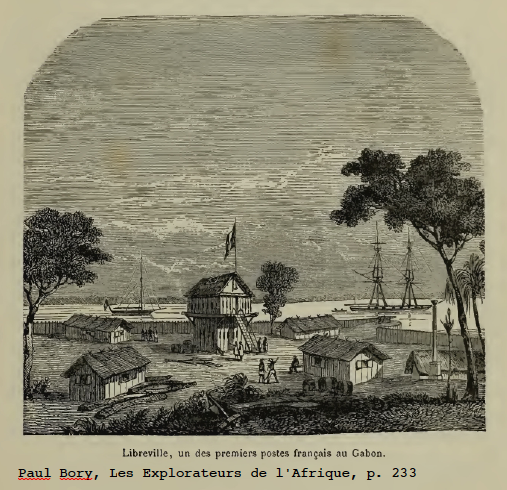
Libreville in 1846
But why on earth is Libreville named free town? Since, there were apparently no freed slaves returning from the colonies, or running away from slavery? I recently found out that the story of Libreville is very similar to that of Freetown, as it does involve slaves! Yes… that’s right! In the old days, i.e. prior to French occupation (the French acquired land there in 1839), the area that is today Libreville was inhabited by the Mpongwé people since the 11th century. In 1846, l’Elizia, a slave ship en route for Brazil, carrying slaves for sale was captured by the French navy near Loango, offshore from the Mbongwé’s kingdom. 260 negroes were thus freed and taken to the Island of Gorée in Senegal in 1846. After an intervention from Paris, 30 – 50 of these slaves will return to Gabon, where the French governor Bouët-Willaumez will take advantage of this, and found Libreville(French for ‘freetown’ or ‘freecity’) in 1849, in close proximity to Fort d’Aumale, where the French navy was installed to “fight” against slavery. The small town, Libreville, was then organized as a “French christian village” around 5 places: the Mpongwé’s place, the freedom place, the Bakélé place, the Pahué place, and the Bulu place, after the main tribes in the area at the time.
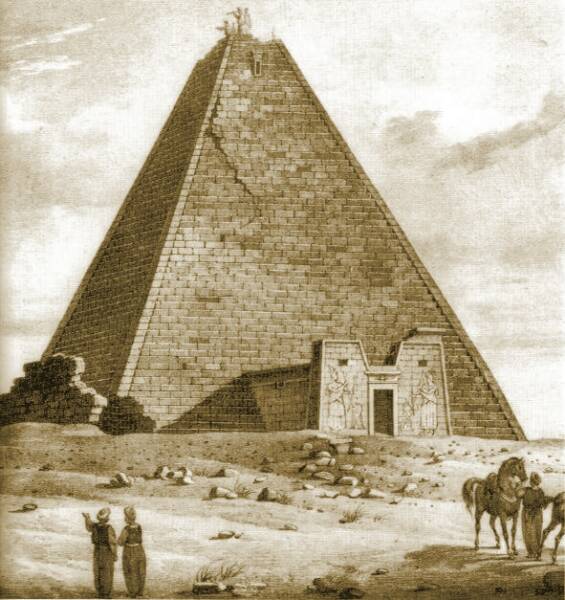
Great women are often left out of history. Rarely do we hear or read about African queens. It is already hard enough to read about great African men and leaders in history books, but as for African women… it is more like impossible. How many have heard of the great warrior queen of Nubia, Amanishakheto, who defeated a Roman army? Who has heard of this great queen whose pyramid/tomb was leveled to the ground by an Italian treasure hunter, Giuseppe Ferlini, in 1832? Who has heard of this woman who led her people with a strong arm, and built pyramids in Meroë? Who has heard of this great candace, whose daughter Amanitore, also queen of Nubia, is mentioned in the Bible (Acts 8:27) … yeah the Queen of Sheba is not the only African queen mentioned in the Bible!
Pyramid N6 of Amanishakheto in Meroe, before its destruction
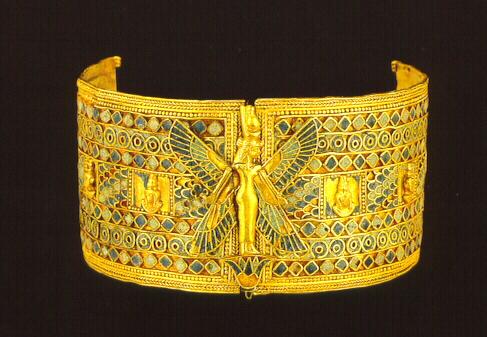
Well, let me tell you about the great Candace (Kandake or queen) of Nubia (present day Sudan), Amanishaketo (also written Amanishaket, or Amanikasheto or Mniskhte in meroitic hieroglyphs) who reigned from around 10 BC to 1 AD. Candace Amanishaket was an extremely wealthy and powerful queen. She succeeded to Candace Amanirenas who was also a great warrior queen (and will be the subject of another post). She built considerable pyramids and temples at Wad Ban Naqa, where she was buried with great treasures. Her residence and several temples were based there. Her palace is one of the largest treasures identified at Wad ban Naqa. It was 61 m long, and covered an area of 3700 m2with the ground floor made up of over 60 rooms. The palace originally had a second floor as indicated by the remains of columns found on the ground floor, and may have contained an atrium or other structure. Inside Amanishakheto’s grave, the Italian treasure hunter Ferlini discovered an amazing quantity of golden artifacts such as armlets, necklaces. The treasure found (or what has been recovered) contained ten bracelets, nine shield rings, sixty seven signet rings, two armbands, and an extraordinary number of loose amulets and necklaces, especially made for queen Amanishakheto created by Nubian artists from her kingdom. Some of her treasures (stolen by Ferlini) are now on display at the Egyptian Museum of Berlin, and at the Egyptian Museum of Munich.
Bracelet of Amanishakheto from the Egyptian Museum of Berlin
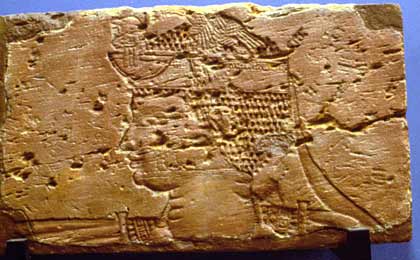
Amanishakheto defeated a Roman Army sent by the first emperor of the Roman empire, Augustus, (who broke a peace treaty) to conquer Nubia. She was a strong, and powerful woman, and a great pyramid builder. Her tomb at Meroë was one of the largest ever built. She is often depicted on pyramid murals as a massive, powerful woman, covered with jewels, elaborate fringed, tasseled robes, and carrying weapons in one hand, preparing to lead her army against others. Enjoy the video below on Amanishakheto, the great warrior queen of Nubia, and do not forget to check out The Treasures of Queen Amanishakheto.
After the joke of elections held in Egypt this past month, and with all the turmoil in Libya, Mali, and Côte d’Ivoire, I thought it will be best to watch this great documentary by Patrick Benquet which stirred thoughts across French Africa since December 16, 2010, date of its official diffusion. It tells you all about the tricks, and machiavelism of France (Africa’s policeman) in Africa, and of course the effect of the cold war on African leaders and countries. Enjoy the first part titled the FrancafriqueReason of State (Raison d’Etat) and share with others! It is important to know!
Il était une fois dans un petit village, Yévi l’Araignée. Yevi avait quatre femmes et beaucoup d’enfants. Il possédait un grand champ qu’il travaillait avec ses fils. Le soir, ils revenaient tous ensemble vers leur maison et partageaient entre eux la nourriture. Mais Yevi était très astucieux et très vorace. Jamais il ne se satisfaisait de la part de repas qu’on lui donnait et il réfléchissait constamment au moyen de s’approprier tous les meilleurs produits de son champ sans avoir à en distribuer à ses femmes et à ses enfants.
Voici la ruse qu’il avait inventée :
Un beau matin, il se plaint de sa tête et de son ventre et déclare qu’il est trop malade pour aller travailler. Il reste donc tranquillement étendu sur sa natte durant toute la journée. Chaque fois qu’une de ses épouses, inquiète, s’approche de lui, il pousse de sourds gémissements. Lorsque la nuit tombe, ses fils reviennent au village et vont aussitôt prendre nouvelle de leur père.
Champs Africains
Toute le famille se rassemble dans la case de Yevi et s’installe au chevet du faux malade …Quand celui–ci voit que toutes ses femmes et tous ses enfants sont auprès de lui il ouvre les yeux et d’une voix expirante leur dit :
Pauvre de moi! hélas! … hélas! … Je sens … que… Je … Vais mourir … Hélas !… Quelle douleur !…
Aussitôt, les épouses se mettent à sangloter … Yevi reprend alors la parole.
Approchez mes fils … Approchez … Je veux vous donner mes dernières instructions…
Les garçons viennent s’asseoir tout près du soi-disant moribond et prêtent une oreille attentive aux paroles que leur père prononce d’une voix de plus en plus faible.
Après ma mort, vous irez … m’enterrer … dans mon champ … Vous creuserez un grand trou … pour y déposer mon cercueil … N’oubliez pas !… Je veux que le cercueil reste grand ouvert … Et que la tombe ne soit pas refermée … Afin que mon esprit puisse venir vous protéger tous … Autour de la tombe ,vous déposerez en offrande les aliments qui me permettront de faire le grand voyage dans l’au-delà … N’annoncez ma mort à personne … Et si quelqu’un vous question à mon sujet, dites que je suis parti en voyage …
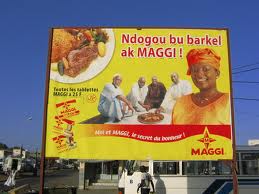
Depuis que je suis enfant, le cube Maggi faisait déjà partie de la vie culinaire d’une femme… mais ce n’est qu’en grandissant, avec l’avenue de la télévision et des publicités spéciales aux heures des feuilletons favoris que Maggi cube est entré dans le quotidien de tous les foyers. Dans certains pays, le cube maggi est surnommé ‘le corrige madame’ une appellation pour venter son mérite dans la cuisine. Mais corrige-t-il vraiment la cuisine, ou la déforme-t-il? A mon humble avis, le cube maggi déforme la cuisine africaine, et détruit les gouts et les saveurs originelles. Car imaginez-vous que les cuisinières ne font plus appel à nos bonnes herbes, épices, et ingredients locaux, mais jettent 2 ou parfois meme 4 ou 5 cubes bouillons dans la sauce pour y relever le goût. Alors un Ndolé normal épicé avec crevettes, ou autres, est maintenant épicé avec un maggi crevette! Comme si un cube de sel aromatisé pouvait contenir toute la saveur de bonnes crevettes de chez nous. Imaginez mon choc lorsque j’ai vu une jeune mère jetter des cubes maggi dans un met traditionnel camerounais, le Mbongo Tchobi? Kaï! Ayooooo! Quel affront!
Une pancarte publicitaire de Maggi au Senegal
Mais pourquoi cette insistance à vouloir substituer nos bonnes épices pour ces atrocités fabriquées en occident (ces substituts pas cher d’extrait de viande), donc non adaptées à nos mets locaux? La vidéo qui suit vous fera part de la stratégie de Julius Maggi pour utiliser le grand marché colonial. Hey oui… le cube maggi est un héritage de la colonisation existant depuis 1886 (soit 2 ans après la conference de Berlin)!
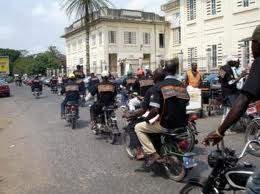
Commonly called Bend-Skin (pronounce ‘bend-sikin‘) in Cameroon, motorcycle taxis occupy a special place in many African countries, as one of the key forms of public transportation. Yes… you heard me right! In the big traffic jams of Douala, in the potholes of African capitals, or in the remotest villages, the motorcycle taxis are the quickest, and most economical way to get to one’s destination. In Cameroon, they are dearly called bend-skin because people actually have to ‘bend their skin’ as they go through the potholes, holding tightly their belongings and their hearts even tighter. They are ‘technically’ supposed to carry only one passenger, but often can be seen carrying 2 or even more. They became prominent in the streets of Douala in the late1990s after the economic crisis following the CFA franc devaluation, and particularly after the government left the streets of Douala degrade to the point where driving through giant potholes in a car became almost dangerous and extremely costly for car owners. Moreover, many college graduates who could not find jobs started taking to moto-taxis as a mean to make ends meet. The moto-taxis form queues outside office buildings, public markets, and near the corners of residential streets. Bend-skin are affordable and readily available: one can hardly wait too long for one to come around. They do not wear helmets, and tend to be aggressive drivers, leading to a rise in road-accidents in recent years. Today they have their own unions, and bike wash. Enjoy watching a moto-taxi or bend-skin wash in Cameroon. (A note:if they are called bend-skin in Cameroon, how are moto-taxis called in your country?)
==========
Bend-Skin
Communément appelés Bend-Skin (prononcer ‘Bend-sikin‘) au Cameroun, les moto-taxis occupent une place spéciale dans un grand nombre de pays africains, car ils sont un moyen de transport en public très répandu. Oui… vous m’avez bien entendu! Dans les grands embouteillages de Douala, dans les nids de poules des capitales africaines, ou même dans les villages les plus reculés, les moto-taxis sont le moyen le plus rapide et économique d’arriver à bon port. Au Cameroun, ils sont appelés bend-skin, car l’on doit effectivement se ‘plier la peau‘ et solidement tenir ses affaires, pour éviter de se retrouver dans des nids de poules sur la route. Ils sont supposés transporter un seul client, mais on peut souvent les voir transportant 2 ou même plus. La présence des moto-taxis sur les routes de Douala s’est developpée dans les années 1990 après la crise économique qui a suivi la dévaluation du FCFA; et particulièrement après que le gouvernement ait delaissé les rues de Douala qui se sont delabrées au point de former des trous béants sur la chaussée trop dangereux et extrêmement coûteux (le prix des reparations) pour les propriétaires de voitures. De plus, beaucoup de jeunes licenciés, diplômés de l’enseignement supérieur, sans boulot s’y sont mis pour afin de joindre les deux bouts. Les moto-taxis s’alignent à l’extérieur de bâtiments administratifs, marchés publiques, et au coin des rues résidentielles, pour attendre les clients. Le prix du moto-taxi est bon prix et à la portée de tout le monde. Par dessus tout, ils sont ‘versés’ partout: nul besoin d’attendre trop longtemps pour voir un arriver. Ils ne mettent pas de casques, et ont tendance à être des conducteurs très aggressifs; ce qui conduit a une augmentation d’accidents routiers ces dernières années. De nos jours, les bend-skin ont leurs propres syndicats de travailleurs, et leurs propres laveries. Regardez cette vidéo d’une laverie de Bend-skin au Cameroun. (Une note: s’ils sont appelés Bend-skin au Cameroun, comment les moto-taxis sont-ils appelés chez vous?)
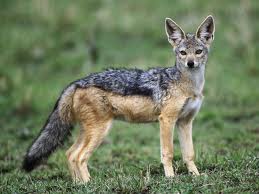
Jackal, it is said, came once to Dove, who lived on the top of a rock, and said, “Give me one of your little ones.”
Dove answered, “I shall not do anything of the kind.”
Jackal said, “Give me it at once! Otherwise, I shall fly up to you.” Then she threw one down to him.
He came back another day and demanded another little one, and she gave it to him. After Jackal had gone, Heron came, and asked, “Dove, why do you cry? “
Dove
Dove answered him, “Jackal has taken away my little ones; it is for this that I cry.” He asked her, “In what manner did he take them?” She answered him, “When he asked me I refused him; but when he said, ‘I shall at once fly up, therefore give me it,’ I threw it down to him.“
Heron said, “Are you such a fool as to give your young ones to Jackal, who cannot fly?” Then, with the admonition to give no more, he went away.
Jackal came again, and said, “Dove, give me a little one.” Dove refused, and told him that Heron had told her that he could not fly up.
Heron
Jackal said, “I shall catch him.”
So when Heron came to the banks of the water, Jackal asked him: “Brother Heron, when the wind comes from this side, how will you stand?” He turned his neck towards him and said, “I stand thus, bending my neck on one side.” Jackal asked him again, “When a storm comes and when it rains, how do you stand?” He said to him: “I stand thus, indeed, bending my neck down.”
Then Jackal beat him on his neck, and broke his neck in the middle. Since that day Heron’s neck is bent.
South African Folktales, J.A. Honey, 1910, Baker and Taylor Company.
Last night I thought about writing a piece on the greatest long-distance runner of all times, the great Haile Gebrselassie. My interest for Track and field (athletism) has always been big, but my interest for 10,000 m was awaken by Haile Gebrselassie running 10,000 m and taking the gold medal at the 1995 Gothenburg games. This great athlete hails from Ethiopia and has redefined what it means to run 10,000 m. He is a long-distance track and road running athlete. Imagine someone who has just run 9600 m, and still has the power to accelerate and sprint through the next 200-400 m as if he was Michael Johnson or Usain Bolt? If you can imagine this, you have imagined Haile Gebrselassie! I have enjoyed watching him run with grace, poise, endurance, and strength. I once read that he would train by running 30 km every day, and I thought to myself, no wonder he is a 2-time Gold olympic winner (1996 Atlanta, and 2000 Sydney), 4-times world championship winner, 4-times consecutive Berlin marathon winner, 3-times consecutive Dubai marathon winner (not sure how one could run in Dubai’s heat), broke 61 records in Ethiopia, and 27 world records, and is greatly considered the world’sgreatest distance runner in history. He has broken his own record several times, and is a true inspiration to many. He starred as himself in the 1999 movie Endurance.
Haile Gebrselassie, of Ethiopia, defeating Paul Tergat of Kenya in the 10000 m run at the Sydney 2000 Olympics in a historic finish.
I dream of running a 10000 m race one day, just like Haile… Imagine a non-runner inspired to run? Yes… that’s being influenced by the greatest of all, Haile Gebrselassie… So many of us in Africa owe to this man who started running 10 km to go to school back when he was just a child; this man from a poor background, who went through all odds to reach the summit. The current gold olympic title holder is Kenenisa Bekele, a fellow Ethiopian, and a protégé of Haile. A whole generation of Ethiopian long-distance runners, and African runners, and kids like me, have been inspired by this athlete who is running the distance for greatness (He gave his first gold medal to his church to thank God for his talent). All praise to the greatest of all: Haile Gebrselassie. I had hoped to see him at the London 2012 olympic games this summer, but just learnt that he would not be there. Although I feel sad, I am just grateful that we will be watching Kenenisa Bekele, and many others who have all been inspired by the greatest of all, Haile Gebrselassie.
J’ai été admirablement surprise de lire la charte du Manden (Mandé), qui semble être la première déclaration des droits de l’homme au monde. Elle fut prononcée lors de l’intronisation de Soundiata Keïta comme empereur du Mali en 1222. Imaginez-vous ma joie: première declaration des droits de l’homme au monde, érigée en Afrique? en 1222? plusieurs siècles (7 siècles) avant la fameuse déclaration des droits de l’homme de l’ONU? Waou…! Et après on vous dira qu’il n’ya jamais rien eu en Afrique. Lisez, et rejouissez-vous, car au Mali, du temps de l’empereur Soundiata Keïta, il y avait le concept du droit de l’homme et l’amour de l’être humain.
===========
La Charte du Manden (Mandé)
Soundiata Keïta a l’Assemblée constitutive de l’empire du Mandé avec les chefs de guerre (Source: Wikipedia.fr)
1. Les chasseurs déclarent :
Toute vie (humaine) est une vie.
Il est vrai qu’une vie apparaît à l’existence avant une autre vie,
Mais une vie n’est pas plus “ancienne“, plus respectable qu’une autre vie,
De même qu’une vie n’est pas supérieure à une autre vie.
2. Les chasseurs déclarent :
Toute vie étant une vie,
Tout tort causé à une vie exige réparation.
Par conséquent,
Que nul ne s’en prenne gratuitement à son voisin,
Que nul ne cause du tort à son prochain,
Que nul ne martyrise son semblable.
Assemblée constitutive de l’empire du Mandé (Source: Wikipedia)
3. Les chasseurs déclarent :
Que chacun veille sur son prochain,
Que chacun vénère ses géniteurs,
Que chacun éduque comme il se doit ses enfants,
Que chacun “entretienne”, pourvoie aux besoins des membres de sa famille.
4. Les chasseurs déclarent :
Que chacun veille sur le pays de ses pères.
Par pays ou patrie, faso,
Il faut entendre aussi et surtout les hommes ;
Car “tout pays, toute terre qui verrait les hommes disparaître de sa surface
Deviendrait aussitôt nostalgique.”
Assemblée constitutive de l’empire du Mandé (Source: Wikipedia.fr)
5. Les chasseurs déclarent :
La faim n’est pas une bonne chose,
L’esclavage n’est pas non plus une bonne chose ;
Il n’y a pas pire calamité que ces choses-là,
Dans ce bas monde.
Tant que nous détiendrons le carquois et l’arc,
La faim ne tuera plus personne au Manden,
Si d’aventure la famine venait à sévir ;
La guerre ne détruira plus jamais de village
Pour y prélever des esclaves ;
C’est dire que nul ne placera désormais le mors dans la bouche de son semblable
Pour allez le vendre ;
Personne ne sera non plus battu,
A fortiori mis à mort,
Parce qu’il est fils d’esclave.
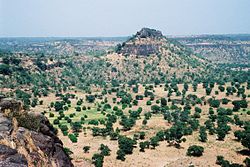
le Manding, berceau de l’empire du Mali (photo: Olivier Epron)
6. Les chasseurs déclarent :
L’essence de l’esclavage est éteinte ce jour,
“D’un mur à l’autre”, d’une frontière à l’autre du Manden ;
La razzia est bannie à compter de ce jour au Manden ;
Les tourments nés de ces horreurs sont finis à partir de ce jour au Manden.
Quelle épreuve que le tourment !
Surtout lorsque l’opprimé ne dispose d’aucun recours.
L’esclave ne jouit d’aucune considération,
Nulle part dans le monde.
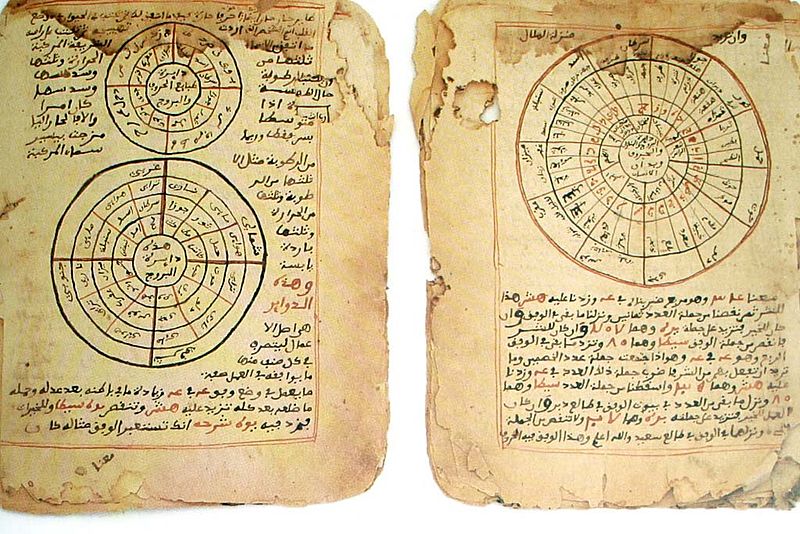
Manuscripts à Tombouctou (Mali) montrant de l’astronomie et mathématique
7. Les gens d’autrefois nous disent :
“L’homme en tant qu’individu
Fait d’os et de chair,
De moelle et de nerfs,
De peau recouverte de poils et de cheveux,
Se nourrit d’aliments et de boissons ;
Mais son “âme”, son esprit vit de trois choses :
Voir qui il a envie de voir,
Dire ce qu’il a envie de dire
Et faire ce qu’il a envie de faire ;
Si une seule de ces choses venait à manquer à l’âme humaine,
Elle en souffrirait
Et s’étiolerait sûrement.”
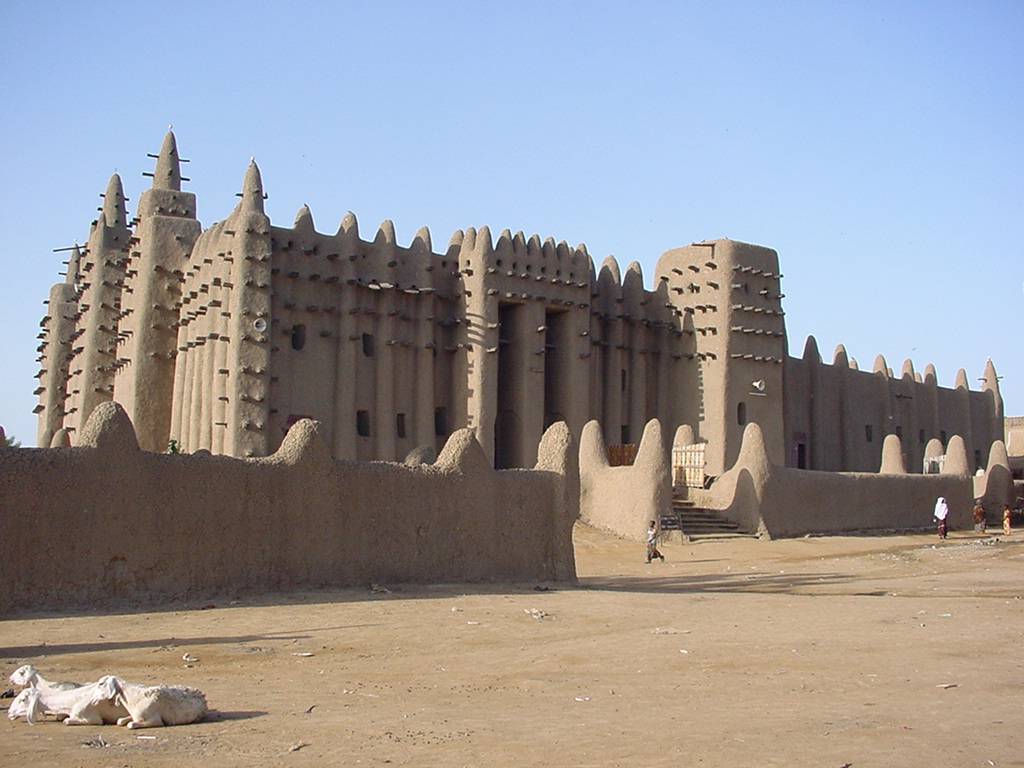
La grande mosquée de Djenné (Mali – héritage du grand empire du Mali)
En conséquence, les chasseurs déclarent :
Chacun dispose désormais de sa personne,
Chacun est libre de ses actes,
Chacun dispose désormais des fruits de son travail.
Tel est le serment du Manden
A l’adresse des oreilles du monde tout entier.
Youssouf Tata Cissé
Texte réécrit par Youssouf Tata Cissé dans “Soundjata, la Gloire du Mali”, éd. Karthala, ARSAN, 1991
This famous speech of KingBéhanzinis the last strong message he gave onJanuary 20, 1894, in homage to his army which he always praised the courage, and bravery of the soldiers and amazons. For the original,click here.Since this is such an important piece of African history, I decided to translate his farewell speech into english. Enjoy!
“Fellow sufferers, last faithful friends, you know the circumstances under which, when the French wanted to grab the land of our ancestors, we decided to fight.
We had the certitude to lead our army to victory. When my warriors rose by the thousand to defend theDanhomèand his king, I recognized with pride the same bravery manifested by those ofAgadja, ofTégbessou, ofGhézo, and ofGlèlè. I was by their sides in all the battles.
Despite the legitimacy of our cause, and our courage, our compact troops were decimated in an instant. They could not defeat the white enemies whom I also praise the courage and discipline. And already my weeping voice arouses no more echo.
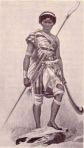
An Amazon warrior, ca 1890
Where are now myardent amazonswho were inflamed by a mighty anger?
Where are theirindomitable chiefs:Goudémè,Yéwê,Kétungan?
Where are theirrobust captains:Godogbé,Chachabloukou,Godjila?
Who will praise theirsplendid sacrifices? Who will tell about theirgenerosity?
Since they sealed the pact ofsupreme loyaltywith theirblood,how could I accept any sort of abdication without them?
How could I dare presenting myself in front of you, brave warriors, if I signed the general’s paper?












 African Heritage