Thinking about all the wasted years of corruption, mismanagement, neo-colonialism, nepotism, and all the -isms going on in many African countries after independence, I thought of sharing with you this poem by the Cameroonian author Charles Ngande. The poem can be found in Anthologie Négro Africaine by Lilyan Kesteloot, Edicef 1992, P. 329. The English translation is offered to you by Dr. Y., http://www.afrolegends.com
Today, I would like to talk about one of the heroes of Cameroonian history, Rudolf Douala Manga Bell, who stood against the Germans in the 1910s in Kamerun. His courage, and strong determination earned him the right of martyr and hero in the history of the Douala (or Duala) people, and thus of Cameroon.
Rudolf Douala Manga Bell was born in 1872, and studied in Cameroontown (modern-day Douala). He was the first son of King Manga Ndumbe Bell, of the Douala people. After completing his primary education and part of his secondary school in Cameroon, he went to study at the Lycée of Aalen in Bonn (Germany) finishing secondary school. He later went on to study law at the university there.
Kamerun (German Cameroon)
Manga Bell married Emily Engome Dayas, the daughter of an English trader and a Douala woman after his return home in 1896. He also became a civil servant. On 2 September 1908, he succeeded to his father as Paramount Chief (Chef Supérieur) of the Bell dynasty (founded since 1792) which encompassed the Bonamandone, Bonapriso, Bonadoumbe, all owners and inhabitants of the Plateau Joss in Douala. In those days, Douala was composed of several tribes: Bakole, Bakweri, Bamboko, Isubu (or Isuwu), Limba (or Malimba), Mungo, and Wovea. Among those chiefs, some of them including the famous King Akwa, signed a Germano-Douala treaty on 12 July 1884, which placed Cameroon under German protection. Cameroontown thus became Kamerunstadt.
Rudolf Douala Manga Bell, Leader of Douala people
In 1910, the German governor of Cameroon, Theodor Seitz, approved an urbanization project for the city of Douala (Kamerunstadt had been renamed Douala) set to turn it into one of the largest ports of Africa. The project outlined a plan to relocate the Douala people inland from the Wouri river to allow European-only settlement of the area. Neighborhoods such as Neu Bell, Neu Akwa, and Neu Deido were to be created for the indigenous people; these new allotments were going to be separated from the ‘European city’ by a barrier 1km wide (early version of apartheid!). The expropriations affected most of the Douala clans, who were angered and formed a united front behind Manga Bell. Rudolf Douala immediately refused, and told the Germans that the treaty signed in 1884 did not stipulate the removal/expulsion of the locals from their lands, and that this separation constituted a form of apartheid. Manga Bell then enlisted the help of Hellmut von Gerlach, a German journalist. Gerlach managed to secure a suspension order from the Reichstag Budget Commission in March, but the order was overturned when Colonial Secretary Wilhelm Solf convinced elements of the press, businessmen in the colony, politicians, and other groups to finally rally behind the expropriation. Manga Bell and the Douala requested permission to send envoys to Germany to plead their case, but the authorities denied them. In secret, Manga Bell sent Adolf Ngoso Din to Germany to hire a lawyer for the Douala and pursue the matter in court.
Adolf Ngoso Din, Assistant to Rudolf Manga Bell
Manga Bell then turned to other European governments and to leaders of other African ethnic groups for support. His envoys to other Cameroonian leaders reached Bali, Balong, Dschang, Foumban, Ngaoundéré, Yabassi, and Yaoundé. Charles Atangana (Karl Atangana), leader of the Ewondo and Bane peoples, kept Manga Bell’s plan secret but urged the Douala leader to reconsider. In Bulu lands on the other hand, Martin-Paul Samba agreed to contact the French for military support if Manga Bell petitioned the British. However, there is no evidence that Manga Bell ever did so. In Foumban, Ibrahim Njoya, sultan of the Bamum people, rejected the plan and informed the Basel Mission on 27 April 1914 that Manga Bell was planning a pan-Kamerun rebellion. The missionaries alerted the Germans.
Noticing the German lack of respect of the signed law, who started removing locals from their lands, Bell allied with other chiefs of Cameroon to counter the colonial plans. During the mutiny, the Germans arrested the Douala leader and Ngoso Din on 10 May 1914 accusing him of high treason. Their trial was held on 7 August 1914. World War I had just begun, and an attack by the Allied West Africa Campaign in Kamerun was imminent; accordingly, the trial was rushed. On 8 August 1914, Rudolf Douala Manga Bell and Ngoso Din were hanged.
Let us all celebrate Rudolph Douala Manga Bell, the Tét’èkombo (the king of kings in Douala), the first, the uniter of Cameroon (already reaching out to other kings), and one of Cameroon’s biggest resistant. Enjoy this old rendition by Charles Ewandje (probably recorded in the 70′s) of Tet’Ekombo an ode to resistance and to the land. The song was written in 1929 in memory of Rudolf Douala Manga Bell.
As South Africa‘s President Jacob Zuma opened an exhibition about the life of the country’s first black leader, Nelson Mandela, in Johannesburg yesterday, I thought it befitting to remind you of this great speech by Nelson Mandela where he was prepared to give his life for South Africa, and for his cause. Enjoy! The integral speech can be found here: Nelson Mandela 1964 speech_I am prepared to die.
========
“I am the First Accused.
… At the outset, I want to say that the suggestion made by the State in its opening that the struggle in South Africa is under the influence of foreigners or communists is wholly incorrect. I have done whatever I did, both as an individual and as a leader of my people, because of my experience in South Africa and my own proudly felt African background, and not because of what any outsider might have said….
Nelson Mandela
Our fight is against real, and not imaginary, hardships … Basically, we fight against two features which are the hallmarks of African life in South Africa and which are entrenched by legislation which we seek to have repealed. These features are poverty and lack of human dignity, and we do not need communists or so-called ‘agitators’ to teach us about these things. …
… This struggle is a truly national one. It is a struggle of the African people, inspired by their own suffering and their own experience. It is a struggle for the right to live.
Nelson Mandela clothed in a Pathe’O shirt
During my lifetime I have dedicated myself to this struggle of the African people.I have fought against white domination, and I have fought against black domination.I have cherished the ideal of a democratic and free society in which all persons live together in harmony and with equal opportunities. It is an ideal which I hope to live for and to achieve. But if needs be, it is an ideal for which I am prepared to die.”
Today I would like to talk about the man who invented the process of pollination of vanilla when he was only 12 years of age: the Reunionese Edmond Albius. His technique allowed for the pollinating of the vanilla orchids quickly and profitably. Albius’s technique revolutionized the cultivation of vanilla and made it possible to profitably grow vanilla beans away from their native Mexico.
Vanilla flowers
Edmond Albius, at the time of his discovery was a slave, who was born in Sainte-Suzanne in 1829, on the island of Bourbon (modern-day Réunion). He was orphaned from birth, as he lost his mother and never knew his father. Later, his master sent him to work with Fereol Bellier-Beaumont who initiated him into horticulture, and then botany. Albius spent most of his time following Beaumont around the estate as tended to his plants. Beaumont later wrote about Albius, that “this young black boy became my constant companion, a favorite child always at my feet.”
Bottle of Vanilla
French colonists brought vanilla beans to Réunion in the 1820s with the hope of starting production there. However, the vines were sterile because no insect would pollinate them. In the 1830s, Charles Morren, a professor of botany at the University of Liège in Belgium, developed a method of hand-pollinating vanilla, but his technique was slow and required too much effort to make cultivating vanilla a money-making proposition. Albius discovered in 1841 the practical process for the pollination of vanilla, a process which has revolutionized the culture of this almost ubiquitous spice. He discovered how to quickly pollinate the vanilla orchid with a thin stick or blade of grass and a simple thumb gesture. With the stick or grass blade, field hands lift the rostellum, the flap that separates the male anther from the female stigma, and then, with their thumbs, smear the sticky pollen from the anther over the stigma. Albius’s manual pollination method is still used today, as nearly all vanilla is pollinated by hand. His discovery thereby allowed the Island of Reunion to become for a while, the largest world supplier of vanilla, and the cradle for the diffusion of his process.
Vanilla
Since this discovery was made by a child, who was black, and a slave, the invention was quickly contested by all the jealous people. The unscrupulous botanist Jean-Michel-Claude Richard would pretend to have taught the technique to the slave Albius three or four years earlier. The lie will reach its paroxysm when at the beginning of the 20th century, the French press will go as far as claiming that Edmond Albius was white. Albius eventually gained his freedom with the abolition of slavery in 1848, but will not get any financial benefit from his invention which made the fortune of planters and of the French economy. He died in misery in 1880.
As you enjoy vanilla aromas in cakes, perfumes, and all those delicacies, don’t forget to celebrate the genius of Edmond Albius as well, and read Voices to learn more.
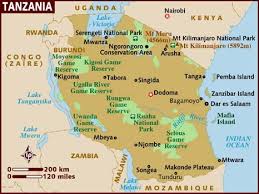
I always thought that the name of the Tanzanian city Dar es Salaam had something to do with peace, since it made me think of the Arabic greeting As-salamu alaykum which means peace be upon you . Great was my joy when I found out that it was indeed true. Dar es Salaam means ‘the abode of peace‘ or ‘the house of peace.’
Flag of Tanzania
Formerly Mzizima or ‘the healthy town‘ in Kiswahili, Dar es Salaam is Tanzania‘s largest and richest city today. It is a regional important economic center. In the 19th century, it was a coastal fishing village on the periphery of the Indian ocean trade routes. In 1865, Sultan Majid bin Said of Zanzibar began building a city near Mzizima, and named it Dar es Salaam or harbor/haven of peace with Darin Arabic meaning house, and es salaam meaning peace. Dar es Salaam fell into decline after Sultan Majid’s death in 1870, but was revived in 1887 when the German East Africa Company established a station there. The town’s growth was facilitated by its role as the administrative and commercial centre of German East Africa and industrial expansion resulting from the construction of the Central Railway Line in the early 1900s.
Map of Tanzania
As Germany lost World War I, German East Africa was captured by the British and from then on was referred to as Tanganyika. Dar es Salaam was retained as the territory’s administrative and commercial centre. Under British indirect rule, separate European (e.g., Oyster Bay) and African (e.g., Kariakoo and Ilala) areas developed at a distance from the city center. The town’s population also included a large number of south Asians. After World War II, Dar es Salaam experienced a period of rapid growth including political development with the formation of the Tanganyika African National Union or TANU which will lead Tanganyika to independence from British rule in 1961.
Dar es Salaam, once the capital of Tanzania, lost its status of capital city to Dodoma in 1974. Please enjoy the singer Momba who sings Dar es Salaam, and feel at peace in this haven.
Il y a longtemps très longtemps hyène et lièvre étaient de très bons amis. Mais la hyène, plus rusée trompait toujours le lièvre.
Chaque fois que ce dernier pêchait un superbe poisson bien dodu, c’était la hyène qui se régalait. Elle inventait des jeux étranges et sournois qu’elle “gagnait” toujours, puis dévorait le gros poisson cuit par le pauvre lièvre. Un jour le lièvre prit un si gros poisson que son amie hyène faillit s’étrangler de gourmandise quand elle le vit ! Mais ce jour-là, le lièvre dit:
– “Aujourd’hui est mon jour ! Je mangerai tout seul ce gros poisson !“
– “Il est bien trop gros pour ton petit ventre ” rétorqua la hyène; ” il pourrira avant que tu ne finisses de le déguster.“
– “C’est vrai, mais je le mettrai à fumer dès ce soir pour le manger par petits morceaux ensuite. Ce sera délicieux ! ”
Lievre
La hyène faillit s’évanouir d’envie. Elle voulait ce poisson. Elle devait le manger. Et seule ! Elle convoita tant le poisson qu’elle réfléchit à une nouvelle façon de satisfaire son égoïsme et sa gourmandise aux dépends du lièvre. Elle agirait discrètement.
La nuit venue, la hyène traversa doucement la rivière tout près de laquelle dormait le lièvre. Le poisson cuisait tout doucement, embroché au dessus du feu et parfumant la nuit. La hyène gloussa de joie devant le mauvais tour qu’elle jouerait à son amie et s’approcha. Le lièvre faisait mine de dormir. Lorsque la hyène s’empara du poisson, le lièvre bondit, attrapa la broche chauffée à blanc et rossa la hyène qui s’enfuit en hurlant de douleur, de honte, mais surtout de rage ! C’est depuis ce temps que la hyène porte des rayures sur son pelage. Et qu’elle hait le lièvre.
Voici la video/audio de Thomas Sankara avec sa fameuse citation:
«…l’esclave qui n’est pas capable d’assumer sa révolte ne mérite pas que l’on s’apitoie sur son sort.Cet esclave répondra seul de son malheur s’il se fait des illusions sur la condescendance suspecte d’un maître qui prétend l’affranchir.Seule la lutte libère … » [… the slave who is not capable of assuming his rebellion does not deserve that we feel sorry for himself. This slave will respond only to his misfortune if he is deluding himself about the suspect condescension of a master who claims to free him. Only struggle liberates …] Discours de Sankara à l’ONU le 4 octobre 1984 (texte intégral)
In view of recent events in Mozambique between Renamo and Frelimo, and the possibility of war again in that country which has suffered so many years of civil war, I thought of ‘Ancien Combattant’ by the Congolese singer Casimir Zoba also known as Zao. This song used to be sung across Africa when we were children. It is a clear hymn against war. As the song says, when the war is global, everybody dies, … when there is war, there is no pity, … the bomb, the atomic bomb, does not choose, it kills everybody… why war… war is not good. Like he says at the end, plant seeds of peace,let us be friends, let us hold our hands, friendship is more important than war. We can all greet people from across the globe in their own language to foster peace: “… if you see German – Guten tag, if you see Spanish – Buenos dias, … if you see Chinese – Hi ho, … if you see Senegalese – Nangadef, … if you Zairois – Mboté Na Yo, etc…” is what Zao says. What particularly characterizes the song, is the humor and the provocative nature of the message. This is a clear ‘NO’ to war in any shape or form. So let us all sing ‘Ancient Combattant’ and refuse war in any country of this world. We need peace, not war!
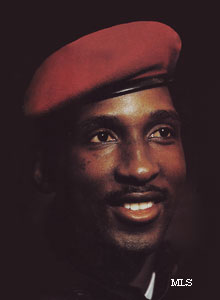
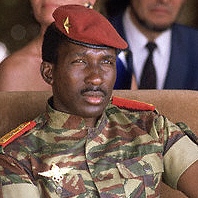
15 October 1987 was the day Africa lost one of his greatest sons: Thomas Sankara. Words cannot express the loss we’ve felt, and the loss Africa and the world suffered on that day. I would like to share with you some of Thomas Sankara’s famous declarations.
=====================
« Une jeunesse mobilisée est dangereuse, une jeunesse mobilisée est une puissance qui effraye même les bombes atomiques. Il y en a qui possède les bombes atomiques et qui ont des problèmes avec d’autres peuples qui, eux, ne possèdent pas la bombe atomique, mais pourquoi ils n’osent pas l’utiliser ? Parce qu’ils savent très bien, parce qu’ils savent très bien, que dans ces peuples que osent les attaquer, ils trouvent une jeunesse mobilisée, une jeunesse à mourir.» [A youth mobilized is dangerous, a youth mobilized is a power which scares even atomic bombs. There are those who own atomic bombs, and who have problems with other nations who do not own the atomic bomb, but why don’t they dare using it? Because they know very well, that in these people who they want to attack, they find a mobilized youth, a youth ready to die.] 14 mai 1983s’adressant aux jeunes de Bobo Dioulasso
« Nos ancêtres en Afrique avaient engagé une certaine forme de développement. Nous ne voulons pas qu’on assassine ces grands savants africains. » [Our ancestors in Africa were actively committed to a certain form of development. We do not want these great African wisemen to be assassinated.] 2 octobre 1984 à Harlem
Burkina Faso
«Il faut que l’école nouvelle et l’enseignement nouveau concourent à la naissance de patriotes et non d’apatrides.Mettre un enfant à l’école doit cesser d’être perçu comme un simple placement comptable, si tant est vrai que la transformation continue des sociétés qui incombe aux générations successives comporte des éléments quantifiables et non quantifiables. »[We need the new school and the new teaching concur with the birth of patriots and not stateless people. Putting a child in school should stop being conceived as a simple accounting investment, if indeed the ongoing transformation of societies which fall on successive generations has quantifiable elements and non-quantifiable.] 17 octobre 1986Appel de Gaouasur la qualité de l’enseignement.
« Il n’y a pas de révolution sociale véritable que lorsque la femme est libérée. Que jamais mes yeux ne voient une société où la moitié du peuple est maintenue dans le silence. J’entends le vacarme de ce silence des femmes, je pressens le grondement de leur bourrasque, je sens la furie de leur révolte. J’attends et espère l’irruption féconde de la révolution dont elles traduiront la force et la rigoureuse justesse sorties de leurs entrailles d’opprimées. » [There are no true social revolution until the woman is liberated. May my eyes never see a society where half of the people is maintained under silence. I hear the racket of this silence of women, I suspect the roar of their storm, I feel the fury of their revolt. I wait and hope for the fertile irruption of the revolution for which they will translate the force and rigorous righteousness coming from their oppressed bowels.] 8 mars 1987, Ouagadougou
«La Révolution démocratique et populaire a besoin d’un peuple de convaincus et non d’un peuple de vaincus, d’un peuple de convaincus et non d’un peuple de soumis qui subissent leur destin. » [The people’s democratic revolution needs a people that is confident and not defeated, a people of conviction and not a subjected people who suffer their fate.] 4 août 1987
African Venus, a sculpture by Charles-Henri Joseph Cordier 1851 (Source: Walters Art Museum)
«Je parle au nom des femmes du monde entier, qui souffrent d’un système d’exploitation imposé par les mâles.Pour ce qui nous concerne, nous sommes prêts à accueillir toutes les suggestions du monde entier, nous permettant de parvenir à l’épanouissement total de la femme burkinabè. En retour, nous donnons en partage à tous les pays, l’expérience positive que nous entreprenons avec des femmes désormais présentes à tous les échelons de l’appareil de l’État et de la vie sociale au Burkina Faso. Des femmes qui luttent et proclament avec nous, que l’esclave qui n’est pas capable d’assumer sa révolte ne mérite pas que l’on s’apitoie sur son sort.Cet esclave répondra seul de son malheur s’il se fait des illusions sur la condescendance suspecte d’un maître qui prétend l’affranchir.Seule la lutte libère et nous en appelons à toutes nos sœurs de toutes les races pour qu’elles montent à l’assaut pour la conquête de leurs droits. » [I speak on behalf of women from around the world, who suffer from an exploitation system imposed by the males. As far as we are concerned, we are ready to welcome all the suggestions from around the world, which will enable us to achieve the full development of the Burkinabe woman. In return, we will share with all the countries, the positive experience that we start with women now present at all levels of the state and the social life of Burkina Faso. Women who fight and proclaim with us, that the slave who is not capable of assuming his rebellion does not deserve that we feel sorry for himself. This slave will respond only to his misfortune if he is deluding himself about the suspect condescension of a master who claims to free him. Only fighting liberates and we call on all our sisters of all races so that they rise up to conquer their rights.] Discours de Sankara à l’ONU le 4 octobre 1984 (texte intégral)
I saw this very good photojournal article on BBC about Nigeria’s many monarchs. I just loved it, because of its depiction of African culture, and the beauty of their heritage. I had to share. From the Ovie of Umiaghwa Abraka kingdom in the Delta State, to the Pere of Isaba kingdom (a kingdom which exists since the 14th century), to the Emir of Zauzau in Kaduna State, this photojournal is rich and depicts the multiple kingdoms and cultures of Nigeria. The author of these, i.e. the photographer is George Osodi, took many years to capture these monarchs in their attire in never before seen images. Enjoy! (Don’t forget to click on the BBC link.)
The Ovie of Umiaghwa Abraka kingdom, Delta State, Nigeria (Source: George Osodi – BBC)

 Thinking about all the wasted years of corruption, mismanagement, neo-colonialism, nepotism, and all the -isms going on in many African countries after independence, I thought of sharing with you this poem by the Cameroonian author Charles Ngande. The poem can be found in Anthologie Négro Africaine by Lilyan Kesteloot, Edicef 1992, P. 329. The English translation is offered to you by Dr. Y., http://www.afrolegends.com















 African Heritage