11 Feb 2014 : Cameroon’s National Youth Day

Flag of Cameroon
Flag of Cameroon

Today happens to be the Cameroonian National Youth Day.  I have been thinking about the true meaning of a youth day.  For as long as I can remember, it has always been a speech from the President, and marches/parades from children across the nation.  But is that really what the National Youth Day is all about?  Well, for starters, I must admit that growing up, I was always really proud of marching on that day.  It was as if somehow, I suddenly mattered to the country… as if, from my child’s world, I could somehow influence changes in my country: bring clean water, stop the electricity cuts, build bridges, make better roads, build airports, etc.  It was as if, by marching, I had a say in the direction of my country, I was important; I mattered!  11 February was not just a day off to watch the parade on TV, it was a special day, a day dedicated to me, to my needs as a youth, to my well-being, to my inner desires, and to my potentials.
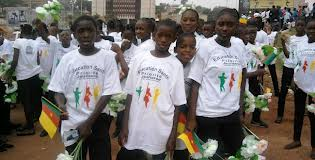
Youths during the parade celebrating Cameroon's National Youth Day
Youths during the parade celebrating Cameroon’s National Youth Day

As a teenager, the thought started to thaw a little bit, was 11 February only about the President’s speech?  was it just a time to cajole me as a youngster into thinking that I was important? that there was light at the end of the tunnel? that I was the future of the country, when around me, adults were feeling like the future had been beaten out of them? How was I supposed to make changes, when looking at big brothers ahead, I could only see unemployment looming in the horizon?  How was I supposed to concentrate into doing well in school or achieving all these great things I was asked to, when the future looked so grim?  What was the future going to look like with me in the picture?

Today, I see that it was actually necessary to acquire all this education, to read, and to focus, because in reality, even if the president’s speeches were empty words… I have the obligation, no the duty, to think of my elders: Ruben Um Nyobe, Felix Moumié, Abel KinguéOsendé Afana (who was Cameroon’s first PhD in economics), Ernest Ouandié, and countless others who sacrificed themselves so that I could be better.  Yes… it sounds so easy, but to think about it should bring fire, no, rage into our hearts.  Just thinking about all the great minds we have, all this great potentials, talented musicians who influence the world (like Ekambi Brillant who produced Angélique Kidjo who is now a world star), footballers, writers (Mongo Beti), comedians, doctors, scientists, journalists (Pius Njawe), who live and die like paupers, should give extra, ten times, 100 times more fire into our hearts, and really make us realize that we are the indeed the future of our country, and nobody else will build it for us, not even 80 years-old ministers.  I live you here with K’naan hymn to the youth which was sung during the 2010 FIFA World Cup: “Out of the darkness, I came the farthest, … Learn from these streets, it can be bleak.  Accept no defeat, surrender, retreat.  So we struggling, fighting to eat, And we wondering when we’ll be free ... we patiently wait for that fateful day… it is not far away… when I get older, I will be stronger, they’ll call me freedom just like a waving flag“.

Black Presence at the Sochi 2014 Winter Olympics

Sochi 2014
Sochi 2014
Flag of Togo
Flag of Togo

Yes, I know… you are probably going to say what? Africans? Blacks at the Winter Olympics? Given that most of us, Africans, grew up without any snow, how could we possibly compete at the Winter olympics?  Well, I wanted to have you give a shout out to some of our sisters from Togo at Sochi 2014 : Alessia Afi Dipol competing in alpine skiiing (born and raised in Italy, check out Alessia’s website to learn more), and Mathilde Amivi Petit Jean competing in cross country skiing (she represented France at the Junior level, before switching to compete for Togo in 2013).  Mathilde said “If I was told I would one day compete at the Olympic Games, I would never have believed it would be in the colours of Togo.” Representing another African country is Luke Steyn from Zimbabwe in Alpine skiing.  Sadly, this year, there will be no snow leopard from Ghana: Kwame Nkrumah-Acheampong to cheer us.

Flag of Zimbabwe
Flag of Zimbabwe

Other athletes of African ancestry from the Carribbeans to watch will be Bermuda  Tucker Murphy in cross-country skiing, and Jamaica‘s Wayne Blackwood, Marvin Dixon, and Winston Watts in Bobsleigh.

Shani Davis
Shani Davis

Now, the big one to look out for will be American super star (or at least mine) Shani Davis who wowed us in Turin 2006, and Vancouver 2010.  I have been waiting for him for the past 4 years, and really look forward to seeing him speed skate to gold in Sochi making him the first male speed skater to win gold at three (3) consecutive winter olympics.

The American women’s bobsleigh team features six athletes and five of them are African-American.  For the first time in women’s bobsled history, the teams will feature black women in the front, piloting. Watch out for Elana Meyers, Jazmine Fenlator, Aja Evans, Lauryn Williams with the biggest olympic pedigree of the 5, and of course the ever famous Lolo Jones.

Robin Szolkowy & Aliona Savchenko

Another athlete to watch out for will be Robin Szolkowy of Germany, whose father is from Tanzania and mother from Germany.  Szolkowy is a German pair skater, who skated with partner Aliona Savchenko to win the Bronze medal at the Vancouver Olympics in 2010.  Canadian Bobsleigh Lascelles Brown will also be present this year.  Sister Nkeiruka Ezekh, is a Russian Federation curling athlete which has participated at all olympics since Salt Lake 2002Just raise your hat to all these brothers and sisters proudly representing the continent, and other countries.  There are probably more athletes of African ancestry at Sochi 2014, and if you find any… just share with me as well.

Proverbe Bayombe sur la Tentation / Bayombe Proverb on Temptation

Safoutier
Un safoutier / A safou tree

Le fruit de safou qui depasse le mur de la parcelle du voisin vous séduit (Proverbe Bayombe – Zambia).

The Safou fruit which exceeds the neighbor’s plot seduces you (Bayombe proverb – Zambia).

The Timkat Festival or the Ethiopian Epiphany

Young girl attending the Timkat Festival (Carlos de Souza, AFP)
Timkat festival
Timkat festival

Today, I would like to talk about the Timkat Festival, which is an Ethiopian celebration of Epiphany.  It is usually celebrated on 19 January or on 20 January on leap years (which is the 10th day of the Terr – Ethiopian calendar).  This festival celebrates the baptism of Jesus Christ on the Jordan river by John the Baptist.  It is particularly praised for its reenactment of the baptism.  Pilgrims come from around the country to celebrate the Epiphany, which lasts three (3) days.  During the ceremonies of Timkat, the Tabot, a model of the Ark of the Covenant, is reverently wrapped in rich cloth and borne in procession on the head of the most senior priest to a place near the river, where a special tent will be erected for it.  The Tabot represents the manifestation of Jesus as the Messiah when he came to the Jordan river for baptism; this holy relic is also said to hold the ten commandments as handed down to Moses by God on Mount Sinai.  The Divine Liturgy is celebrated near a stream or pool early in the morning (around 2 a.m.).  Then the nearby body of water is blessed towards dawn and sprinkled on the participants, some of whom enter the water and immerse themselves, symbolically renewing their baptismal vows.  It is a feast of celebration, and processional crosses of varying size and elaboration as well as various Ethiopian artifacts can be seen on the occasion.  Participants wear the traditional shamma, which is a thin, white cotton wrap worn like a toga and as headdress.  The best place to attend the event is in Lalibela, Gondar, or Addis Ababa.  The actual ark of the Covenant is said to be held in a place in northern Ethiopia, guarded by priests who have sworn never to leave the chapel grounds.

Here are photojournals from The Guardian, the Huffington Post, and the BBC on the Timkat Festival; my favorite one is from the Guardian.  Enjoy!!!

Proverbe du Burundi sur le Choix d’une Epouse / Burundi Proverb on the Choice of a Wife

African princess
African princess

La femme que Imana (Dieu) t’a destinée vaut mieux que celle choisie par l’oeil (Proverbe du Burundi).

The wife Imana (God) has chosen for you is better than the one chosen by the eye (Proverb from Burundi).

The Battle of Isandlwana: the Day the British Lost the War to the Zulus

The Battle of Isandlwana

Today, I will tell you about the Battle of Isandlwana, the battle where the mighty Great Britain lost to African warriors… Yes you heard me right: Great Britain lost to Zulu warriors in South Africa on 22 January 1879The battle of Isandlwana remains the single greatest defeat of the British army at the hands of a native army.  This occurred in KwaZulu-Natal, where approximately 22,000 Zulu warriors defeated a contingent of approximately 1,350 British and Native troops (notice… the real number for the native forces cannot be found anywhere) in one of the first engagements of the Anglo-Zulu war.  The Zulu force was under King Cetshwayo, a nephew of King Shaka Zulu.

Zulu King Cetshwayo, ca 1879

The Battle of Isandlwana is a battle of pride as it reminds us that our ancestors did not quietly accept colonization, and were not easily defeated.  They fought, and even defeated the European colonizers, as is the case for Cetshwayo’s forces.  The battle was a decisive victory for the Zulus and caused the defeat of the first British invasion of Zululand.  For the first time, the British Army suffered its worst defeat against a technologically inferior indigenous force.  Isandlwana resulted in the British taking a much more aggressive approach in the Anglo–Zulu War, leading to a heavily reinforced second invasion and the destruction of King Cetshwayo’s hopes of a negotiated peace.

A depiction of the Battle of Isandlwana, taken from the London News

The Zulus were equipped mainly with the traditional assegai (iklwa) iron spears and cow-hide shields.  The British and colonial troops were armed with the state-of-the-art Martini-Henry breech-loading rifle and two 7 pounder artillery pieces as well as a rocket battery.  He he he…  Despite a vast disadvantage in weapons technology, the numerically superior Zulus commanded by inDunas (Princes) Ntshingwayo kaMahole Khoza and Mavumengwana kaNdlela Ntuli ultimately overwhelmed the British, killing over 1,300 troops, including all those out on the forward firing line.   The Zulu army wiped six (6) companies of the 24th regiment as well as volunteers from the Natal province and Basotho auxiliaries under Colonel Durnford.  The Zulu army suffered around a thousand killed.

Zulu warriors at Isandlwana, 1879

The primary reason for the Zulu victory is that the Zulus, unlike the British, kept their main fighting force concentratedFurther, they made a very successful effort to conceal the advance and location of their force until they were within a few hours’ striking distance of their enemy.  See… my ancestors were military geniuses too!!  Created by King Shaka, the Zulu army or Zulu impi was the most powerful war machine the British ever faced in Southern Africa.  The combat strategy was perfected by King Shaka himself, who added great organization and discipline to the traditional qualities of courage and mobility cultivated within African armies.  During the battle, the Zulu army would organize itself as an arc facing the adversary.  At the center (known as the chest in Zulu) were found the most seasoned regiments; on the wings (or horns) were found the regiments of younger warriors.  The latter used their speed and agility to outflank the enemy by attacking him on the flanks while trying to encircle him, while the chest warriors engaged him in the front.  Behind the chest, and with their back turned so as to keep their calm, were the veteran regiments (also known as the kidneys) who will wait as reserves, intervening only to switch the battle to victory.  Every man knew his place, moves, and maneuvers with extreme precision.

A Zulu regiment attacking at Isandlwana (C. Fripp)

Finally, when the location of the main Zulu Impi was discovered by British scouts, the Zulus, without hesitation, immediately advanced and attacked, achieving tactical surprise.  This tactical surprise prevented the British, although they now had some warning of a Zulu advance, from concentrating their central column.  The Zulus had outmanoeuvred Chelmsford, and their victory at Isandlwana was a decisive defeat of the British invasion that forced the main British force to retreat out of Zululand until a far larger British army could be shipped to South Africa for a second invasion.  During this battle, there was also a solar eclipse; this however did not stop the warriors from fighting.

I have to admit that I was quite proud to learn about the battle of Isandlwana, the battle the British lost to technologically inferior Zulus warriors (so it is said).  I just think that, on that day, the Zulus despite not having the technological advantage, had the strategic advantage.  They were well-trained, well-prepared, and they were also fighting for their land.  To learn more about the Battle of Isandlwana, please check out Military history which debunked some of the myths about the battle, British Battles, and this article on the BBC.

“Equal Rights” by Peter Tosh

Peter Tosh
Peter Tosh

Over 50 years after the Civil Rights movements, and almost 20 years after the avenue of “democracy” in South Africa, people around the world are still fighting for ‘equal rights‘.  The Black people of Brazil are screaming for equal rights, women in many countries of the world are still fighting for equal rights, people of lower social classes in the society are crying for equal rights, people of different castes in India are demanding equal rights… many African countries and governments just want equal rights to be treated and dealt with like proper economic partners to the G8 and G20 countries.  One of my favorite Reggae singers, the Jamaican Peter Tosh sang it so well over 20 years ago… and I just want to reiterate that it is a basic human need to be treated equally with respect no matter who we are, what the color of our skin is, what our gender is, what our social background is, what our religious affiliations are, etc.: we are first human beings and we deserve equal rights!

Proverbe du Ruanda sur le Respect des Autres / Rwandan Proverb on Respect of Others

La langue (the tongue)

La langue n’a pas d’os, mais n’en est pas moins tres puissante (Proverbe du Ruanda).  On peut etre faible sur un point et fort sur un autre.

The tongue does not have bones, but is nonetheless very powerful (Proverb from Rwanda).  One can be weak on one point, and strong on another.

‘Poetry’ by Amilcar Cabral

Amilcar Cabral on a stamp with the flag of Guinea Bissau

January 20th, is the day of Amilcar Cabral, the father of Cape Verde and Guinea Bissau independence was murdered.  I would like to celebrate this day of remembrance with a poem written by Amilcar Cabral himself.  He used to sign his poem by the name Larbac, which is an anagram of his last name Cabral.  The current poem is attributed to him… I was unable to find the Portuguese version.  Enjoy this poem by one of Africa’s greatest sons.

===========

… No, Poetry …
Do not hide within the inscrutability of my soul
Do not run away from life itself.
Break the invisible bars of my prison,
Open wide the doors of my being
– Come out…
Come out to struggle (life is a struggle)
The men outside call for you,
And you, Poetry, you are also a Man.
Love everyone’s poetry,
– Love Men
Let your poems flow to every race, to all things.
Merge with me …
Oh Poetry,
Take my arms to embrace the World,
Give me your arms to embrace Life
I am my own Poetry.
Amilcar Cabral Poem, 1946

Queen Amina of Zazzau: the Great Hausa Warrior born to Rule

Queen Amina of Zazzau

Today, I would like to tell you about yet another great queen of Africa, Queen Amina of Zazzau.  Just like Amanishakheto of Nubia, Nzingha of Angola, or Ranavalona I of Madagascar, Amina was a strong queen who loved her people, and totally marked her kingdom forever.

Queen Amina of Zazzau was born around 1533 in the province of Zazzau, in modern-day Nigeria.  Zazzau refers to the Zaria emirate which is a traditional state with headquarters in the city of Zaria in Kaduna state in Nigeria.  Zazzau was one of the seven Hausa city-states which dominated the subsaharan trade after the collapse of the Songhai Empire at the end of the 16th century.  Its wealth was due to the commerce of leather, textile, horses, salt, kola, cloth, and metals imported from the East.

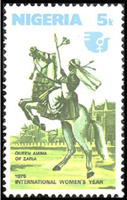
Queen Amina celebrated on a Nigerian stamp

As a toddler, Amina was already attending state business on her grandfather, the king’s laps.  At the age of 16, Amina was seen as a potential contender to her mother’s throne (Magajiya), the queen Bakwa of Turunku.  Amina started to learn the responsibilities of a queen from her mother: taking part in daily assemblies with high dignitaries of the kingdom.  Even though her mother’s reign had been one of peace and prosperity, Amina chose to learn military skills from the warriors.

Queen Bakwa died around 1566, and the Zazzau kingdom was governed by her youngest brother Karama.  During the reign of her brother, Amina emerged as principal warrior of the kingdom’s cavalry.  Her military successes brought her wealth and power.  When her brother died after ten years of reign, Amina was crowned queen of Zazzau in 1576.  During her reign, which lasted 34 years, she expanded her kingdom’s boundaries down to the Atlantic coast, she founded several cities, and personally led an army of 20,000 soldiers to numerous battles.  However, her focus was not on annexation of neighboring lands, but on forcing local rulers to accept vassal status and allow Hausa traders safe passage.

Portrait of Queen Amina

During her reign, she commanded the construction of a defensive mural around each military camp that she established.  Later, those camps evolved into prosperous cities within those walls, and some can still be seen today in northern Nigeria.  Those cities are known as walls ‘ganuwar of Amina’ or ‘Amina’s walls‘.  It is believed that Amina died in the town of Altagara in 1610. Today, Amina is remembered in Nigeria as ‘Amina, rana de Yar Bakwa ta San’ (Amina, daughter of Nikatau, woman as capable as a man).  The introduction of kola nuts into the region is often attributed to Amina.  Amina is celebrated across the Hausaland as a great warrior queen who was born to rule, and led thousands of soldiers to war.  To learn more, check out Black history heroes, History and Women, as well as the book African Princess which dedicates a chapter to this great queen.  Amina’s achievement was the closest that any ruler had come in bringing the region now known as Nigeria under a single authority.  Enjoy the video below of great African queens including Amina.