On répare le trou d’un vêtement, mais pas le trou de la bouche (Proverbe Bayombe – République Démocratique du Congo (RDC)).- Quand on a trop parlé, c’est difficile de réparer.
One can repair the hole on a garment, but not the hole of the mouth (Bayombe Proverb – Democratic Republic of Congo (DRC)). – When you have talked too much, it is difficult to repair.
Few countries in the world, apart from European and American (as if writing was only part of the western world) countries, can claim several Nobel prizes in literature. South Africa is one of those countries: with Nadine Gordimer and J.M. Coetzee.
The South African Nobel-prize-winning author Nadine Gordimer, one of the literary world’s most powerful voices against apartheid, died today at the age of 90. She passed away peacefully at her home in Johannesburg. She was the first winner of this prize for South Africa.
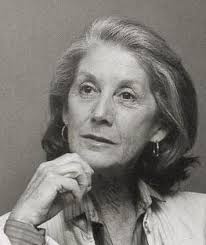
Nadine Gordimer
Born in Gauteng, South Africa, in 1923 to immigrant European parents, Gordimer was awarded the Nobel prize for literature in 1991 for novels and short stories that reflected the drama of human life and emotion in a society warped by decades of white-minority rule.
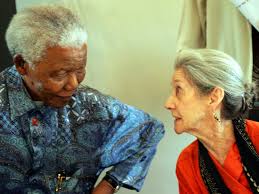
Many of her stories dealt with the themes of love, hate and friendship under the pressures of the racially segregated system that ended in 1994, when Nelson Mandela became South Africa’s first black president. She became active in the then banned African National Congress (ANC) after the arrest of her best friend Bettie du Toit in 1960, and the Sharpeville Massacre on 21 March 1960. Thereafter, she was a close friends with Mandela’s defense attorneys (Bram Fischer and George Bizos) during his 1962 trial; she actually helped Mandela edit his famous speech I am prepared to die. She was one of the first people president Mandela asked to see after his release from prison in 1990.
Nadine Gordimer and President Nelson Mandela
She was called one of the great “guerrillas of the imagination” by the poet Seamus Heaney, and a “magnificent epic writer” by the Nobel committee. Her intense, intimate prose helped expose apartheid to a global readership and continued to illuminate the brutality and beauty of her country long after the demise of the racist government. “She makes visible the extremely complicated and utterly inhuman living conditions in the world of racial segregation,” Sture Allen, permanent secretary of the Swedish Academy, said while awarding Ms. Gordimer the Nobel Prize for literature in 1991. “In this way, artistry and morality fuse.”
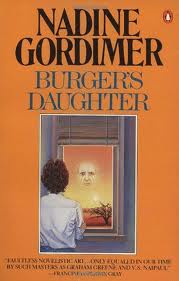
“Burger’s Daughter” by Nadine Gordimer
She had three books banned under the apartheid regime’s censorship laws, along with an anthology of poetry by black South African writers that she collected and had published. The first book to be banned was ‘A World of Strangers,’ the story of an apolitical Briton drifting into friendships with black South Africans in segregated Johannesburg in the 1950s. In 1979 Burger’s Daughter was banished from the shelves for its portrayal of a woman’s attempt to establish her own identity after her father’s death in jail makes him a political hero.
I never read any of her work, and now plan to start. Thank you to Nadine Gordimer for her brightness, and for her endless fight for freedom through her works.
After walking on the sandy beaches of Abidjan, I have often romanticized the name of such a beautiful place, and no matter how much intellectual gymnastics I did, I could never decipher its meaning. After all, I do not speak the local language, but I somehow thought that it could have been a French name with some local texture to it; but which one?
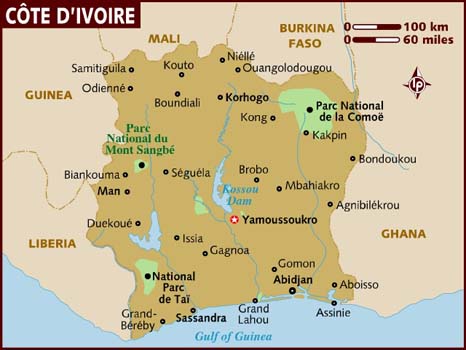
Map of Côte d’Ivoire
Well, according to oral tradition of the Ébrié people as reported in the Encyclopedic Dictionary of Côte d’Ivoire, the name “Abidjan” results from a misunderstanding. Legend states that an old man carrying branches to repair the roof of his house met a European explorer who asked him the name of the nearest village. The old man who did not speak the language of the explorer, thought that he was being asked to justify his presence in that place. Terrified by this unexpected meeting, he fled shouting “min-chan m’bidjan“, which means in the Ébrié language: “I return from cutting leaves.” The explorer, thinking that his question had been answered, recorded the name of the locale as Abidjan.
La ville d’Abidjan (source RFI)
A slightly different and less elaborate version of the legend is as such: When the first colonists asked native women the name of the place, the women misunderstood and replied “T’chan m’bi djan“: “I’ve just been cutting leaves“. Thus the name Abidjan.
Originally a fishing village, Abidjan was made the capital city of the French colony after a deadly epidemic of yellow fever decimated the French colonists in 1896 in Bassam. In 1934, Abidjan became the third capital of Côte d’Ivoire after Grand-Bassam and Bingerville. It offered more opportunities for trade expansion, particularly with its greater wharf. In 1983, the capital was moved to Yamoussoukro, the village of then-president Félix Houphouët-Boigny. However, Abidjan has remained the political and economic heart of the country.
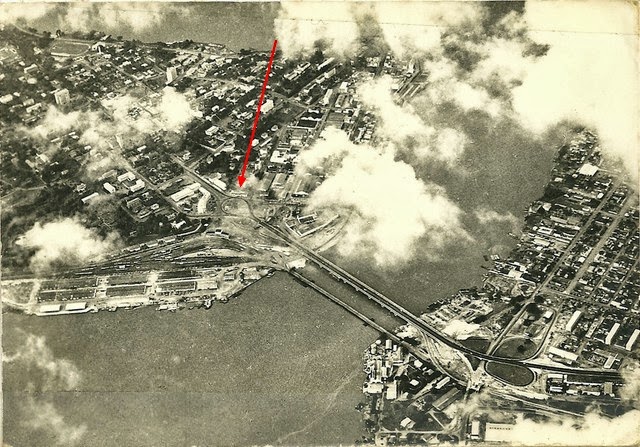
Aerial view of Abidjan (Source: raymondadrienne.blogspot.com)
Today, Abidjan is Côte d’Ivoire’s largest city, and the third largest French-speaking city in the world after Paris and Kinshasa. The city is located in the Ébrié Lagoon on several converging peninsulas and islands connected by bridges. Abidjan is considered a cultural hub for most of West Africa, and Francophone Africa in particular. It has the biggest port in West Africa, and second largest port of Africa after the Lagos port in Nigeria. With the political unrest of the past decade which reached its paroxysm in 2011 with the French army bombing strategic places in Abidjan in order to impeach President Laurent Gbagbo (including the presidential palace), the city has been destroyed, and is today going through a rebuilding phase.
Affectionately nicknamed the “Manhattan of the tropics“, “Small Manhattan“, or “Pearl of Lagoons“, because of its impressiveness, Abidjan is a unique city perfect for business tourism. The place is so beautiful, that the French once considered making Côte d’Ivoire an overseas department of France; it is not so far from it today, but that will be the subject for another day. The video below is on Côte d’Ivoire as a whole. Enjoy!
The wild animals, it is said, were once asembled at Lion’s. When Lion was asleep, Jackal persuaded Little Fox to twist a rope of ostrich sinews, in order to play Lion a trick. They took ostrich sinews, twisted them, and fastened the rope to Lion’s tail, and the other end of the rope they tied to a shrub. When Lion awoke, and saw that he was tied up, he became angry, and called the animals together. When they had assembled, Lion said (using this form of conjuration)–
“What child of his mother and father’s love, Whose mother and father’s love has tied me? ”
Then answered the animal to whom the question was first put– I, child of my mother and father’s love, I, mother and father’s love, I have not done it.
Renard / Fox
All answered the same; but when he asked Little Fox, Little Fox said– I, child of my mother and father’s love, I, mother and father’s love, have tied thee!
Then Lion tore the rope made of sinews, and ran after Little Fox. But Jackal said: “My boy, thou son of lean Mrs. Fox, thou wilt never be caught.” Truly Lion was thus beaten in running by Little Fox.
South African Folk Tales, by James A. Honey, 1910, Baker & Taylor Company.
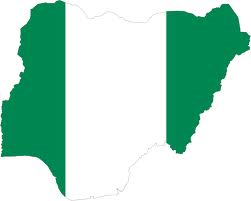
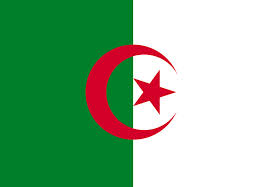
The 2014 FIFA World Cup has brought a lot of surprises thus far: the sharp exit of the defending champions Spain, the exit of Italy and England, the advances of countries like Costa Rica, Belgium, Colombia, or Switzerland into the last round of 16. Above all, what has brought joy to me, a fellow African, is the advance of two African countries for the first time in the history of the FIFA World Cup into the last round of 16: namely, Nigeriaand Algeria(never mind that their names both finish with ‘geria‘). I am glad to see that my predictions of seeing Algeria move forward into the round of 16 came true, and agreed with Maradona’s. I am also thrilled to see Nigeria (whom I had thought were in a good group and had big chances of advancing) progress.
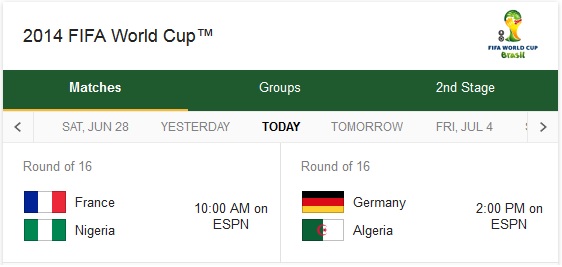
Flag of AlgeriaSchedule for 30 June 2014, FIFA World Cup Round of 16
Today, both countries will face France and Germany respectively (France – Nigeriaand Germany – Algeria). We wish them the very best as they carry the hopes of the entire continent up, and we hope to be elated by the strength of the Super Eagles of Nigeria, and the dexterity and perseverance of the Fennecs of Algeria. May the best teams win!
Quand on a qu’une lance, on ne doit pas s’en servir contre un léopard(Proverbe Bamiléké – Cameroun). – On ne s’amuse pas avec ce qu’on ne peut pas perdre sans danger grave.
When you have only one spear, do not use it against a leopard(Bamileke Proverb – Cameroon).- Do not play with what you cannot afford to lose without real danger.
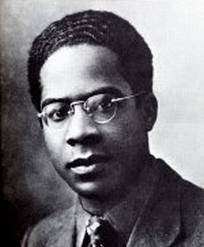
I am posting here, a poem by the great poet founder of the negritude movement, the Francophone poet Aimé Césaire from Martinique. The breadth of Césaire’s work is amazing. He has published over 100 poems. The poem “Scalp” is one of them. Enjoy!
SCALP
Il est minuit
les sorciers ne sont pas encore venus
les montagnes n’ont pas fondu
ai-je assez dit à la terre
de ne pas s’installer par crainte de l’insolation?
Me serrerai-je la gorge avec une corde faite du lierre de mes murmures?
poissons cueilleuses de l’eau et son réceptacle
c’est par-dessus vos têtes que je parle
comme les étoiles dans la bave du miel de ses mauvais rêves et la terre elle a enfanté sous nous
C’est vrai que j’ai laissé mes ongles
en pleine chair de cyclone
parmi le fracas des hannetons gros et jusqu’à faire jaillir le jaune neuf d’un sperme me jetant sous son ventre pour mesurer mon rut
Maintenant
par le sang dur du viol
entre deux criminels
je sais l’heure celui
qui meurt
celui qui s’en va
Mais un mais moi
enserré dans la touffe qui m’endort
et par la grâce des chiens
sous le vent innocent et déplisseur des lianes
héros de chasse casqué d’un oiseau d’or
SCALP
It is midnight
the sorcerers have not yet come
the mountains have not melted
have I sufficiently told the earth
not to set itself up in fear of sunstroke?
Shall I tighten my throat with a cord made from the ivy of my mutterings?
fish gatherers of water and its receptacle
it is above your heads that I speak
like the stars in the honey drool from my bad dreams and the earth it has birthed beneath us
It is true that I left my fingernails
full in the flesh of the cyclone
amongst the brawl of huge cockchafers even to making spurt a new yellow semen throwing myself under its belly to measure my rutting
Jadis, les animaux n’avaient pas de queue. Le cheval ne pouvait pas chasser les mouches, l’écureuil sans queue avait du mal à sauter de branche en branche, le renard était bien moins beau et ne parlons pas du lion!
Le sage roi des animaux, le lion, prit la décision de remédier à cette situation. Il réfléchit pendant longtemps à la façon dont il allait s’y prendre et à la fin, il fit appeler le renard pour lui demander conseil.
« Tous les animaux ne peuvent pas avoir la même queue », estima le renard.
« Je sais cela, moi aussi », répondit le lion. « Mais comment départager les animaux sans se montrer injuste ? »
Le renard réfléchit un instant, puis déclara :
« C’est simple. Ceux qui arriveront les premiers recevront les plus belles queues. »
Le lion acquiesça :
Renard
« C’est une excellente idée. Cours vite dans la forêt et préviens tous les animaux qu’ils doivent se présenter à midi, au bord du ruisseau, pour la distribution des queues. »
Le renard transmit le message et courut vite vers le ruisseau pour arriver le premier. Il fut suivi de près par le cheval, l’écureuil, le chat et le chien qui arrivent toujours les premiers quand on distribue quelque chose. Vinrent ensuite les autres animaux : l’éléphant, le cochon et le lièvre se présentèrent les derniers.
Lievre
Lorsque tous les animaux furent réunis dans la clairière, le lion se mit à distribuer les queues. Il se servit d’abord lui-même : ce fut une superbe queue, longue et dorée, terminée par un plumeau. Ensuite, le lion attribua de très belles queues bien touffues au renard et à l’écureuil. Le cheval opta pour une magnifique queue en crin. Le chien et le chat reçurent encore des queues fort présentables, mais les animaux qui arrivèrent les derniers, se trouvèrent bien démunis. L’éléphant eut une maigre cordelette avec quelques soies au bout. Il en fut si navré qu’il en porte aujourd’hui encore la trompe basse. La queue du cochon était fine comme un ver de terre. Il la fit boucler pour la rendre plus jolie. Le pauvre lièvre resta sans queue. Le chien et le chat commencèrent à se disputer pour savoir lequel d’entre eux avait la plus belle queue. À la fin, le chien attrapa le chat et lui arracha d’un coup de dents l’extrémité de la queue. Le chat s’enfuit dans l’arbre et depuis ce jour, il préfère se sauver devant le chien. Le lièvre ramassa le bout de la queue du chat et le colla sur son derrière. Ceci explique pourquoi la queue des lièvres est si petite.
















 African Heritage