BABOON, it is said, once worked bamboos, sitting on the edge of a precipice, and Lion stole upon him. Baboon, however, had fixed some round, glistening, eyelike plates on the back of his head. When, therefore, Lion crept upon him, he thought, when Baboon was looking at him, that he sat with his back towards him, and crept with all his might upon him. When, however, Baboon turned his back towards him, Lion thought that he was seen, and bid himself. Thus, when Baboon looked at him, he crept upon him.* When he was near him Baboon looked up, and Lion continued to creep upon him. Baboon said (aside), “Whilst I am looking at him he steals upon me, whilst my hollow eyes are on him.”
When at last Lion sprung at him, he lay (quickly) down upon his face, and Lion jumped over him, falling down the precipice, and was dashed to pieces.
*Whilst Baboon did this, Lion came close upon him.
South African Folk Tales, by James A. Honey, 1910, Baker & Taylor Company.
Ethiopian Emperor Fasilides is one of most remarkable rulers of Abyssinia, the ancient name of Ethiopia. A member of the Solomonic dynasty, emperor Fasilides ruled over Abyssinia from 1632 to 1667. He founded the city of Gondar in 1636 which became the capital of Abyssinia, in the northwestern part of Ethiopia. He was known as Alam Sagad or ‘To whom the world bows.’ Today, thousands bow to his work, and his footprints have marked the history of Ethiopia forever.
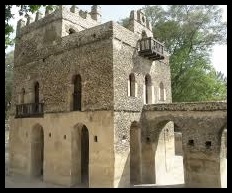
Fasilides’ Castle
Among the buildings he constructed there are the beginnings of the complex later known as Fasil Ghebbi, as well as some of the earliest of Gondar’s famous 44 churches: AdababayIyasus, Adababay Tekle Haymanot, Atatami Mikael, Gimjabet Maryam, Fit Mikael, and Fit Abbo. Fasilides is also credited with building seven stone bridges in Ethiopia. Sebara Dildiy (broken bridge in Amharic) was one of two stone bridges built over the Blue Nile River during Fasilides reign. Sebara Dildiy was later repaired during Emperor Menelik II‘s reign in 1901. Emperor Fasilides also built the Cathedral Church of St Mary of Zion at Axum. Fasilides’ church is known today as the “Old Cathedral” and stands next to a newer cathedral built by Emperor Haile Selassie.
Fasilides’ Bath
When King Fasilides made Gondar the seat of his empire in 1636, he constructed a palace that would eventually sprawl into a large complex, as succeessors added their own buildings to the compound. Set in the heart of what is now one of Ethiopia’s largest cities, the palace complex is a mixture of beautifully-preserved period architecture with European and Moorish influences, and rambling ruins. Interestingly, Fasilides’ Castle itself is the best-preserved, with its lower halls, reservoirs and steam-baths, remains of kitchens and stables, and even enclosures for leopards and lions that used to grace the grounds. The castle is located near the city center. Its structure is purely made of stone. Today, Fasilides baths are used for baptism during the Timkat festival, the epiphany, in late January; they are only filled with water for the festival. The castle can be found in Gondar, Amhara region. Fasilides’ Castle is definitely a representation of Ethiopia’s great and rich history.
I know Rudyard Kipling is not an African, but I always liked his poem ‘If‘. I first read it in secondary school, and to me it has always represented a way of living life without being too frazzled. This symbolizes a way of living, that we should all aspire to. Kipling apparently wrote it as advice to his son. There is so much stoicism in it. Enjoy!!
Today, I would like to talk about Habib Benglia, one of the pioneers of Black theater and cinema in France.
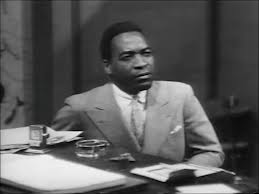
Habib Benglia was an African artist born in Oran, Algeria, on 25 August 1895. He was originally from Mali, and lived in Timbuktu throughout his childhood. He then moved to France for studies. After high school, he wanted to become an agricultural engineer. However, one evening in 1913, at the Café Riche, while describing his love for theater and having fun with his friends reciting prose, he was noticed by Régine Flory who presented him to Cora Lapercie. That same year, she made him star at the Renaissance in Le Minaret of Jacques Richepin, then he went on to play in Aphrodite by Pierre Frondaie, and L’Homme richeof Jean-José Frappa and Dupuy-Mazuel.
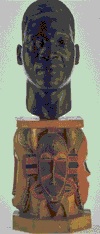
Sculpture of Habib Benglia by E. Jonchere (Source: Les Amis du Musee des annees 30)
The first world war of 1914 started, and Benglia joined the French troops as many other skirmishers (tirailleurs). Demobilized just before the end of the war, he resumed theater with Firmin Gémier, in L’Oedipe Roide Bouhélier. In 1923, he became the first black actor to star in the main role at the national French theater at the age of 27: it was in The Emperor Jones whom Gaston Baty put in scene at the Odéon. Benglia always dreamt of seeing Black theater unveiled in France, which would reveal evidence of an African/Black art. He also wrote a few plays: one of them, Un soir à Bamako (An evening in Bamako) was broadcasted in 1950. He passed away in 1960 after having starred in over hundreds of plays.
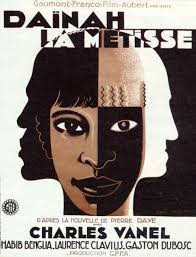
Poster of “Dainah la Metisse” (source: filmweb.pl)
Benglia was a versatile and prolific actor, who was confined to secondary and codified roles in colonial cinema, and as a result was largely ignored by critics. This was both the fate of many actors (particularly Black actors in his time), overshadowed by stars, and the result of prejudice and racism. Benglia’s roles were always very traditional. Colonial cinema, both as propaganda or exotic entertainment, made proficient use of his abilities. Originally a conveyor of stereotypes, this genre gradually evolved toward more truth and realism, but never gave Benglia the opportunity to rise to stardom. A few plays where Benglia held the main role was Dainah la Métisse, then Sola, and Les Mystères de Paris, as well as in les Enfants du Paradis.
On répare le trou d’un vêtement, mais pas le trou de la bouche (Proverbe Bayombe – République Démocratique du Congo (RDC)).- Quand on a trop parlé, c’est difficile de réparer.
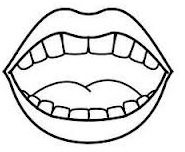
One can repair the hole on a garment, but not the hole of the mouth (Bayombe Proverb – Democratic Republic of Congo (DRC)). – When you have talked too much, it is difficult to repair.



















 African Heritage