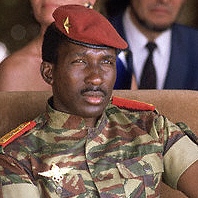
Here is the complete text of a hand-written speech that the revolutionary Burkina Faso President and African statesman Thomas Sankara was set to deliver on the evening of the day he was assassinated, October 15, 1987. Enjoy this rare jewel! The original in French is on ThomasSankara.net, while the translated English version appeared on Pambazuka.
=========
Dear Comrades,
The Revolution’s prestige, and the confidence with which the masses have devoted themselves, has suffered a serious shock. The consequences are a remarkable decline in enthusiasm for the revolution amongst activists, a serious decrease in the commitment, determination, and mobilization of our grassroots base; finally, distrust and suspicion everywhere and factionalism amongst our leadership.
What are the causes of this?
Burkina Faso
There are, on one hand, significant questions which could divide us pertaining to the operating structures and the internal functioning of the CNR based on ideological positions. On the other hand, there are questions regarding the relationships between the principal actors, as each of us is a leader. However, as important as ideological and organisational questions are, they are shown to be less important in our current situation. Indeed, at the soul of any organisation, there is a clash of opposites followed by union of these same opposites. The unity of these opposites is always academic, it is never absolute; it is both relative and temporary. “The unity of opposites is consequently an absolute, exactly as development and motion are absolutes”. This is why balance itself is temporary. It can be questioned at any time. It is our responsibility to preserve it as long as possible, to restore it each time it has been threatened or broken. In the case of organizational and ideological questions, we have benefited each time that someone considered it necessary to raise an opinion different from mine, to defend a position different than mine; you did this with freedom and confidence. These I have adopted and implemented, along with advice, suggestions, and recommendations. Moreover, resolution of disputes between men is always simple when trust exists. This means that as long as the revolution is governed by principles, open debate, criticism and self-criticism, it will succeed in resolving any misunderstandings, provided that trust is maintained. Continue reading “Thomas Sankara: the Speech he would have given on 15 Oct 1987”→
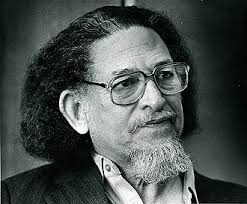
Friends, today, I want to introduce you to a poem by the great South African author Dennis Brutus. Dennis Brutus broke rocks next to Nelson Mandela when they were imprisoned together on the notorious Robben Island. He spent 18 months there. His crime, like Mandela’s, was fighting the injustice of racism, and challenging South Africa’s apartheid regime. His weapons were his words: soaring, searing, poetic. He was banned, he was censored, he was shot. However, this poet’s commitment and activism, his advocacy on behalf of the poor, never flagged. Brutus inspired, guided and rallied people toward the fight for justice in the 21st century; his poetry was his way of protesting against the injustices of the apartheid regime and the world, while celebrating the freedoms all men deserved.
The poem below poem is a call to friendship without borders, freedom, love, and peace. Enjoy!!!
There will come a time
There will come a time we believe
When the shape of the planet
and the divisions of the land
Will be less important;
We will be caught in a glow of friendship
a red star of hope
will illuminate our lives
A star of hope
A star of joy
A star of freedom
IT is said that once Sun was on earth, and caught Horse to ride it. But it was unable to bear his weight, and therefore Ox took the place of Horse, and carried Sun on its back. Since that time Horse is cursed in these words, because it could not carry Sun’s weight:
Le soleil / The sun
“From to-day thou shalt have a (certain) time of dying. This is thy curse, that thou hast a (certain) time of dying. And day and night shalt thou eat, But the desire of thy heart shall not be at rest, Though thou grazest till morning and again until sunset. Behold, this is the judgment which I pass upon thee,” said Sun.
Since that day Horse’s (certain) time of dying commenced.
South African Folk Tales, by James A. Honey, 1910, Baker & Taylor Company.
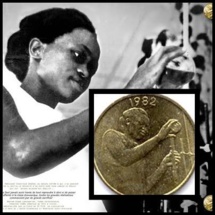
Mme Dicoh Mariam Konan, 1ere femme chimiste de Cote d’Ivoire, sur la piece de monnaie avec ses burettes
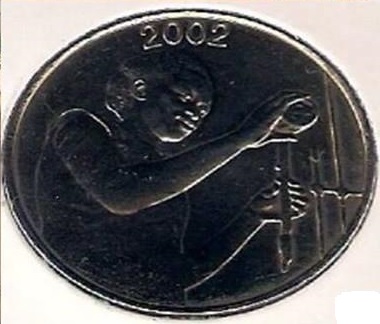
Je suis sûre que si vous êtes de l’Afrique de l’Ouest, et de la zone CFA, vous êtes certainement tombée sur cette pièce de 25FCFA sur laquelle une femme est representée. Eh bien cette femme-là est la toute première femme chimiste de la Côte d’Ivoire, Mme Konan née Dicoh Mariam. Elle est gravée sur la pièce de 25f CFA avec une burette de chimiste.
On utilise cette pièce sans même se demander qui est cette personne qui se trouve dessus… ou même ce qu’elle fait, ou ce qu’elle tient en main.
Mme Konan, une brillante chimiste qui a su manier plein de formules chimiques est le genre de personnes dont on doit parler; elle mérite bien plus qu’un prix d’excellence. C’est un exemple pour toutes les filles de l’Afrique, et du monde entier, parce qu’elle a su briller par son ambition et sa motivation. Chapeau à elle et à toutes les autres femmes en Afrique qu’on ne nomme pas, car elle est une femme très battante et remarquable. Un modèle de femme dont on doit se souvenir dans le futur de génération en génération. Waou… premiere femme chimiste de tout un pays… quel merveilleux exemple de détermination!
Aujourd’hui, Mme Konan est propriétaire de l’espace gastronomique ” La Gorge d’Or,” à Abidjan. Elle est une fierté pour toute l’Afrique. Longue vie à cette femme intelligente et nous espèrons en apprendre plus sur toutes les femmes brillantes du continent.
=======
25FCFA coin
If you are from West Africa, and from the CFA economic zone, you have probably come across the 25 FCFA coin on which a woman is engraved. That woman happens to be the first woman chemist of Côte d’Ivoire, Mrs Konan Dicoh Mariam. She is engraved on the 25 FCFA coin with a burette.
People use this coin without wondering who is on it, or even what she is doing, or even what she is holding.
Mariam Dicoh Konan
Mrs Konan, a bright chemist who was able to handle a lot of chemistry formulas, is the kind of people we should be talking about; she deserves an excellence prize. She is an example for all the girls and women of Africa, and the world, because she was able to shine by her ambition and motivation. I raise my hat to her and all other women who remain unnamed, because she is a strong and remarkable woman. She is a model who should be remembered in the future by all generations. Wow… first female chemist of an entire country… such a marvelous example of determination!
Today, Mrs Konan is the owner of a gastronomical space ‘La Gorge d’Or‘ in Abidjan. She makes all Africans proud. Long life to this intelligent woman, and we hope to learn more about all the other bright women of the continent.
I would like to share with you some quotes by Steve Biko himself. When I read Biko’s words, I realize that he was a true African leader who wanted good for all; he was really ahead of his time. I have also added, at the end, a documentary ‘The Return of Biko‘ by Jeff Ogola. Enjoy!
==========
“The greatest weapon in the hand of the oppressor is the mind of the oppressed.”Speech in Cape Town, 1971
“It is better to die for an idea that will live, than to live for an idea that will die.”
“At the time of his death, Biko had a wife and three children for which he left a letter that stated in one part: “I’ve devoted my life to see equality for blacks, and at the same time, I’ve denied the needs of my family. Please understand that I take these actions, not out of selfishness or arrogance, but to preserve a South Africa worth living in for blacks and whites.”
“The basic tenet of black consciousness is thatthe black man must reject all value systems that seek to make him a foreigner in the country of his birth and reduce his basic human dignity.”From Steve Biko’s evidence given at the SASO/BPC trial, 3 May 1976
“In time, we shall be in a position to bestow on South Africathe greatest possible gift – a more human face.“
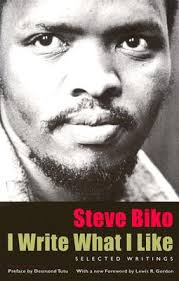
‘I Write What I Like’ by Steve Biko
“Merely by describing yourself as black you have started on a road towards emancipation, you have committed yourself to fight against all forces that seek to use your blackness as a stamp that marks you out as a subservient being.”The Definition of Black Consciousness, I Write What I Like, 1978.
“Black man, you are on your own.”Slogan coined by Steve Biko for the South African Student’s Organization, SASO.
“We do not want to be reminded that it is we, the indigenous people, who are poor and exploited in the land of our birth. These are concepts which the Black Consciousness approach wishes to eradicate from the black man’s mind before our society is driven to chaos by irresponsible people from Coca-cola and hamburger cultural backgrounds.”The Quest for a True Humanity, I Write What I Like, 1978.
“It becomes more necessary to see the truth as it is if you realize thatthe only vehicle for change are these people who have lost their personality. The first step therefore is to make the black man come to himself; to pump back life into his empty shell; to infuse him with pride and dignity, to remind him of his complicity in the crime of allowing himself to be misused and therefore letting evil reign supreme in the country of his birth.“We Blacks, I Write What I Like, 1978.
Black Consciouness Movement flag
“You are either alive and proud or you are dead, and when you are dead, you can’t care anyway.”On Death, I Write What I Like, 1978
“Black Consciousness is an attitude of the mind and a way of life, the most positive call to emanate from the black world for a long time. Its essence is the realization by the black man of the need to rally together with his brothers around the cause of their oppression – the blackness of their skin – and to operate as a group to rid themselves of the shackles that bind them to perpetual servitude.“The Quest for a True Humanity, I Write What I Like, 1978.
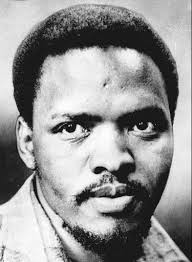
Stephen (Steve) Bantu Biko was born on 18 December 1946 in Ginsberg township, in present-day Eastern Cape, in South Africa. Biko was the third of 4 children, and belonged to the Xhosa ethnic group. He was orphaned at the tender age of 4, after his father passing. As a child, he attended Brownlee Primary School and Charles Morgan Higher Primary School. He was sent to Lovedale High School in 1964, a prestigious boarding school in Alice, Eastern Cape, where his older brother Khaya had previously been studying. During the apartheid era, with no freedom of association protection for non-white South Africans, Biko would often get expelled from school for his political views. He was influenced by Frantz Fanon‘s and Aime Cesaire‘s works, and like Fanon, he first started as a medical doctor, before turning to politics.
Black Consciouness Movement flag
Steve Biko was not alone in forging the Black Consciousness Movement. He was nevertheless its most prominent leader, who with others, guided the movement of student discontent into a political force unprecedented in the history of South Africa. Can you imagine that: all alone they created a force that scared the apartheid regime, and started it on its end. Biko and his peers were responding to developments that emerged at the height of the hideous apartheid regime. This culminated with the Soweto uprising of 1976.
The Black Consciousness movement argued that blacks had to overcome the feelings of inferiority instilled into them by 300 years of domination, the “oppression within“, before they could deal with whites as equals. “It [BC] seeks to infuse the black community with a new-found pride in themselves, their efforts, their value systems, their culture, their religion and their outlook to life,” Biko explained in 1971.
Steve Biko was a very charismatic, tall, handsome, and articulate man. Once asked by a judge “Why do you call yourself black, when your skin is brown?” Biko replied “Why do you call yourself white, when you are actually pink?” – he bore himself with rare confidence that showed no hint of any “oppression within.” Remember his famous phrase “Black is Beautiful“, which was an inspiration to the civil rights movement in the USA, and to many other movements across the globe.
‘I Write What I Like’ by Steve Biko
In order for Black People to achieve their freedom being political and economical, Steve Biko believed that they should rally together; hence he said: “The realization by the Black man of the need to rally together with his brothers around the cause of their oppression – the blackness of their skin – and to operate as a group in order to rid themselves of the shackles that bind them to perpetual servitude.”
Biko understood that the system we are facing is not just a matter of laws and policies that suppresses us, he knew that the system seeks to undermine our thinking, ideas, values and beliefs, thus he said: “The most potent weapon in the hands of the oppressor is the mind of the oppressed.”
On 18 August 1977, Steve Biko was arrested at a police roadblock under the Terrorism Act No 83 of 1967 and interrogated by officers of the Port Elizabeth security police including Harold Snyman and Gideon Nieuwoudt. This interrogation took place in the Police Room 619 of the Sanlam Building in Port Elizabeth. The interrogation lasted twenty-two hours and included torture and beatings resulting in a coma. He suffered a major head injury while in police custody at the Walmer Police Station, in a suburb of Port Elizabeth, and was chained to a window grille for a day. On 11 September 1977, police loaded him in the back of a Land Rover, naked and restrained in manacles, and began the 1100 km drive to Pretoria to take him to a prison with hospital facilities. He died shortly after arrival at the Pretoria prison, on 12 September. The police claimed (and the apartheid government) his death was the result of an extended hunger strike, but an autopsy revealed multiple bruises and abrasions and that he ultimately succumbed to a brain hemorrhage from the massive injuries to the head, which many saw as strong evidence that he had been brutally clubbed by his captors.
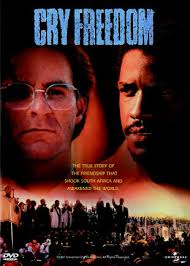
‘Cry Freedom’ the movie on Steve Biko
Biko believed in the unity of the oppressed, he also knew we should constantly educate each other on what is happening in our society. Today, Biko’s views could be applied to almost every society where there are oppressed people, oppressed by unfair laws, unfair economics that favors extreme greed, forced into poverty, and dehumanization.
I watched the movie Cry Freedom which talked about Biko’s life, and also about his journalist friend Donald Woods who published the pictures of Biko’s beaten body after his death, thus showing to the entire world that he had been brutally murdered by the South African police. I do recommend it, the main actor is none other than Denzel Washington. To learn more about Biko, you could read his own book I Write What I Like, or the autobiographic book Biko by Donald Woods. In 1980 the singer Peter Gabriel had a world hit titled Biko, in which he sang: “You can blow out a candle/ But you can’t blow out a fire/ Once the flames begin to catch/ The wind will blow it higher.” Let us all, keep the fire of Steve Biko. Enjoy this rare video of Steve Biko talking!













 African Heritage