To all my precious queens out there, I had to share this dear song. The lyrics are simply out of this world, and the ladies in the video just too beautiful. I raise my hat to 2Face Idibia for capturing the African beauty so well. I have included parts of the lyrics below; for the full version, go here: Enjoy!
‘African Queen’ by 2Face Idibia
Just like the sun, lights up the earth, you light up my life The only one, I’ve ever seen with a smile so bright And just yesterday, you came around my way
And changed my whole scenery with your astonishing beauty
Ah, you gonna make a brother sing, You ordinary thing, a supernatural being,
I know you are just brighter than the moon Brighter than the star, I love you just the way you are.
And you are my African Queen, the girl of my dreams. You take me where I’ve never been You make my heart go ting-a-ling-a-ling, oh ahh You are my African Queen, the girl of my dreams And you remind me of a thing And that is the African beauty yahhh
… Out of a million you stand as one The outstanding one I look into your eyes, girl what I see is paradise,
…
So black so beautiful
… I love you, ooohhh yeah, my African Queen, I Love you, I love you
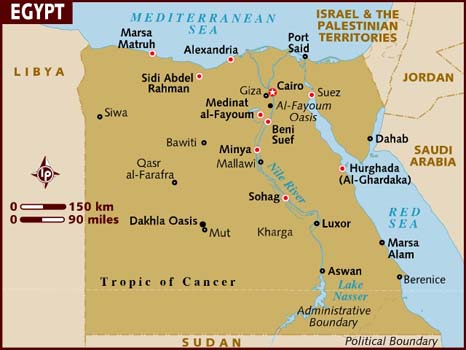
Dear all, today, I would like to talk about the city of Cairo, the capital of Egypt. Have you ever wondered what the name of Africa‘s second most populous city, after Lagos, stood for?
Old Cairo, ca early 1900s, Fustat
Well, Cairo’s official name is al-Qāhirah, which means literally: “Place or Camp of Mars“, in reference to the fact that the planet was rising at the time of the city’s foundation as well as, “the Vanquisher“; “the Conqueror“; “the Victorious” or, “the Strong” (al-Qahira) in reference to the much awaited Caliph Al-Mu’izz li-Din Allah who arrived from the old Fatimid capital of Mahdia in 973 AD to the city. “The Victorious” is often quoted as the most popular meaning of the name Cairo. The Egyptian name for Cairo is said to be: Khere-Ohe, meaning: “The Place of Combat“, supposedly, in reference to a battle which took place between the Gods Seth and Horus. Sometimes the city is informally also referred to as كايروKayro[ˈkæjɾo]. It is also called Umm al-Dunya, meaning “the mother of the world“.
Modern-day Cairo
Cairo is located on the shores of the Nile river, as well as on several adjacent islands in the north of Egypt. To the west of the city is Giza, and its ancient necropolis of Memphis on the Giza plateau, with its three great pyramids among which the Great Pyramid of Cheops and the Great Sphinx. The area around present-day Cairo, especially Memphis, had long been a focal point of Ancient Egypt, its pharaohs, and its rich culture, due to its strategic location upstream from the Nile Delta. However, the origins of modern-day Cairo are generally traced to a series of settlements in the first millenium, as Memphis’ importance was declining. In the 4th century AD, the Romans established a fortress town, known as Babylon, along the east bank of the Nile. This fortress remains the oldest structure in the city to this day. Later on, the Caliph al-Mu’izz li Din Allah of the Fatimid dynasty moved his capital from Mahdia in Tunisia to Cairo in 973; and gave the city its present name, al-Qahira(“The Victorious“). Cairo remained the capital through the end of the Fatimid dynasty 200 years later, and has remained the capital of Egypt through the Ottoman rule, and into the modern era.
The Great Sphinx of Giza
Indeed, Cairo’s life has been quite victorious. Egypt is the land of so many rich civilizations: the great Pharaohs of Egypt, the Greeks, Babylonians, Romans, Muslims with the introduction of Islam; thus Cairo inherited from this wealth and has been a great melting pot. Egypt as a whole, and Cairo in particular, is like an open museum with monuments reflecting different periods of the world’s history. As Africa’s second largest city, Cairo is a vibrant city, with the oldest and largest film and music industries in the Arab world, and the world’s second oldest institution of higher learning, al-Azhar University founded in 969 AD.
Please enjoy this great city, Cairo, the Victorious, and hopefully think of visiting it.
I liked this poem “Mother to Son” by Langston Hughes… although it is a bit bitter, it is a mother advising her son on life. Enjoy!
=======
Mother to Son
Well, son, I’ll tell you: Life for me ain’t been no crystal stair. It’s had tacks in it, And splinters, And boards torn up, And places with no carpet on the floor— Bare. But all the time I’se been a-climbin’ on, And reachin’ landin’s, And turnin’ corners, And sometimes goin’ in the dark Where there ain’t been no light. So, boy, don’t you turn back. Don’t you set down on the steps. ‘Cause you finds it’s kinder hard. Don’t you fall now— For I’se still goin’, honey, I’se still climbin’, And life for me ain’t been no crystal stair.
The Adinkra symbols are believed to originate in Gyaman, a former kingdom in modern day Côte d’Ivoire. According to an Ashanti (Asante) legend, Adinkra was the name of a king of the Gyaman kingdom, Nana Kofi Adinkra. King Adinkra was defeated and captured in a battle. According to the legend, Nana Adinkra wore patterned cloth, which was interpreted as a way of expressing his sorrow on being taken to Kumasi, the capital of Asante. He was finally killed and his territory was annexed to the kingdom of Asante. The Asante people, around the 19th century, took to painting of traditional symbols of the Gyamans onto cloth, a tradition which has remained to this day.
Adinkra work, 1825
The arrival of the adinkra in Akan culture seems to date as far back as 1817, when the English T.E. Bowdich collected a piece of adinkra cotton cloth from the city of Kumasi. The patterns on it were printed using carved calabash stamps and a vegetable-based dye. The cloth featured fifteen stamped symbols, including nsroma(stars), dono ntoasuo (double Dono drums), and diamonds, and is currently hosted at the British Museum in London.
Sankofa symbol
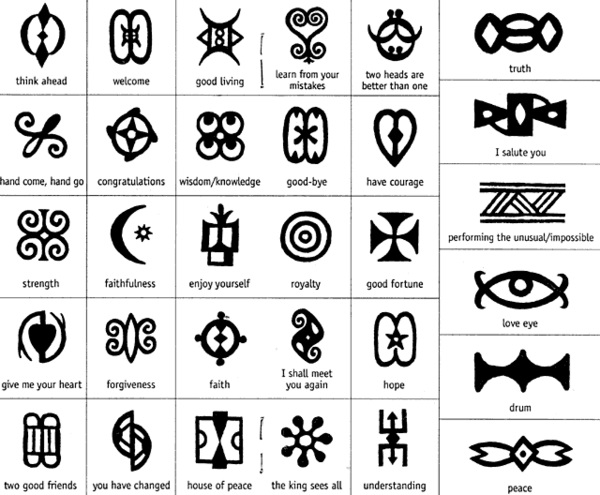
Adinkra symbols are visual representation of conceptsand aphorism developed by the Akan people of Ghana. Adinkra symbols are extensively used in fabrics, pottery, logos, and advertising. They can also be found on architectural buildings, as well as on traditional Akan gold weights, and sculptures as well as stools used for traditional rituals. The adinkra symbols are not just decorative objects, or drawings, but actual messages conveying ancient traditional wisdom relevant to aspects of life or the environment. A lot of the Adinkra symbols have meanings linked to proverbs, such as the sankofa symbol. Sankofa, in the Twi language, translates in English to ” reach back and get it” (san – to return; ko – to go; fa – to look, to seek and take) or the Adinkra symbol of a bird with its head turned backwards taking an egg off its back, or of a stylised heart shape. It is often associated with the proverb, “Se wo were fi na wosankofa a yenkyi,” which translates “It is not wrong to go back for that which you have forgotten.” Other Adinkra symbols depict historical events, human behavior and attitudes, animal behavior, plant life, and objects’ shapes.
Adinkra means ‘goodbye’ or ‘farewell’ in the Twi language of the Akan ethnic group, to which the Asante belong. No wonder the Akan people, and particularly the Asante, wore clothes decorated with Adinkra symbols mostly for funerals as a way to show their sorrow, and to bid farewell to the deceased.
Some Adinkra symbols
Adinkra cloths were traditionally only worn by royalty and spiritual leaders for funerals and special occasions. They were also hand printed on undyed, red, dark brown, or black hand-woven cotton fabric depending on the occasion and the wearer’s status. Today, adinkra is worn by anyone, women, men or children, and it is frequently mass-produced on brighter colored fabrics. The 3 most important funerary Adinkra are: the dark – brown (kuntunkuni), the brick – red (kobene), and the black (brisi). There are however, other forms of which cannot be properly called mourning cloth. Their bright and light backgrounds classify them as KwasiadaAdinkra or Sunday Adinkra meaning fancy clothes which cannot be suitable for funerary contents but appropriate for most festive occasions or even daily wear.
Adinkra symbols and their meaning
The center of traditional production of adinkra cloth is Ntonso, 20 km northwest of Kumasi, the city where the Englishman was first given it in 1817. Dark Adinkra aduro pigment for the stamping is made in Ntonso, by soaking, pulverizing, and boiling the inner bark and roots of the badie tree (Bridelia ferruginea) in water over a wood fire. Once the dark color is released, the mixture is strained, and then boiled for several more hours until it thickens. The stamps are carved out of the bottom of a calabash piece, and measure on average 5 to 8 cm2.
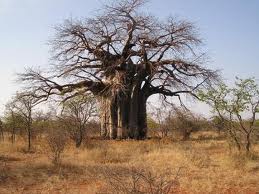
BABOON, it is said, once worked bamboos, sitting on the edge of a precipice, and Lion stole upon him. Baboon, however, had fixed some round, glistening, eyelike plates on the back of his head. When, therefore, Lion crept upon him, he thought, when Baboon was looking at him, that he sat with his back towards him, and crept with all his might upon him. When, however, Baboon turned his back towards him, Lion thought that he was seen, and bid himself. Thus, when Baboon looked at him, he crept upon him.* When he was near him Baboon looked up, and Lion continued to creep upon him. Baboon said (aside), “Whilst I am looking at him he steals upon me, whilst my hollow eyes are on him.”
When at last Lion sprung at him, he lay (quickly) down upon his face, and Lion jumped over him, falling down the precipice, and was dashed to pieces.
*Whilst Baboon did this, Lion came close upon him.
South African Folk Tales, by James A. Honey, 1910, Baker & Taylor Company.
Ethiopian Emperor Fasilides is one of most remarkable rulers of Abyssinia, the ancient name of Ethiopia. A member of the Solomonic dynasty, emperor Fasilides ruled over Abyssinia from 1632 to 1667. He founded the city of Gondar in 1636 which became the capital of Abyssinia, in the northwestern part of Ethiopia. He was known as Alam Sagad or ‘To whom the world bows.’ Today, thousands bow to his work, and his footprints have marked the history of Ethiopia forever.
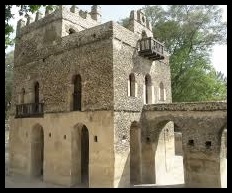
Fasilides’ Castle
Among the buildings he constructed there are the beginnings of the complex later known as Fasil Ghebbi, as well as some of the earliest of Gondar’s famous 44 churches: AdababayIyasus, Adababay Tekle Haymanot, Atatami Mikael, Gimjabet Maryam, Fit Mikael, and Fit Abbo. Fasilides is also credited with building seven stone bridges in Ethiopia. Sebara Dildiy (broken bridge in Amharic) was one of two stone bridges built over the Blue Nile River during Fasilides reign. Sebara Dildiy was later repaired during Emperor Menelik II‘s reign in 1901. Emperor Fasilides also built the Cathedral Church of St Mary of Zion at Axum. Fasilides’ church is known today as the “Old Cathedral” and stands next to a newer cathedral built by Emperor Haile Selassie.
Fasilides’ Bath
When King Fasilides made Gondar the seat of his empire in 1636, he constructed a palace that would eventually sprawl into a large complex, as succeessors added their own buildings to the compound. Set in the heart of what is now one of Ethiopia’s largest cities, the palace complex is a mixture of beautifully-preserved period architecture with European and Moorish influences, and rambling ruins. Interestingly, Fasilides’ Castle itself is the best-preserved, with its lower halls, reservoirs and steam-baths, remains of kitchens and stables, and even enclosures for leopards and lions that used to grace the grounds. The castle is located near the city center. Its structure is purely made of stone. Today, Fasilides baths are used for baptism during the Timkat festival, the epiphany, in late January; they are only filled with water for the festival. The castle can be found in Gondar, Amhara region. Fasilides’ Castle is definitely a representation of Ethiopia’s great and rich history.















 African Heritage