Ethiopia is known as the cradle of humanity, but also as one of the best stables for long distance runners in the world. Ethiopia has produced a lot of super stars of the long distance running, but one who stands out above all is Haile Gebrselassie, the king of the distance. As a child, I remember being glued to the TV waiting to watch Haile’s performances. It was like watching a maestro at work. I loved seeing him run the whole 9600 m, then sprint through the last 200-400 m like he had just started the race. Gebrselassie has inspired me, and thousands of youths to run. We have all dreamed of running the distance the way he ran.
Haile Gebrselassie, of Ethiopia, defeating Paul Tergat of Kenya in the 10000 m run at the Sydney 2000 Olympics in a historic finish.
So it is with sadness that I learnt of Gebrselassie’s retirement from competitive running. I am delighted to have had a chance to see him in his prime years, and watch him transition from 10000 m to marathon running, and there still express perfection. Truly, everything he did in his running was done with perfection, striving to be the very best every stride he took, and that is the message to everyone out there: strive for perfection, strive to do the very best you can in everything you do, every single day. To that effect, Gebrselassie said: “You need three things to win: discipline, hard work, and, before everything commitment. No one will make it without those three, sport teaches you that;” and “When you run the marathon, you run against the distance, not against the other runners, and not against time.” I am leaving you with the article I wrote three years ago about him, and with this great video on some of his accomplishments.
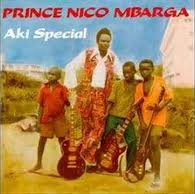
To celebrate Mother’s day this Sunday, I just wanted to bring back “Sweet Mother” by Prince Nico Mbarga. “SweetMother” is one of the most popular songs on the African continent, ahead of Miriam Makeba‘s “Malaika“, Franco‘s “Mario“, and Fela Kuti‘s “Lady“. What is so special about this song, is that it is an ode to all our precious mothers, it is often called Africa’s anthem sung by a child to his mother. It is a highlife song sung by Prince Nico Mbarga and his group Rocafil Jazz International, a Cameroonian-Nigerian artist, and the song has rocked many on the continent; Sung in Pidgin English, “Sweet Mother” became one of the top sellers in the history of Nigerian music. It was voted as Africa’s favorite song by BBC in 2004, and many other programs. So, to all the mothers out there, Happy Mother’s Day and enjoy “Sweet Mother“!!!
“Sweet Mother“ by Prince Nico Mbarga
Sweet Mother Sweet mother I no go forget you for the suffer wey you suffer for me.
Sweet mother I no go forget you for the suffer wey you suffer for me.
When I dey cry, my mother go carry me she go say, my pikin, wetin you dey cry ye, ye, stop stop, stop stop make you no cry again oh.
When I won sleep, my mother go pet me, she go lie me well well for bed, she cover me cloth, sing me to sleep, sleep sleep my pikin oh.
When I dey hungry, my mother go run up and down. she go find me something when I go chop oh.
Sweet mother I no go forget you for the suffer wey you suffer for me
When I dey sick, my mother go cry, cry, cry, she go say instead when I go die make she die.
O, she go beg God, God help me, God help, my pikin oh.
If I no sleep, my mother no go sleep, if I no chop, my mother no go chop, she no dey tire oh.
Sweet mother I no go forget you, for the suffer wey you suffer for me.
You fit get another wife, you fit get another husband, but you fit get another mother? No!
And if I forget you, therefore I forget my life and the air I breathe.
And then on to you men, forget, verily, forget your mother, for if you forget your mother you’ve lost your life.
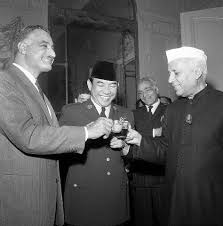
Nasser, Sukarno, and Nehru celebrating the success of the conference in 1955
As the world marks the 60-year-anniversary of the Conference of Bandung, the real turning point in the history of decolonization for Asian and African countries, I found this article on Pambazuka particularly relevant. One question still remains: has anything changed 60 years later? Do we need another Bandung Conference? Is the world a better place for the ‘weaker’ countries? Enjoy! For the full article, go to Pambazuka (pour une lecture en francais, aller sur Voltaire).
============
One of the key outcomes from the Bandung Conference [in 1955] was the Afro-Asian hope to open the opportunity for the Global South representing largely Asian, African, Latin American and Oceania to have a voice in world affairs. The creation of a non-alignment space to seek freedom from joining either the USA or the USSR camp was a clear objective. The choice to pursue agency to realize full independence from all forms of colonialism, which much of Africa was still in, and the urgent need to deal with the risk of neo-colonialism by the recognition and appreciation to strengthen the formally independent Asian countries to remain free appeared to have motivated the Bandung gathering. The Bandung spirit and purpose was primarily driven to bring about a total post-colonial condition by removing the penetrability of the African, Asian, Oceania and Latin American peoples by opening the non-alignment route to independence and freedom. The objective was to try to identify and pursue ways and strategies of development along a decolonizing trajectory, free from the dictation of either the USA dominated world order or the attempt by the ex-USSR through the Cold War to create an alternative non-capitalist-driven world order.
Bandung Conference – 1955
Though in many ways the 1955 conference in Bandung, Indonesia was a turning point for attempting to construct a post-colonial international political order; we still live in a world where imperialism, colonialism, war, exploitation, injustice and unfairness continue to complicate the contemporary world political economic space. What was loudly voiced at Bandung was the anti-colonial spirit and the aspiration for building a world order that appreciates rather than ignores the Global South and the newly growing numbers of independent countries from colonialism still remain largely unfulfilled. Instead of decoloniality prevailing we have neo-colonialism penetrating most of the Global South. The state and condition of post-coloniality is still waiting to be realized. We need a new and revitalized Bandung Conference spirit and a strong Global South to put on the agenda a total post-colonial reality to guide the architecture of new global world re-order. Continue reading “The Conference of Bandung – 60 years later”→
Ne crachez pas en l’air, sinon la salive retombera sur vous(Proverbe Bakusu – République Démocratique du Congo). – Ne vous exposez pas au danger.
Do not spit up in the air, otherwise, the saliva will fall back on you(Bakusu Proverb – Democratic Republic of Congo). – Do not expose yourself to danger.
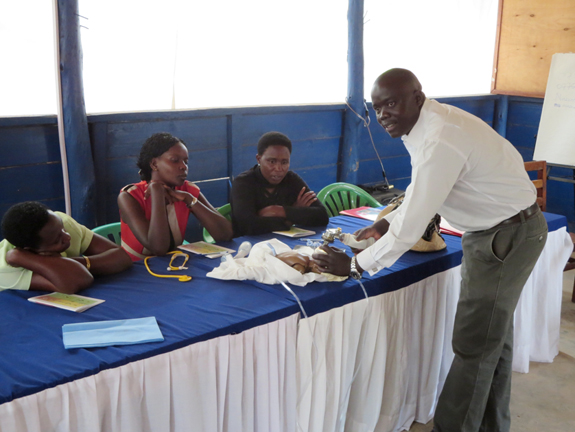
Dr. Santorino Data demonstrating the device in Uganda (AIR Project)
What is the wish of any mother who has just given birth to a baby, after lengthy hours of labor? To hear that child cry while taking his/her first breath of air. Any parent, and medical staff present, anxiously awaits for that child’s first cry, and sometimes the child needs help with that. It is said that 10 million babies per year do not breathe immediately, while 6 million babies require basic neonatal resuscitation, and 3 million do not survive past their first day of life, and at least 1 million die each year due to breathing issues. Well, a doctor in Uganda, Dr. Santorino Data, has created the Augmented Infant Resuscitator (AIR), an inexpensive add-on device used to improve emergency ventilation, to help newborn babies who are having difficulty taking their first breath. The device monitors manual ventilation to provide real-time feedback on ventilation technique/quality and common errors such as leakage between the face and mask, airway blockage and incorrect pace or volume. This will give instant feedback to the health workers who are helping the child breathe, and will allow them to correct any mistakes instantly.
The Augmented Infant Resuscitator (AIR) – (AIR Project/ MIT D-Lab)
Well, check out this article on BBC which highlights Dr. Data’s work, and his partnership with a team of medical doctors at Massachusetts General Hospital to improve the chances for more newborns around the globe to take their first breath of fresh AIR.
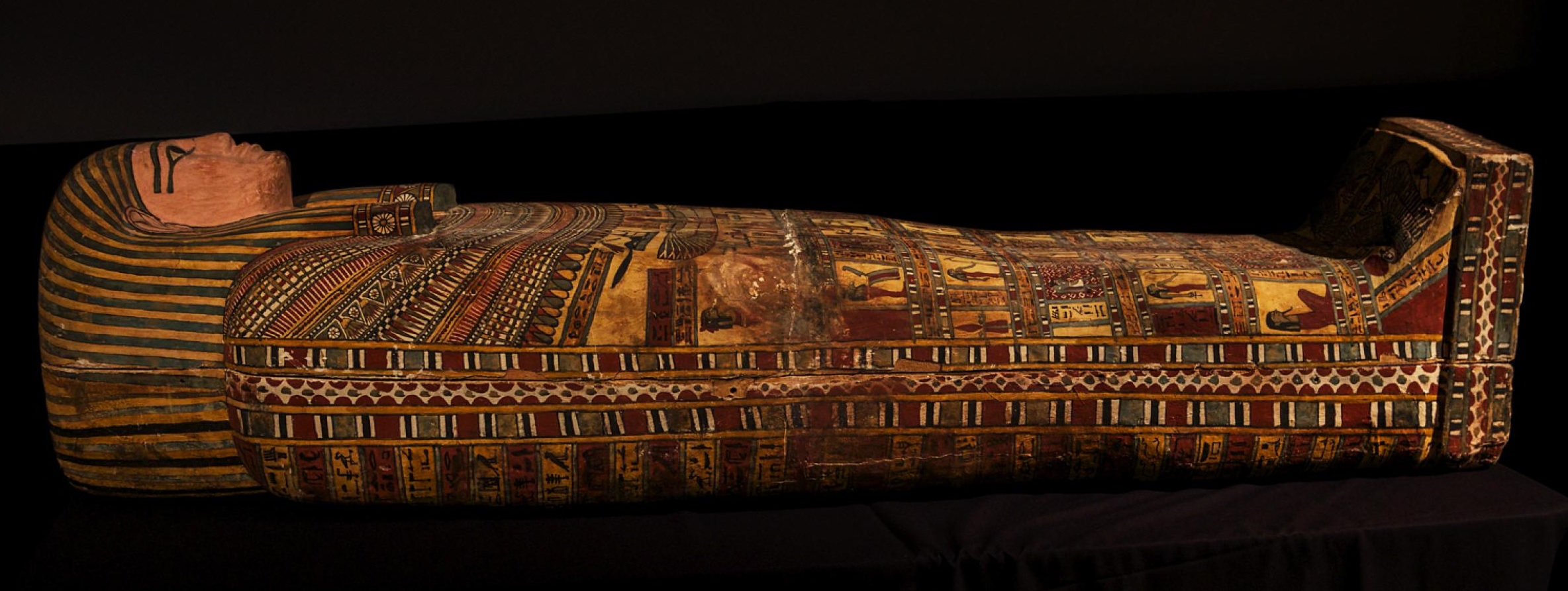
Coffin of Shesepamuntayesher, mummified 2600 years ago (Source: National Geographic)
It is true: some ancient Egyptian artifacts smuggled into the US are returning home. For many years, people looted the graves of pharaohs in Egypt and smuggled their finds by express shipping to the US (and other countries – particularly in Europe). Excerpt of an article in National Geographic reads:
“Some 2,600 years ago, an Egyptian woman named Shesepamuntayesher was mummified and laid to rest in an elaborate three-part coffin to ensure the continuation of her life force and the beginning of an eternal afterlife.
Stylized face of Shesepamuntayesher depicted on her coffin (Source: National Geographic)
Shesepamuntayesher’s afterlife has unfortunately included a trip to Dubai, in the United Arab Emirates, and an ignominious stop in a garage in Brooklyn, New York. On Wednesday, thanks to a five-year investigation by U.S. Homeland Security Investigations (HSI) and Immigration and Customs Enforcement (ICE), the empty sarcophagus that once cradled her mummy is being returned to Egypt, where it will be housed in the Grand Egyptian Museum in Cairo.”
The damages done to Egyptian culture, and many African cultures, by art smugglers and looters cannot be quantified. It is important to fight to preserve these ancient cultures which tell us so much more about some of the world’s greatest civilizations, and about humanity in general. So it feels good to see art going back to their land of origin: like the looted art from Benin Kingdom which was returned to its people, or the great Obelisk of Axum, which was stolen by the Italians in 1935, and later returned after countless demands from the Ethiopian government in 2005. Please do check out the rest of the article on National Geographic.
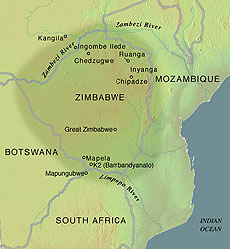
Map of the area including the Kingdom of Mapungubwe and Great Zimbabwe to the north- and the whole Kingdom of Zimbabwe (sahistory.org.za)
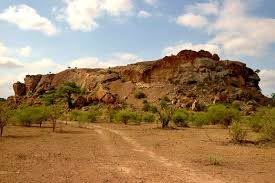
After talking about the origin of the name of the country Zimbabwe, named after Great Zimbabwe, the capital of the Kingdom of Zimbabwe which flourished in southern Africa from the 13th to 17th century, I thought it only wise to talk about some of the kingdoms that flourished in that area, starting with the Kingdom of Mapungubwe, a predecessor to the Kingdom of Zimbabwe. The Kingdom of Mapungubwe was a rich iron age civilization that flourished in the area of modern-day Zimbabwe, Botswana, and South Africa, from the 10th to the 13th century AD. It was a pre-colonial state located at the confluence of the Shashe and Limpopo rivers. The kingdom’s development culminated in the creation of the Kingdom of Zimbabwe in the 13th century, as a normal evolution of itself, and with gold trading links to Rhapta and Kilwa Kisiwani on the African east coast.
Mapungubwe Hill (Wikipedia)
From archaeological searches, the people of Mapungubwe were of the Venda and Kalanga people ancestry, and were attracted to the Shashe-Limpopo area because of its fertile soils for agriculture, and also because it was an area rich with elephants, thus rich with ivory. The area of Mapungubwe was also rich in gold, and the people traded in gold and ivory, snail shells, pottery, wood, and ostriches’ eggs (eggshells), with places as far as Egypt, Persia, India, and China.
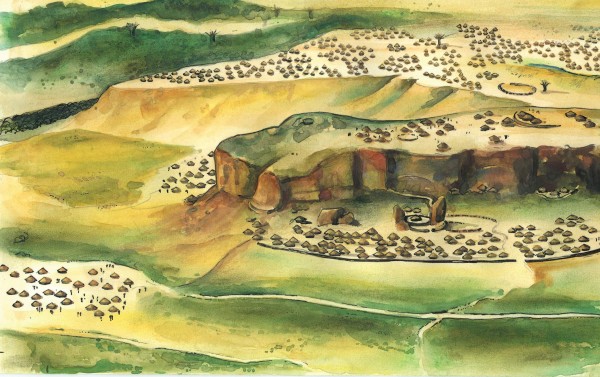
An artist impression of Mapungubwe (Source: newhistory.co.za)
Stone walls were used to demarcate important areas, and important residences were built with stone and wood. Life in Mapungubwe was centered around family and farming. The kingdom, as well as the way people lived, was divided into a three-tiered hierarchy, with the commoners inhabiting low-lying sites, district leaders occupying small hilltops, and the kingdom’s elites residing at the capital at Mapungubwe hill as the supreme authority. Important men maintained prestigious homes on the outskirts of the capital.
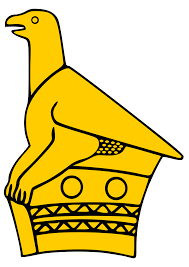
Bateleur Eagle on the flag of Zimbabwe
The kingdom was named after its capital city, the city of Mapungubwe. Several theories have been put forward for the meaning of the name itself. For some, Mapungubwe means “place of Jackals,” or “place where jackals eat,” or “hill of jackals.” In Shona, the language spoken by the majority of people in Zimbabwe, Mapungubwe means “rocks of the Bateleur eagle,” a bird which has deep spiritual connotations in the Shona culture (ma= many; pungu=suffix for chapungu= bateleur eagle, the massive bird which once graced the entrance of the royal complex of Great Zimbabwe; bwe= diminutive for ibwe= stone).
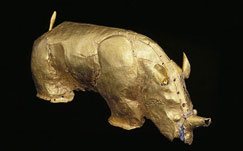
Mapungubwe’s famous gold foil rhinoceros (Source: Univ. of Pretoria)
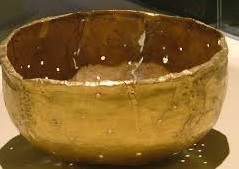
The site was rediscovered in 1932. At the top of Mapungubwe, they found many golden objects: bangles, beads, nails, miniature buffalo, rhino, a skeleton, and gold anklets, about 2.2 kg of gold and many other clay and glass artifacts. Between 1933 and 1998, the remains of about 147 individuals were excavated from the Mapungubwe Cultural Landscape. These findings were kept quiet for a long time, as they provided contrary evidence to the racist ideology of black inferiority underpinning apartheid.
Golden bowl found at Mapungubwe (golimpopo.com)
So any time you think about southern Africa only being populated by pastoralists, nomadic peoples, think again. There were very rich, and strong empires, such as the kingdom of Mapungubwe which was the first major iron age kingdom in Southern African, and traded with places as far as Egypt, Persia, India and China. For more information, check out the very rich Mapungubwe National Park website, South Africa.info, the Metropolitan Museum (MET) article, South African History Online, the Mapungubwe Kingdom website, and the UNESCO World Heritage website as Mapungubwe is listed. Enjoy the video below!
On jette des pierres dans l’arbre s’il porte des fruits(Proverbe Bakongo – République du Congo, République Démocratique du Congo, Angola). – Plus on est riche ou au pouvoir, plus on est importuné et critiqué.
We throw stones in the tree if it bears fruits(Bakongo proverb – Republic of Congo, Democratic Republic of Congo, Angola). – The richer or more powerful one is, the more one is bothered and criticized.

















 African Heritage