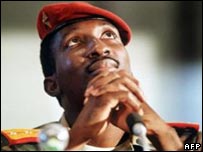
In view of recent events in Burkina Faso, and to continue our fight for democracy, for equal rights, for the right of a nation to choose its leaders without military/external forces dictating it, I live you with a quote by President Thomas Sankara, president of Burkina Faso. It was previously published in a “prayer for Cote d’Ivoire.” As the quote goes:
================
La patrie ou la mort nous vaincrons!
Telle était la devise de Thomas Sankara, notre grand Che africain, ce grand maitre de la révolution Burkinabé, le president du Faso. Telle est la devise que nous nous devons de garder dans nos coeurs en ce moment pour le Burkina Faso: savoir que nous nous battons pour notre liberté, pour notre patrie, pour la seule terre que le bon Dieu a bien voulu nous donner! Amandla!… Ngawethu!
Flag of Burkina Faso
Homeland or death, we shall overcome!
Such was the motto of Thomas Sankara, our great African Che, this great master of the Burkinabe revolution, the president of Burkina Faso. This is the motto that we must keep in our hearts for Burkina Faso right now: to know that we are fighting for our freedom, for our country, for the only land God ever gave us! Amandla! …Ngawethu! Power to the People!
Patria o muerte, venceremos!
Tal era el lema de Thomas Sankara, nuestro gran Che de África, este gran maestro de la revolución de Burkina Faso, el presidente de Burkina Faso. Este es el lema que debemos tener en nuestros corazones para Burkina Faso en este momento: saber que estamos luchando por nuestra libertad, para nuestro país, por la tierra sólo Dios nunca nos dio! Amandla!… Ngawethu!
Burkina Faso
Pátria ou morte, venceremos!
Esse foi o lema de Thomas Sankara, o nosso grande Africano Che, este grande mestre da revolução burkinabe, o presidente do Burkina Faso. Este é o lema que devemos ter em nossos corações para Burkina Faso agora: saber que estamos lutando por nossa liberdade, para o nosso país, para a única terra que Deus já nos deu! Amandla!… Ngawethu!
Image of a young woman’s face (agnautacouture.com)
These days, many of my fellow African brothers and sisters sport tattoos of some European or foreign symbols on their skins. These symbols are usually alien to our cultures, traditions, thinking, and history. So I thought about talking about scarification, which could be called an “ancient” African culture of tattoos.
For starters, Africa has a rich culture of scarification. Many cite HIV, and ugliness as being the reason why they would not do scarification and why the practice has been abandoned. I neither agree nor disagree with them, but I would like to give a history of scarification and why, this is something to be cherished as part of our history, even if it is no longer practiced and/or needed today.
Sculpture of a Mangbetu person, in Congo (exposed at the MET)
In the past, a woman or man would have scarification marks that will distinguish her/him from anyone else, tell her/his rank in society, family, clan, and tribe, and symbolize her beauty or strength. In some African tribes, it was like wearing your identity card on your face. True, some may hate that, but this was a mark of pride, not shame. In most African cultures, it was a major aesthetic and cultural componentas can be seen on sculptures in museums around the world. Scarification patterns on sculptures are not only marks of beauty, but marks of one’s lineage as well, and in some cases protection against evil spirits. Lastly, in Africa like in Polynesia, scarification is more visible on darker skinned people than say, tattoos.
Diamond and Rectangular patterns on the forehead and temples of a Tikar mask from Cameroon (exposed at the MET)
What is scarification? Scarification is the practice of incising the skin with a sharp instrument such as a knife, glass, stone, or coconut shell, in such a way as to control the shape of the scar tissue on various parts of the body. Cicatrisation is a special form of scarification where a gash is made in the skin with a sharp instrument, and irritation of the skin caused by applying caustic plant juices forms permanent blisters. Dark pigments such as ground charcoal are sometimes rubbed into the wound for emphasis. These cuts, when healed, form raised scars, known as keloids. The most complicated cicatrisation was probably found in the Congo Basin and neighboring regions, and among the Akan people of West Africa.
Pendant Ivory mask representing Queen Idia, Iyoba of Benin City (16th Century)
Scarification is a long and painful process, and a permanent modification of the body, transmitting complex messages about identity and social status. Permanent body markings emphasize social, political, and religious roles.Beautiful and complex designs depend on the artist’s skills but also on a person’s tolerance to pain. Facial scarification in West Africa was used for identification of ethnic groups, families, individuals but also to express beauty; scars were thought to beautify the body. It was also performed on girls to mark stages of life: puberty, marriage, etc. These marks assisted in making women more attractive to men, as the scars were regarded as appealing to touch as well as to look at, but also as testimony that women could withstand the pain of childbirth. Princesses in many places, including West Cameroon, used to sport amazingly beautiful and intricate marks. The sculpted face of Queen Idia of Benin Kingdom sports two marks on her forehead. For the Karo people of Ethiopia, men scar their chests to represent killing enemies from other tribes; women with scarred torsos and chests are considered particularly sensual and attractive.
Intricate patterns on a Dogon mask from Mali (exposed at the MET)
Today, the art of scarification is changing in Africa, and can mostly be spotted on elders. Mostly because of fears of HIV transmission via blades, and also because of the shame encountered. It is a culture which was once loved and is now despised. Ironically, people in western societies go under the knife to perfect their bodies; they prefer to hide their scars (it is also not on their faces)! Moreover, with the advent of identification cards, the need for scarification has also reduced.
I just wanted us to cherish and not frown upon an ancient culture which had its purpose, and was an integral part of our society, history, and traditions. For more on scarification in African cultures, check out Ezakwantu.com and RandAfricanArt which have amazing images of scarification in Africa, and these articles on the Huffington Post, National Geographic, and Lars Krutak‘s article on the Bétamarribé people of Benin.
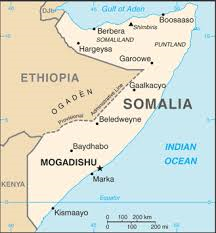
Have you ever wondered what the name of the capital city of Somalia, Mogadishu, meant? Somalia has been in the news in recent decades, particularly after the humiliation the American army received with Operation Restore Hope in 1993 at the hand of the local proclaimed president-to-be Mohamed Farrah Aidid, and also because of pirates roaming its coasts in the 2000s. The movie Black Hawk Down shows part of this operation with the ensuing Battle of Mogadishu, while Captain Phillips focuses on pirates.
The city of Mogadishuis located on the Indian Ocean coast of the Horn of Africa, in the Banaadir administrative region (gobol) in southeastern Somalia. The name Mogadishu is said to come from the Persian word Maq’ad-i-Shah, which means “the seat of theShah.” This is a reflection of the city’s early Persian influence. Locally, it is spelled Muqdisho. To locals, the city is also known as Xamar.
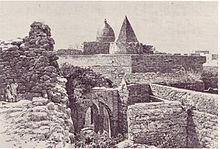
Engraving of the 13th century Fakr ad-Din Mosque in Mogadishu
So where does the Persian influence stem from in a city on the horn of Africa? Well, for starters, the city was founded in the 10thcentury by Arab traders. However, 2500 years old relics and pictographs were found on rocks in northern Somalia attesting to the area’s ancient occupation. Tradition and old records assert that southern Somalia, including the Mogadishu area, was inhabited in early historic times by hunter-gatherers of Khoisan descent who were later either driven out of the region, or assimilated by other migrants in the area.
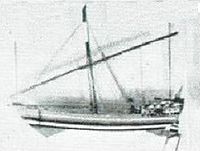
Mogadishan medieval ship
In 1331, the Moroccan explorer Ibn Battuta visited the city when it was at its zenith. He described Mogadishu as “an exceedingly large city” with many rich merchants, which was famous for the high quality fabric that it exported to destinations including Egypt. Batutta added that the city was ruled by a Somali Sultan, Abu Bakr ibn Sayx ‘Umar, who was originally from Berbera in northern Somalia and spoke both Somali (referred to by Battuta as Mogadishan, the Benadir dialect of Somali) and Arabic with equal fluency. The Sultan also had a retinue of wazirs (ministers), legal experts, commanders, royal eunuchs, and other officials at his service.
There appears to have been a strong Persian presence in both Mogadishu and Zeila for a time. A Shi’a influence can still be seen in some areas, as in the southern Somalia veneration of Fatimah, the Prophet Muhammad‘s daughter. Moreover, in the olden days, the city’s textiles were forwarded far and wide throughout the interior of the continent, as well as to the Arabian peninsula and as far as the Persian coast.
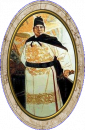
Zheng He, Chinese explorer
The Chinese navigator Zheng He visited the region with his expedition from 1413 to 1415. From the 13th to the 15th centuries, Mogadishu was an important city of the Ajuran Sultanate. The city was governed by the Muzzaffar dynasty. Mogadishu is one of the rare cities on the East coast of Africa which was never conquered by the Portuguesewhose attempts to occupy the city failed in the 16th century. However, the Muzzaffar dynasty lost control of the city to the Hawiye Somali when the Ajuran sultanate was defeated in the 17th century.
By 1892, Mogadishu was under the joint control of the Somali Sultanate of the Geledi and the OmaniSultanate of Zanzibar. The Geledi Sultans were at the height of their power. They dominated the southern ivory trade, and also held sway over the Jubba and Shebelle valleys in the hinterland.
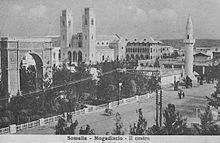
In 1905, Italy made Mogadishu the capital of the newly established Italian Somaliland. The Italians subsequently referred to the city as Mogadiscio. After World War I, the surrounding territory came under Italian control with some resistance. Thousands of Italians settled in Mogadishu and founded small manufacturing companies. They also developed some agricultural areas in the south near the capital, such as Janale and the Villaggio duca degli Abruzzi (present-day Jowhar). In the 1930s, new buildings and avenues were built. A 114 km (71 mi) narrow-gauge railway was laid from Mogadishu to Jowhar. An asphalted road, the Strada Imperiale, was also constructed and intended to link Mogadishu to Addis Ababa.
Mogadishu (downtown) in 1936, Arba’a Rukun Mosque to the centre right
In 1990, Mogadishu fell under the control of rebels who forced President Mohamed Siad Barre into exile. The rebels formed rival factions each recognizing different presidents, and civil war broke out. In 1992, the United Nations sent armed forces led by American forces. After deadly combats, the American forces were defeated and forced to run away by Aidid‘s troops.
Sandy beach in Mogadishu
Today, the amazing sandy beaches of Mogadishu with its vibrant coral reefs are prime land for tourist resorts. Since the city’s pacification on 2011, the city is slowly rebuilding, and establishing international trades with other cities and countries. Mogadishu traditionally served as a commercial and financial centre. Mogadishu’s economy has grown rapidly since then. The Port of Mogadishu is the official seaport of Mogadishu, and the largest harbour in the country. Please enjoy this vibrant, reviving, and historical city. Do check out Somaliagenda.com for amazing pictures of Mogadishu and its people.
Here is an Ethiopian tale from the Afar region of Ethiopia. You can read the entire story on the Ethiopian Folktales‘ website. Enjoy!
========
Once there was a very intelligent Afar boy aged fifteen, but he was always upset and angry because he knew what was happening in his house. His father was having an affair with one of his mother’s servants and his mother was having an affair with someone outside the household. And the boy knew about this and he was very angry.
Then one day, as he was asleep in the corner covered with clothes, his mother’s lover came in and didn’t notice him.
And he said to his mother, “You’re a very generous woman. You’ve given me everything I’ve ever asked for. Now tomorrow what I want is to eat the big white ox that belongs to your husband.”
And his mother said, “There’s no problem, as long as you come with ten of your friends.”
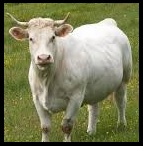
White ox
Then the next day, her lover came with ten of his friends.
She went to her husband and said, “Look, all of my relatives have come and we’ve got to feed them and they’re so many, I can’t give them just injera1 and ordinary things.”
And the husband said, “OK, I’ll slaughter the big white ox for you so you can feed them.”
And he took the ox under a tree and was slaughtering him using his big dagger.
Now the son was very angry and when he went to his father his father had already cut up the pieces of meat and he gave them to the boy, and told him to take it to the guests. Now as they were going along, wherever he passed a rock he bent down and put a piece of meat on each rock. And he continued walking towards the men. And when the father looked up, he saw the pieces of meat on the rock.
Un homme en très mauvais état se présente devant St-Pierre, après une mort apparemment violente.
Celui-ci demande: – Mais qu’est ce qui s’est passé ?
L’homme explique: – J’étais guide de safari en Afrique et j’accompagnais un groupe de six femmes belges et une suisse. En traversant un pont de lianes au dessus d’une rivière infestée de crocodiles, un coup de vent nous a fait basculer. On a tous réussi à se retenir aux cordages. Nous étions suspendus en l’air et comme le pont menaçait de lâcher à cause du poids, il fallait que quelqu’un se sacrifie. Comme j’étais le seul homme…
Une minute plus tard, St-Pierre voit débarquer les six belges dans le même état que l’homme qu’il vient de conduire au Paradis. Il demande immédiatement aux arrivantes: – Mais ce brave homme qui s’est sacrifié, a-t-il donc fait ça pour rien ?
L’une des belges explique alors: – c’est à cause de cette maudite suisse qui nous accompagnait… Quand le guide s’est laissé tomber, elle a dit: – Un homme aussi courageux, il mériterait qu’on l’applaudisse…
========
Applause
A man in very poor condition appears in front of St-Peter, after an apparently violent death. The later asks: – What happened?
The man explains: – I was a safari guide in Africa, and I was leading a group of 6 Belgian women and one swiss one. While crossing a liana bridge on top of a river full of crocodiles, a gust of wind tipped us. We all managed to hold onto the ropes. We were hanging in air, and since the bridge threatened to falter because of the weight, someone had to be sacrificed. Since I was the only man …
A minute later, St-Peter sees the 6 Belgian women arrive in the same state as the man he just led to Paradise. He immediately asks the newcomers: – But this brave man who sacrificed himself, did he do it for nothing?
One of the Belgian ladies replies: – It is because of that cursed swiss who was with us …
When the guide fell, she said: – Such a courageous man, he deserves to be applauded …
Si vous ne suivez pas ce chemin, à quoi bon de vous orienter sur le soleil (Proverbe Ekonda, République Democratique du Congo (RDC)). – Ce n’est pas votre femme, pourquoi la regarder! N’enviez pas ce qui n’est pas à vous.
African Woman
If you do not follow this path, why bother to walk under the sun(Ekonda Proverb – Democratic Republic of Congo (DRC)).- It is not your wife, why are you looking at her! Do not envy what is not yours.
I would like to share with you letters from Ndate Yalla Mbodj, the last Lingeer (Queen) of the Waalo, addressed to the French Governor of Senegal in the 1850s. These are treasures from history, and I thought it very interesting to translate them from French to English. Reading these letters, one can see the duplicity of the French who would take lands from the Waalo people without asking, and will treat the people of the Waalo with great disdain. These are from the National archives of Senegal. For the French version, visit: Seneweb.
=========
National Archives of Senegal 13 G 91
Correspondence of the Kings of the Waalo
Letter number 85 received by the governor
of Saint Louis on May 23rd, 1851
Ndatte Yalla to Mr. the Governor,
The goal of this letter is to let you know that the island of Boyo* belongs to me, from my grandfather down to me today. There is nobody who can claim that that country belongs to them; it belongs to me only. I did not sell this country to anybody. I did not entrust it to anybody, nor to any white person. The people to whom I entrusted my land have to right to do anything to it, I will have nothing to say. Nobody can take this land without their authorization; to prove to you that this letter comes from me, when the dispute had been settled in Lampsar, you went back to the fort. There I came to see you with my husband, you were accompanied by Mr. Alsace and de Bamar, you told me that you wanted to see me alone to talk, I told you that there was only my husband and brother present.
You also asked me who was the King of the Waalo today. I replied that the King of the Waalo was me. If this is true, and this letter comes from me, I desire that no one should take possession of my territory.
The island of Boyo is located in Mauritania, 15 km north of Saint-Louis in Senegal. It houses the village of N’Diago. It is the cradle of the Boye family of Saint-Louis.
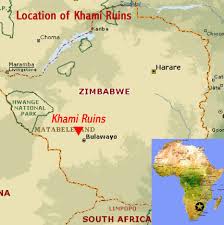
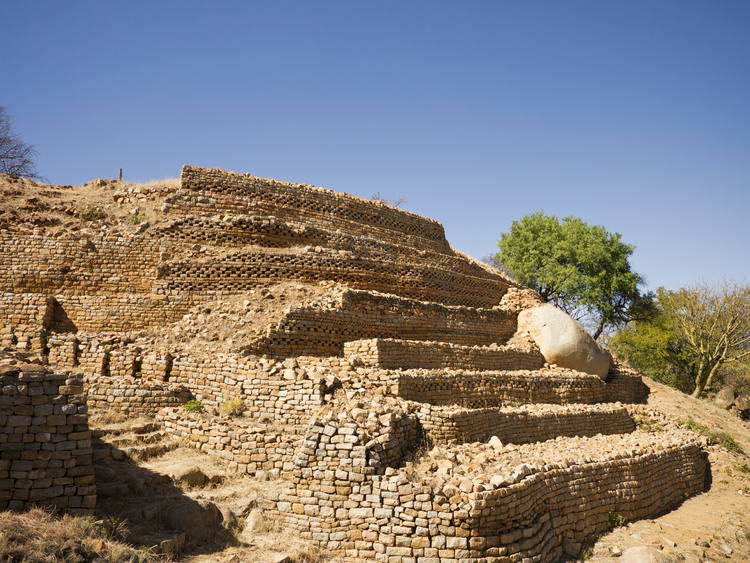
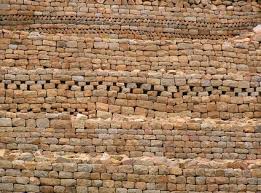
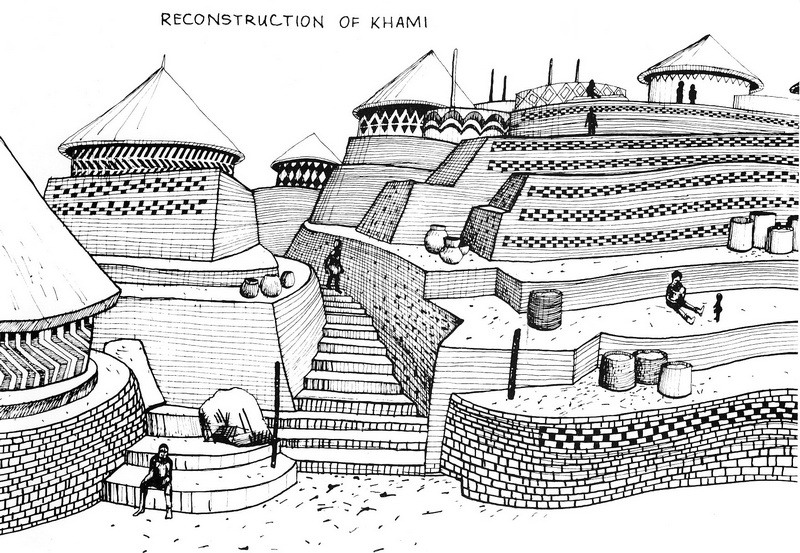
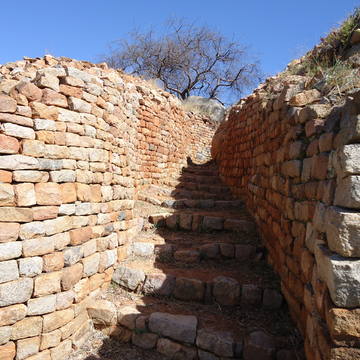
Today, the site of the Khami ruins is a national monument and a UNESCOWorld Heritage Site since 1986. The site is dominated by a series of terraced stone ruins, often highly decorated. It reveals seven built-up areas occupied by the royal family with open areas in the valley occupied by the rest of the population. The complex comprises circular, sometimes terraced, artificial platforms encased by dry stone walls. The beautifully decorated 6m-high by 68m-longretaining wall of the Precipice ruin bears a checkerboard design along its entire length. The imposing front façade marked the main entrance. The Precipice Ruin was a ritual center with the longest decorated stonewall of its kind in the entire sub-region. Nearby are the Cross Ruin with its mysterious stone Dominican Cross, believed to have been placed by a contemporary missionary, and the Northern Platform once used to process gold. The nearby Passage Ruin consists of two adjoining semicircular platforms accessed by a narrow passageway. The platforms, rising 2-7 m above ground, carried clay huts and courtyards where the rest of the populations lived. The remnants of cattle kraals and huts for ordinary people can be seen from the Hill Complex. The ruins include a royal enclosure forming the Hill Complex located on higher grounds, stone walls and hut platforms. There are also ruins on the eastern side of the Khami River.
A wall at the Khami site showing the herringbone and checkerboard patterns
To build the structures at Khami required engineering and architectural feats, since the stone found at Khami (laminar granite) was different from that found in other areas of Zimbabwe (biotite). This stone was harder to quarry and produced shapeless building stone; over 60% of the stone produced at these quarries would not have been of building quality. The building blocks thus needed to be shaped, but even then the stones were not suitable for building free-standing dry stone walls. The builders of Khami thus made an innovation and produced retaining walls instead. Moreover, building platforms made the houses cooler than those in the open areas below. Khami’s architecture conforms to that of Great Zimbabwe in a number of archaeological and architectural aspects but it possesses certain features particular to itself and its successors such as Danangombe and Zinjanja. Retaining walls and elaborate decorations were first expressed in the architectural history of the sub-region at Khami.
Artist rendition of what the city of Khami would have looked like (historum.com)
Archaeological finds include 16th century Rhineland stoneware, Ming porcelain pieces which date back to the reign of Wan-Li (1573-1691), Portuguese imitations of 17th-century Chinese porcelain, 17th-century Spanish silverware, etc. These indicate that Khami was a major centre of trade, presumably linked (like Mapungubwe and Great Zimbabwe before it) to the Swahili ports on the East Africa coast.
A passageway at Khami (WHC-UNESCO website)
Unfortunately, Khami was invaded by Changamire Dombo, around 1683, who led a Rozwi army from the Mwenemutapa (Monomotapa) state. The Rozwi made Danangombe (Dhlo-Dhlo) another area of the Khami site as the new capital of their empire, the Rozwi Empire. In the 1830s, Ndebele raiders displaced the Rozwi from Khami. A small site museum provides useful background information to the site itself. If you are ever in the vicinity, do not forget to visit this amazing site, remnant of a great stone civilization.
















 African Heritage