Rihanna rocking a Stella Jean’s creation (allthingsankara.com)
I couldn’t help but notice the African influence seeping its way through the wardrobe of some of the world’s celebrities. Last fall, Rihanna stunned the world by wearing Ankara fabric at the White House. She was sporting Haitian designer Stella Jean‘s creation, and she was stunning.
Wax Hollandais
I also recently heard about Zimbabwean designer Farai Simoyi, the one behind Nicki Minaj‘s fashion line. Before that Farai Simoyi was a Senior designer at the House of Dereon, the clothing house by mega-artist Beyoncé and her mother Tina Knowles.
So watch out: next time you shop, you may be unconsciously buying some African designs. Enjoy this video about some of the up and coming African designers on the international scene.
Yesterday, David Olusoga of BBC Two published a documentary on Britain’s Slave Owners part 1: Profit and Loss. His work was very profound, and was of course very painful, as it dealt with slavery. Here is the synopsis, from BBC Two website:
“In 1834 Britain abolished slavery, a defining and celebrated moment in our national history. What has been largely forgotten is that abolition came at a price. The government of the day took the extraordinary step of compensating the slave owners for loss of their ‘property’, as Britain’s 46,000 slave owners were paid £17bn in today’s money, whilst the slaves received nothing.
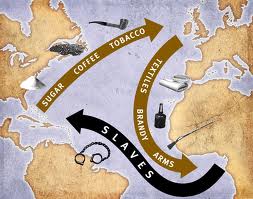
The Transatlantic slave trade
For nearly 200 years, the meticulous records that detail this forgotten story have lain in the archives virtually unexamined – until now. In an exclusive partnership with University College London, historian David Olusoga uncovers Britain’s Forgotten Slave Owners. Forensically examining the compensation records, he discovers the surprising range of people who owned slaves and the sheer scale of the slavery business.
Slaves on board a ship
What the records reveal is that the slave owners were not just the super-rich. There were widows,clergymen and shopkeepers; ordinary members of the middle-classes who exploited slave-labour in distant lands. Yet many of them never looked a slave in the eye or experienced the brutal realities of plantation life.”
Check out the BBC Two website which has an interactive view of it. I also liked the video link below about some instruments of torture used in Jamaica to punish slaves. I invite you to find this outstanding documentary by David Olusoga. Below is an interview he gave.
Le buffle ne se vante pas de sa force devant l’elephant (Proverbe Ambede – Gabon). – Il faut partout une autorité; mais n’enviez pas les chefs.
Elephant
The buffalo cannot boast about his strength in front of the elephant(Ambede Proverb – Gabon). – Authority is always needed; but do not envy the chiefs.
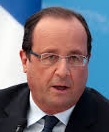
It took over 70 years for a French President to finally admit the genocide perpetrated in Cameroon by France between 1950 and 1970, a genocide which claimed over 400,000 lives, and displaced countless others. In his visit to Cameroon last Friday, French president François Hollande acknowledged that French forces had tried to quash colonial separatists in the 1950s and said he was ready to open up the history books. He said, “I recognize that there have been extremely traumatic and even tragic episodes.” Should we jubilate?
Ruben Um Nyobé
I say NO. It is true that this is somewhat a step forward: recognition of wrong done. However, I call it arrogance to wake up one day, and finally say, “Oh, yes, I killed your fathers, mothers, brothers, or sisters, … I showered many of your cities with Napalm, … I decapitated so many of your freedom fighters and hung their heads in the villages’ square, … I killedRuben Um Nyobé, Felix-Roland Moumié, Castor Osende Afana, Ernest Ouandié, and so many others, … I forced some of you into exile, … and I displaced countless others inside and outside your borders.” And so what? Should we clap for you? where is the apology? Didn’t you think we knew you did that? Where is the reparation?
Maquisards’ heads during the genocide in Cameroon
During the Maquis years, many lost a loved one; is there a reparation for that loved one? that father who never saw his children grow up? that mother who never saw her son again? What about those who kept waiting, and waiting, hoping that after so many years the loved ones would come back home?… What about the pain of that young girl walking to school who had to watch the decapitation of ‘maquisards’ on the public place: she was scarred for life! What about those entire villages burnt with napalm? And those who were displaced internally from French Cameroon to British Cameroon, running for their dear lives and leaving behind their lands? What about Ruben Um Nyobé and his family? Felix-Roland Moumié, and his widow who suffered years of imprisonment in the harshest places? and Ernest Ouandié… and all the children who had to watch in horror as he took his last breath under the firing squad’s shots? What about the remaining population whose history was erased from textbooks, those who now have a gap in their past?
UPC Leaders (L. to R.) front row: Castor Osende Afana, Abel Kingué, Ruben Um Nyobé, Felix Moumié, and Ernest Ouandié
And to stand up there, and say “yes I recognize that we killed you”… it’s like Hitler waking up today, and telling Holocaust survivors and their descendants, “I killed you, jailed your parents, forced you into exile, brought fear into your souls, and decimated every part of you… what can you do?” It is simply arrogant! It is just too easy. Until there is a clear “I am sorry”, until there is a clear “here is what we will do to correct the wrong”, until there is a clear “arrest of all perpetrators”, until there is a clear “story in the history textbooks, opening of all the classified documents”…. until there is a clear “respect for those killed,” until then, there will be no respect for arrogant presidents of the hexagon in our dictionaries!
Ne frappe pas le petit chien qui agite la queue pour toi(Proverbe Mongo – République Démocratique du Congo). – On ne fait pas de mal à celui qui vous aime.
Do not beat the puppy who shakes its tail for you(Mongo Proverb – Democratic Republic of Congo). – Do not hurt the one who loves you.
I came across a video of the Kantanka, a 4×4 All-Wheel Drive made in Ghana by Ghanaians for Ghanaians, on BBC. The car is the brainchild of Dr. Kwadwo Safo, a Ghanaian who always dreamt of making cars and planes in Ghana. He wanted to address the local needs, and demonstrate that it was possible for Africans to design and engineer their own cars for their own roads. Move over Toyota, Honda, Ford, Mercedes, and meet the Kantanka. We do hope that these cars will be solicited by Ghanaians themselves, that they will meet the safety standard, and be a breath of fresh air adapted to their roads and needs. The car is engineless and “green”. The founder’s son, Kwadwo Safo Jr., said, “the non-engine vehicle does not rely on a combustion engine to move, but an electric motor powered by rechargeable batteries. The batteries can be recharged with solar energy or electricity. As you drive the car on the road, it converts the energy from the sun into mechanical energy which powers the car.”
Apart from the lights and tires, everything is done and assembled by local people. The police just bought a few vehicles. The big question will be: does it meet international safety standards? Will Ghanaians be sold by it? Read the article on Forbes and Al-Jazeera, and watch the video on BBC. Enjoy Ghana’s first car, made in Ghana by Ghanaians for Ghanaians!
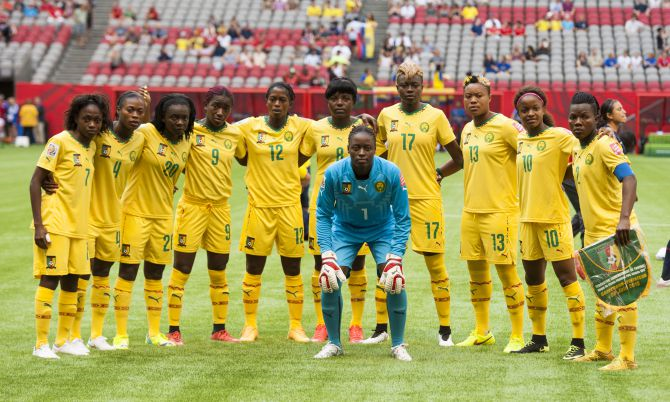
I was quite proud of the Cameroonian team who succeeded in going through the first round of the 2015 Women FIFA’s World Cup in Canada. This was Cameroon’s first World Cup participation. With no government support, barely any equipment, and little organization, they managed to do well with so little. Here is a quote by the Cameroonian coach Enow Ngachu, “The day we prepare and organize very well, I think an African nation will one day win the World Cup. … We just hope that with our performance many things will change in Cameroon and in Africa.”
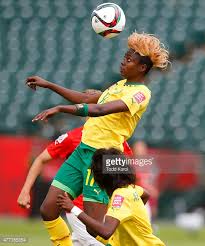
Gaelle Enganamouit in action (Getty Images)
On June 20th, China PR survived a tough examination from Cameroon with a lone early strike from Wang Shanshan, thus ending the Lionnes of Cameroon’s journey. Both teams played with high-tempo and intensity from the opening whistle in Edmonton with chances aplenty at either end, but it was the Chinese who remained resilient at the back to advance into the last-eight. We are very proud of these Cameroonian sisters who showed that African women, and women in general, can play very good, entertaining, and amazing football/soccer, and should be equally cared for by their governments and people. My hat to Gaelle Enganamouit, Madeleine Ngono Mani, Christine Manie, Gabrielle Aboudi Onguene, and all the other sisters who made us proud. Indomitable Lioness Gaelle Enganamouit became the first African to score a hat-trick at the Women’s World Cup. Below is a highlight from the game Cameroon – Switzerland, which was quite intense and beautiful to watch. Enjoy!
Are there days when you feel quite down? Days when you feel surrounded by darkness? It could be bright daylight, and hot outside, but you feel all alone, and surrounded by obscurity? Well, I saw this yellow hibiscus flower, and the way the sun rays fell on it caught my attention. It was as if the flower was emerging from darkness and into the light. What more, it seemed that the flower had never been touched by the darkness, its beauty was always there, and it just needed a ray of light to be rediscovered. It is the same for you: there is no darkness. Your beauty, intelligence, and being remain intact no matter what your mood might be, and all you need is a ray of light for your grace to be revealed… so let go of the obscurity, the past, the heaviness, and just shine, be revealed. May you emerge from darkness into the light just like this yellow hibiscus flower. Enjoy!
Il était une fois un caméléon très généreux et très charitable. Il vivait du produit de son travail dans son champ, avait une grande concession sur laquelle il avait construit une belle case spacieuse.
Araignée, le plus grand paresseux de la région, aimait bien vivre d’expédients, sans se fatiguer à travailler, grâce à ses ruses malhonnêtes. Il entend vanter autour de lui la générosité de caméléon et décide de l’exploiter. Il se rend jusqu’à l’habitation de celui-ci, suivi de sa femme et de ses enfants couverts de haillons. « Ayez pitié de pauvres malheureux sans abri ! Se lamente-t-il. Ayez pitié, Caméléon ! La saison des pluies va commencer ! Nous n’avons pas de maison ! Mes enfants vont mourir de faim et froid, faibles comme ils sont ! »
N’écoutant que son bon cœur, Caméléon invite Araignée et sa famille à s’installer chez lui et met à leur disposition la moitié de sa belle maison. Un jour, alors que Caméléon est parti aux champs, Araignée tue l’épouse de son bienfaiteur et vole tous ses pagnes et tous ses bijoux. Au retour de son hôte, il lui raconte que des bandits ont assassiné Madame Caméléon et emporté tout ce qui se trouvait dans la maison. Araignée ajoute qu’il aurait défendu la malheureuse s’il n’avait été assommé à coups de gourdin. Caméléon est très fâché car, malgré tous ses mensonges, il a compris ce qui s’est passé. Il se jure à lui-même qu’il se vengera cruellement et qu’Araignée mourra en châtiment de son crime.
Un plat de Yeke-yeke
Une semaine plus tard, il rapporte à la maison un énorme plat de yéké-yéké (*). Araignée, son épouse et ses enfants en mangent tant qu’ils peuvent et se régalent. Lorsque le plat est vide, Araignée demande : « Où avez-vous trouvé cette nourriture succulente, mon frère ? »
Caméléon répond : « C’est un génie qui me l’a préparée ! Si, toi aussi, tu tues ta mère en sacrifice aux « Togbesikpé » (**), tu recevras le même cadeau. »
Plein de convoitise, Araignée exécute ce nouveau crime affreux. Mais, contrairement à son attente, il ne reçoit point de yéké-yéké. Le cœur de Caméléon se réjouit de cette vengeance et il murmure : « Si tu n’avais pas été aussi bête qu’avide, tu n’aurais pas fait cela ! » Continue reading “L’Araignée et le Caméléon”→



















 African Heritage