Deportation of African Heads of States

prempeh_i
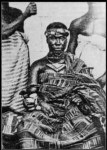
Prempeh I of Ashanti Kingdom

History repeats itself! Over 100 years ago, African Heads of states, Emperors and Kings, were deported by European colonizers for defending their people, lives, independence, land, livelihood, and themselves. Some were killed, and others were exiled. In those days, they were deported to other territories in Africa, far from their lands. Today, 100 years later, they are being deported to the Hague or to some other African lands again. Here are a few, and I am sure you know others.

Prempeh I, Asantehene of Ashanti Kingdom deported to Seychelles in 1896 by British forces. His throne is still displayed at the Royal Signals Museum in Blandford, England. He was allowed to return after 24 years in exile.
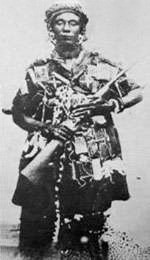
asantewaa
Yaa Asantewaa of Ashanti Kingdom

Queen Yaa Asantewa of the Ashanti Kingdom was deported to Seychelles in 1902 by the British. She arose her people to fight against the British. She died in exile.

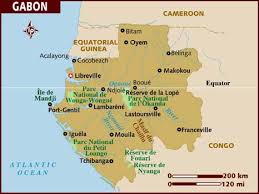
Samori Toure, Founder and leader of the Wassoulou Empire, was deported to Gabon (on an island of the Oogoue) in 1898 by the French. He died in exile.
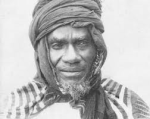
Samori
Samori Touré

Behanzin, King of Dahomey,was deported to Martinique and then later Algeria by the French. He died in exile in Algeria in 1906.

The Oba of Benin Kingdom deported to Calabar by the British in 1897. He died in exile.

Gungunyane, King of Gaza in Mozambique, first sent to Lisbon, and then later to the island of Terceira on the Portuguese Azores. He died in exile in 1906.
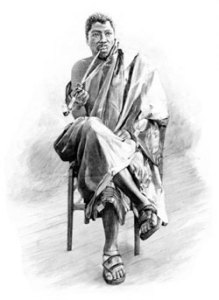
Behanzin, the Last King of independent Dahomey

Cheikh Amadou Bamba, of Senegal, deported to Gabon in 1895 by the French. He was brought back 7 years later in 1902, but deported to Mauritania in 1903 for 4 years, before being brought back to Senegal. He died in Senegal.

Nowadays, Laurent Gbagbo, President of Côte d’Ivoire, deported to the Hague in the Netherlands 2011 by the French and the Ivorian Ouattara. He is still there.
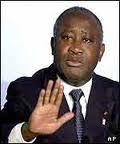
Laurent Gbagbo
Laurent Gbagbo

Charles Ble Goude, Youth Minister of Côte d’Ivoire deported to the Hague in Netherlands in 2011 by the French, and the Ivoirian Ouattara. He is still there.

Moussa Dadis Camara, President of Guinea, shot and almost left for dead, deported to Burkina Faso(let’s call the cat by its name). …

And the list goes on… How long will it last? Can we not judge our people ourselves? Is this a choice by the people for the people? Are we really independent?

Proverbe Congolais sur l’Expérience / Congolese Proverb on Experience

PirogueVous ne pouvez savoir si l’eau est froide que si vous la touchez (Proverbe Ntomba – République Démocratique du Congo).- L’expérience est la meilleure conseillère.

You cannot tell whether the water is cold unless you touch it (Ntomba Proverb – Democratic Republic of Congo).- Experience is the best advisor.

South African teen wins Google prize for orange peel innovation

sa_nirghin_google
Kiara Nirghin (Source: Google)

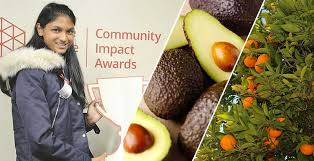
Congratulations to Kiara Nirghin, a 16-year-old South African girl who won the grand prize at the Google’s science fair, beating competitors from around the world, with a product made to address droughts via soil retention of water. Kudos to her!!! This is a good encouragement to other girls who love sciences; they too can contribute to make a better world. Watch the video below about her product.

The excerpt below is from the BBC. For the full article go here.

=======

A 16-year-old South African schoolgirl has won the grand prize at Google’s science fair for using orange peel to develop a cheap super-absorbent material to help soil retain water.

Kiara Nirghin beat students from around the world for a $50,000 (£38,000) scholarship with her “fighting drought with fruit” submission. Her work was in response to the recent drought that has hit South Africa . The drought, the worst since 1982, led to crop failures and animals dying.

sa_nirghin_1
K. Nirghin (mrmondialisation.org)

Ms Nirghin, a student at the Anglican Church-founded St Martin’s High School in the main city Johannesburg, said three experiments over 45 days resulted in her coming up with the “orange peel mixture” as an alternative to expensive and non-biodegradable super-absorbent polymers (SAPs). […]

It was made out of waste products from the juice-manufacturing industry, she said.

These included molecules found in orange peels and naturally occurring oils in avocado skins.

The product is fully biodegradable, low-cost and has better water retaining properties than commercial SAPs. The only resources involved in the creation of the ‘orange peel mixture’ were electricity and time, no special equipment nor materials were required,” Ms Nirghin added in her online submission.


Africa’s Independence: the case of Gabon’s Presidential Election 2016

gabonAbout 6 years ago, most African countries, particularly those in Francophone Africa, celebrated 50 years of independence. Yes… we were all told how many of them fought for their independence, how some of our forefathers bled to death, were killed, to get a chance to march proudly as Africans. We all cheered, and proclaimed ourselves independent. Then, a few months later, starting on 16 December 2010, the light shined on our “dependence”. On that fateful day of 11 April 2011, when the French army bombed the presidential palace of Cote d’Ivoire (and had been bombing all state institutions for over 10 days without any UN mandate and no declaration of war) and dragged its president and first lady in front of the world like mere criminals. In February 2011, NATO and the UN issued an order to bomb Libya and its institutions because Kadhafi was supposedly killing its people… They bombed Libya, killed, and uprooted its people. Today, 5 years later, the people of Gabon are now witnesses to their “obvious dependence” to France. Yes… you heard me right: these countries with that slave currency called FCFA are vassals of France, and today more than ever it has been made clear to us. “Vassals” you asked? “How come? we are independent?”… well, explain to me why a sovereign country with laws, institutions, and a constitution, will not be able to handle elections without meddling from France as was the case in Cote d’Ivoire in 2010 and currently in Gabon in 2016.

gabon3After I heard the French prime minister tell the Gabon president that he needed to have the elections recounted “bureau de vote par bureau de vote”, I thought: could the president of any African country ask the French people to recount their elections? Could the president of any African country tell the French president that he needs to pack his bags and let someone sit on his seat because he did not win the elections fair and square? Well, for starters, elections in Europe, and in America are usually won in the 50-55% range, and nobody says: “the country is divided in the middle”. Second of all, no candidate proclaims himself president before the results of the elections are announced by the constitutional court or supreme court of the country, like we just saw in Gabon. Third, no African ambassador to a European country or the African union calls the headquarters of the opponent or drags the person supposed to read the elections’ results to a hotel the day/hour he is supposed to read (Cote d’Ivoire 2010, where the French and US ambassadors took Mr. to Hotel Ivoire, headquarters of the opponent to read the results of an election). Fourth, nobody, and I mean nobody, goes to TV to issue warning to Bush or Gore to let go because they lost or won. Nobody sullies the constitution of another country. However, for the past 6 years, we have seen the constitutions of African countries being trampled upon by France, the European Union, NATO, and the US. Now, during hurricane Katrina when countless Americans were dying and their government was not raising a finger, did we Africans bomb their land? Did anybody go to the UN security council and say this is outrageous? Did anybody even talk? Did we interfere in that country’s government, and laws? In November 2015 when there was a terrorist attack in France, did the UN security council say to Francois Hollande: “you are destroying that country, your security is not tough enough, basta … we will take it from here”? NO
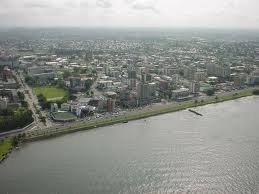
Libreville today
Libreville today

SO now when I hear French ministers having a say in the Gabonese elections, and some French journalists telling us “prior to these elections, Ali Bongo reached out to the Americans, looking for a rupture with France, how dare he?” I say “are we really independent?”


Proverbe Bantou sur l’Experience /Bantu Proverb on Experience

Poisson-Silure
Poisson-Silure

On n’apprend pas à nager à un poisson (proverbe Bantou – Afrique centrale, orientale, et australe).

You cannot teach a fish how to swim (Bantu proverb – Central/Eastern/Southern Africa).

Proverbe Douala sur la Persistance / Duala Proverb on Persistance

Singe
Singe / Monkey

Le singe a appris à sauter de l’arbre en plusieurs essais (Proverbe Douala – Cameroun).

The monkey learnt to jump from the tree in several tries (Duala proverb – Cameroon).

Swiss Firms poison Oil destined for Africa

oil3I had to say a few words about the latest news that Swiss firms have been refining oil destined for Africa with levels of sulfur at least 200 times higher than in Europe. Sulfur is associated with heart disease, lung cancer and respiratory problems. Astounding isn’t it? But what is astounding to me is really why do countries who produce oil choose to refine it elsewhere and then import it back? Some will say that they are too poor to refine it; then why not train your own engineers to that effect; isn’t the cost of shipping it to Europe, then importing it back from European traders not high? Do you really think that those European companies responsible for refining it will not give you back trash for a lesser price? Who/What guarantees the quality? Well, those guilty Swiss companies claim that the regulations of African countries are too lax, and so they have done nothing wrong (so basically if they know something is toxic and has been banned everywhere, but Africans don’t know it, they will sell it to them). Here are a few excerpts from articles on the BBC, and AllAfrica. The maps are from BBC via UNEP.
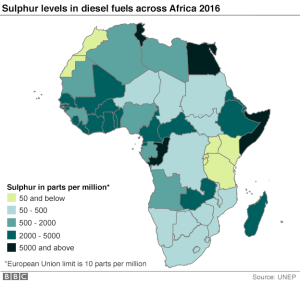
Swiss firms have been criticised in a report for their links to the African trade in diesel with toxin levels that are illegal in Europe.

[…] Why are regulations so lax?

The picture is changing but there are still several African countries which allow diesel to have a sulfur content of more than 2,000 parts per million (ppm), with some allowing more than 5,000ppm, whereas the European standard is less than 10ppm.

africa_sulphur_2016Rob de Jong from the UN Environment Programme (Unep) told the BBC that there was a lack of awareness among some policy makers about the significance of the sulfur content.

For a long time countries relied on colonial-era standards, which have only been revised in recent years.

Another issue is that in the countries where there are refineries, these are unable, for technical reasons, to reduce the sulphur levels to the standard acceptable in Europe. This means that the regulatory standard is kept at the level that the refineries can operate at.

Some governments are also worried that cleaner diesel would be more expensive, therefore pushing up the price of transport.

But Mr De Jong argued that the difference was minimal and oil price fluctuations were much more significant in determining the diesel price.” (Source: BBC)

Speaking with journalists in Abuja, the Executive Director, ANEEJ, Mr. David Ugolor, tasked the federal government to pay serious attention to the dangers posed to the health of citizens by these Swiss commodity trading companies, Vitol and Trafigura.

He argued that due to poor regulatory activities, foreign companies like Vitol and Trafiguratake undue advantage of weak fuel standards in Africa to produce, deliver and sell diesel, petrol and gasoline, which damage the health of the people.”

According to Ugolor, the Swiss companies’ “business model relies on an illegitimate strategy of deliberately lowering the quality of fuels for gain.

Using a common industry practice called blending, Vitol and Trafigura and their conglomerates mix cheap and toxic intermediate petroleum products to produce what the industry calls African Quality fuels.

africa_sulphur_2005These products contain higher levels of Sulphur and other harmful poisons that can never be found in Europe and the United States.”

The ANEEL Executive Director contended that byselling such fuel and diesel at the pump in Africa, the traders increase external air pollution, causing respiratory disease and premature deaths.

“We all know that poor air quality poses serious risks to public health. As air quality declines, the risk of stroke, heart disease, lung cancer, and chronic and acute respiratory diseases increases for residents of cities where the people rely on diesel to power their means of production.”

Ugolor maintained that the dirty fuel shipped to West Africa by Vitol and Trafigura are known to burn very fast, equally leading to huge economic losses to vehicle owners in the African sub region.

“It is impossible to continue to remain silent about this problem, especially for the short and long term repercussions on the health and economy of our people.” (Source: AllAfrica)


Proverbe Ghanéen sur l’Inévitabilité / Ghanaian Proverb on Inevitability

Goat2
Une Chevre / A Goat

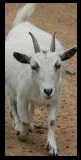
Une chèvre morte ne craint pas le couteau (proverbe Gâ, Ghana).

A dead goat does not fear the knife (Gâ proverb, Ghana).

European-Only Neighborhoods in African Cities before Independence

Africa_map1
Africa

As a note, I recently learned that before independence in African countries and probably in all European colonies around the world, there were “European / white-only” neighborhoods and “Indigenous” neighborhoods – imagine my surprise: it is your country and you can’t go into parts of it! You were born in a city, but you cannot go to certain neighborhoods even if that neighborhood is the burying ground of your family. Furthermore, to go into the European neighborhoods, one needed a pass (like during apartheid in South Africa)! In Douala, the biggest city of Cameroon, the European neighborhoods were Bonanjo, Bali, and Bonapriso. In Accra, Ghana, it was Christiansborg, and Victoriaborg. Which were the “European-only” neighborhoods in your city?

Why the Name: Accra?

ghana_mapAs a child, I often thought of how cool the name of the capital of Ghana, Accra, sounded. My aunt however, told me that it meant ‘beignets‘ in some West African language, and that could not possibly be beautiful. See how funny some words in one’s language could mean something totally different in another. That made me curious to find out about the real meaning of Accra. Well, it is not even in the local language, but rather is a European “deformation”. The main Ga group known as the Tumgwa We led by Ayi Kushie arrived by sea. When the Lartehs of the coast saw them on their canoes at sea, they thought they looked like ants, and thus called them Nkran or ants. Nkran was later deformed by the Danes to Akra, then to present-day Accra. Well, as a fun note, the feeling of an ant walking on one’s skin could make one scream “Aaaaaah Krrrrraaaa”!
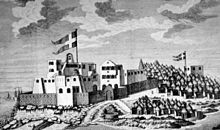
ghana_fort-christianborg_-now-osu-castle
Christiansborg (now Osu Castle) in the 1700s, site of Accra

Jokes aside, originally, Accra was not the most prominent trading center in the country. However, the Dutch built the nearby outposts of Ussher Fort while the British and Swedes built James Fort and Christiansborg castles respectively. By the 17th century, Portugal, France, and Denmark had built forts in the city. As a side, did you know Denmark had been involved in the slave trade? Dutch and Swedes too? The Swedes… in the slave trade along the African coast? For the longest time, I thought the slave trade had only been a Portuguese, British and French affair. So today, the scramble for Africa with the European union, America, China, India, etc… is just a repeat of a 16th – 17th centuries’ history!


accra_main-street-c1885-1908
Main street in Accra between ca 1885-1908

Britain gradually acquired the interests of all other countries beginning in 1851, when Denmark sold Christiansborg (which they had acquired from the Swedes) and their other forts to the British. The Netherlands was the last to sell out, in 1871. In 1873, after decades of tension between the British and Ashantis of the peninsula country Ashantiland, the British attacked and virtually destroyed Ashantiland and Ashanti Region capital of Kumasi. The British then captured Accra in 1874, and in 1877, at the end of the second Anglo-Asante War, Accra replaced Cape Coast as the capital of the British Gold Coast. This decision was made because Accra had a drier climate relative to Cape Coast.


As the newly established Gold Coast’s administrative functions were moved to Accra (1877), an influx of British colonial administrators and settlers grew around Christiansborg (modern Osu, Ministries, Ridge, Labone, and Cantonments), and the city expanded to accommodate the new residents. Victoriaborg was formed in the late 19th century as an exclusively European residential neighborhood, located to the east of the city limits of the time. The boundaries of Accra were further stretched in 1908. This expansion entailed the creation of a native-only neighborhood. Adabraka was thus established to the north of the city.

ghana_aerial-view-accra-7-nov-1929
Aerial view of Accra in 1929

In 1908, the decision was made to build the Accra-Kumasi railway to connect the country’s port with the main cocoa-producing regions. In 1923, the railway was completed, and by 1924, cocoa was Ghana’s largest export.


The modern city of Accra is centered on the original British, Danish, and Dutch forts and their surrounding communities: Jamestown near the British James Fort, Osu near the Danish fort of Christiansborg (now Osu Castle), and Ussherstown near the Dutch Ussher fort.

accra_kwame-nkrumah-memorial2
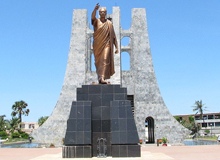
Kwame Nkrumah Memorial in Accra

Tourist attractions include the National Museum of Ghana, the Ghana Academy of Arts and Sciences, the National Archives of Ghana and Ghana’s central library, the National Theatre, the Accra Centre for National Culture, the Jamestown lighthouse, and the Ohene Djan Stadium. The city is also a transportation hub, home to the Kotoka International Airport, and railway links to Tema, Sekondi-Takoradi and Kumasi.


Today, Accra is one of the biggest hubs in West Africa and on the African continent. It is also a place of pilgrimage to many people of African descents trying to retrace their past: African Americans, Afro Brazilians, especially due to the great numbers of slavery forts in the city and country, but also because of the work of W.E.B. Du Bois. Well, if you are ever in Accra, visit, enjoy it, and feel Ghana! The video below will make you want to go there.