 Quand les autres ont reçu, tu pourras encore recevoir, car Imana est encore là (Proverbe Burundais – Burundi).
When others have received, you will still be able to receive, because God is always there (Burundi proverb).

Quand les autres ont reçu, tu pourras encore recevoir, car Imana est encore là (Proverbe Burundais – Burundi).
When others have received, you will still be able to receive, because God is always there (Burundi proverb).

In my series on Reclaiming African History, I came across this article by Ama Biney on Pambazuka about reparations for slavery, which I found very pertinent. I decided to share parts of it. I particularly liked the ending paragraph, “… in addressing the issue of reparations, we must also address transforming the system of capitalism which slavery gave birth to. A rupture with this unequal and exploitative system is fundamental in eliminating oppression that remains with us in the twenty-first century in reconfigured forms“. For the full article, go to Pambazuka.
=============
… what should reparations entail?

… Acknowledging the atrocity and enormity of this experience is necessary in an official apology. Commentators have observed how the Maoris received an apology from the British Queen in 1995. [2] In 2008 the Australian Prime Minister Kevin Rudd apologized in parliament to all Aborigines for laws and policies that “inflicted profound grief, suffering and loss”. [3] It appears when it comes to Africans our lives, bodies and history do not matter. Racism will find various rationalizations (or excuses) to deny that enslavement of Africans merits an apology and reparations. Yet, we cannot erase the collective historical memory and experiences of enslavement that was wrought on people of African descent and continues with the covert and overt forms of racial discrimination that they still experience in the 21st century. …

Whilst it is the case that no amount of financial compensation can address the psychological and emotional scars of enslavement of people of African descent, nor the horrors of the Middle Passage, nor those who remain buried in the Atlantic Ocean as a consequence of suicide, nor the 132 Africans deliberately thrown overboard in 1786 on the slave ship Zong — in order that the ship owners could claim the insurance — a comprehensive economic package needs to address the fact that the current economic and technological underdevelopment of Africa and the Caribbean is symptomatic of the impact of 400 years of enslavement. This enslavement was followed by the brief but no less damaging interlude of colonialism and must be recognized as central to any form of reparations.
… There are those who refuse to accept the fact that the economic wealth of Europe was built on the sweat, blood and toil of African people to the detriment of Africa. Yet, let us be clear that the trans-Atlantic slave trade was not a “trade.” The meaning of “trade” supposes equal benefit to both parties. It was not “trade” but the looting of Africa in which Europe benefited at the expense of Africa as Walter Rodney graphically illustrates in his acclaimed book, “How Europe Underdeveloped Africa.” The consequence for Africa was and remains that “the African economy taken as a whole was diverted away from its previous line of development and became distorted.” [4]

Reparations is therefore a quest to repair the economic damage of underdevelopment wrought by the process of enslavement and colonialism. This economic redress will be symbolic for it may run into trillions of dollars, for one can never place an economic value on the millions of Africans whose lives were lost in the slave raids, or as they died in the long march to the forts on the coast. How many died on such journeys? Can we account for those enslaved women who secretly aborted or killed their child to prevent them from experiencing slavery? And should we not include the medical experimentations carried out on the bodies of enslaved African women graphically documented in the books From Midwives to Medicine and Medical Apartheid? [5]
… Also, it is important for us to remember that on the ending of slavery in the British colonies, the British government were able to compensate the slave owners £20 million (£20 billion in today’s money). There was no compensation for the former enslaved African men and women. In the USA there were pledges to the freed men and women of “forty acres and a mule” that never materialized across the board. [6]
… What should reparations for slavery entail? It should address the following:
First, an apology to all continental Africans and people of African descent for the immorality of slavery, for merely stating “regret” — as the former British Prime Minister Tony Blair did in 2007 — is mere cant. [7] …
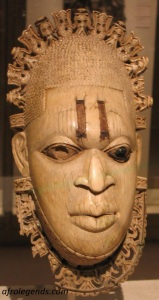
Second, we must demand that all Western governments instruct Western museums and citizens to hand over to African countries illicitly acquired African artifacts languishing both publicly and privately in their hidden vaults. They must also provide the training and facilities for African countries to host, display and conserve these returned items. This includes thousands of artifacts, among them being the more famous and well known 400 Ethiopian treasures looted by British soldiers during the 1868 Magdala expedition. [9] There are also the Benin bronzes looted in the British invasion of the Nigerian kingdom of Benin in 1896. [10] …
Third, as mentioned above, the brain drain of African and African Caribbean professionals should be halted by offering these professionals the same salaries to voluntarily return to Africa and the Caribbean in order to assist in the building of new schools, universities, hospitals and clinics that would be set up and financed by a comprehensive reparations economic program.
Debt cancellation would free up these critical funds to address the real needs of African citizens.
 Fourth, cancellation of all debt incurred by the Caribbean and African nations on the grounds that they are odious and were not incurred by the ordinary citizens of Africa and the Caribbean but rather their ruling classes. … In short, aid is simply a paltry and ineffective band aid that keeps African economies in a continued process of economic subordination to neoliberal capitalism under the illusion that there will be “trickle down growth.” …
… Ultimately, in addressing the issue of reparations, we must also address transforming the system of capitalism which slavery gave birth to. A rupture with this unequal and exploitative system is fundamental in eliminating oppression that remains with us in the twenty-first century in reconfigured forms.
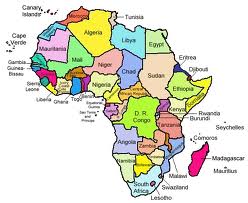
Africa has a rich naming tradition, which varies across the continent.This article by the BBC goes over some of the African naming traditions. I added a few more, and removed their ‘celebrity culture’ section, given that naming children after celebrities is not an African thing but a world thing, and dates as far back as the world. Don’t forget to check out the article I wrote on ‘My Name’ by Magoleng wa Selepe. You can read the full article on BBC.
================
Traditional African names often have unique stories behind them. From the day or time a baby is born to the circumstances surrounding the birth, several factors influence the names parents choose for their children. Whichever ethnic group you look at, these local names reveal a wealth of information about the bearer. Here are [eight] different ways African parents name their children:
Events surrounding birth

Among several ethnic groups, picking out names can be influenced by positive or negative circumstances the family finds themselves in around the time a child is born. Often, such names are complete sentences.
Emotional warnings
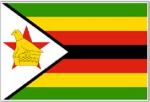
Some names, especially in Zimbabwe, [and Nigeria] reflect the mood or circumstance of the family at the time of birth. Some of them serve as warnings or rebukes.
… But this is not unique to Zimbabwe. [It can be found across the continent, from Malawi, to Nigeria, to Ghana, etc.] …
Order of birth
In many African cultures, there is no need for someone to explain whether they are the eldest or youngest of their siblings. This is because their names can reveal that much. This is especially true of twins.
If you meet a Ugandan boy or man called Kakuru or Wasswa, he is likely to be an elder twin. The younger male twin is usually called Kato. These are names specially reserved for twins.
Similarly, the Kalenjins in Kenya refer to the first born as Yator (first to open the way) and the last born Towett meaning last.
The Yorubas call the first twin Taiwo (taste the world) and the second Kehinde (came after).
In Ghana, the unisex names Panyin and Kakra, which basically mean older and younger, are used for twins.
[In Cameroon, in the Bamileke culture, the child who follows directly after twins is given names such as Kenfack, Kengne or Kammagni. While the parents of twins are given the special names of Magne (mother of twins) and Tagne (father of twins), and the Magne used to have a special place in the society just like the twins. Moreover, babies born breach are also given a particular name, Tcheutchoua, to show how difficult the delivery had been.]
Day-born names
 … Among some Ghanaian [and Ivorian] ethnic groups like the Akan, Ga, Ewe and Nzema, a name is automatically assigned based on the day the child is born. These day names correspond to the day of the week someone is born and so by default, everybody has one – though the name may not necessarily appear on official documents.
These day names can vary slightly depending on the ethnic group.
Faith-based names
… Across the continent, several local names have religious links. Among the Igbo and Yoruba ethnic groups in Nigeria, a name that starts or ends with Chi (Igbo), Chukwu (Igbo) or Oluwa (Yoruba) has some kind of reference to God.
Day and night
Among some groups in eastern and southern Africa, certain names are selected depending on the time of the day or season a child is born.

While the Luos are very specific:
Girls are given the same names but starting with an A instead of an O. [For instance, Atieno (night).]
Meet the ancestors
Respected elders of the family may be dead but they continue to live on through their grandchildren. Parents often name babies after senior members of the clan whether dead or alive. But it is considered disrespectful to casually shout or call out the name of a senior family member that has been given to a child, so instead it is common to hear a child affectionately called Ouma (grandma) or Oupa (grandpa) in southern Africa.
Similarly in Senegal, a child who is named after a grandfather tends to bear the grandfather’s nickname as well. So a baby boy often ends up being called Vieux (old man), [or Pape, or Papa].

Rude nicknames
Somalia has a unique system. Most people have three names – the ones they were given, as well as that of their father and grandfather [same in Sudan]. But many also have nicknames, which are so common that they can find their way onto official ID cards.
These nicknames often pick on the negative physical traits of the bearer, if he is male. Some common nicknames for men include Langare (limpy), Coryaan (handicapped), Lugay (one leg) or Genay (missing tooth).
Women, however, mostly get flattering nicknames like Lul (diamond), Macanay (sweet), Cod Weyne (rich voiced), Dahable (golden) and Indho Daraleey (gazelle eyes). …
Fellow readers, I wish you all an AMAZING new year, may the year 2017 mark the fulfillment of old and new dreams that will last a lifetime. I would like to express my profound gratitude to all those who visited my blog, reblogged articles, commented, and to all future visitors. 2016 was a beautiful year: Afrolegends.com had lots of new views, new subscribers, and many articles getting reblogged on multiple sites. We also ended the year with a book getting published on Kindle, and started new collaborations. For 2017, I wish you wonders without borders, peace, joy, and love.
The 5 top posts of 2016 can be seen below. For this new year, we will bring you even more amazing, fun, and rich articles. Keep trusting, reading, sharing, reblogging, and liking. Keep your heads up, and may your year be as beautiful as the petals of this flower! As always, like Agostinho Neto said, “A luta continua … a vitória é certa!”

1. Adinkra Symbols and the Rich Akan Culture
2. ‘Love Poem for My Country’ by Sandile Dikeni
3. Samori Toure: African leader and Resistant to French Imperialism
4. History of African Fabrics and Textiles
5. Timbuktu, one of the world’s first and oldest university

La poule pond ses oeufs quand les gens ne la regardent pas (Proverbe Libinza, Mongo – RDC). – On cache les secrets du métier.
The hen lays eggs when no one is looking (Libinza proverb, Mongo – DRC). – Trade secrets are hidden.
Tis’ the season of blessing, joy, happiness, and merry-ness. I would like to share with you a book which will make you all laugh to tears. A king, a beautiful princess, and a pot of hot chili sauce… the combination is bound to make you laugh. Enjoy this book, an African Children’s book, for young and young at heart, perfect for Christmas and to spice it up the African way! It is on kindle e-book. Enjoy and Happy Holidays!

Que de couleurs, que de rires, que d’astuces, que d’intelligence dans ce livre! Le Lièvre, la Princesse, et la marmite de piment est un livre véritablement adapté a toute période enjouée! Je vous garantis qu’il vous fera passer de bons moments. C’est sur Amazon Kindle. Bonnes fêtes de fin d’année!


It is about time we talked about Alexandria, the light of Egypt. So why the name Alexandria? If you thought about Alexander the Great, then you are absolutely right! Yes. The second largest city and major economic center of Egypt was named and founded by Alexander the Great.
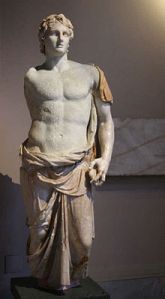
Alexandria was founded around a small Ancient Egyptian town around 331 BC by Alexander the Great. It became an important center of the Hellenistic civilization and remained the capital of Hellenistic and Roman and Byzantine Egypt for almost 1000 years until the Muslim conquest of Egypt in AD 641, when a new capital was founded at Fustat (later absorbed into Cairo). Hellenistic Alexandria was best known for the Lighthouse of Alexandria (Pharos), one of the Seven Wonders of the Ancient World; its Great Library (the largest in the ancient world; now replaced by a modern one); and the Necropolis, one of the Seven Wonders of the Middle Ages. Alexandria was the second most powerful city of the ancient world after Rome. Ongoing maritime archaeology in the harbor of Alexandria, which began in 1994, is revealing details of Alexandria both before the arrival of Alexander, when a city named Rhacotis existed there, and during the Ptolemaic dynasty.

To me, Alexandria, has always had a special place in my heart because of its Great Library. Imagine thousands upon thousands of ancient papyri, scrolls, and books on mathematics, philosophy, medicine, architecture, etc. Just the thought of it makes my eyes shine with light. Isn’t it thrilling? And then to know that this library had been burnt down by the army of Julius Caesar in 48 BC (more like a repeat of history: Palmyra, The giant Buddhas of Afghanistan, Timbuktu, …) also makes my heart ache at the thought of all this knowledge gone down in flames. Today, we remember the Great Library of Alexandria thanks to what poets and writers of the past said about it, but there are no vestiges of it. I also remember Alexandria because of the brilliant female mathematician Hypatia who chaired a department of philosophy and astronomy, and the world-renowned mathematician Euclid.
Today, Alexandria is Egypt’s largest seaport, serving approximately 80% of Egypt’s imports and exports. It is an important industrial center because of its natural gas and oil pipelines from Suez. Alexandria is also an important tourist destination. Enjoy the video below about Alexandria, the beautiful!

This story is from a book called “The Secret of the Crocodile“, a Namibia Oral Tradition Project, published by New Namibia Books. (Paraphrased)
=========
The crocodile originally had a beautiful smooth golden skin, and it stayed that way because the crocodile would spend all day in the muddy waters and only come out at night.
During the day all the other animals would come and admire it’s beautiful golden skin.
The crocodile became very proud of its skin and started coming out of the water to bask in the other animals’ admiration, even while the sun was shining. He began thinking he was better than the other animals and started bossing them around.
The other African animals became bored with his change in attitude and fewer and fewer started showing up to look at his skin.
But each day that the crocodile exposed his skin to the hot African sun, it would get uglier and bumpier and thicker, and was soon transformed into what looked like bulging armor.
Crocodile never recovered from the humiliating shame and even today will disappear from view when others approach, with only his eyes and nostrils above the surface of the water.

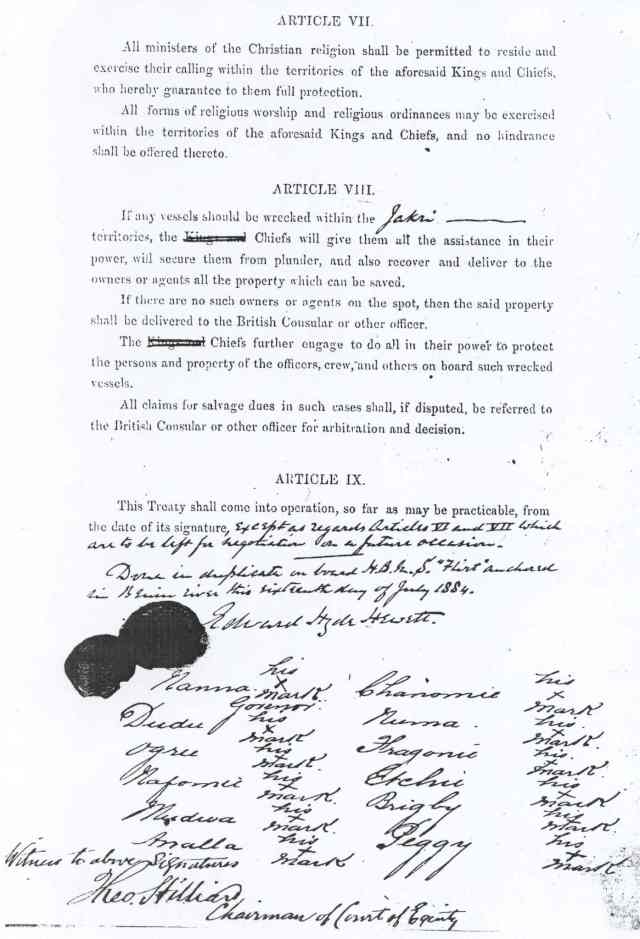
First of all, I would like to raise my hat to Peter Ekeh, the editor of the website Waado.org who has done an amazing job archiving and analyzing some of the treacherous treaties signed between the British and the local populations of Southern Nigeria. I am publishing here a protection treaty signed on 16 July 1884; this was the first treaty signed by the British in that area. Here is what Ekeh says, “Although the first clause, Article I, of these pro forma Protection Treaties claimed that the British were engaging in their agreements in “compliance with the request of the Chiefs and People” of the political communities concerned, it was clear that the Foreign Office from London and its assigned imperial agents, in the Niger Delta and beyond, were driving the terms and purpose of the treaties.

Indeed, it is doubtful that the Chiefs of any Nigerian communities understood the letter, let alone the spirit, of these Treaties of Protection whose pro forma texts were printed in England, written in English, and “interpreted” by British imperial agents to the signatory chiefs. However, the consequence of their signing the Treaties was that these Chiefs and their people lost their sovereignty.” Below is one of them. Check out Waado.org to read an in-depth analysis of the 16 July 1884 British colonial treaty with the Itsekiri people, as well as to see the appendix to the 1884 Treaty between the British and the Itsekiri.
==========




 African Heritage