
Originally posted on Good Black News.
Very happy to see the cover of Vogue Spain which claims ‘Black is Beautiful’ and to see model Aya Jones rocking cornrows (on a cover). See… this made me think of the poem ‘African Hair’ by Esmeralda Yitamben and its beauty, the photographs taken by J.D. Okhai Ojeikere of different African hairstyles posted on my blog recently. Enjoy!
Category: Uncategorized

Happy International Woman’s Day!
 For today, in celebration of millions, and billions of women out there, I choose to re-post this poem which always stood on the door to my Mother’s office for many years. This poem, “WOMAN” is from Gold Touch International, and was originally posted on March 8th, 2012 on Afrolegends. Enjoy, and yes salute all the strong women in your lives.
WOMAN
Be tough, woman.
Be brave
Go out fearlessly and do the things
That your heart desires to do.
You will be counted in the world.
Don’t allow fear to paralyze you.
Stand up and face the challenges of life,
Squarely in the face, however great
They may be.
Forge ahead and conquer.
March on to the victory that awaits you.
No one will toss victory onto you.
You have to win it yourself.
Carve out a place for yourself in the sun, woman.
Let not fear destroy that great dream of yours.
Don’t fear to be laughed at;
Don’t fear to be criticized;
Don’t fear to fail;
Don’t fear to be thought crazy when you dare
To do the things that others fear to do.
Be tough and march on.
You will conquer, woman.
You have what it takes to
To win all the victories
That your heart desires to win.
Be tough and win.
This is a message from Gold Touch International.
Share this:

Proverbe contre la violence aux femmes/ Proverb against domestic violence
 Le chien ne retourne jamais là où on l’a frappé (Proverbe Ruandais – Ruanda).- Ne frappez jamais votre femme.
The dog never returns where it was beaten (Rwandan Proverb – Rwanda).- Never beat your wife.
Share this:

J.D. Okhai Ojeikere: Capturing Afro Hair for History

The following words are from Nigerian photographer J.D. ‘Okhai Ojeikere who decided to take pictures of Nigerian Afro Hairstyles as a way of preserving history. The pictures were taken from 1950 – 1970s. You will see that some of the styles are no longer made today. The text below and the pictures can be found in André Magnin: J.D. ‘Okhai Ojeikere/ Photographs, First Scalo Edition 2000.
========
… I never stopped taking photographs as both a memory of the past and a witness to a culture in constant evolution.
Hairstyling is a practice to increase beauty. It is not specific to Nigeria. It is found throughout… the continent. There are hundreds of ethnic groups in Nigeria, each with its own language, traditions and as many different hairstyles. … The hairstyles are never exactly the same; each one has its own beauty. … Most of my pictures are of quotidian hairstyles, but there are also ceremonial hairstyles. …

The styles are determined by the type of ceremony, the social position of the family or of the woman and the artistic talent of the hairstylist. Some have lost their original meaning to new meanings assigned to them. You can easily identify a woman by her hairstyle: a woman who has become an adult; a woman who is preparing for marriage… It is difficult today to know the origins of some hairstyles because different groups mix and adapt to modern culture. … There are many new hairstyles everywhere, but many of them are inspired by older models.
Hairstyling is a form of art. When you see a hairstylist do this or that, every single movement is precise and rapid. She creates a hairstyle the way a sculptor would work – from nothing. It’s fascinating. These hairstyles pass from one woman to another; from one style to another without every repeating. It’s like a school, but some have a real talent that makes them stand out.

Share this:

Proverbe sur l’essentiel / Proverb on the essential
 Si un seul cheveu de votre tête tombe, cela ne gêne pas votre tête (Proverbe Zigula – Tanzanie). – Ne pas s’occuper de détails, mais de l’essentiel.
If one hair of your head falls, it does not bother your head (Zigula proverb – Tanzania).- Do not deal with details, but with the essential.
Share this:

Nelson Mandela in his Own Words

I remember the day Nelson Mandela was freed from jail after 27 years of imprisonment. It was on 11 February 1990. This being a national holiday in Cameroon, we were all at home, and could watch live as Nelson Mandela was released from prison and walked hand in hand with Winnie Mandela, both with their fists raised high up. Later that day, Mandela stood outside the balcony with his fist raised high up, and said: “Amandla!” to which the overjoyed crowd replied “Ngawethu!”, in other words, “Power to the People!” And he finished “iAfrika!” I am leaving you here with some words by Mandela himself.
========
“I raised my right fist and there was a roar. I had not been able to do that for 27 years and it gave me a surge of strength and joy.” Describing the day of his release from prison in 1990 – Long Walk to Freedom, Nelson Mandela, 1994.
“I am fundamentally an optimist. Whether that comes from nature or nurture, I cannot say. Part of being optimistic is keeping one’s head pointed toward the sun, one’s feet moving forward. There were many dark moments when my faith in humanity was sorely tested, but I would not and could not give myself up to despair. That way lays defeat and death.” Long Walk to Freedom, Nelson Mandela, 1994.

“I learned that courage was not the absence of fear, but the triumph over it. The brave man is not he who does not feel afraid, but he who conquers that fear.” Long Walk to Freedom, Nelson Mandela, 1994.
“Everyone can rise above their circumstances and achieve success if they are dedicated to and passionate about what they do.” Long Walk to Freedom, Nelson Mandela, 1994.
“Education is the most powerful weapon which you can use to change the world.” Long Walk to Freedom, Nelson Mandela, 1994.
“Resentment is like drinking poison and then hoping it will kill your enemies.” Long Walk to Freedom, Nelson Mandela, 1994.
“I like friends who have independent minds because they tend to make you see problems from all angles.” Long Walk to Freedom, Nelson Mandela, 1994.

“I found solitary confinement the most forbidding aspect of prison life. There is no end and no beginning; there is only one’s own mind, which can begin to play tricks. Was that a dream or did it really happen? One begins to question everything. Did I make the right decision, was my sacrifice worth it? … But the human body has an enormous capacity for adjusting to trying circumstances. I have found that one can bear the unbearable if one can keep one’s spirits strong even when one’s body is being tested. Strong convictions are the secret of surviving deprivation; your spirit can be full even when your stomach is empty.“ On Prison – Long Walk to Freedom, Nelson Mandela, 1994.

“In the name of the law, I found myself treated as a criminal… not because of what I had done, but because of what I stood for, because of my conscience. No-one in his right senses would choose such a life, but there comes a time when a man is denied the right to live a normal life, when he can only live the life of an outlaw because the government has so decreed to use the law. … The question being asked up and down the country is this: Is it politically correct to continue preaching peace and non-violence when dealing with a government whose barbaric practices have brought so much suffering and misery to Africans? I cannot and will not give any undertaking at a time when I, and you, the people, are not free. Your freedom and mine cannot be separated. I will return.” Message read by his daughter, Zindzi Mandela, at a rally in Soweto in 1985.
“It seems the destiny of freedom fighters to have unstable personal lives… to be the father of a nation is a great honour, but to be the father of a family is a greater joy. But it was a job I had far too little of.” Talking about fatherhood – Long Walk to Freedom, Nelson Mandela, 1994.
“A man who takes away another man’s freedom is a prisoner of hatred, he is locked behind bars of prejudice and narrow-mindedness… The oppressed and the oppressor alike are robbed of their humanity.” On prison – Long Walk to Freedom, Nelson Mandela, 1994.
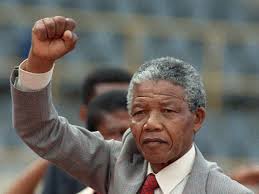
“The value of our shared reward will and must be measured by the joyful peace which will triumph, because the common humanity that bonds both black and white into one human race will have said to each one of us that we shall all live like the children of paradise… But there are still some within our country who wrongly believe they can make a contribution to the cause of justice and peace by clinging to the shibboleths [dogmas] that have been proved to spell nothing but disaster. It remains our hope that these, too, will be blessed with sufficient reason to realize that history will not be denied and that the new society cannot be created by reproducing the repugnant past, however refined or enticingly repackaged.” On receiving the Nobel Peace Prize with F.W. de Klerk, 1993.
“There is no passion to be found playing small – in settling for a life that is less than the one you are capable of living.” Presidential Inauguration, 10 May 1994.
“Never, never, and never again shall it be that this beautiful land will again experience the oppression of one by another… The sun shall never set on so glorious a human achievement. Let freedom reign. God bless Africa!” Presidential inauguration, 10 May 1994.
“There is no easy walk to freedom anywhere, and many of us will have to pass through the valley of the shadow of death again and again before we reach the mountaintop of our desires.” Long Walk to Freedom, Nelson Mandela, 1994.

“I am confident that nobody … will accuse me of selfishness if I ask to spend time, while I am still in good health with my family, my friends, and also with myself.” On stepping down after his first term as president.
“Sometimes it falls upon a generation to be great. You be that great generation. Let your greatness blossom. Of course the task will not be easy. But not to do this would be a crime against humanity, against which I ask all humanity now to rise up.” Message at the Live 8 Concert in Edinburgh, July 2005.
Share this:

Nelson Mandela, Madiba, Our Freedom Fighter is no Longer
Words cannot quite express my sadness at the loss of Africa’s greatest man, and probably one of the world’s greatest icon: Nelson Rolihlahla Mandela. Just to think that this man spent 27 years in jail so that we, Black people, could have rights, could have freedom, could be free to love, live, and work, is beyond amazing! Yes… almost 3 decades, and more, since he did not really lead a ‘true’ family life because he spent most of his time pursuing his cause for the freedom of Blacks in South Africa. What tribute could I possibly give for a man who spent most of his life fighting so that I, a Black child, could walk free in South Africa after our land was taken by the Boer invader, and we were beaten under oppressive laws? What could I possibly say for a man who epitomizes true leadership, statesmanship, democracy, humility, and love… love in the face of so much hate. Because, for Nelson Mandela to make it, there were those like Steve Biko or Chris Hani who were killed by the apartheid system. I would just like to say farewell Madiba… for you, I am a proud African child… Farewell Father Mandela, for you, I can roam the streets of South Africa free… Farewell Nelson, for you, I am free… because of you, I am a proud Black child, for you I am a proud African!
I live you with one of his quotes: “What counts in life is not the mere fact that we have lived. It is what difference we have made to the lives of others that will determine the significance of the life we lead.” Madiba, you have truly changed my life, and that of millions around the globe! The world is a better place because you stepped on it! So long… Madiba!
Share this:

‘Sous-Developpement’ de Charles Ngande / ‘Under-development’ by Charles Ngande
 Thinking about all the wasted years of corruption, mismanagement, neo-colonialism, nepotism, and all the -isms going on in many African countries after independence, I thought of sharing with you this poem by the Cameroonian author Charles Ngande. The poem can be found in Anthologie Négro Africaine by Lilyan Kesteloot, Edicef 1992, P. 329. The English translation is offered to you by Dr. Y., http://www.afrolegends.com
| Sous-développement
J’ai croqué tous mes rêves Dans les fragiles écuelles de nos indépendances, Assis Dans les fauteuils Des banques étrangères! |
Under-development
I chewed all my dreams In the fragile bowls of our independences, Seated In the armchairs Of foreign banks! |
Share this:

Y’en a Marre and The New Type of Senegalese: Be the Change You Want to See

Today, I would like to talk about the “Y’en a Marre” (“Fed Up“), a Senegalese group which influenced change in the presidential election of 2012 in Senegal, by forcing President Abdoulaye Wade (and his son, Karim Wade) out of office. Y’en a Marre decided to stop complaining and to start acting, to make the changes they wanted implemented. It is a group of Senegalese rappers and journalists, created in January 2011, to protest ineffective government and register youth to vote. They are credited with helping to mobilize Senegal’s youth vote and oust incumbent President Abdoulaye Wade, though the group claims no affiliation with Macky Sall, Senegal’s current president, or with any political party.
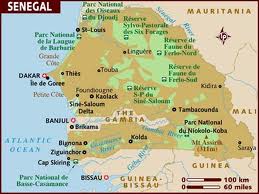
The group was founded by rappers Fou Malade (“Crazy Sick Guy“, real name: Malal Talla), Thiat (“Junior“, real name: Cheikh Oumar Cyrille Touré), Kilifeu (both from celebrated rap crew “Keur Gui of Kaolack“) and journalists Sheikh Fadel Barro, Aliou Sane and Denise Sow. The movement was originally started in reaction to Dakar‘s frequent power cuts, but the group quickly concluded that they were “fed up” with an array of problems in Senegalese society. “One day, there was 20 hours of cuts,” said Fadel Barro, whose dimly lit apartment served as the place where the movement took shape. “I said: ‘Guys, everyone knows you. But you’re not doing anything to change the country.’ ”[from NYT interview – see link below]. Those words energized the musicians.
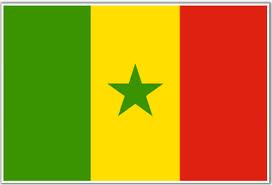
Their goal was to incite Senegalese to vote, to renew the political personnel, to fight against corruption and to promote a sense of civic responsibility. Their most famous quote is: « L’heure n’est plus aux lamentations de salon et aux complaintes fatalistes face aux coupures d’électricité. Nous refusons le rationnement systématique imposé à nos foyers dans l’alimentation en électricité. La coupe est pleine. » [The hour is no longer to ballroom lamentations and fatalistic complaints in the face of power cuts. We refuse the systematic rationing imposed on our homes in the power supply. Our cup is full to the rim.]
Through recordings, rallies and a network of regional affiliates, called “the spirit of Y’en a Marre“, the group advocates for youth to embrace a new type of thinking and living termed “The New Type of Senegalese” or NTS. In late 2011, the collective released a compilation titled “Y’en A Marre“, from which the single “Faux! Pas Forcé” (“Don’t force it”) emerged as a rallying cry for youth frustrated with President Wade and his son and presumed successor. They followed with a single, “Doggali” (“Let’s finish”), which advocated for cleansing the country of Wade and son.

From April to August 2011, the group and their members campaigned door to door to register young Senegalese to vote at the Presidential election of 2012, and they claimed more than 300,000 voters registered. During 2011, they organized manifestations, called “foires aux problèmes” (“problem fairs”), and sit-ins in Dakar’s Obelisk Square. On 15 February 2012, these manifestations were prohibited by Wade’s government, leading to 3 members of Y’en a Marre’s arrest on the 16th. This did not stop the group which continued manifesting until the election of Macky Sall as President. Today, even though Macky Sall has been elected president, Y’en a Marre remains active, hosting meetings, and shows, urging the new government to implement all the promised reforms.
So we can all choose to be the change we want to see, stop complaining, and start acting like Y’en a Marre. If there is anything wrong bothering you in your community, it is possible to work at it, to act upon it, and change it the way you want it to be. Our countries all need it, our continent needs it. Read the article the New York Times did on Y’en a Marre, as well as the UNRIC, and the article on NPR. So let’s us be “fed up” like the Y’en a Marre, and let us act and be the change we want to see.
Share this:

Celebrating 2 years of blogging
Dear all,
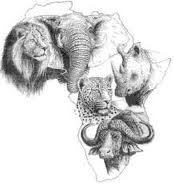
21,200 blog views, and over 100,000 youtube views, I would like to thank all my fellow readers, and writers, for stopping by my blog. If 2 years ago, someone had told me that I will be blogging and having an active blog life, I would have never believed it. I am extremely grateful for the support of all of you my readers, and grateful for your trust. I hope to keep you updated, and keep up with the great work.
Once again THANK YOU!


