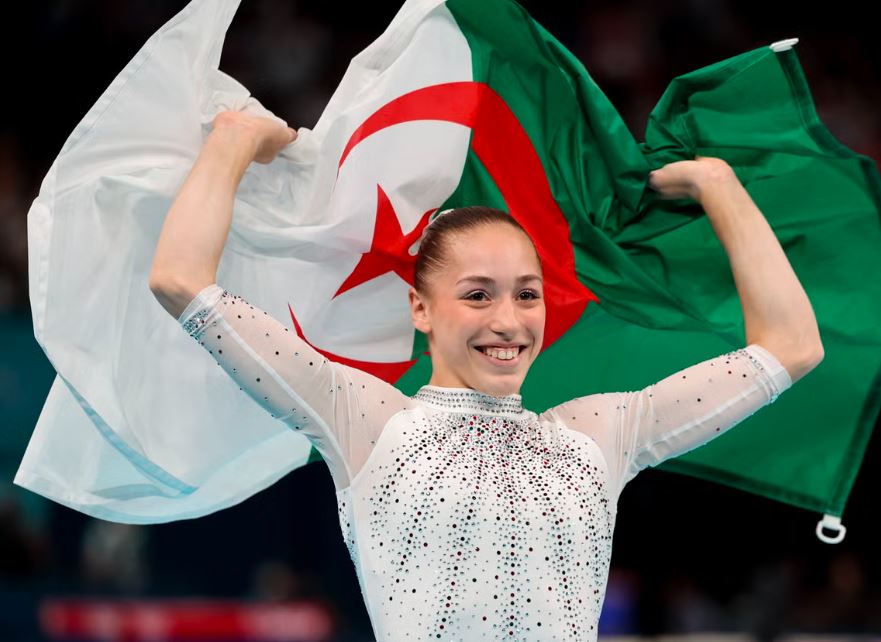
Kaylia Nemour celebrates with the Algerian flag (Source: Reuters / Independent)
As the Paralympics 2024 are currently under way in Paris, and as paralympians show us that there is so much beauty in life, today, we will focus on yet another African athlete who gave her country the highest honors at the Paris 2024 Olympics. The athlete of our focus today is Algerian Kaylia Nemour, the goldmedalist in gymnastics in Women’s uneven bars. Born in France of an Algerian father and a French mother, Nemour was representing France until last year when she switched her country to represent that of her father, Algeria. The switch came as a result of a rift between her and the French Gymnastics Federation which did not clear her to resume training after a knee surgery despite the fact that she had been cleared by her surgeon, and which also wanted Nemour to leave her club and train in Paris under their supervision instead, but she did not want to, and opted instead to switch to representing Algeria. She still lives and trains in France, at her club Avoine Beaumont Gymnastique whose director is her mother.
Kaylia Nemour in action during the uneven bars final (Source: EPA / Independent.co.uk)
Since Nemour opted to represent Algeria, she has been on fire. At last year’s world championships, she won a silver medal on uneven bars, the first World medal ever by a gymnast representing an African nation. She is also an African all-around champion and has an element named after her in the Code of Points (The Nemour). This year at the Paris 2024 Olympics, she handed Algeria and Africa as a whole, its very first gold medal in gymnastics. She also got the best score of her life in the event, with a score of 15.700. Her victory is reminiscent of the victory of the great Algerian Hassiba Boulmerka who won the gold medal at the Barcelona 1992 Olympics in the Women’s 1500m, thus handing her country its very first Olympic gold medal ever.
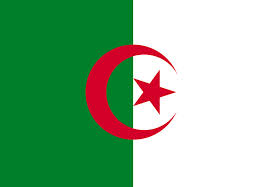
Flag of Algeria
We are proud of Kaylia’s choice to represent Algeria, it must not have been an easy choice, and we are also happy that the Algerian federation has been supportive of her. Her coach, Marc Tcherlinko, said, “It [representing Algeria] was not in the plan,but life serves you some curves, some rivers you must cross. For two years she stayed focused on her goal – the Olympics. What she’s achieved is amazing.” Nemour is considered by many as one of the best gymnasts of her generation on uneven bars. As a result of her Olympic victory, she has been decorated with the Ahid National Order of Merit of Algeria presented by the nation’s president. Just after her win, she said: “I am very, very, very happy with what I was able to do today. … It was my ultimate dream, years of work and hard work, details. … I am really honored to have been able to win this medal, first for me and for Algeria too.” I am sure Nemour has set an example for countless Algerian and African little girls. The future is bright for Nemour and promising for Algeria and the continent as a whole in gymnastics.
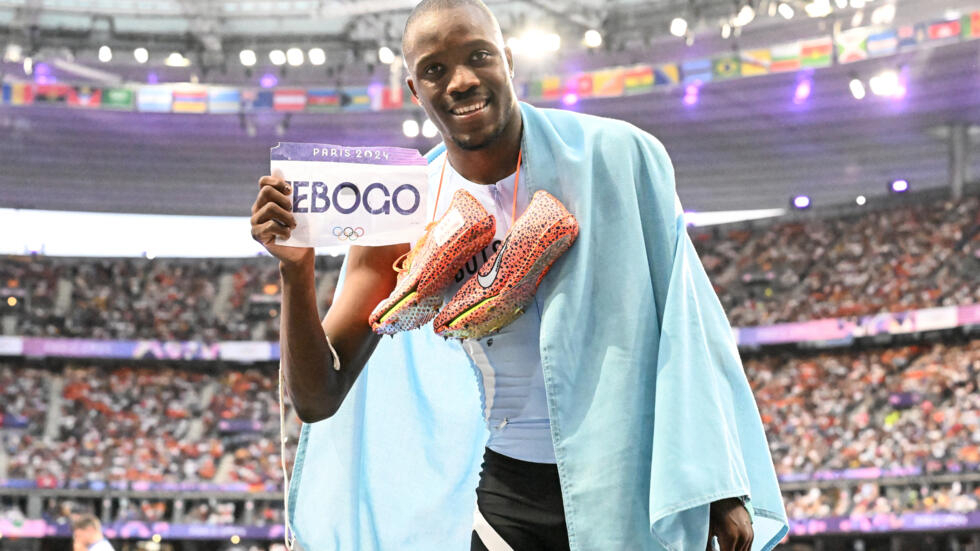
Letsile Tebogo after winning gold in 200m (Source: Onuaonline)
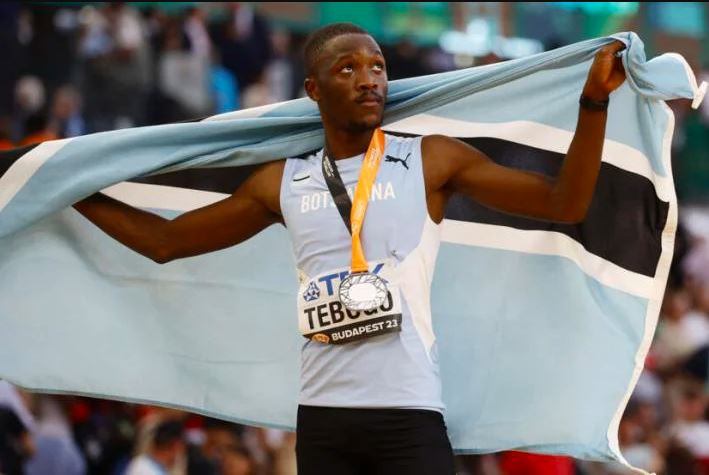
Since Frankie Fredericks of Namibia, who used to always win silver at the Olympics in the 1990s, no African has gotten close to the gold medal in the 100-200 m distances until Letsile Tebogo of Botswana who won the first African gold in the Men’s200 m discipline ever, at the Paris 2024 Olympics. He also helped Botswana and an African country land silver in 4 x 400 m Men’s relay. By winning the gold medal at the Paris 2024 Olympics, Tebogo became the first Olympic gold medal winner from Botswana and the first runner from Africa to win the 200m final at the Olympic Games. He set a new African record by shaving off 0.04 seconds off his previous best to clock 19.46 s. “Africans can be sprinters, too,” he said in an interview to NBC Sports.
Letsile Tebogo (Source: SportNewsAfrica)
Tebogo started with a strong love for football (soccer). At the age of six, Tebogo was already a well-rounded footballer and sprinter. His teachers encouraged him to practice both sports, but injuries hampered his football career so he opted to focus solely on track. As he explained in an interview with Runblogrun.com., “I used to run past people and won medals. I also played football. Every time though I went to play football I was being benched.” “[This] made me frustrated…and prompted my decision to go back to athletics as I saw [that] I am able to put food on the table for my family from that,” added the runner whose single mother Seratiwa Tebogo struggled to raise him and his younger sibling. His mother, who was his pillar, passed away this past May and did not get to see her son achieve this great accomplishment, but there is no doubt that she would be very proud of her son. Tebogo dedicated his 200m gold medal win to her, and held up his shoe to the camera after the race, which featured his mother’s birthdate on it. He also painted her initials on his nails. … ” I’ve had such a huge blow that affected me deeply so I’m still trying to get the confidence back into the body. It’s not about injuries, it is all about my mum.” Reflecting on his Paris Olympic victory, Tebogo shared, “It was a truly memorable race. Heading into the final, my coach told me his job was done and the rest was up to me—to finish the race healthy, medal or not. I’m glad I could finish stronger than before, carrying the memory of my mother with every stride. She’s watching from above, and I know she’s proud. I chose not to mark the date of her death on my shoe because it’s too emotional.”
Flag of Botswana
He “didn’t take sprints seriously until 2019” when he raced his first major 100m in 10.68s and clocked 21.12s in the 200m. “For a while, I didn’t pay more attention to athletics until about 2018-2019 when I realized I could go professional with it,” Tebogo said. “The motivation to get into athletics was from watching the big guys likeIsaac Makwala, Karabo Sibanda and Nijel Amos,” explained Tebogo. “However, I just really wanted some change in the country, so I had to do something different from the big guys, that’s why I opted to compete in the 100m and 200m.”
Like so many track and field athletes in the sprint distances, he looks up to Usain Bolt, the fastest man in the world and 8-times Olympic champion, and dreams of running faster and faster. “It’s time for Africa to take charge over the sprints and every event,” he said in the interview with Runblogrun.com.
Since his Olympic triumphant victory in Paris, he has been taking charge by winning 2 other games so far. Keep an eye out for Tebogo tonight at the Diamond League event in Rome, Italy.
Thomas Kanza was a Congolese diplomat who served as Congo (now Democratic Republic of Congo (DRC))’s first ambassador to the United Nations from 1960 to 1962. He also served as a minister of foreign affairs at some point. He wrote a memoir entitled, The Rise and Fall of Patrice Lumumba: Conflict in the Congo, which covered his own personal experiences as the Congo became independent, and his interactions with Patrice Emery Lumumba. He said, about Lumumba in an interview to Jeune Afrique:
“Patrice Lumumba represents for Congo what Fidel Castro represents for Cuba, Nasser for Egypt, N’krumah for Ghana, Mao Zedong for China, and Lenin for the Soviet Union.
Despite his short political life and his tragic end, perhaps because of them, Patrice-Emery Lumumba has entered history through the front door : that of heroism and martyrdom.
He is at once the flag and the symbol. He is all.He embodies everything : the struggle, the courage, even temerity, the suffering, the action and the perseverance. He lived as a free man, as an independent thinker : his writings, his words, his acts were those of the responsible man, conscious of his vocation as a liberator.”
(Lumumba et le lumumbisme, Jeune Afrique, nº 268, 13 Février 1966) Translated to English by Dr. Y., Afrolegends.com
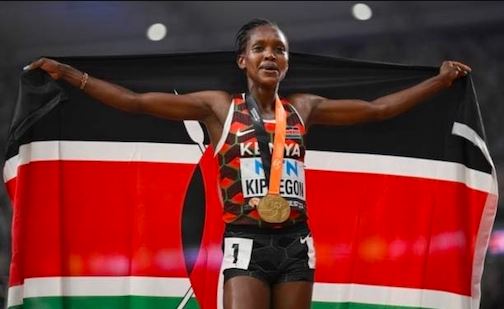
This week, we will talk about Faith Kipyegon, our Kenyan sister who made history at the Paris 2024 Olympics as the first African athlete to earn a gold medal in the same discipline three times in a row: Rio 2016, Tokyo 2020, and now Paris 2024. This is a remarkable feat never achieved before by an African, and only a select few athletes in the world can claim such in any Olympic discipline. She said, “It’s a big, big achievement. I was really looking forward to defending my title. I had a dream, I completed it. … I managed to make history, to win the gold medal in the 1500. It was my key target. I’m so, so grateful.” And Faith went further by setting a new Olympic record in the event with a time of 3:51.29. She is considered one of the greatest 1,500m athletes the world has ever seen, and has dominated the field for the past 7 years. Moreover, she has a gracious presence which makes her endearing to her fellow competitors. She is nicknamed the “smilingdestroyer.”
Faith Kipyegon winning historic 3rd gold medal at the Paris 2024 Olympics (source: Kelly Ayodi for Olympics Kenya – EastleighVoice.co.ke)
She posted on X,
“Track History Made in Kenya Three successive Olympic titles in women’s 1500m : Rio-2016, Tokyo-2020, Paris-2024
It has taken DISCIPLINE, HARD WORK, DEDICATION, CONSISTENCY and FAITH
Praise be to God Thanks for the love“
Flag of Kenya
Born in 1994 on a rural Kenyan farm in Nakuru County in the Rift Valley, Kipyegon, like so many Kenyan and Ethiopian distance runners, walked and jogged many miles to and from school. She grew up exposed to a culture of running in her family (her elder sister Beatrice Mutai is a 10km and half marathon specialist, her dad Samuel Kipyegon Koech was a 400m and 800m runner, whole her mother was also in athletics) and community. Her talent was identified early on by her physical education (P.E.) teacher. By the time she was 16, she had already placed 4th in the World Cross Country championships. She trains in Kaptagat and shares the same coach, Patrick Sang, as another great Eliud Kipchoge. She is also a mother of a beautiful daughter, and on the year she came back from maternity in 2019, she won at the Diamond League in Oregon. She owes her success to, as she says, hard work, discipline, dedication, consistency and faith, but also to the great Kenya’s athletics training system which has given us phenomenal distance runners over the years.
Now onto further victories for Faith, for Kenya, and for Africa as whole. The 2028 Los Angeles Olympics are around the corner. Let’s keep working hard, consistently, in a discipline manner, and with faith.
Tamirat Tola wins Men’s Marathon at Paris 2024 Olympics (Source: afrik.com)
There were many awesome stories at Paris 2024 Olympics. Many athletes surpassed themselves, broke new records, and set new firsts. The Olympics are over, but over the next few weeks, we will highlight those whose story may inspire us to get even better at what we do in our day-to-day lives. One athlete whose story particularly touched us was Ethiopian Tamirat Tola. Why?
Abebe Bikila on the podium during the 1960 Olympics in Rome, after winning the gold medal in the marathon, and surrounded by Rhadi Ben Abdesselam of Morocco (silver) and Barry Magee of New Zealand (Bronze)
Tamirat Tola is not a stranger to the Olympics: he was a bronze medalist in the Men’s 10,000 m at the Rio 2016 Olympics. He has had many victories since then, more recently winning the 2023 New York CityMarathon, and coming 3rd at the 2023 London Marathon. However, his performances this year were not enough for him to make it into the Ethiopian team selected for this year’s Olympics/Marathon. Ethiopia is a powerhouse for long distance runners, producing some of the best runners in the world: there is no secret that since Abebe Bikila: Emperor of the Distance and Running Barefoot, the world of long distance has been partially dominated by Ethiopia (and Kenya). So in a powerhouse team, Tola’s performance this year was not enough to make the cut. This makes it so that some of the best athletes may not make the cut for the team even though they are very good, and would be outstanding for other countries.
Tamirat Tola crosses the finish line at the Paris 2024 Olympics winning the gold medal and setting a new Olympic Record (Source: EthiopiansToday.com)
Two weeks prior to the Men’s Marathon at the 2024 Paris Olympics, Tola was added to the team as a substitute for teammate Sisay Lemma, winner of this year’s Boston Marathon, who had been injured. Teams are selected weeks ahead of the Olympics, and Tola was just selected 2 weeks prior. He made the best of this second chance and won the gold medal at the Olympics in a very hilly route billed extremely difficult with inclines as steep as 13%. Tola also set up an Olympic Record in 2 hours 6 minutes 26 seconds. His win also marks Ethiopia’s first gold medal in the event since Sydney 2000. He said, “I was the reserve in the Ethiopian team, but when Sisay had injuries then I had a chance, … I was fully prepared and knew I could fulfil my dream. I am very proud, very happy.” Indeed, it was an opportunity given to him by his teammate, and Tola acknowledged his teammate in his victory. “Sisay told me that it was better for him to drop out and for me to compete. He said, ‘You can do better than me in my condition.’ … It is thanks to him. This victory also belongs to him for giving me this opportunity.… I am happy today because I fulfilled my goal, … I prepared well. I trained hard so I could win. In my life, this is my great achievement.”
Tola’s victory inspired us to remember to always be ready, one never knows when a second chance will come, be ready, stay ready, and make the best of it.
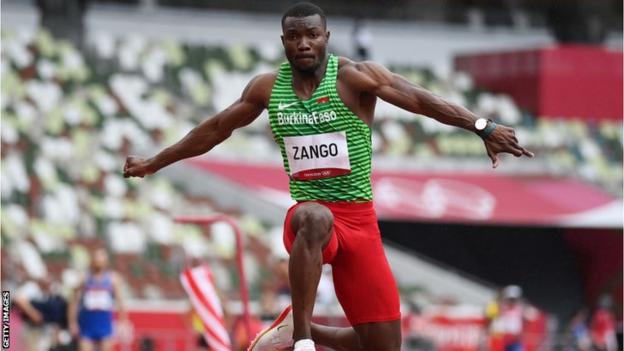
Hugues Fabrice Zango getting his triple jump (Source: bbc.co.uk)
The controversial opening ceremony of the 2024 Paris Olympic Games has not dimmed the spirits of African athletes, they know that they are there to work and make their continent proud.
Before the beginning of the games, there were a few African athletes to watch out for:
Our golden athlete Hugues Fabrice Zango, the first gold medal of Burkina Faso, and representing us all on the triple jump. As a fun fact, Zango also recently defended his PhD thesis in Electrical Engineering, and looks to make the colors of his country shine again this year.
Faith Kipyegon (Source: StarConnectMedia)
Our loved one, Kenyan Faith Kipyegon… we all have faith in her to make us proud again. With 2 world titles won and 4 world records, Faith is hoping to win her 3rd successive Olympic gold in the women’s 1500m; if she manages to accomplish this, she will be the first African to even win gold in the same event 3 times in a row. On Monday, she already won silver in a very contested Women’s 5000 m at the Olympics, where she was first disqualified for track obstruction, and then reinstated as the silver medal winner after appeal by the Kenyan federation. Her compatriot Beatrice Chebet won the first Kenyan gold medal of these olympics.
The revelation is this year’s Eritrean athlete Biniam Girmay who has won stage events at the Tour de France, becoming the first African to ever do so, and also topping the points classification. We will be on the look out for him in cycling.
Letsile Tebogo (Source: SportNewsAfrica)
We had our eyes on Letsile Tebogo of Botswana who took silver in the 100m and bronze over 200m at the world championships; however, the 100m did not go well for Tebogo, but we are all throwing our support behind him for the 200m. Our young brother lost his mother, Seratiwa Tebogo, his pillar and rock back in May, and we are sending him lots of love and support.
Blessing Oborududu of Nigeria is a wrestling baobab in Nigeria and Africa, with 14 continental titles, 4 commonwealth medals, and a silver medal at the Tokyo 2020 Olympics. However, today, Oborududu lost on advancing to gold or silver, but will be competing for the Bronze medal tomorrow.
Flag of Uganda
Before the Olympics, our Ugandan brother Joshua Cheptegei told us that this will be his last Olympics, and promised us magic. Cheptegei did not disappoint, he ran his heart out serving us a performance worthy of a novel, he came from behind to win gold in the men’s 10,000m, and land Uganda its first gold at the games so far. Compatriot Peruth Chemutai won silver in the Women’s 3000m steeplechase, while Kenyan Faith Cherotich won the Bronze medal.
In swimming, Tatjana Smith of South Africa made her country proud by winning gold and silver medals in 200m and 100m breaststroke events. South Africa also landed 2 bronze medals in rugby and mountain bike with Alan Hatherly. Flag bearer Akani Simbine ended 4th in a highly contested 100m track and field men’s final.
I will write an article at the end of the Paris 2024 Olympics games to tally all our victories.
The Guinea of Sekou Toure was the first country to say ‘NO’ to the General de Gaulle. Sekou Touré, proud descendent of one of the great African leaders who fought colonialism, Samori Touré, said, on 25 August1958, Sekou Touré said: “Il n’ya pas de dignité sans liberté. Nous préférons la liberté dans la pauvreté à la richesse dans l’esclavage.” [There is no dignity without freedom. We prefer freedom in poverty to wealth in slavery].
After Sekou Toure said ‘No‘, De Gaulle did not take it lightly and reacted harshly to crush the new Guinean state, and ensure that no other African countries followed the Guinean example. The Washington Post back then, observed how brutal the French were in tearing down all what they thought was their contributions to Guinea: “In reaction, and as a warning to other French-speaking territories, the French pulled out of Guinea over a two-month period, taking everything they could with them. They unscrewed light bulbs, removed plans for sewage pipelines in Conakry, the capital, and even burned medicines rather than leave them for the Guineans.” Imagine that, they unscrewed light bulbs! It is said that they even poured cement on water pipes!… the French reacted like a really angry boyfriend who had been thrown out.
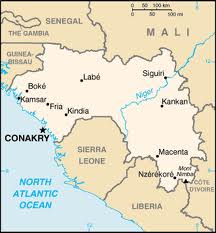
Guinea-Conakry
Maurice Robert, head of the African cell for the Service de documentation extérieure et de contre-espionnage (SDECE), France‘s external intelligence agency from 6 November 1944 to 2 April 1982 said in an interview, « Nous devions déstabiliser Sékou Touré, le rendre vulnérable, impopulaire et faciliter la prise du pouvoir par l’opposition. Une opération de cette envergure comporte plusieurs phases : le recueil et l’analyse des renseignements, l’élaboration d’un plan d’action à partir de ces renseignements, l’étude et la mise en place des moyens logistiques, l’adoption de mesures pour la réalisation du plan. Avec l’aide d’exilés guinéens réfugiés au Sénégal, nous avons aussi organisé des maquis d’opposition dans leFouta-Djalon. L’encadrement était assuré par des experts français en opérations clandestines. Nous avons armé et entraîné ces opposants guinéens pour qu’ils développent un climat d’insécurité en Guinée et, si possible, qu’ils renversent Sékou Touré. Parmi ces actions de déstabilisation, je peux citer l’opération Persil, par exemple, qui a consisté à introduire dans le pays une grande quantité de faux billets de banque guinéens dans le but de déséquilibrer l’économie. » [“We had to destabilize Sékou Touré, make him vulnerable, unpopular and facilitate the seizure of power by the opposition. An operation of this scale involves several phases: the collection and analysis of information, the development of an action plan based on this information, the study and implementation of logistical means, the adoption of measures to implement the plan. With the help of Guinean exiles who had taken refuge in Senegal, we also organized opposition groups in Fouta-Djallon. Supervision was provided by French experts in clandestine operations. We have armed and trained these Guinean opponents so that they develop a climate of insecurity in Guinea and, if possible, overthrow Sékou Touré. Among these destabilizing actions, I can cite Operation Persil, for example, which consisted of introducing a large quantity of counterfeit Guinean banknotes into the country with the aim of unbalancing the economy.”]
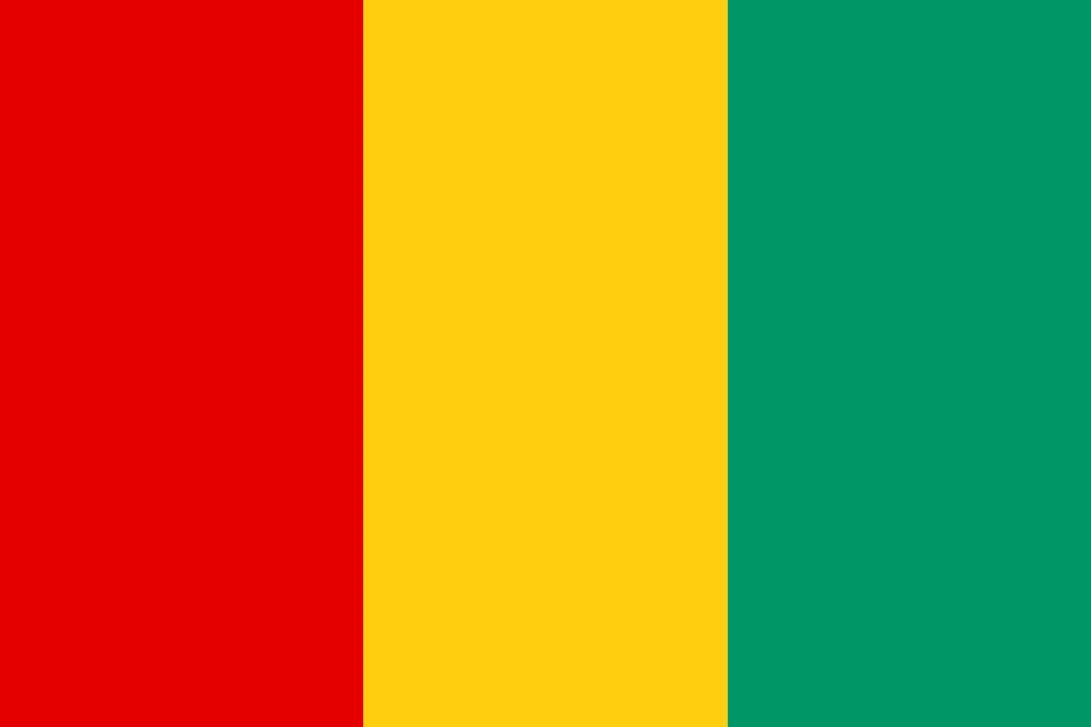
Flag of Guinea
Thus, the strategies to destabilize Guinea were, among others, 1) Make Sekou Toure weak and impopular by financing and arming his opponents; 2) using exiled Guineans in neighboring Senegal, training them militarily to create zones of insecurities in the country to eventually topple off Sekou Toure’s government; 3) economically weaken the country by using fake currency.
There are numerous examples of how these strategies were used in recent years: in Cote d’Ivoire during the presidency of Laurent Gbagbo with the armed rebellion financed from external forces, terrorist forces’ attacks in the AES countries, and much more…
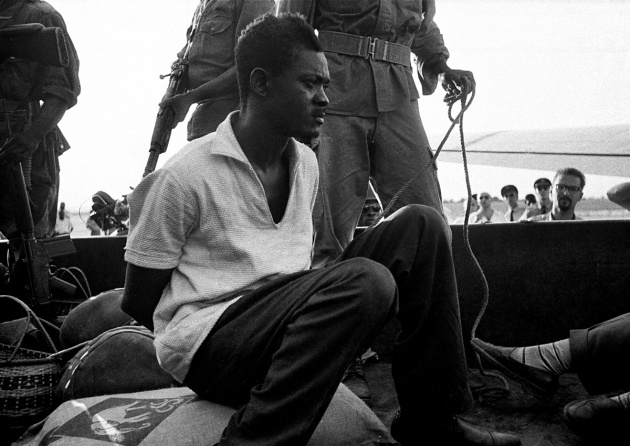
Two weeks before his murder, on January 4th 1961, Patrice Lumumba wrote from prison in Thysville (now Mbanza-Ngungu) to Rajeshwar Dayal, a Special Representative to the UN Secretary General. In prison, Lumumba was accompanied by Maurice Mpolo and Joseph Okito, two political associates who had planned to assist him in setting up a new government. They were fed poorly by the prison guards, as per Mobutu’s orders. In one of Lumumba’s last documented letter, he wrote to Dayal who was the head of the United Nations Operation in the Congo: “In a word, we are living amid absolutely impossible conditions; moreover, they are against the law.”
=====
LETTER TO M. DAYAL, SPECIAL REPRESENTATIVE OF THE U.N. SECRETARY-GENERAL Thysville, January 4, 1961
Mr. Special Representative,
On December 27 last, I had the pleasure of receiving a visit from the Red Cross, which occupied itself with my plight and with the plight of the other parliamentarians imprisoned together with me. I told them of the inhuman conditions we are living in.
Lumumba detained
Briefly, the situation is as follows. I am here with seven other parliamentarians. In addition there are with us Mr. Okito, President of the Senate, a Senate employee and a driver. Altogether there are ten of us. We have been locked up in damp cells since December 2, 1960, and at no time have we been permitted to leave them. The meals that we are brought twice a day are very bad. For three or four days 1 ate nothing but a banana. I told this to the Red Cross medical officer sent to me. I spoke to him in the presence of a colonel from Thysville. I demanded that fruit be bought on my own money because the food that I am given here is atrocious. Although the medical officer gave his permission, the military authorities guarding me turned down my request, stating that they were following orders from Kasavubu and Colonel Mobutu. The medical officer from Thysville prescribed a short walk every evening so that I could leave my cell for at least a little while. But the colonel and the district commissioner denied me this. The clothes that I wear have not been washed for thirty-five days. I am forbidden to wear shoes.
In a word, the conditions we are living in are absolutely intolerable and run counter to all rules.
Moreover, I receive no news of my wife and I do not even know where she is. Normally I should have had regular visits from her as is provided for by the prison regulations in force in the Congo. On the other hand, the prison regulations clearly state that not later than a day after his arrest a prisoner must be brought before the investigator handling his case. Five days after this a prisoner must again be arraigned before a judge, who must decide whether to remand him in custody or not. In any case, a prisoner must have a lawyer.
The criminal code provides that a prisoner is released from prison if five days after he is taken into custody the judge takes no decision on remanding him. The same happens in cases when the first decision (which is taken five days after a person is arrested) is not reaffirmed within fifteen days. Since our arrest on December 1 and to this day we have not been arraigned before a judge or visited by a judge. No arrest warrant has been shown to us. We are kept simply in a military camp and have been here for thirty-four days. We are kept in military detention cells.
The criminal code is ignored as are the prison rules. Ours is purely a case of arbitrary imprisonment. I must add that we possess parliamentary immunity.
Such is the situation and I ask you to inform the United Nations Secretary-General of it.
I remain calm and hope the United Nations will help us out of this situation.
I stand for reconciliation between all the children of this country.
I am writing this letter secretly on bad paper. I have the honour to be, etc.
As always, ahead of June 30, the ‘independence’ day of the Democratic Republic of Congo (DRC), we write about Patrice Emery Lumumba, the first Prime Minister of Congo. This time, we will take a trip down memory lane with the great article by the prominent anti-colonial thinker, activist and writer, Frantz Fanon, which was published earlier here on Afrolegends in French in 2011. (You will find the original here). In view of all the events occurring in Africa (The New Scramble for Africa, Creation of the AES and destabilization attempts) with the United Nations (UN) approval, I thought that this article, published in 1964, was so important that I had translated it into English for all to read! In the article, Fanon talks about the kind of Africans who betray their people, and the uselessness (to us, Africans) of the UN which only serves Western interests. The scenario is the same and has not changed over the past 6 decades: wherever the UN lands in a country, all of sudden there are troubles, tensions, massacres, (ONUCI, MINUSMA, MONUSCO, …), etc. Enjoy… For the full article, check out: Lumumba’s death: Could we (Africans) have acted differently?
—————————————————
Frantz Fanon
The great success of the enemies of Africa is to have corrupted the Africans themselves. It is true that these Africans had vested interest in the murder of Lumumba. Heads of puppet governments, in a fake independence, faced everyday by massive opposition from their peoples, it did not take long to convince themselves that the real independence of the Congo would put them personally at risk. And there were other Africans, a little less puppet, but who get frightened when it comes to disengaging Africa from the West. It seems as if these African Heads of State are still afraid to face Africa. These, also, though less actively, but consciously, contributed to the deterioration of the situation in Congo. Little by little, we were reaching the agreement in the West that there was a need to intervene in Congo, we could not let things evolve at this pace.
Gradually, the idea of a UN intervention was taking shape. So we can say today that two simultaneous errors were committed by Africans.
Patrice Lumumba
And first by Lumumba when he sought the intervention of the UN. He should have never called on the United Nations.The UN has never been able to properly solve problems brought to man’s consciousness by colonialism, and whenever it has intervened, it was to actually come to the aid of the colonial power to the oppressed country. Look at Cameroon. What kind of peace do the subjects of Mr. Ahidjo kept in check by a French expeditionary force, which most of the time, made its debut in Algeria, enjoy? The UN, however, controlled the autodetermination of Cameroon and the French government has set up a “Provisional Executive” there.
Look at Viet-Nam. Look at Laos.
It is not true to say that the UN fail because the causes are too difficult.
Map of the Democratic Republic of Congo
In reality the UN is the legal card used by imperialist interests when brute force has failed. The sharing, the mixed controlled joint committees, under guardianship are international means of torture to break the will of the people, cultivating anarchy, banditry and misery.
… Lumumba’s fault was then initially to believe in the impartiality of the UN. He forgot that the UN, particularly in the current state, is only a reserve assembly established by the Greats to continue, between two armed conflicts, the “peaceful struggle” for the balkanization of the world. …
Africans should remember this lesson. If outside help is necessary to us, let us call on our friends. Only they can truly and fully help us achieve our goals precisely because the friendship between us is a friendship of struggles.
… Our mistake, as Africans, is to have forgotten that the enemy never backs down sincerely. He never understands. He surrenders, but is not converted.
Our mistake is to have believed that the enemy had lost its militancy and its harmfulness. If Lumumba disturbs, Lumumba should disappear.
Hesitation in commiting murder has never been a feature of imperialism.
“Quand l’Africain était l’or noir de l’Europe” de Bwemba Bong
I came across another gem in the book of Professor Bwemba Bong, “Quand l’Africain était l’or noir de l’Europe. L’Afrique: Actrice ou Victime de la Traite des Noirs? – Démontage des mensonges et de la falsification de l’histoire de l’hydre des razzias négrières transatlantiques” (When the African was the black gold of Europe. Africa: Actress or Victim of the Slave Trade ? – Dismantling the lies and falsification of the hydra history of the transatlantic Slave Raids).” After the textile industry, this time, it is about the fertility of the Kongo soil, its agriculture, and the different cultures in the 16th century. In the text, it is good to note the ancient grains used in Central Africa at the time: a grain called luco (could it be the finger millet?) from which a white flour similar to wheat, corn (introduced by Portuguese in Kongo, and which had no real value except to feed pigs, just like rice), nuts like palm nuts (from the description of its usage, one can see the beginning of the multi-million dollar palm oil industry), kola nuts, date nuts, and banana tree. As we read, we note the use of some of those grains to feed but also to heal. I wonder if some these native grains are still used today?
African fields
In his book, Pr. Bong shows that traditional African agriculture was good, and fed correctly its populations from rich and fertile plateaus, until the arrival of the Europeans who collapsed their agriculture so as to turn the economy entirely toward the trade of humans which was the only commodity of interest to them. This led to cycles of famine on a continent full of arable lands and strong agricultural knowledge. The cycle has not changed today on the African continent, with the cash crops cultures destined for consumption in the West and now East, once again leaving streaks of famine on its wake; thus the constant news about famine in Africa in countries rich with arable lands, but which are cultivating say, coffee or cocoa or others for western consumption.
Filippo Pigafetta et Duarte Lopes, Le royaume de Congo et les contrees environnantes (1591), Chandeigne/Unesco, 2002, p. 133-136 (trad. Willy Bal, présentation et notes Willy Bal); Bwemba Bong, Quand l’Africain était l’or noir de l’Europe. L’Afrique: Actrice ou Victime de la Traite des Noirs?, MedouNeter 2022, p. 175-177 (translated to English by Dr. Y, Afrolegends.com). Enjoy!
=====
The entire plateau is fertile and cultivated. It has grassy meadows and the trees are always green. It produces grains of various kinds; the main and best one is called luco. It resembles mustard see, although a little larger. It is crushed with hand mills; a while flour comes out from which we make a white bread, healthy, pleasant to the taste and which is in no way inferior to wheat bread, except that with it we celebrate mass. Such grains are found in abundance throughout the kingdom of Congo where they have been growing for a short time; the seed comes from the banks of the Nile, in the region where this river fills the second lake.
There is also white millet called mazza di Congo, that is to say “Congo grain,” and corn, which is the least esteemed and which is fed to pigs; rice doesn’t have much value either. Corn is called mazzaManputo, that is to say “grain of Portugal,” Portugal in fact bearing the name Manputo. [could this be another origin ofthe name Maputo in Mozambique?].
A plantain bunch
There are also various species of trees which produce an enormous amount of fruits, to the point that most inhabitants feed on the fruits of the country, such as citrons, limes, and particularly oranges, which are very tasty, neither sweet nor bitter and which do not in any way inconvenience those who eat them. Mister Duarte recounted (to show the fertility of the country) that he had seen a citron seed, preserved in the pulp and in the citron itself, germinate in four days.
Other fruits are those called banana. We think that they are musa from Egypt and Syria, with the difference that in Congo the banana tree reaches the size of a tree; it is pruned every year so as to produce better. The banana is a very fragrant and very nourishing fruit.
Different species of palm trees also grow on these plateaus : one of them is the date palm, the other is the one which bears Indian nuts called coccos, because inside there is a head that resembles a monkey. Hence the custom in Spain of shouting “coccola” to frighten children.
Tapper harvesting palm wine
There is another species of palm tree, similar to the previous ones and from which oil, wine, vinegar, fruits and bread are obtained. The oil is made from fruit pulp; its color and consistency are those of butter, although it is more greenish; it has the same uses as olive oil and butter; it bursts into flames; it can be used to anoint the body; it is excellent for cooking; we get it from the fruit, as we get oil from olives; we cook it to preserve it. Bread is made with the stone of the fruit, which resembles an almond, although harder; inside, we find a marrow that is good to eat, healthy, nourishing. All this fruit is green, including the pulp and is eaten raw and roasted. Wine is obtained by perforating the top of the tree : a liquor oozes out, similar to milk ; sweet the first days, it becomes sour and over time turns into vinegar, which is used in salad. But the wine is drunk chilled, it is diuretic, to the point that in this country no one offers from grit or stones in the bladder; it intoxicates the one who drinks it in excess; it is very nourishing.
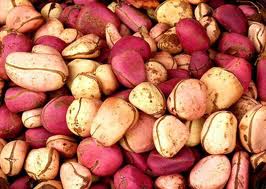
Kola nut
Other trees produce fruits called kola, the size of a pine cone and inside of which are other chestnut-shaped fruits, themselves containing four separate pulps, red and crimson in color. These fruits are kept in the mouth, chewed and eaten to quench thirst and add flavor to the water; they preserve and restore the stomach and are especially effective in liver ailments. Lopes said that a liver of a chicken or other bird, already in putrefaction, sprinkled with the juice of these fruits, became fresh again and almost resumed its previous state. Everyone uses this food commonly, in very large quantities; also it is a good commodity.
We find other wild species of palm trees which bear various edible fruits and whose leaves are used to make mats, to cover houses, to weave baskets, baskets and other objects of the same kind, which we need each day.
Other trees are called ogheghe, the fruits they bear resemble yellow plums, they are excellent to eat and fragrant. We cut branches from these trees, they are planted so closely that they touch each other; they take root and, growing and growing, form palisades and walls around the houses. By then laying mats, we create a fence, a courtyard and these kinds of trellises also serve to provide shade and protect from the heat of the sun.














 African Heritage