On the black woman. “I believe that black has been oppressed by white; female by male; peasant by landlord; and worker by lord of capital … the black female worker and peasant is the most oppressed. She is oppressed on account of her color like all black people in the world; she is oppressed on account of her gender like all women in the world; and she is exploited and oppressed on account of her class like all workers and peasants in the world. Three burdens she has to carry.” Wizard of the Crow
On unity. In A Grain of Wheat, Ngũgĩ stressed the importance of unity of resisting tyranny, “Our fathers fought bravely. But do you know the biggest weapon unleashed by the enemy against them? It was not the Maxim gun. It was division among them. Why? Because a people united in faith are stronger than the bomb.”
Petals of Blood by Ngũgĩ wa Thiong’o
Like Sengat-Kuo in his poem “Ils sont venus“, Ngũgĩ highlighted in Petals of Blood the holy trinity of the Bible, the guns, and commerce to conquer and oppress Africans, “He carried the Bible; the soldier carried the gun; the administrator and the settler carried the coin. Christianity, Commerce, Civilization: the Bible, the Coin, the Gun: Holy Trinity.“
Language as a weapon. In his groundbreaking book Decolonising the Mind: The Politics of Language in African Literature, he championed the use of the mother tongue, arguing, “To speak one’s language is to celebrate one’s identity, … but to impose a language is a way to divide people – it is to practice tribalism of another kind.”
Dreams in a Time of War: A Childhood Memoir by Ngũgĩ wa Thiong’o
On Women condition. In Wizard of the Crow, Ngũgĩ said, “The condition of women in a nation is the real measure of its progress.“
On self-validation. in Dreams in a Time of War, he added “Belief in yourself is more important than endless worries of what others think of you. Value yourself and others will value you. Validation is best that comes from within.“
I love this message of our general and president Assimi Goïta: “if I die before reaching our ideal, continue the project without me and lay the groundwork for change with my blood and my flesh. No sacrifice is huge for this country“[Assimi Goïta Speaks to the Malian People: No Sacrifice is too Big for this Country]. This is indeed the motto that all the leaders of the AES, Assimi Goïta of Mali, Abdourahamane Tchiani of Niger, and Ibrahim Traoré of Burkina Faso lead with and live by. They all created the Alliance of the Sahel (AES) so as to be strong together, uniting their forces, people, and resources to fight together against the forces of imperialism. Now the west is trying hard to break apart the union by singling out Traoré (Coup against Ibrahim Traoré and Worldwide Support for Him). Traoré is brilliant, no doubt. He has been doing an awesome job, no doubt. And he has been the true communicator in the AES plan. He is young, and appeals to the youths of the entire continent. He speaks with great charisma, and confidence, which scares many. He is a true son of Burkina Faso inspired by the great Thomas Sankara.
Capitaine President Ibrahim Traore (Source: sig.gov.bf)
A mother does not love one child over the other. She loves each one, albeit differently and uniquely, given the uniqueness of each child. Mama Africa loves all her leaders of the AES equally and together we will free the whole. Thus, it is important to know that we, Africans, cannot afford to have just oneTraoré, for we are all Traoré, and we should all endeavor to have thousands of Traoré, Tchiani, and Goïta throughout the continent, for history not to repeat itself. We have to be careful… and take care of our leaders, and make sure we keep working towards total freedom. Just a few years back (not even 5 years), John Magufuli of Tanzania was here, Pierre Nkurunziza of Burundi was here and we, Africans, applauded them. Both went down… and we all cried… we need to make sure history does not repeat itself! Let’s have Millions of African Leaders: Be the Leader You Want to Have!
Below are excerpts from an article from the BBC explaining why Ibrahim Traoré is loved… yet claiming that it is a “skillfully built persona af a pan-africanist”… pure nonsense… they really have not known him when he was younger. Had they known him, they would have known that there is nothing ‘built’ about him, and it is not a persona… when an African stands up proudly and with confidence without the complex of inferiority, they call it a persona. Our duty is to all be Ibrahim Traoré!
=====
Ibrahim Traore lays the foundation for the Thomas Sankara Mausoleum (Source: LeFaso.net)
A charismatic 37-year-old, Burkina Faso‘s military ruler Capt Ibrahim Traoré has skilfully built the persona of a pan-Africanist leader determined to free his nation from what he regards as the clutches of Western imperialism and neo-colonialism.
His message has resonated across Africa and beyond, with his admirers seeing him as following in the footsteps of African heroes like Burkina Faso’s very own Thomas Sankara – a Marxist revolutionary who is sometimes referred to as “Africa’s Che Guevara“.
“Traoré’s impact is huge. I have even heard politicians and authors in countries like Kenya [in East Africa] say: ‘This is it. He is the man’,” Beverly Ochieng, a senior researcher at global consultancy firm Control Risks, told the BBC.
“His messages reflect the age we are living in, when many Africans are questioning the relationship with the West, and why there is still so much poverty in such a resource-rich continent,” she said.
Flag of Burkina Faso
After seizing power in a coup in 2022, Traoré’s regime ditched former colonial power France in favour of a strong alliance with Russia, that has included the deployment of a Russian paramilitary brigade, and adopted left-wing economic policies.
This included setting up a state-owned mining company, requiring foreign firms to give it a 15% stake in their local operations and to transfer skills to Burkinabé people.
As part of what Traoré calls a “revolution” to ensure Burkina Faso benefits from its mineral wealth, the junta is also building a gold refinery and establishing national gold reserves for the first time in the nation’s history.
… The junta [they still call it a junta, even though, he has received a full vote of confidence for 5 years by the entire Faso nation – like said before: Gabon and the Double Standards of the International Community] has also nationalised two gold mines previously owned by a London-listed firm, and said last month that it planned to take control of more foreign-owned mines.
Enoch Randy Aikins, a researcher at South Africa’s Institute for Security Studies, told the BBC that Traoré’s radical reforms had increased his popularity in Africa. “He is now arguably Africa’s most popular, if not favourite, president,” [No, Traore does not want to be the most popular or the favorite, he just wants to do right by his people! – Thus African, let us follow his footsteps and make our countries and continent proud!] Mr Aikins said.
Burkina Faso
… Ms Ochieng said that Traoré first caught the attention of Africans when he spoke at the Russia-Africa summit in 2023 [that is not true… we already knew him before 2023], telling African leaders to “stop behaving like puppets who dance every time the imperialists pull the strings“.
… Traoré’s popularity comes despite the fact that he has to fulfil his pledge to quell a 10-year Islamist insurgency failed [has he failed? What did the French, and Operations Barkhane via the TakubaTask Force and Serval… – that compendium of all western nations- do in over 10 years in the region? And who was funding these terrorist groups?] that has fuelled ethnic divisions and has now spread to once-peaceful neighbours like Benin. [yeah right… we know who is in Benin – France!].
… “Traoré is stylish and confident, with a very open face and a small smile. He is also a powerful orator, and presents himself as a man of the people.”
We have previously spoken about the Trap of Democracy in Africa, and the double standards of the ‘International Community’ when it comes to the application of this word: a person who serves the West to the detriment of his country is deemed a democrat; however, someone who serves the interests of his people and not the West is deemed a tyrant, a dictator, a junta leader, etc.
Thus, it is no surprise that the mainstream media (MSM) has not applauded the vote of confidence which was recently granted to General Assimi Goïta of Mali by his people last week [Assimi Goïta Speaks to the Malian People: No Sacrifice is too Big for this Country]. Why? Because he does not serve their interests. The MSM has been lauding someone like Oligui Nguema of Gabon who traded his military fatigues to win elections by over 90% (talk about democracy!), because he does not disturb their system; however Goïta is not serving them, and he has even dared to liberate Kidal in the north of the country, where the French army and MINUSMA could not or chose not to [Mali Forces Succeed in Kidal where France and Allies could not!].
Flag of Singapore
Singapore is known as an example of progress and development in the world. Do you know that Lee Kuan Yew ruled as prime minister for over 30 years, and was in the government in some shape or form for over 50 years? Have you ever heard Singaporeans complain about him, or talk about democracy?
Last week, General Assimi Goita was given 5 years by the people of Mali. Excerpts below are from the very biased article by BBC.
=====
Map of Mali with its capital Bamako
Mali’s military leader Gen Assimi Goïta has won the backing of key political allies to be declared president for the next five years.
The 41-year-old, who has seized power twice, was named transitional president after his last coup in 2021. At the time he promised to hold elections the following year – but has since reneged, in a blow to efforts to restore multi-party rule in the West African state.
A national conference organised by the regime – but boycotted by leading opposition parties – has now recommended naming Gen Goïta president until 2030.
He has not yet commented on the recommendation, but the conference was seen as an attempt to legitimise his bid to remain in power.
Over the weekend, an opposition leader, Mohamed Salia Touré [backed by the West], told the AFP news agency that suppressing the multi-party system would be a “historic error”.
Flag of Mali
… The conference also recommended suspending anything to do with elections until there was peace in the country [rightfully so… how can there be elections when the country is at war or when the territory is divided? – Gbagbo of Cote d’Ivoire can tell you that, that is a sham], according to a document seen by AFP. The military government has been trying to quell jihadist violence unleashed by groups linked with the Islamic State (IS) and al-Qaeda.
Since taking power, the junta leader has formed an alliance with coup leaders in neighbouring Burkina Faso and Niger, pivoting the region towards Russia after drastically reducing ties with former colonial power France.
Gen Goïta has also withdrawn Mali from the regional grouping Ecowas over its demands to restore democratic rule. Burkina Faso and Niger have also left the grouping.
Capitaine President Ibrahim Traore (Source: sig.gov.bf)
For the past few weeks, the price of gold has hit a record high of $3400. Some of the places with some of the largest gold mines is in the Sahel, the AES. So it is no surprise that there was a recent coup against the president of Burkina Faso, one of the leaders of the AES a few weeks ago.
Ibrahim Traoré, president of Burkina Faso, escaped another coup attempt on his life. Coincidentally, this attempted coup happened the day after the American General Langley lied in front of the US congress saying that Traoré was embezzling the country’s funds for his personal security. It is quite preposterous to hear. Why doesn’t Langley mention Ouattara who has put Ivory Coast in debt and destroyed the country? Why doesn’t Langley mention Paul Biya of Cameroon who has been in power 43 years, and taken the country 60 years backwards? Why doesn’t Langley mention Sassou Nguesso of the Republic of Congo who has siphoned all the country’s money into his pockets and those of his family? Or Faure Eyadema who comes from the Eyadema dynasty? Moreover, how can someone like Ibrahim Traoré who has foregone his presidential salary embezzle money? Then how disgusting of this man to stand in front of congress and lie? It reminds me of another, a certain Colin Powell, who stood in front of the whole world and spoke of things which never existed in Irak?
Flag of Burkina Faso
Since coming to power, Ibrahim Traoré has bought over 400 tractors for farmers, 953 motorcycles, 710 motor pumps for water, 10,000 tons of fish food, 68,964 tons of fertilizer, 10,000 liters of products to name a few to try to empower the country’s agriculture. In the ministry of health, his accomplishments include buying 15 mobile clinics, 36 vehicles for hospitals, 3 oxygen units, 11 cold rooms, 835 tablets, 1,900 solar refrigerators. There was also the inauguration of a full tomato plant to enhance local productions, and now the plan for the largest Coca Cola plant in Africa.
A Escrava Isaura (Source: primetelenovelas.com)
This Langley dude reminds me of the slave/overseer Domato, in the Brazilian telenovela A Escrava Isaura who was always treating his slave brothers and sisters so much worse than the white master.
Burkina Faso’s military government has said it foiled a “major plot” to overthrow junta leader Capt Ibrahim Traoré, with the army alleging the plotters were based in neighbouring Ivory Coast [this is no secret, but BBC writes it as if the Burkinabe people were hallucinating].
Security Minister Mahamadou Sana said the coup attempt was led by current and former soldiers working with “terrorist leaders“. The intention was to attack the presidential palace last week, he added. The aim of the plan was to “sow total chaos, and place the country under the supervision of an international organisation“, Sana said on state television on Monday.
It is the latest of several claims of attempts to remove the junta leader who seized power in 2022 amid increasing militant attacks. …
=====
Burkina Faso
Thousands of people gathered at the Place de la Révolution in Ouagadougou on Wednesday 30 April to show their support to the President of the transition, Captain Ibrahim Traoré.
The demonstration happened after the US commander of AFRICOM, General Michael Langley, told the US Senate Armed Services Committee in early April that the military regime in power in Burkina Faso has taken advantage of the resources of the country, particularly the gold reserves [interesting, why does he mention only gold and no other resources?], for his own protection instead of the population. What General Langley told the US Senate provoked people to react in Burkina Faso and throughout the AES countries and even beyond the region. The government of Burkina Faso condemned the statement by the US military command, made with the ‘aim to spoil the country’s image.’
… The massive support for Burkina Faso’s military leader, Captain Ibrahim Traoré, comes at a time of growing tensions with Western powers. General Langley’s accusations of corruption leveled against the President of the transition, Captain Ibrahim Traoré, instead of weakening the regime in Burkina Faso, has reinforced the status and aura of the young military leader, whose popularity extends beyond national borders.
Alliance des Etats du Sahel (source: linfodusahel.com)
… Traoré quickly adopted an anti-imperialist stance, where he strongly criticized the interference of Western powers, particularly France. They see his decision to draw closer to new partners like Russia and Iran, and to leave certain regional cooperation frameworks (G5 Sahel, ECOWAS) as a stamping of his sovereignty. This geopolitical shift excites young people seeking political and economic independence happy.
… Captain Traoré has become a symbol of resistance to Western influence, particularly French influence, and this has gone positively with the predominantly young population. His revolutionary stance and commitment to African unity appeals to many Burkinabè, especially young people.
‘There is a third element for me: Ibrahim Traoré’s youth, his outspokenness and his imperialist stance which are inline with another Burkinabe president, Captain Thomas Sankara, whose popularity for almost 40 years after his death is in doubt‘ [says] Seidik Abba, President of the Centre international d’études et de réflexions sur le Sahel (CIRES).
The military regime in power in Burkina Faso is multiplying symbolic and even populist acts to boost its image. The decision to forego the presidential salary and opt for the modest income he receives as army leader also makes his popular with the public.
… Since taking power in 2022, Captain Ibrahim Traoré has undertaken a series of reforms that will strengthen the state’s control over mining resources, particularly gold, for the country’s main export.
“Je pense à toi, mon amour, ma bien-aimée, Ne m’abandonne pas, Je pense à toi, Mon amour Ma chérie” … [“I am thinking of you, my love, my beloved. Do not abandon me, my love, my dear …“]
Those are the words of the song that propelled the blind Malian duo Amadou & Mariam onto the international scene, beyond West Africa. Those words rocked the lives of millions of African children as a lullaby in some cases. Sadly, Amadou, from the duo, is no longer.
Map of Mali with its capital Bamako
The duo Amadou & Mariam was made up of singer and guitarist, Amadou Bagayoko, and his wife Mariam Doumbia. The Grammy-nominated duo Amadou & Mariam was a blind duo from Mali. They both met at the Institute for the young blind in Bamako in 1976, in the capital of Mali. Bagayoko became blind at the age of 15, while Mariam was at age 5. Mariam started singing at weddings from a young age, while Amadou played instruments. At the institute, they joined the Eclipse Orchestra and quickly became a couple both on stage and in real life. They got married in 1980. Their music blend their traditional Malian sounds emanating from the kora or balafon, with the rock guitars and Western blues. This iconic couple became a source of inspiration to countless artists from Bamako to Dakar, to Abidjan or Conakry. Their music has been anchored in the rich tradition of griots of West Africa [The Griot, the Preserver of African Traditions].
Amadou & Mariam went on to sell millions of albums across the world. They composed the official song for the 2006 football World Cup in Germany, and played at the closing ceremony concert for the 2024 Paris Olympics. They even played for Barack Obama, at the concert marking the US president’s Nobel Peace prize award, and were nominated for a Grammy award in 2010. So long Amadou, and courage to Mariam and the family. Please check out this really good eulogy from Seneweb.com
In Africa, there is the concept of fetishism which has been prevalent as a description of African beliefs. Thus, a fetish is an object which holds spiritual power or supernatural significance. Given that African statues hold deep cultural, spiritual, and symbolic significance [Authorship in African Art: The Case of Yoruba Art], the term fetishism has been historically associated to them. Early European anthropologists have linked African religions and statues to fetishism. However, we are learning that this was a technique designed by Europeans to denigrate and dehumanize the African person so as to justify slavery [Dum Diversas or The Vatican’s Authorization of Slavery] early on, and colonialism later on.
Cheikh Anta Diop, the great Senegalese historian, anthropologist, philosopher, physicist, and politician, showed in his book, Nations Nègres et Culture: de l’Antiquite nègre égyptienne aux problèmes culturels de l’Afrique noire d’aujourd’hui, that fetishism in Africa is not an inherent school of thought, but rather arose from the disconnection of modern Africans to their original religions due to violent exposure to centuries of attacks (slavery) from the West. Thus, he said,
Cheikh Anta Diop
“From one end of Black Africa to the other, passing through Egypt, the statues were originally intended to be the support of the immortal “double” of the ancestor after his earthly death. Placed in a sacred place, the statue was the object of offerings and libations: this fact, misinterpreted by Westerners, created the false idea of fetishism. In reality, there is a tendency towards fetishism, that is, idolatry, only where the meaning of the cult has been forgotten through a break in tradition.”
Cheikh Anta Diop, Nations Nègres et Culture, Présence Africaine, Paris p. 339 (1954). Translated to English by Dr. Y, Afrolegends.com.
The poster for “Katanga, la danse des scorpions” by Dani Kouyate
On March 1, 2025, Burkinabè filmmaker Dani Kouyaté was awarded the prestigious Étalon d’or deYennenga (Golden Stallion of Yennenga). His film, Katanga, la danse des scorpions, is a cinematic adaptation of William Shakespeare’s Macbeth set in an African (Burkinabe) context and told in the Mooré language of Burkina Faso. His movie focuses on the power play in Africa. His win marked Burkina Faso’s first Étalon d’or in 28 years after Buud Yam of Gaston Kaboré, and the third win of Burkina Faso34 years after the first Tilaiof Idrissa Ouedraogo. Beyond the Étalon d’or, Katanga, la danse des scorpions garnered several other accolades, including the Public Prize with an average score of 9.18/10, the Sembène Ousmane Prize from the Ecobank Foundation, the Special Prize from the Cultural and Tourism Development Fund (FDCT), the Special UEMOA Prize for feature fiction, and the Paulin Soumanou Vieyra African Critics’ Prize.
The 29th edition of the FESPACO took place from February 22 to March 1, 2025, in Ouagadougou, the capital of Burkina Faso.
The host country, Burkina Faso was represented by two films: Katanga, la danse des scorpions by Dani Kouyaté and Les Invertueuses by Chloé Aïcha Boro. The guest country of honor, Chad, was represented by Diyaby Achille Ronaimou. There were several entries from diverse countries including Egypt, Algeria, Tunisia, Democratic Republic of Congo (DRC), Côte d’Ivoire, Zambia, Somalia and many more.
Dani Kouyate receives his Golden Stallion from President Ibrahim Traore (Source: DNE Africa)
On March 1, 2025, Burkinabè filmmaker Dani Kouyaté was awarded the prestigious Étalon d’or de Yennenga (Golden Stallion of Yennenga). His film, Katanga, la danse des scorpions, is a cinematic adaptation of William Shakespeare’s Macbeth set in an African (Burkinabe) context and told in the Mooré language of Burkina Faso. His win marked Burkina Faso’s first Étalon d’or in 28 years after Buud Yam of Gaston Kaboré, and the third win of Burkina Faso 34 years after the first Tilaiof Idrissa Ouedraogo. Beyond the Étalon d’or, Katanga, la danse des scorpions garnered several other accolades, including the Public Prize with an average score of 9.18/10, the Sembène Ousmane Prize from the Ecobank Foundation, the Special Prize from the Cultural and Tourism Development Fund (FDCT), the Special UEMOA Prize for feature fiction, and the Paulin Soumanou Vieyra African Critics’ Prize.
The Golden Stallion of Yennenga
The Somali movie The Village next to Paradiseby Mo Harawe won the Silver Stallion of Yennenga. The Bronze Stallion (Étalon de bronze) was awarded to On Becoming a Guinea Fowl by Rungano Nyoni (Zambia).
L’Homme-Vertige by Guadeloupean Malaury Eloi-Paisley won the Golden Stallion in the documentary section, as well as the Paul Robeson Prize for best diaspora film.
During the award ceremony, a special tribute was paid to Malian filmmaker Souleymane Cissé, who had been slated as jury president but passed away shortly before the festival. Dani Kouyaté, upon receiving his award, honored Cissé by saying, “Souleymane Cissé has been a model for me… he lives on in our hearts and minds.”
Malian filmmaker Souleymane Cisse at the Silicon Valley African Film Festival (SVAFF) in 2024
Burkina Faso’s President, Ibrahim Traoré, presented Kouyaté the award and praised film enthusiasts for the “resounding success of this celebration of African cinema.”
“The director [Dani Kouyaté] shows legitimate recognition for the courage and self-sacrifice of our worthy daughters and sons committed to victory over the forces of evil,” Traoré said on social media after the event.
Have you by any chance watched the South African movie “Tsotsi”? In 2006, it was the first South African film and first African film not made in French to win an Oscar for foreign language film and numerous international awards. It tells the story of a ruthless gang leader who steals a car, only to find a baby in the back seat. The movie is based off the novel by the same name “Tsotsi” by South African playwright, novelist, actor, and director widely regarded as South Africa’s greatest playwright Athol Fugard.
This past Saturday, Athol Fugard, who in 1985 was acclaimed as “the greatest active playwright in the English-speaking world” by Time, passed away at the age of 92. His work confronted apartheid and spanned over 7 decades with over 30 playwrights. He was a critic of apartheid and very early broke the rules and included all as in his 1961 breakthrough play, Blood Knot, which featured for the first time in South African history a black and white actor played by Fugard himself, and was played in front of a multiracial audience.
Athol Fugard, who has died aged 92, was widely acclaimed as one of South Africa’s greatest playwrights.
The son of an Afrikaner mother, he was best known for his politically charged plays challenging the racist system of apartheid.
… Fugard wrote more than 30 plays in a career that spanned 70 years, making his mark with The Blood Knot in 1961. It was the first play in South Africa with a black and white actor – Fugard himself – performing in a front of a multiracial audience, before the apartheid regime introduced laws prohibiting mixed casts and audiences. The Blood Knot catapulted Fugard onto the international stage – with the play shown in the US, and adapted for British television. The apartheid regime later confiscated his passport, but it strengthened Fugard’s resolve to keep breaking racial barriers and exposing the injustices of apartheid. He went on to work with the Serpent Players, a group of black actors, and performed in black townships, despite harassment from the apartheid regime’s security forces.
Fugard’s celebrated plays included Boesman and Lena, which looked at the difficult circumstances of a mixed-race couple. Having premiered in 1969, it was made into a film in 2000 starring Danny Glover and Angela Bassett.
John Kani (left), Athol Fugard (center) and Winston Ntshona at the Royal Court Theatre in 1973. Picture: Evening Standard/Getty Images
His novel, Tsotsi, was also made into a film, winning the 2006 Oscar for best foreign language movie.
… Other well-known plays by Fugard include Sizwe Banzi Is Dead and The Island, which he co-wrote with the actors John Kani and Winston Ntshona, in a powerful condemnation of life on Robben Island, where anti-apartheid icon Nelson Mandela was imprisoned.
… Fugard won several awards for his work, and received a lifetime achievement honour at the prestigious Tony awards in 2011, while Time magazine described him in 1985 as the greatest active playwright in the English-speaking world.
“Apartheid defined me, that is true… But I am proud of the work that came out of it, that carries my name,” Fugard told the AFP news agency in 1995.
Sam Nujoma (Source: newscentral.africa)
This past Saturday, February 8 2025, Sam Nujoma, Namibia’s first president and founding father passed away at the age of 95. The ancestors are greeting this illustrious brother who fought for the independence of his country. Nujoma led the long fight for independence from South Africa for many years, which culminated with independence on 21 March 1990 of South West Africa, as the country was formerly known. Nujoma helped found Namibia’s liberation movement known as the South West Africa People’s Organisation (SWAPO) in the 1960s. After independence, Nujoma became president in 1990 and led the country until 2005.
Flag of NamibiaSamuel Shafiishuna Daniel Nujoma was born at Etunda, a village in Ovamboland, on 12 May 1929, to Daniel Uutoni Nujoma and Helvi Mpingana Kondombolo, an Uukwambi princess. From his mother, he inherited his strong charismatic influence during his political career. He was the oldest of 11 children. His childhood was spent taking care of his siblings, tending to the family’s cattle, and farming.
Statue of Sam Nujoma in front of the Independence Museum in Windhoek, Namibia
At the age of 17, Nujoma moved to the harbor town of Walvis Bay, where he slowly learned about the plight of Black people under white-minority rule; he also worked at a general store and later at a whaling station. In 1949, Nujoma moved to Windhoek where he worked as a railway sweeper for the South African Railways (SAR), while he went to night school. It was there that he was introduced to the Herero tribal chief Hosea Kutako, who was lobbying to end apartheid rule in Namibia, then known as South West Africa. Kutako took the young Nujoma under his wing, and mentored him as he became politically active among Black workers in Windhoek who were resisting a government order to move to a new township in the late 1950s. First, he joined with the Ovamboland People’s Congress (OPC) co-founder Jacob Kuhangua to start a Windhoek branch; at its first congress, he was elected president. At Kutako’s request, Nujoma began life in exile in 1960, first to Bechuanaland (now Botswana), then Bulawayo in then Southern Rhodesia (Zimbabwe), and later ending in Tanzania where he was welcomed by President Julius Nyerere. The same year, he was elected president of the South West Africa People’s Organization (SWAPO) in abstencia. The problem of South West Africa, similar to Kamerun, was that they were former German colonies, which had been placed under League of Nations mandate of South Africa in the case of South West Africa, and France and Great Britain for Kamerun; thus the country should have been independent a while back. Nujoma spent a few years asking the United Nations to ensure that the occupying power that was South Africa released control of South West Africa. After many unsuccessful tries, while shuttling from capital to capital in quest for support, he authorized the launch of armed resistance in 1966 against South African forces. The attack marked the beginning of the Namibian War of Independence, which would last more than 25 years.
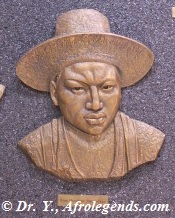
Sam Nujoma on a plaque to Early Resistance Leaders inside the Independence Museum in Windhoek, Namibia
On 19 March 1989, the signing of the cease-fire agreement with South Africa took place. After 29 years in exile, Nujoma returned to Namibia in September 1989 to lead SWAPO to victory in the UN-supervised elections that paved the way for independence. Nujoma was elected first president of the new nation which became independent on 21 March 1990. He was re-elected in 1994 and 1999, and stepped down in 2005.
The current president of Namibia, President Nangolo Mbumba said of Sam Nujoma, He “inspired us to rise to our feet and to become masters of this vast land of our ancestors,” … “Our founding father lived a long and consequential life during which he exceptionally served the people of his beloved country.”
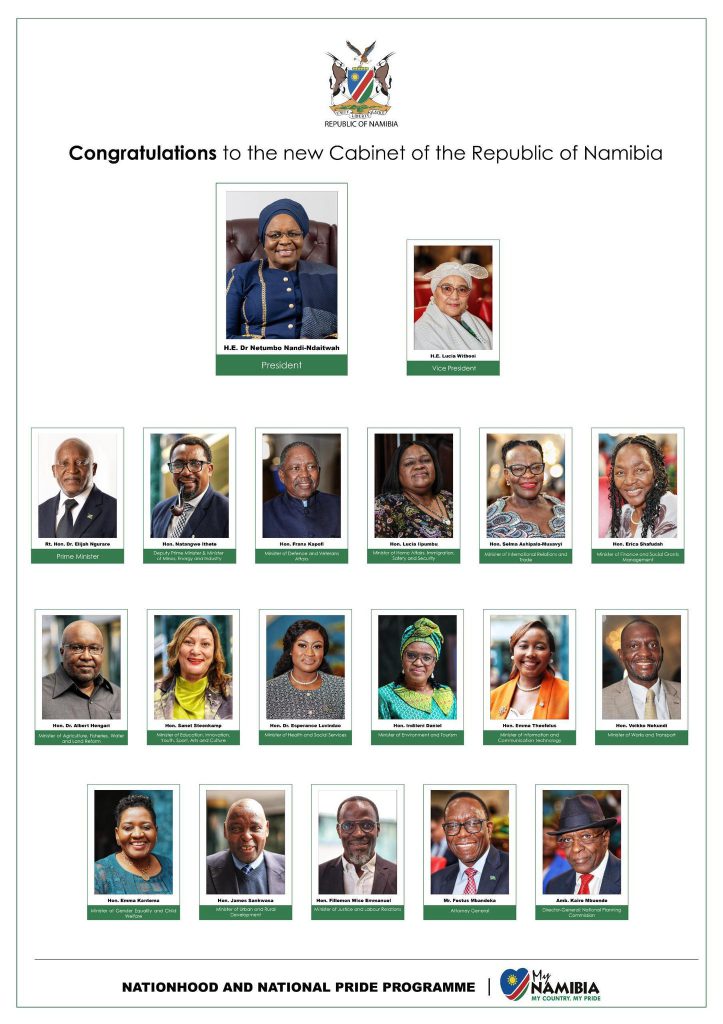
Namibia’s Vice-President Netumbo Nandi-Ndaitwah, who is due to be inaugurated as president in March after leading SWAPO to victory in elections, said his “visionary leadership and dedication to liberation and nation-building laid the foundation for our free, united nation“.
Bust of Sam Nujoma, inside Independence Museum, in Windhoek, Namibia
South Africa’s President Cyril Ramaphosa said the former Namibian president was an “extraordinary freedom fighter” who played a leading role in not only his country’s fight against colonialism, but also in the campaign that led to the end of the apartheid regime in South Africa in 1994. “President Nujoma’s leadership of a free Namibia laid the foundation for the solidarity and partnership our two countries share today – a partnership we will continue to deepen as neighbours and friends.”
South African President Cyril Ramaphosa said Nujoma led Namibia’s independence movement “against the seemingly unshakeable might of colonial and apartheid authorities and forces” and spurred the anti-apartheid movement in South Africa on its own final steps to freedom. “Sam Nujoma inspired the Namibian people to pride and resistance that belied the size of the population,” Ramaphosa said. “Namibia’s attainment of independence from South Africa in 1990 ignited in us the inevitability of our own liberation.”