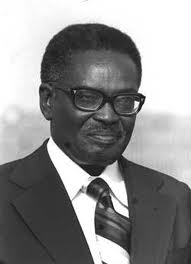
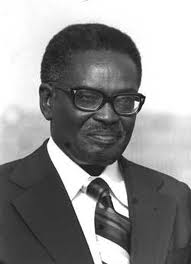
Agostinho Neto was the a medical doctor, a poet, and most importantly the first president of Angola. Today, I would like you to sit back and enjoy a poem written by this great African leader
Dear All, I was so surprised when I learned that Alexandre Dumas, yes… the writer of the “Three Musketeers” was just recently (2002) inducted into the Pantheon of Paris, you know… the place where the remains of the most famous/distinguished French citizens are buried. I wondered why?… because the Three Musketeers is the most acclaimed French book adapted to screen, movies, and theater. I wondered why?… because The Three Musketeers and The Count of Monte Cristo are among the most read books by a French author in the world… why only in 2002, 132 years after his death? when Victor Hugo had been indicted in 1885? why since Rousseau, Voltaire, Emile Zola, had all been indicted, while the most read French author, Alexandre Dumas’ remains were not? Well… you’ve guessed it right: Alexandre Dumas was Black! Yes… the great French writer was just like the Russian Father of modern literature Alexander Pushkin: Black! Yes… you can paint it all you want… he was of African descent: he was Black! Just look at his hair! He was actually Haitian, the grandson of a French nobleman and a Haitian slave. See… they hide this to you in the classroom.
The Three Musketeers, by Alexandre Dumas
Alexandre Dumas was born in 1802 in Picardy, France. His paternal grandparents were Marquis Alexandre-Antoine Davy de la Pailleterie, a French nobleman and Général commissaire in the Artillery in the colony of Saint Domingue (Haiti), and Marie-Cesette Dumas, an Afro-Carribean creole of mixed African and French ancestry. His father Thomas-Alexandre Dumas served in Napoleon’s army as general, and later fell out of favor. By the time Alexandre was born, his family was very poor. His being of mixed race affected him all his life. He once said to someone who had insulted his mixed-race background: “My father was a mulatto, my grandfather was a Negro, and my great-grandfather a monkey. You see, Sir, my family starts where yours ends.”
The Count of Monte Cristo, by Alexandre Dumas
In 2002, then French president Jacques Chirac had him exhumed from his original burial place and transported to the Pantheon of Paris. Chirac said: “With you, we were D’Artagnan, Monte Cristo, or Balsamo, riding along the roads of France, touring battlefields, visiting palaces and castles—with you, we dream.” Chirac acknowledged the racism and injustice that had been done to one of the greatest French writers of all time. Imagine that, Dumas’ works have been translated into over 100 languages, and have inspired over 200 motion pictures.
Alexandre Dumas
Please check out some of these websites which give a detailed biography of Alexandre Dumas: the Alexandre Dumas pere website, and The Literature Network. In 2005, a lost novel by Dumas was found: it is titled The Chevalier de Sainte Hermine (The Knight of Sainte Hermine), was first serialized by Dumas in a French newspaper in 1869 but was never finished by the time of his passing a year later. Imagine if I had known in high school that Alexandre Dumas, the author of the Three Musketeers was black… Imagine how I would have delved further into his writings! Goodness Gracious… Goodness Gracious! As Dumas would say himself, “One for all, all for one!“
UPC Leaders (L. to R.) front row: Castor Osende Afana, Abel Kingué, Ruben Um Nyobé, Felix Moumié, and Ernest Ouandié
After my article on one of Africa’s greatest freedom fighter, the Cameroonian leader, Ruben Um Nyobé, I thought that this small rare video with pictures of Um Nyobé would be very fit to add to our knowledge. Ruben Um Nyobé with the UPC in 1948 were the first in Africa to ask for the independence of their country, Cameroon. He was murdered by the French colonial administration, and his story was totally buried for many years: it was as if he had had no impact on the lives of Cameroonians, and Africans as a whole. It is just amazing to realize that, 50 years later, he had spoken at the United Nations tribune three times for the independence and reunification of Cameroon in 1952, 1953, and 1954. It is amazing to think that in Cameroon, there was someone of the caliber of N’Krumah, Lumumba, and Nyerere… Yes… Ruben Um Nyobé’s place should be at the Pantheon (if it existed) of African legends. Enjoy!!!
With presidential elections taking place this Sunday October 9th in Cameroon, with its plethora of opposition candidates, and no real organization, I thought that a trip down memory lane to the time of the 1940s-1960s when there was a real opposition in Cameroon will be very appropriate. I would like to talk about one of Cameroon’s greatest opposition fighters and freedom fighters: Ruben Um Nyobé, the real father of Cameroon’s independence.
Ruben Um Nyobé was a Cameroonian freedom fighter, and an anti-imperialist leader. Born in Song Mpeck in 1913, Um Nyobé was a stellar student raised in a modest family of farmers. Initiated to the culture of the Bassa by his father who was well-versed, Um noticed early all the crimes committed by the colonial administration on the indigenous people, crimes such as indentured servitude, forced labor, dehumanization, spanking, beating etc… This made him later write: “la colonisation, c’est l’esclavage ; c’est l’asservissement des peuples par un groupe d’individus dont le rôle consiste à exploiter les richesses et les hommes des peuples asservis“( “Colonization is slavery; it is an enslavement of the populations by a group of individuals whose role is to exploit the riches and the men of the enslaved populations.”)
Flag of the UPC
On April 10th, 1948, the Union des Populations du Cameroon (Cameroon People’s Union or UPC) was founded and was first led by Leornard Bouli, and later Um Nyobé was elected general secretary. The main goal of the party was the independence and reunification of both (British and French) Cameroons. Its symbols were a red flag with a black crab on it: red for the blood of patriots who lost their lives, the crab as a reference to the reunification of Kamerun, and black to symbolize the color of the Black continent, Africa, the cradle of humanity.
The party was at first the Cameroonian branch of the RDA, of which Um Nyobé became one of its vice presidents in 1949. However, the RDA of Houphouet-Boigny choose to cooperate with the French colonial administration, while UPC of Um Nyobé refused to join in this treason and choose to continue the fight for the immediate recognition of the nation of Cameroon (independence), and its reunification. Um Nyobé, the leader of UPC, was particularly charismatic, courageous, and a very good orator. For the Cameroonian intellectual youth of those days, he was without any doubt the leader which embodies Cameroonian patriotism, and for the masses, he was the hero who will bring a new dawn. His aura was such that his name travelled into the country in rural areas. He was affectuously known as “Mpodol” or “celui qui porte la voix ou qui défend la cause“, “the one who carries the demands.” He was particularly active, wrote political articles, held meetings where as much as tens of thousands could be seen, met the masses, and moved across the country.
Ruben Um Nyobé with his family
As the charismatic leader of the UPC, Ruben Um Nyobé (1913-1958), defended three times (1952, 1953, and 1954) the cause of Cameroon at the United Nations tribune in New York. On 22 April 1955, the UPC published the “Proclamation commune” (Common proclamation), which was considered as a unilateral declaration of independence and a provocation by the French authorities. On 19 May, Um Nyobé went underground and on 22 May, the French gendarmes dispersed UPC meetings and the party announced it would no longer recognize French authority. Following violent riots, the UPC and its branches were banned by the French authorities on 13 July 1955. Since the UPC was then the main political party in Cameroon, the French authorities decided to support other, less provocative parties, to try to divide-and-conquer. In December 1956, the UPC which was banned from participating in the general elections, set up an armed branch called the “Comité National d’Organisation” (Organization National Committe or CNO) and started an armed struggle. A pacification campaign was performed by the French army which was actually a genocide perpetrated on the people of Cameroon, and culminated with the assassination of Um Nyobé on 13 September 1958. He was murdered by the French army, near his natal village of Boumnyebel, in the department of Nyong-et-Kéllé in the maquis Bassa. Um Nyobé ‘s death set in motion events that totally decapitated the UPC (even to this date) as the strongest opposition party of Cameroon. In essence, his murder allowed the French to set a neo-colonial state in Cameroon, which today still lives as a puppet state serving Western interests. At the time, however, his fierce fight forced the French colonial power to abuse of its powers, commit a genocide (still not well-documented almost 50 years later) in the Western highlands, and Bassa maquis, and finally forcing them to award independence to Cameroon.
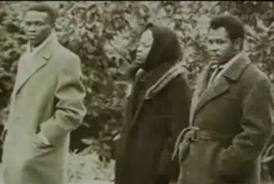
L-R: Ernest Ouandié, Marthe Moumié, and Abel Kingue in Geneva after Felix Moumié's death
The independence of Cameroon, under complete French control, was proclaimed on 01 January 1960 and some leaders of the “legal UPC” rallied President Ahidjo. However, others in the UPC continued with the struggle within the country and abroad. Félix Moumié, Um Nyobé ’s successor, was poisoned with thallium on 3 November 1960 in Geneva by a French secret agent (William Bechtel). Abel Kingue died in Algeria in 1964, while Osende Afana was arrested and decapitated in 1966. A post-colonial struggle by UPC rebels opposing the new Cameroon army (trained and armed by France) continued until August 1970 when the last battalion of the UPC, commanded by Ernest Ouandié, was arrested. Ouandié was sentenced to death and was shot by a death squad in a market on 15 January 1971, in Bafoussam. The civil war, resulting in the destruction of villages and use of napalm is estimated to have resulted in at least 30,000 to 500,000 deaths. It has been conveniently removed from official history, both in Cameroon and in France.
In his book, Richard A. Joseph says: “He [Ruben Um Nyobé ] was undoubtedly one of the most brilliant political thinkers and organizers to emerge after the Second World War in Africa. Had he survived to lead his country to independence, he would most certainly be ranked today on the same level as Julius Nyerere, and the late Kwame Nkrumah and Patrice Lumumba.”
'Remember Ruben' by Mongo Béti
Check out the website Grioo.com where there is a good biography on Ruben Um Nyobe’s life. Don’t forget to check out the website of Dibussi Tande. The great Cameroonian writer Mongo Béti wrote the book Main basse sur le Cameroun, autopsie d’une décolonisation (about the Cameroonian resistance led by the UPC) which was banned in France in the 70s, which led to him to write Remember Ruben in honor of Ruben’s memory. As leader of the UPC, Um Nyobé made several trips to the United Nations headquarters in New York where he spoke in favor of an independent Cameroon. I leave you here with the rare footage, the only footage of Um Nyobé speaking at the UN tribune. This is the only audio and visual record of Um Nyobé found to date. Enjoy hearing Mpodol speak!!! It is a real treasure!!!
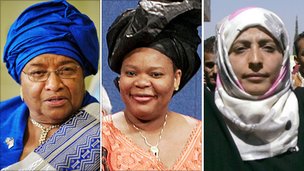
Nobel Peace Prize winners (L to R): Ellen Johnson-Sirleaf, Leymah Gbowee, and Tawakkul Karman (source: BBC)
Wow… such was my surprise and joy when I woke up this morning to find out that Madam President, Mrs. Ellen Johnson-Sirleaf had won the Nobel peace prize this year with another fellow Liberian lady Leymah Gbowee, and a lady from Yemen Tawakkul Karman. I just thought that you would want to re-read the post I wrote almost two years ago on this proud African Iron Lady, and watch the video on her first 52 weeks in power. Enjoy!!! (Just a spin: why is it that for women they had to put all three of them together? couldn’t the Nobel committee have acknowledged Madam president this year, and then the other two next year? or Madam president and the fellow Liberian lady this year, and the other one next year?So sad that when it comes to women, the world, even the Nobel committee is still sexist!)
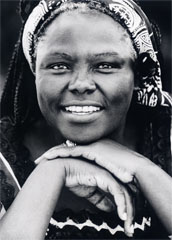
I once took a class in environmental and social changes, where I studied the work of Dr. Wangari Maathai. Her boldness and her stand for truth made her a great role model for many African women, and Africans in general. She was bold! “Wangari Maathai was known to speak truth to power,” said John Githongo, an anticorruption campaigner in Kenya who was forced into exile for years for his own outspoken views. “She blazed a trail in whatever she did, whether it was in the environment, politics, whatever.” Indeed, Wangari Maathai was one of the most widely respected women on the continent, where she played many roles: environmentalist, politician, feminist, professor, human rights advocate, and head of the Green Belt Movement which she started in 1977. She was scoffed at by the Kenyan Forestry department who thought that uneducated women could not fight the desert. She told them ‘We need millions of trees and you foresters are too few, you’ll never produce them. So you need to make everyone foresters.’ I call the women of the Green Belt Movement foresters without diplomas.”
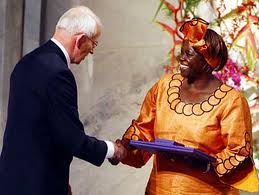
Wangari Maathai receiving the Nobel Peace Prize
As a star student after high school, she won a scholarship to study biology in Kansas (US), and went on for a Masters of Science at the University of Pittsburgh, and later a doctorate degree in veterinary anatomy at the University of Nairobi where she later taught and became chair of the department in the 1970s. Wangari’s work started with the Green Belt Movement with the mission of planting trees across Kenya to fight erosion, stop desertification, create firewood for fuel, provide jobs for women, and empower the women of Kenya. According to the United Nations’ data, her organization has planted over 45 million trees in Kenya, helped 900,000 women, and inspired similar projects in other African countries. “Wangari Maathai was a force of nature,” said Achim Steiner, the executive director of the United Nations’ environmental program. He likened her to Africa’s ubiquitous acacia trees, “strong in character and able to survive sometimes the harshest of conditions.”
Maathai planting a tree
Her work was illustrated in one of my secondary school English textbook. The government of Arap Moi was trying to build a skyscraper in one of Nairobi’s only parks, and she brought women who protested until the government abandoned the project. She was beaten by police until she fainted. Wangari was not one to back down from her beliefs. She would go to jail for what she believed in. For instance, her husband divorced her because he said she was too strong-minded for a woman. When she lost her case in court, she criticized the judge and told him her mind, and was thus thrown to jail.
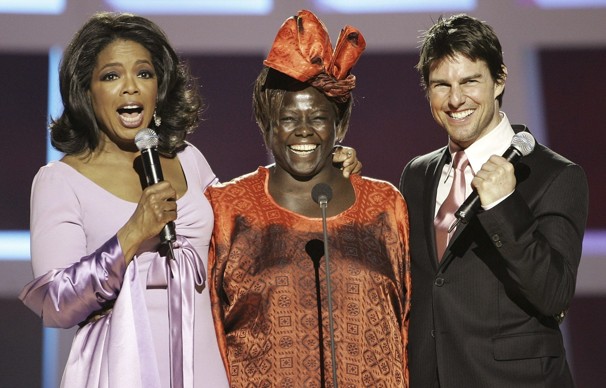
Oprah Winfrey and Tom Cruise congratulating Wangari Maathai on her Nobel Peace Prize
In presenting her with the Peace Prize, the Nobel committee hailed her for taking “a holistic approach to sustainable development that embraces democracy, human rights and women’s rights in particular” and for serving “as inspiration for many in the fight for democratic rights.” Wangari Maathai has received many honorary degrees, including an honorary doctorate from the University of Pittsburg, her alma mater. Check out articles by the BBC, CNN, her Interview on NPR, and the Huffington Post whose article is entitled “Wangari Maathai and the Real Work of Hope .” Don’t forget to click also on the The Green Belt Movement website, and the movie “Taking Root: The Vision of Wangari Maathai.” She once said that ‘we should all be hummingbirds‘: doers, and not spectators, even in the face of great challenges; do the best you can. Goodbye Wangari, your work is not over, for Africa has been blessed with millions of Wangari Maathais who will continue your outstanding work.
In remembrance of Agostinho Neto (Sept. 17 1922 – Sept. 10th 1979), great leader and first president of Angola, I will leave you with a poem written by the great Nigerian writer Chinua Achebe in honor of Agostinho Neto. Enjoy!!!
Agostinho, were you no more
Than the middle one favored by fortune
In children’s riddle; Kwame
Striding ahead to accost
Demons; behind you a laggard third
As yet unnamed, of twisted fingers?
No! Your secure strides
Were hard earned. Your feet
Learned their fierce balance
In violent slopes of humiliation;
Your delicate hands, patiently
Groomed for finest incisions,
Were commandeered brusquely to kill,
Your gentle voice to battle-cry.
Perhaps your family and friends
Knew a merry flash cracking the gloom
We see in pictures but I prefer
And will keep that sorrowful legend.
For I have seen how
Half a millennium of alien rape
And murder can stamp a smile
On the vacant face of the fool,
The sinister grin of Africa’s idiot-kings
Who oversee in obscene palaces of gold
The butchery of their own people.
Neto, I sing your passing, I,
Timid requisitioner of your vast
Armory’s most congenial supply.
What shall I sing? A dirge answering
The gloom? No, I will sing tearful songs
Of joy; I will celebrate
The man who rode a trinity
Of awesome fates to the cause
Of our trampled race!
Thou Healer, Soldier and Poet!
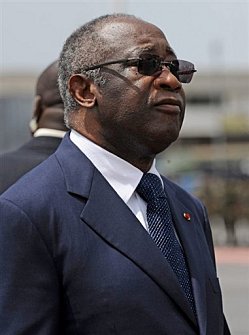
J’ai trouvé le discours du Président Gbagbo à l’occasion de la fête d’independance Ivoirienne très très pertinent, surtout face aux problemes actuels de l’Afrique (Côte d’Ivoire, Libye, Zimbabwe, …) dans le nouvel ordre mondial du gangsterisme! J’invite tout africain à le lire. L’intégralité du discours se trouve sur Revue de Presse CI ——
Ivoiriens, Ivoiriennes, peuples de CÔTE D’IVOIRE, très chers compatriotes, très chers habitants de la CÔTE D’IVOIRE.
Je voudrais, en ce jour solennel qui marque le 51ème anniversaire de l’Indépendance de notre pays, me joindre à chacun de vous pour rendre d’abord gloire à Dieu, notre Maître qui continue de manifester sa fidélité à notre pays, malgré les tribulations de ces derniers moments. […]
Cette réflexion est un exercice de prospection de nous-mêmes qui s’impose à chaque citoyen de ce pays, mais surtout aux dirigeants, et aux responsables politiques et administratifs qui ont la charge de conduire le destin de notre nation, surtout dans le contexte actuel de grands traumatismes causés à notre peuple, qui n’aspire qu’à vivre sa souveraineté en tant qu’acteur et sujet de l’humanité, et non pas comme simple objet ou simple spectateur de la construction de sa propre histoire.
L’Indépendance est une notion forte, qui renvoie à un mouvement de rupture. La rupture ici ne s’entend point d’un isolement ou d’un repli sur soi, position idéale des faibles, mais elle correspond plutôt à une métamorphose de la conscience, qui fait passer celui qui s’en prévaut, de la servitude à sa pleine responsabilisation dans le processus de construction de l’humanité. […]
Je mesure mieux de ma position, les grandes souffrances, mais en même temps le grand mérite de tous ces hommes qui, à travers l’Histoire, ont combattu pour la Liberté et l’Indépendance de leur peuple. Je pense notamment à Martin LUTHER KING, dont l’engagement politique jusqu’à la mort a permis, plus de quarante ans après, l’élection de Barack OBAMA comme Président des ETATS-UNIS d’Amérique; à GHANDI, dont l’ œuvre continue de nourrir l’âme de la grande INDE; au Général de GAULLE qui a refusé la fatalité de la défaite pour restaurer la grandeur perdue de la France; à Mao TSE TOUNG, qui a rompu les liens de la servitude au prix d’énormes sacrifices pour donner à la CHINE sa gloire d’aujourd’hui.
Je loue le courage de MANDELA, de Kwame NKRUMAH, de Patrice LUMUMBA et de tous les autres dignes combattants de l’Afrique, qui sont des exemples de don de soi pour la liberté et la fierté du peuple africain. Je salue plus particulièrement la mémoire de nos illustres pères qui ont combattu pour dessiner les contours de ce que nous appelons Indépendance. Leur mérite est tout à fait grand dans le contexte qui était le leur.
Mais nous devons avoir à l’esprit que leur combat serait vain si nous nous arrêtions à admirer seulement leurs acquis. Les symboles de l’Etat et les armoiries de la République nous rappellent chaque jour notre devoir et notre responsabilité devant notre propre destin. Chacun est appelé à leur donner un sens réel. C’est le combat permanent qui doit mobiliser toutes les énergies des filles et fils de notre pays. […] Continue reading “Le Président Gbagbo s’adresse aux Ivoiriens à L’occasion de la fête nationale”→
Agostinho Neto was the first president of Angola, and served from 1975 to his death in 1979. He was born in a Methodist family (his father was a Methodist pastor), attended high school in Luanda, and studied medicine in Lisbon (specializing in gynecology). In Lisbon, he befriended future political leaders such as Amilcar Cabral (Guinea Bissau and Cape Verde) and Marcelino dos Santos (Mozambique). He combined his academic life with covert political activities.
In 1948 he published his first volume of poetry and was arrested for the first time. There followed a series of arrests and detention, which interrupted his studies. He joined the Movimento Popular da Libertação de Angola (MPLA, People’s Movement for the Liberation of Angola) when it formed in 1956. He was released from detention and allowed to complete his studies in 1958, retuning shortly afterwards to Angola (1959), where he set up a private medical practice.
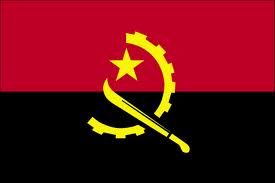
Flag of Angola
On 6 June 1960, Agostinho Neto was arrested at his practice as a result of his campaigning against the Portuguese colonial administration of Angola. When patients, friends, and supporters marched in demonstration for his release, the police opened fire and 30 were killed, 200 more injured. This became known as the Massacre de Icolo e Bengo (his birthplace). Neto was exiled to and held in captivity initially in Cape Verde and then in Portugal, where he wrote his second volume of poetry. After international pressures, the Portuguese government put him under house arrest, where he escaped to Morocco and later to Zaire (Congo).
He became president of the MPLA in 1962, and looked for support in the American government against Portugal, but was turned down. He received the support of Cuba and the Soviet Union for the fight for the freedom of the people of Angola from Portuguese imperialism.
After the Revolução dos Cravos (Carnation Revolution) in 1974 in Portugal, which took down the government by a military coup, Portugal’s foreign policy changed in its African colonies. On 11 November 1975, Angola became independent, and Neto was proclaimed president on that day. The country was effectively held under the rule of three independence movements, with the MPLA holding the central section and the capital.
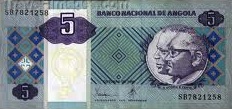
Agostinho Neto & Jose Eduardo dos Santos
Neto’s rule was marked by armed conflict with Holden Roberto’s FNLA (supported by Mobutu of Zaire, and the US) and Jonas Savimbi‘s UNITA which had military support from South Africa. While Neto enjoyed the help and support of the Soviet Union and Cuba, he still encouraged Western investment in the country – especially in oil production. He died of cancer on September 10th, 1979 in Moscow. After his death, the civil war in Angola lasted for over a quarter of a century opposing Jose Eduardo dos Santos (his successor) and Jonas Savimbi.
Agostinho Neto was not only Angola’s first president, he was also a medical doctor, and a poet; he is actually one of Angola’s most acclaimed writer and poet. Please check out the website of the Fundação António Agostinho Neto, which has done a brilliant work in presenting Neto’s writings, debates, and comments by other leaders on Neto. Now I leave you with his great saying: “A luta Continua … A Vitória é certa!”
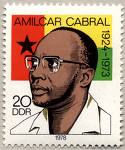
Amilcar Cabral was not only an agronomic engineer, or a freedom fighter, or the father of Bissau and Cape-Verde independence, but he was also a poet… like Che Guevarra or Sankara… he was a visionary with a poetic mind. In the following lines, you will read the poem ‘Regresso‘ also known as ‘Mamãi Velha‘ which was sung by the Cape-Verde singers Cesaria Evora (appeared in album Sao Vicente di Longe (2001)), and Isa Pereira.
Regresso
Old mama, come and let’s listen
To the beat of the rain against the door
It’s a friendly beat
That pounds in my heart
The rain, our friend, old mama
The rain that hasn’t been falling this way
In a long time I heard that Cidade Velha
The entire island becomes a garden
In just a few days
I heard that the country is covered in green
The most beautiful colour
The colour of hope
That now, the soil really looks like Cape Verde
Peace has now replaced the storm
Come old mama, come
Regain your strengths and come to the door
The rain, our friend, sends its salvation
And can beat in my heart
—-
Regresso
Mamãi Velha, venha ouvir comigo
o bater da chuva lá no seu portão.
É um bater de amigo
que vibra dentro do meu coração.
A chuva amiga, Mamãi Velha, a chuva
que há tanto tempo não batia assim…
Ouvi dizer que a Cidade Velha,
– a Ilha toda –
em poucos dias já virou jardim…
Dizem que o campo se cobriu de verde,
da côr mais bela, porque é a côr da esp’rança.
Que a terra, agora, é mesmo Cabo Verde,
– É tempestade que virou bonança…
Venha comigo, Mamãi Velha, venha
recobre a força e chegue-se ao portão.
A chuva amiga já falou mantenha
e bate dentro de meu coração.












 African Heritage