This past weekend saw the anniversary of Thomas Sankara’s assassination. In memory of this great man who graced our continent. I decided to repost his speech on African debt, which after almost 30 years is still very actual. His speech in one of unity. Imagine if we had been united, would there have been a Libya 2011, or Cote d’Ivoire 2011, or all the subsequent others? Unity does make us strong.
===========
Thomas Isidore Sankara, our African hero, was killed for his convictions, love of his people and his country. This great hero gave one of the greatest speech I have heard about the problem of the African debt. Such an eloquence! Such Truth my Lord! Such humor! I do agree with him that the African debt cannot be entirely paid… and that the African nations who do not show up at the UA summit should not have favors extended to them the same as those who attend the meetings. Moreover, he talks about living and breathing African: his delegation and himself were entirely dressed by Burkinabés tailors with cotton from Burkina Faso. Please watch, listen, and celebrate one of the greatest man the African continent has ever seen! Don’t forget to watch part 2 as well.
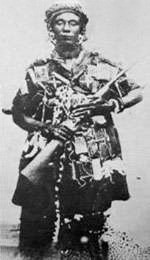
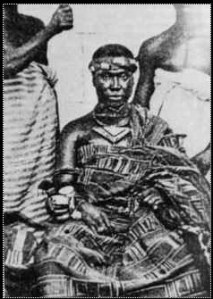
Queen Yaa Asantewaa in Batakarikese (Ceremonial war dress)
On 17 October 1921, the great Ashanti warrior queenYaa Asantewaa passed away. Her story is that of a queen who rallied masses to fight for their independence; hers is a story of courage, determination, and stamina. Yaa Asantewaa led a rebellion against the British at a time when the men surrounding her were low in spirit, afraid, and discouraged. She arose them to fight for their independence, and for their nation. Her fight against British colonialists is a story woven throughout the history of Ghana.
Yaa Asantewaa was born in 1840 in the Gold Coast in the Kingdom of Ashanti. She was a successful farmer, mother, intellectual, politician, human right activist, Queen and leader. Yaa Asantewaa became famous for leading the Ashanti rebellion against British colonialism to defend the Golden Stool, symbol and soul of the Ashanti nation (1900–1901). She promoted women emancipation as well as gender equality. She was the sister of the Ruler of Ejisu (Ejisuhene) Nana Akwasi Afrane Okpase, an ethnic group in present-day Ghana.
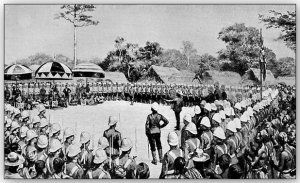
January 1896: British formally annexing the Ashanti Kingdom – depiction of governor’s discussions with Prempeh I
During her brother’s reign, Yaa Asantewaa saw the Asante Confederacy go through a series of events that threatened its future, including civil war from 1883 to 1888. When her brother died in 1894, Yaa Asantewaa used her right as Queen Mother to nominate her own grandson as Ejisuhene. When the British exiled him in the Seychelles in 1896, along with the King of AsantePrempeh I and other members of the Asante government, Yaa Asantewaa became regent of the Ejisu-Juaben District. As seen earlier, this was the European’s way of dealing with African kings, as in Benin Kingdom. Sending a king to exile was usually followed by the looting of their land. This has led to the discovery of lots of Africa’s valued arts and crafts in Europe, which to this date have not been returned to their rightful owners.
Ashanti captain 1819
After the deportation of Prempeh I, the British governor-general of the Gold Coast, Frederick Hodgson, demanded the Golden Stool. This request led to a secret meeting of the remaining members of the Asante government at Kumasi, to discuss how to secure the return of their king. There was a disagreement among those present on how to go about this. Yaa Asantewaa the Queen Mother of Ejisu, was at the meeting. The chiefs were discussing how they should make war on the white men and force them to bring back the Asantehene. She saw that some of the chiefs were afraid. Some said that there should be no war. They should rather go to beg the Governor to bring back the Asantehene King(Nana) Prempeh.
Disgusted by the men’s behavior, Yaa Asantewaa stood up and addressed the members of the council with these now-famous words:
“Now, I see that some of you fear to go forward to fight for our king. If it was in the brave days ofOsei Tutu, Okomfo Anokye, andOpoku Ware I, chiefs would not sit down to see their king to be taken away without firing a shot. No European could have dared speak to chiefs of Asante in the way the governor spoke to you this morning. Is it true that the bravery of Asante is no more? I cannot believe it. It cannot be! I must say this: if you, the men of Asante, will not go forward, then we will. We, the women, will. I shall call upon my fellow women. We will fight! We will fight till the last of us falls in the battlefields.”
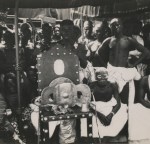
The Golden Stool in 1935
With this, she took on leadership of the Asante Uprising of 1900, gaining the support of some of the other Asante nobility. She led the famous war knows as the War of the Golden Stool against the British. After several months, the British Gold Coast governor eventually sent a force of 1,400 to quell the rebellion. During the course of this, Queen Yaa Asantewaa and 15 of her closest advisers were captured, and they too were sent into exile to the Seychelles. She died there on 17th of October 1921. Three years later, on 27 December 1924, Prempeh I and the other remaining members of the exiled Asante court were allowed to return to Asante Kingdom. Prempeh I made sure that the remains of Yaa Asantewaa and the other exiled Asantes were returned home for a proper royal burial. She was buried with all the honors due a queen like her.
Yaa Asantewa’s War was the last major war led by an African woman. She embodied courage and strength when faced with the injustice of the European invader. She is honored with a school named after her, ‘Yaa Asantewaa Girl’s Secondary School’ In Kumasi in 1960. Many young girls in Ghana are proudly named after her.
Ashanti King Palace being ransacked and burnt by the British in 1874 after the 3rd Anglo-Ashanti war
Prempeh I was the Asantehene (King) of the Kingdom of Ashanti. He was born as Prince Kwaku Dua III Asamu of the Kingdom of Ashanti, and he took the name of Prempeh I upon ascension on the throne at the young age of 16. His reign was a troubled one as it fell during the time of British invasion/colonization of the Gold Coast. In essence, he was the last king of the Kingdom of Ashanti before the Gold Coast fell under British protectorate.
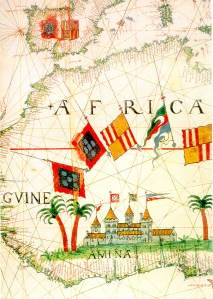
Europeans were already installed in the region and had been trading on the coast since the 15th century for gold and slaves (as we saw with the slave castles of Elmina and Cape Coast). By the beginning of the 19th century, the British government decided to formalize its control of the Gold Coast. They dispatched a force to conquer the Ashanti. They only won the war against the disciplined Ashanti because of the superiority of their artillery and rifles over the traditional muskets of the Ashanti. Once in Kumasi, the capital, the British hastily looted the royal palace and burned the town to the ground. The defeated Ashanti had already released their prisoners and subsequently were forced into agreeing to a treaty togive up claims on coastal territories, to cease the practice of human sacrifice and to pay a huge indemnity of 50,000 ounces of gold. This was known as the Wolseley’s expedition. The Gold Coast was then declared a Crown Colony.
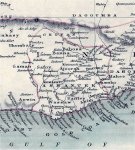
16th Century map of West Africa with Fort Elmina
Having lost their invincibility in war, the Ashantis were now faced with rebelling neighboring tribes, and the Ashanti confederation was descending into civil war. The Ashanti had become so weak that, in 1888, they asked the British governor to send an arbitrator from the coast to decide who, amongst rival claimants, should be the next Asantehene. The governor’s delegate decided in favor of the 16 year-old Prempeh. But Prempeh I turned out to be no puppet and refused to agree that Ashanti should become a British Protectorate.
Asantehene Prempeh I began an active campaign of the Ashanti sovereignty. The British offered to take the Kingdom of Ashanti under their protection, but Asantehene Prempeh I of the Kingdom of Ashanti refused each request. Asantehene Prempeh I stated, “My Kingdom of Ashanti will never commit itself to any such policy of protection; Ashanti people and the Kingdom of Ashanti must remain an independent sovereign state as of old, and at the same time be friends with all white men“.
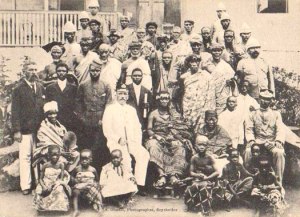
Prempeh I and his suite in the Seychelles (taken by F.A.L. Ramseyer) ca 1900-1903
Still wary of the French in Ivory Coast and alarmed by a resurgent Ashanti, the British now (1894) “remembered” that the Wolseley indemnity had never been paid. Prempeh Itried to appeal directly to a fellow sovereign, Queen Victoria, and sent an embassy to London to plead his cause. But the British government refused to give his delegates an audience for almost a year and mounted another elaborate British army expedition to Kumasi. Prempeh I refused to allow the Ashanti to fight, partly because of the memory of the Wolseley expedition and partly because of the British support for him during the succession dispute. Instead, he diplomatically greeted the troops as his guests when they marched into Kumasi, in January of 1896. The British governor arrived and coldly received Prempeh I and his chiefs. Prempeh I desperately tried to placate the invaders and to the horror of his people, he demeaned himself by prostrating himself before the governor in a sign of submission. The governor’s only response was to demand the gold promised to Wolseley. Prempeh could not provide such a huge indemnity at once but offered to pay in instalments starting with 680 ounces as a down payment. This was refused and then, to the astonishment of the Ashantis, Prempeh and some of his main chiefs were suddenly arrested.
Prempeh I’s place was looted. His throne is still displayed in the Royal Signals Museum at Blandford in England. The abducted Asantehene, Prempeh I, some of his relatives and advisors were first taken to Elmina for about a year, then to Freetown in Sierra Leone until 1900 when, upon the outbreak of Yaa Asantewaa (story for another day), the British feared proximity and sent the royal party to the Seychelles, in the Indian Ocean.
Once there, Prempeh I spent time in his villa on Mahe, the largest of the Seychelles’ island in the Indian Ocean. Prempeh I’s villa, and 16 new wooden houses with sandy floors and roofed with corrugated iron-sheets were built in Seychelles and allocated to the various Asante’s nobles. The place was called the Ashanti Camp. Prempeh made an effort to educate himself in English and made sure that the children received education.
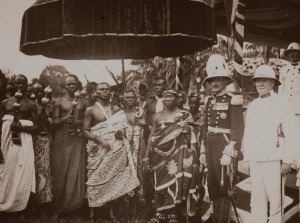
Prempeh I reinstated in Kumasi in 1926 (Source: thekingdomofAsante.com)
On 27 December 1924, Prempeh I and the other remaining members of the exiled Ashanti court were allowed to return to Ashanti Kingdom. Upon his return, and to appease the Ashanti people, the British created for Prempeh I the official position of Kumasehenein 1926, position which he held until his death in Kumasi, Ghana, on 12 May 1931. He was succeeded by his heir apparent Prempeh II of the Kingdom of Ashanti.
Prempeh I was definitely a king caught between trying to hold the sovereignty of his people, and keeping peace, while working with the British invader peacefully. Was his approach the correct one when faced with a greedy, heartless, and treacherous opponent?For more information, please check out Kreol magazine, The Kingdom of Asante, asantekingdom.org websites which are full of great articles.
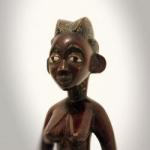
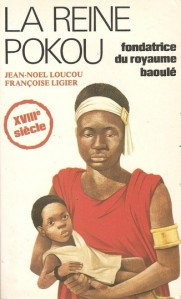
Just to add a bit more to the story of Queen Abla Pokou, the outstanding queen who led a group of the Ashanti people who later became the Baoule people of Cote d’Ivoire, I leave you here with a snipet of the 3D movie: POKOU Princesse Ashanti.
The story of Queen Abla Pokou (Abla Poku in English) is the story of the creation of the Baoule people of Côte d’Ivoire. She was a strong and loving queen who made a profound sacrifice for the well-being of her people, and thus was granted their deep love.
In the 17th century, King Osei Kofi Tutu I founds the Ashanti Empîre of Ghana. Given that in the Ashanti culture the law is matrilineal, when King Oseï Tutu dies, his nephew succeeds him. However, when his nephew dies shortly after, a war for the throne starts in Kumasi, the capital of the kingdom; this war opposes an old uncle of the royal family named Itsa, and Dakon, the second brother of the future queen Abla Pokou (born at the beginning of the 18th century). Dakon will also die in this fratricide war. Quickly, Abla Pokou, understanding that she and her followers will be next to die, decides to flee. Led by her, they walk for several days and nights, fleeing from those threatening to kill them. They soon arrive on the shores of the Comoé River, located on the frontier between Ghana and Côte d’Ivoire. But the river is unsurmountable, its waters are dangerous, and their enemies are getting closer. After having overcome so many obstacles, and walked for days, it is impossible to stop there.
Queen Pokou looks to her court wizard for advice, saying, “wizard, tell us what the genie of the river wants from us in order to cross its treacherous waters!” The wizard replies, “Queen, the river is quite irritated, and would only stop once an offering of what is most dear to us is made to it.” Thus, the women of the court start taking off their gold and ivory jewelry, and the men bring their cattle for offering. But the wizard, shaking his head sadly, states “What is most dear to us is our sons!”
Looking upon her people, the queen decides to make the most difficult sacrifice ever: that of her toddler son wrapped on her back. After untying him, she says to him, “Kouakou(‘Kwaku’ in English), my only child, forgive me, but I have understood that I need to offer you to the river for the survival of our people. More than a woman or mother, a queen is first a queen!” She then stoically, without shedding a tear, offers her son as a sacrifice to the Comoé River.
Once the offering made, a path quickly appears within the waters of the Comoé river allowing the queen and her people to cross it. Once the river crossed, the queen finally cries, “BA OULI!” meaning “the child is dead.” This will become the name of the people “Baoulé”. Once they arrived in a good place, the tribe holds a funeral for the sacrificed child. In memory of this, the place will be called Sakassou, meaning “place of funerals.” Queen Abla Pokou will rule over her people for many years, and news of her good reign will travel very far. She will die around 1760.
Poster for the 3D movie: Pokou Ashanti Princess
Some historians claim that a big tree bent over to let the Queen and her people cross, while others maintain that a group of hippopotamuses lined up a path across the river for the queen. Either way, the story of the queen’s great courage remains the same. Queen Abla Pokou, the founder of the Baoulé people of Côte d’Ivoire, was a great queen and woman who sacrificed what she held most dear for the well-being of her people. Many African presidents would learn a lot from Queen Abla Pokou’s courage, determination, and love of her people. Today in Côte d’Ivoire, her story has just been made into a 3D movie: POKOU Princesse Ashanti. The Ivorian author Véronique Tadjo has also published a book Reine Pokou: concerto pour un sacrifice in 2005. The story of Queen Pokou and the Baoule was retold by Maximilien Quenum in his Légendes africaines. Check out the websites Naforo-Ba and Matricien.org to learn more about it.
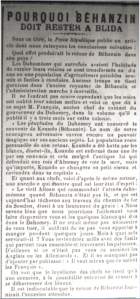
The article below is from 1906 giving reasons why the French government refused to return Béhanzin to his country. The English translation is brought to you by Dr. Y., Afrolegends.com .
===========
Under this title, La Petite République published an article from which we extract the following conclusions:
What will be the effect of Béhanzin’s return in his country?
The Dahomeans, who in the old days, used to raid their neighbors have been transformed under 10 years, into a population of peaceful docile peasants and easy to be led. No troops are stationed in the ancient kingdom of Behanzin and the administration is working amazingly.
Do not for one instant believe that the negroes have forgotten their old master and here is what M. Francois, ancient chief of cabinet of the governor of Dahomey, says about this in the volume he published three months ago on this colony.
The original article from La Petite Republique, in French
“The people of Dahomey have kept the memory of Kondo (Béhanzin). The name of our courageous adversary still exerts a magical power on his old subjects. The population remains certain of his return. They say, Kondo was defeated by the whites, Kondo is imprisoned on an island by his enemies and this despite the ancient law which guards the Kings of Abomey from seeing the sea, but anyhow, Kondo will transform himself into a small bird and will come back to his capital.”
As for the chiefs, here is, from the same author, an anecdote which shows their state of mind:
“The old Alloan who used to command the Dahomean army when Béhanzin was not here, and who today is a worker on the Sudan railroad, was telling one of the engineers, “We know well that we could easily make you disappear, you and the other white people who are in the Dahomey. It would not even be necessary to kill you, it will suffice not to bring you any food for a few days. But what will be the point of this? You will come back, by the thousand, with guns which fire all at once and traverse palm trees. Moreover, if it wasn’t you, it will be the British or the Germans.” And he politely added, “better if it is the French.”
One can see that the loyalty of the chiefs holds onto a fine thread, an occasion, a possibility, to rid their land of the whites.
It is undeniable that the return of Béhanzin will provide this anticipated occasion.
It is important to cultivate integrity in all our actions. Muhammad Ali, born Cassius Clay, was a man of great integrity. What do I mean by that? When drafted to go to war, he said NO. He said he could not understand why he was being made to fight a people who had done nothing to him. He thought, how could he, a Black man in America with newly acquired rights, could go kill people (the Vietnamese people), who were victim of the white man’s greed? He probably thought, “they did nothing to me, why should I kill them? Who gives me the right to kill them?” He stood his ground, and refused to serve. For this, he was punished, banned for 5 years. For many, this could have been a descent into depression, alcoholism, drugs, etc… for he had lost his source of income; he was eventually arrested, found guilty of draft evasion charges and stripped of his boxing titles. He successfully appealed in the US Supreme Court, which overturned his conviction in 1971, by which time he had not fought for nearly four years—losing a period of peak performance as an athlete. Many thought he was arrogant, but he stood for his beliefs. Instead of falling down, he stood up, he became an activist, and worked tirelessly to end the war in Vietnam… he rallied masses.
Muhammad Ali was also the first international boxer of his stature to fight in Africa. Who has not heard of “The Rumble in the Jungle” the 1974 fight which took place in Kinshasa, Zaire (now Democratic Republic of Congo)? This was a historic game not only because it was deemed the fight of the century, and featured Ali vs. Foreman, but also because it took place on African soil. It brought in representatives from all over the continent, and singers from around the world. In the emission on the Origin of Rumba, the late Papa Wemba clearly stated that he had been at that game and met several legends of music James Brown, Celia Cruz and the Fania All-Stars, B.B. King, Miriam Makeba, Johnny Pacheco, and it had been an experience like none other.
So let us remember Muhammad Ali, a man of integrity, who inspired so many by his spirit, strength, determination, and courage. So long Ali… the Greatest.
I really liked this Pambazuka article on the brief history of the passport. For those of us coming from ‘third-world’ countries, the act of applying for visas is both quite expensive and time-consuming. I always wondered why citizens of the ‘developed’ world could enter most countries in the world free of charge, while citizens of underdeveloped countries needed visas. The logic always seemed twisted to me, especially given that the converse was not true. For instance, a South African citizen needs a visa to enter the USA for tourism/business, but an American citizen does not need a visa to enter South Africa for the same reasons, and the list goes on. The article below goes over it. For the full article go to: Pambazuka . Here are some excerpts.
=========
Fatou Diome
[…] In spring 2015, Senegalese author Fatou Diome, whose works include The Belly of the Atlantic, caused a stir during the French talk show Ce soir ou jamais!. Only a month earlier, over 1,000 had drowned in one week in the Mediterranean Sea after their boat had capsized en route from the Tunisian coast to Italy. Diome vented her anger about the current European perspective and discourse on migration. And she expressed her belief that there is an underlying global problem that is rooted in the privileged treatment of a small percentage of the world’s population that depends on a document:
“Europeans see Africans arriving, ok. This migratory movement of populations is tracked and visible. But you don’t see the migratory movement of Europeans going to other countries. This is the migratory movement of those with power, with money. Those who have the right kind of passport. You go to Senegal, you go to Mali, you go to any country in the world, to Canada, to the U.S. Everywhere I go […], I meet French people, German people and Dutch people. I run into them everywhere on this planet because they have the right kind of passport.” (translated from French) (Diome 2015)
‘The Belly of the Atlantic’ by Fatou Diome
Apart from unmasking a very selective European perception and use of the word ‘migration’, Diome addressed an apparent inequality. There is a structural force which privileged nationals can ignore while the unprivileged are confronted with it every day, namely the power of a passport. Clearly, this inequality is not a natural development, but has evolved over time, as a look at the history of this small document shows.
[…] The focus here will be on the international passport. This document is used to control the departure from the home country, entering a foreign country and returning to the home country. All those who have crossed a national border know the process of handing his or her passport to a border official behind a glass panel. This guard checks you and your passport very thoroughly and sometimes asks questions about your purpose of travelling.
Nonetheless, a German passport allows the holder to enter 172 of the Earth’s 192 countries without a visa. Reversely, people from only 81 countries can enter Germany without a visa – an imbalance that quantifies a passport’s power. The development of a passport hierarchy is an advanced process, which has only been taking place for some decades. It leaves citizens from countries such as Somalia, Eritrea, Sudan, South-Sudan, Ethiopia, Congo or Liberia at the bottom of this hierarchy and enforces a restrictive and often arbitrary system of visa issuance on them. This system allows economically and politically powerful nations to use people’s mobility as a bargaining resource and reinforces their dominance. An example of this mechanism is the 2014 FIFA world cup in Brazil: European countries had a keen interest in granting their football-mad citizens free access to the host country. Brazil managed to secure liberalized visa regulations for its own citizens traveling to Europe in return. In this instance, the cultural event gave Brazil negotiating power and that in turn increased its economic and political power. When states lack these material and symbolic resources, they are less able to give their populations access to international networks, exchanges, education and jobs.
World map (Wikipedia)
Alternatives become possible when we start deconstructing the perceived ‘naturalness’ of the status quo. A growing number of intellectuals, scholars, artists and political activists are pointing to the historical development of borders and making us aware of their violence and their arbitrariness. They argue in favor of social and economic advantages that non-existent borders might yield…a world in which we can claim that the passport was just an episode that lasted for little more than a century. It would be a world in which Diome’s statement would ring true for everyone:
“We live in a globalized world in which an Indian might live and make a living in Dakar, someone from Dakar in New York, someone from Gabon might live and make a living in Paris. Whether you like it or not, this is an irreversible fact. So let’s find a collective solution, or move away from Europe, because I intend to stay.” (translated from French) (Diome 2015)
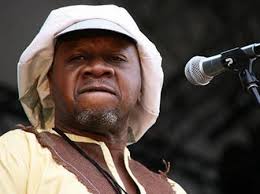
Papa Wemba was not only a star, a musician, and artist, but he was also a father, a husband, and a son. He had been married to his wife, Marie-Rose ‘Amazone’ Luzolo, for almost 50 years; they had met when he was 20, and she was 14. They had 6 children. In this world, very few celebrities have been married to only one person for almost 50 years.
Here are a few words of Papa Wemba, le rossignol (the nightingale), the King of Rumba and SAPE.
About his mother who was a professional ‘wailing woman’: “My mother was my first teacher and my first public. … I grew up with my mother’s melancholic singing. … When I will sing, she will say “my son, block here, and now project your voice“… when I did well, she will clap for me“(source: Tv5 – Africanité). For his mother, he composed Mamaand Maria Valencia.
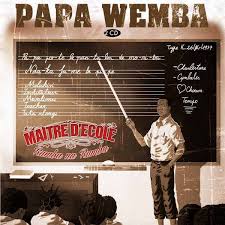
Papa Wemba’s last album ‘Maitre d’Ecole’
His daughter, Victoire, said that after Papa Wemba was convicted by the Belgian justice, “Dad prayed a lot. Dad was a champion, and he was victorious“(source: TV5 – Africanité).
About his wife, he said: “For my first trip to Japan, I said I will never go alone… my first long trip,… 13h long…, I brought my tender spouse and one of my children to experience it with me” (source: RFI- Dernière interview avec ClaudySiar). For his wife, he sang 4 min 29 secondes d’adoration, Phrase, and Ma Rosa.
He was a compassionate being: during one of his concert, he asked the audience for one minute of silence for one of his band members, Patrick Bebey, who had lost his father the week before (source: TV5- Edition spéciale – Hommage Papa Wemba).
Papa Wemba’s album ‘Emotion’
He was a generous soul: a neighbor in Matonge said: « Je me souviens qu’une fois, je l’ai juste salué en passant. Il m’a rétorqué. Albert pourquoi tu fais le pied. Je lui ai expliqué que mon véhicule était tombé en panne. Il m’a donné à l’instant même l’argent que j’avais besoin pour réparer ma voiture. » “I remember that one time, I just greeted him [Papa Wemba] in passing. He asked me. Albert, why are you walking. I told him that my car was broken. Instantly, he gave me to money to fix my car.” (source: Radio Okapi).
Papa Wemba was known for his legendary humility: « A l’annonce d’un cas de décès à Matonge et surtout dans notre avenue ici Kandakanda, il s’arrangeait toujours pour envoyer sa contribution lorsqu’il n’était pas au pays. Dans les cas où le décès intervenait et qu’il se trouvait sur place à Kinshasa, il venait personnellement conduire la quête pour soutenir la famille éprouvée. Bien sûr, sa contribution était toujours largement au-dessus par rapport à ce que nous autres pouvions bien volontiers donner » témoigne Francine, une voisine de Papa Wemba à Matonge. “At the announce of a death in Matonge, and particularly on our avenue here in Kandakanda, he always made sure to send in his contribution when he was outside the country. When the announcement happened and he was in Kinshasa, he personally came to lead the quest for people’s contribution to support the bereaved family. Of course, his contribution was way bigger than anything we could gladly contribute” (source: RadioOkapi).
“I was lucky to cross all the oceans with my voice.” … “I was lucky to belong to a country with a musical genre such as Rumba.”
Papa Wemba defined Rumba as “the maternity of the African music” (source: TV5 – Africanité).
He said: “I am Rumba, it is thanks to Rumba that I have made a name for myself in the world” (source: TV5 – Africanité, RFI- Dernière interview avec Claudy Siar).
About la SAPE and his influence around the world: “Today even great politicians sapent (are dandy)… Before Mr. Obama steps out, he first takes a look in his mirror to make sure that he looks good… La SAPE is international“(source: TV5 – Africanité).
About SAPE: “La vie est trop courte pour s’habiller triste. [Life is too short to dress sadly]” (source: Oeil d’Afrique).
About leading: “Il ne faut pas tenir la queue, il faut être devant le peloton.” [Don’t be at the back of the queue, You must lead the pack.] (source: RFI- Dernière interview avec Claudy Siar).
About retirement: “Moi, Papa Wemba, N-O-N, jamais je ne parlerais de retraite. A moins que le Bon Dieu lui-même ne me dise ‘ta voix n’y est plus’… Tant que je serais un homme debout, tant j’aurais toujours ma belle voix, je serais toujours sur scène.” [I, Papa Wemba, N-O, I will never talk of retirement. Unless God says ‘your voice is no longer there’… as long as I will still stand, as long as I still have my beautiful voice, I will always be on stage.](source: RFI- Dernière interview avec Claudy Siar).
And lastly about his gift, his voice, and God: “My voice is my gift. … I have the grace of God, God loves me very much, and He always puts His hand on me” (source: RFI- Dernière interview avec Claudy Siar).
Very few in this world have had a chance to ‘depart’ while doing something they loved, while in the midst of doing something they’ve always been passionate about. Papa Wemba’s departure was sudden, but it was in the midst of doing what he loved. This man had been at the forefront of African music for over 40 years. He was truly an African global star. He loved Rumba and introduced the world to the Rumba Rock. Japanese fans created bands and sang in Lingala in Japan, thanks to Papa Wemba’s touring the country. Papa Wemba toured the United States with artists such as Peter Gabriel. People in Colombia and in other countries across the world danced to the rhythm of Papa Wemba. He was truly a global star, and Africa just lost a legend.






 Just to add a bit more to the story of
 Queen Pokou looks to her court wizard for advice, saying, “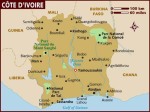




 I really liked this

 Nonetheless,



 “I was lucky to cross all the oceans with my voice.” … “
 About leading: “
 Very few in this world have had a chance to ‘depart’ while doing something they loved, while in the midst of doing something they’ve always been passionate about.
 African Heritage