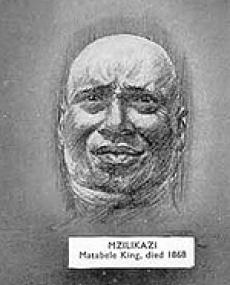
Mzilikazi (meaning The Great Road), was a Southern African king who founded the Matabele kingdom (Mthwakazi), Matabeleland, in what became Rhodesia and is now Zimbabwe. He was born ca. 1790 near Mkuze, Zulu Kingdom (now part of South Africa). The son of Matshobana whom many had considered to be the greatest Southern African military leader after the Zulu king, Shaka. In his autobiography, David Livingstone referred to him as the second most impressive leader he encountered on the African Continent. He was also the father of Lobengula.
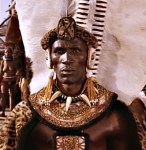
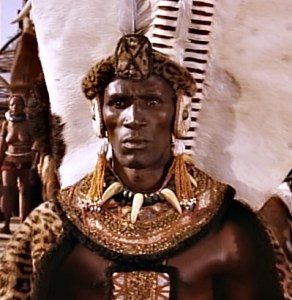
King Shaka
The territory of the Northern Khumalo was located near the Black Umfolozi River, squeezed between the lands of two strong rival groups: the expanding Mthethwa empire of Dingiswayo and the land of the equally ambitious and much more ferocious Zwide of the Ndwandwe. Mzilikazi’s boyhood was spent in the household of his grandfather Zwide. Inevitably, as he grew to manhood he observed the less powerful Khumalo being drawn into the conflict between Dingiswayo and Zwide.
Bayethe! Ndebele Nation! You are the knobkerrie that menaced Tshaka. You are the big one who is as big as his father Matshobana. You are the string of Mntinti and Simangele Simangele son of Ndaba. You are the string of Mntitni and Ndaba The string they made until they wet tears You are the sun that rose from the ear of the elephant, It rose where upon the birds announced to each other. You are the son of Simangele who was kicked! Who was kicked by long feet and by the short ones. You refused to eat the gift of meat in Bulawayo. You are the fighter who has marks of fighting, You are the cattle that opened the closed pen with their horns, Because they opened the Ngome forests and left. You are the moon the people said had set Yet it was just rising; It rose in the year of Mpeyana. You are the cow that showed its face from the crowd. You are the log from which the Zulus cut firewood until they left it. You are the cow that, while it was just emerging made progress.
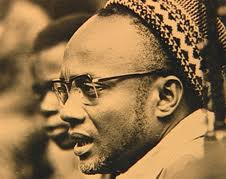
« Always bear in mind that people are not fighting for ideas, for the things in anyone’s head. They are fighting to win material benefits, to live better and in peace, to see their lives go forward, to guarantee the future of their children.» (Amilcar Cabral).
Here is a poem by Patrice Lumumba (1925–1961), published on Pambazuka News. Patrice Lumumba was elected the first prime minister of the Democratic Republic of the Congo (DRC). Assassinated by Belgian colonialists and the CIA, Lumumba was a founder member of the Movement National Congolais (MNC), which led the Congo to independence. Patrice Lumumba is the symbol of aspirations of an entire continent, and he continues to serve as an inspiration to contemporary Congolese and African politicians. His spirit lives on, and his pride is ours!
=======
Dawn in the Heart of Africa
For a thousand years, you, African, suffered like beast, Your ashes strewn to the wind that roams the desert. Your tyrants built the lustrous, magic temples To preserve your soul, reserve your suffering. Barbaric right of fist and the white right to a whip, You had the right to die, you also could weep. On your totem they carved endless hunger, endless bonds, And even in the cover of the woods a ghastly cruel death Was watching, snaky, crawling to you Like branches from the holes and heads of trees Embraced your body and your ailing soul. Then they put a treacherous big viper on your chest: On your neck they laid the yoke of fire-water, They took your sweet wife for glitter of cheap pearls, Your incredible riches that nobody could measure. From your hut, the tom-toms sounded into dark of night Carrying cruel laments up mighty black rivers About abused girls, streams of tears and blood, About ships that sailed to countries where the little man Wallows in an ant hill and the dollar is king, To that damned land which they called a motherland. There your child, your wife were ground, day and night In a frightful, merciless mill, crushing them in dreadful pain. You are a man like others. They preach you to believe That good white God will reconcile all men at last. By fire you grieved and sang the moaning songs Of a homeless beggar that sinks at strangers’ doors. And when a craze possessed you And your blood boiled through he night You danced, you moaned, obsessed by father’s passion. Like furry of a storm to lyrics of a manly tune From a thousand years of misery a strength burst out of you In metallic voice of jazz, in uncovered outcry That thunders through the continent like gigantic surf. The whole world surprised , wakes up in panic To the violent rhythm of blood, to the violent rhythm of jazz, The white man turning pallid over this new song That carries torch of purple through the dark of night.
The dawn is here, my brother! Dawn! Look in our faces, A new morning breaks in our old Africa. Ours alone will now be the land, the water, mighty rivers Poor African surrendered for a thousand years. Hard torches of the sun will shine for us again They’ll dry the tears in eyes and spittle on your face. The moment when you break the chains, the heavy fetters, The evil cruel times will go never to come again. A free and gallant Congo will rise from black soil, A free and gallant Congo-black blossom from black seed!
Below is a description of Kong, the last capital of Samori Touré, by a French explorer back in 1892. In 1892, it was a delight to the eyes, and even the French explorers and conquerors were stunned by its beauty! Enjoy!
=======
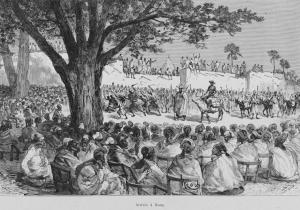
Arrival of the French explorer Louis-Gustave Binger in Kong in 1888
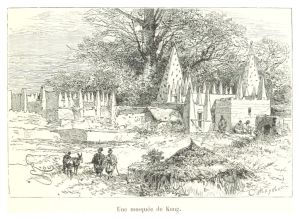
“Kongis infinitely less dirty that Bondoukou, even though its population is six (6) or seven (7) times higher. The deleterious miasmas are less persistent probably because of the altitude (about 700 meters). At these heights, the wind beats any infection. Built on an elongated rump, the city is freshened up by the least breeze. The surroundings, except a few groups of large trees used as sheds for animals, are deforested as far as the eye can see. At this time of the year, this immensity is of a deep green similar to English lawns, the whole landscape is of an exquisite charm. – And the grace, charm, are rare things on this
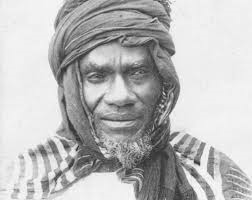
Samori Touré
morose continent ! – The city, especially from the northwest, gilded by the setting sun, with its pyramidal minarets of its five mosques, the palm trees separating their thin silhouette from the sky, the superimposed terraces where groups of faithful appear at the time of prayer, is an unforgettable vision. This is how Binger saw Kong for the first time, and I can imagine what must have been his surprise.”
Marcel Monnier, France Noire, Plon ed. Paris, p. 204, 1894 . Translation to English by Dr. Y. Afrolegends.com
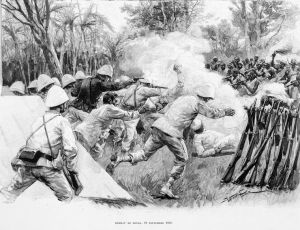
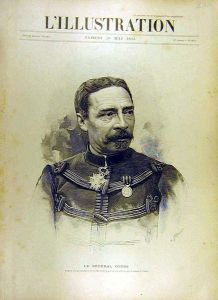
Below is the notification by Alfred-Amédée Dodds from the French Republic stating that the Kingdom of Dahomey is now under the Protectorate of the French Republic, with the exception of Whydah and certain other territories, which were declared by a French Notification issued on the 3rd December, 1892, to be annexed to France.
The following is a Translation of that Notification :—
(Translation)
le general Alfred-Amedee Dodds
“In the name of the French Republic:
“We, Brigadier-General, Commander-in-Chief of the French Settlements of Benin, Knight Commander of the Legion of Honour.
“In virtue of the powers conferred upon us,
“We declare :
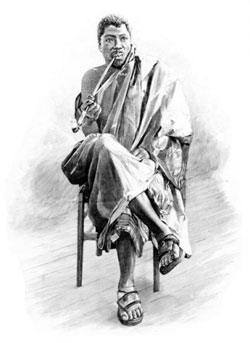
“That KingBéhanzinAhy-Djerehas been deposed from the throne ofDahomey, and has been banished for ever from this country.
Behanzin, the Last King of independent Dahomey
“That the Kingdom ofDahomeyis, and remains, placed under the exclusive Protectorate of France, with the exception of the Territories of Whydah, Savi, Avlékété, Godomey, and Abomey-Kalavy, which constituted the ancient Kingdoms of Ajuda and Jacquin, which are annexed to the Possessions of the French Republic. The limits of the annexed Territories are: to the west, the River Aheme; to the north and to the east, the River Savi and the north-east frontiers of the Territory of Abomey-Kalavy; to the south, the AtlanticOcean.”
The world celebrates men. Men can be ambitious, they can work to liberate their countries, they can be revolutionaries, and lead people. No one is against that. The world applauds these men. But when women fight for the liberation of their countries, they are vilified; they are called all sorts of names. It’s as if the world suffers from selective amnesia. We have a woman who is at the same level as all the world revolutionaries, Winnie Madikizela-Mandela.
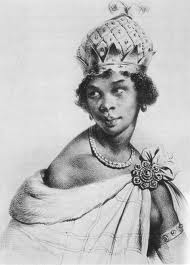
Just taking a look back at history, men, white supremacy, and patriarchy do not like strong women, and particularly strong black women. For instance, in the 1660s, white men described (and it can still be read in history books) the great Angolan warrior Queen Nzingha who fought for her people’s freedom and fought the Portuguese against slavery, as an angry, power-hungry, and over-sexed woman who would sleep with one new soldier every night, and have him killed the next morning. Such absurdity! Wouldn’t that diminish her troops, troops strongly needed to fight against the Portuguese?
Queen Nzingha of Angola
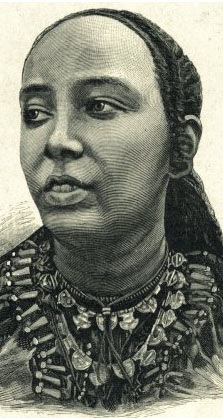
Next, we have the great queen Taytu Betul, the queen without whom there would have been no Battle of Adwa, where Ethiopia defeated Italy, the first victory of an African nation on a European one. There again, European historians describe Queen Taytu Betul as a man-eater, a woman with a black heart, manipulative, hateful, and conniving.
Empress Taytu Betul of Ethiopia
In both cases, the truth is that they are afraid of the power of the Black woman; these historians vilify Black women. The patriarchal and white supremacy system hatesWinnie Madikizela-Mandela because she fought like no other, like no man would have. She was strong, and brave, and a woman of principle. To them, she was a woman, she should have stayed home, and not joined and fought tirelessly for freedom.Even though she was cleared of the murder of Stompi, she is hated while Nelson Mandela is sanctified, but everybody forgets that Nelson Mandela was once the leader of Umkhonto we Sizwe the armed branch of the ANC. We do not hate that fact, because we know that, that was what was needed at the time for the apartheid regime to fall. So why do people applaud Nelson Mandela, and honor him, while they hate Winnie Madikizela-Mandela who kept his name alive while he was in jail 27 years, and fought like not many human beings (not even him) would have fought? The world applauds him, because he is a man. The world should also celebrate her, Winnie Madikizela-Mandela.
Stop the sexist history, the patriarchist history, the racist history. Winnie Madikizela-Mandelais a world revolutionary, and should be applauded for her stance all those years, for her hard work, her determination, her principle, and her love of her people. She should be celebrated. Please do watch what EFF leader Julius Malema has to say about it.
Here is Winnie Madikizela-Mandela’s last interview. She goes over parts of her life, the apartheid era, the transition, and the difference between political vs economical power. She also talks about the current leadership, and the need for a re-evaluation of the ANC, and the need for a new vision. A note: the leadership of Ghana had a delegation there with EFF leader Julius Malema to send their last goodbyes to Mama Winnie. Also the light has been shed on the truth about the fact that Winnie never killed Stompi! Enjoy!
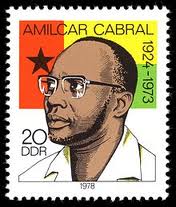
Amilcar Cabral on a stamp with the flag of Guinea Bissau
« It is not the existence of a race and ethnic group or anything of the kind that define the behaviors of a human aggregate. No, it is the social environment and the problems arising from the reactions to this environment and the reactions of the human beings in question. All this defines the behavior of the human aggregate » (Cabral).
“They think because they have put my husband on an island that he will be forgotten. They are wrong. The harder they try to silence him, the louder I will become!” – 1962
“I will not allow the selfless efforts of my husband and his friends to be abandoned. I will continue the struggle for a free and equal South Africa.” – 1962
“To those who oppose us, we say, ‘Strike the woman, and you strike the rock‘.” – 1966
Winnie Madikizela-Mandela during her exile in Brandfort, 1977 (Source: Timeslive.co.za)
A flavor of the harassment and trauma of a typical raid [under the apartheid regime]: “…that midnight knock when all about you is quiet. It means those blinding torches shone simultaneously through every window of your house before the door is kicked open. It means the exclusive right the security branch have to read each and every letter in the house. It means paging through each and every book on your shelves, lifting carpets, looking under beds, lifting sleeping children from mattresses and looking under the sheets. It means tasting your sugar, your mealie meal and every spice on your kitchen shelf. Unpacking all your clothing and going through each pocket. Ultimately it means your seizure at dawn, dragged away from little children screaming and clinging to your skirt, imploring the white man dragging Mummy away to leave her alone.” – 1960s
Up until the 1970s, the years of constant police harassment, jail time and intimidation had done absolutely nothing to quash Winnie’s revolutionary spirit; indeed, her conviction had only become stronger. Her message to the authorities was clear: “you cannot intimidate people like me anymore.” – 1970s
‘491 Days Prisoner number 1323/69’ by Winnie Madikizela-Mandela
“It is only when all black groups, join hands and speak with one voice that we shall be a bargaining force which will decide its own destiny.” – 1976
“If you are to free yourselves you must break the chains of oppression yourselves. Only then can we express our dignity, only when we have liberated ourselves can we co-operate with other groups. Any acceptance of humiliation, indignity or insult is acceptance of inferiority.” – 1976 (similar to President Thomas Sankara’s words, 8 years before he uttered them).
“We have no guns – we have only stones, boxes of matches and petrol. Together, hand in hand, with our matches and our necklaces, we shall liberate this country.” – 1986
Winnie Mandela during a rally (Source: Business Insider South Africa)
“There is no longer anything I can fear. There is nothing the government has not done to me. There isn’t any pain I haven’t known.” – 1987
“I am the product of the masses of my country and the product of my enemy.” – 1996
“I was not made by a racist media and I will not be unmade by a racist media. What matters is what I mean to my people…without economic power, freedom is worthless.”
Winnie Madikizela-Mandela
“I’m not sorry. I will never be sorry. I would do everything I did again if I had to. Everything.”
“All what we fought for is not what is going on right now. It is a tragedy that he lived and saw what was happening, we cannot pretend like South Africa is not in crisis, our country is in crisis and anyone who cannot see that is just bluffing themselves.”– 2017












 African Heritage