At last, Germany is returning artifacts back to Namibia which it had stolen some 126 years ago from a Namibian freedom fighter, Hendrik Witbooi. This is a good step forward, as they also returned the human remains of people they had killed via committing a genocide, last August. As a flashback, the First Genocide of the 20th Century was committed by Germany on the Nama and Herero people of Namibia. During that time, it is estimated that Germany wiped out at least 75% of the Herero and 50% of the Nama population (the Namibian genocide or the Herero and Namaqua genocide). The skulls and bones of the people they decimated had been sent to Germany to study the racial superiority of Europeans. To that effect, tens of thousands of Nama and Herero people were murdered. There are thought to be hundreds of Namibian skulls in Germany and last August about 25 remains were handed back. Their descendants are still waiting today for an apology from the German government, as well as reparations. Skulls from Germany’s other African colonies, including modern day Cameroon, Tanzania, Rwanda and Togo, were also used in these now discredited studies.
A bible and a whip from the estate of Hendrik Witbooi. (Getty images)
The German city of Stuttgart will return artifacts looted from the country’s colony in what is now Namibia on March 1 during a ceremony with Namibian president Hage Geingob.
German state minister for science Theresia Bauer will travel to Namibia to hand over a whip and bible from the collection of Stuttgart’s Linden Museum that once belonged to Namibian national hero Hendrik Witbooi, a leader in the fight for independence against the German colonizers during the Nama-Herero uprising.
“The restitution of these objects is for us the beginning of a reappraisal of German-Namibian colonial history,” Bauer said in a statement published on the Linden Museum website.
The ceremony is taking place in Witbooi’s hometown of Gibeon, where a museum is being built and will eventually house the items. In the meantime they will be safeguarded by the state.
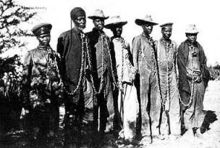
Chained Herero men
German soldiers stole the artifacts during an attack on Witbooi’s stronghold of Hornkranz in 1893. Colonial troops in former German southwestern Africa launched a brutal crackdown on Witbooi’s people after the leader refused to sign a protection treaty to cede territory to the colonizers. In response, German troops ransacked the village, took livestock, burnt huts, and looted possessions.
Both the whip and bible were donated to the Linden Museum in 1902, according to the German art magazine Monopol.
The German imperial empire colonized parts of Namibia from 1884 to 1915. Germany officially [recognized] the Nama-Herero genocide in 2004, in which an estimated 65,000 members of the Nama and Herero tribes were murdered in response to the uprising.
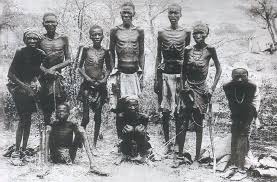
Survivors of the Herero genocide
In November 2018, the Minister President of Baden-Württemberg said that the German state “is aware of its historical responsibility and is ready to take action. Sending an important message and signaling an important step in the process of reconciliation.”
Today Witbooi is revered as a national hero in Namibia and one of the most important chiefs of the Nama tribes. He is honored by numerous monuments across the country and his portrait is printed on numerous paper bills.
During the last elections held on 30 December 2018 in the Democratic Republic of the Congo (DRC), Félix Tshisekedi was pronounced winner . He defeated another opposition leader, Martin Fayulu, as well as Emmanuel Ramazani Shadary, who was supported by term-limited outgoing president Joseph Kabila. Immediately, the ‘international community (I.C.)’ pounced on Tshisekedi claiming that he could not have won, and that it was but Martin Fayulu the second who had won. There were even threats by the ‘international community’ via the French government through her Ambassador to the Congolese government. Tshisekedi’s victory has since then been upheld by the constitutional court of the DRC, and he was installed as president on 24 January 2019.
Maurice Kamto (Maurice Kamto Facebook page)
In Cameroon, the story is a fair tale. After the 7 October 2018 presidential elections, opposition candidate Maurice Kamto, from all indications, came out winner of the elections against outgoing president, Paul Biya, who has been in power for the past 37 years… It was total silence by the I.C., in the case of Cameroon, who saw nothing wrong with a man who had been in power 37 years! They clapped and called those elections a standard of democracy! In the western media, there was no mention of Maurice Kamto, and the international community saw nothing wrong with the results of a presidential election being read 2 weeks after polling took place! This is the same international community that was so eager to get the results out in a timely manner in other countries such as the DRC, Madagascar, etc. Yet, Maurice Kamto won the elections and no mention of what happened to him took place. For Kabila in the DRC, the international community, via its medias, spent long time telling the world how Kabila had been in power for 18 years, and how anti-democratic that was. Yet in Cameroon, Paul Biya has been in power for 37 years, and they are clapping and calling the electoral hold-up democratic!
Map of Cameroon with all its regions
Since then, Cameroon has further descended into the abyss that it slipped into 37 years ago. Not only is the Cameroon territorial integrity in question: Boko Haram in the North has cut off the 2 northernmost regions from the rest of the country, the 2 English-speaking regions are cut off from the country ; in the East of the country, armed bands coming from the Central African Republic (CAR) are terrorizing the population, and in the Adamawa Region, armed groups coming from CAR are kidnapping people for ransom including traditional chiefs and stealing cattle; there are refugees both inside and outside the country, and post-electoral violence has ushered in a profound exacerbation of tribalism leading to the politics of divide-and-conquer. It looks like the ultimate objective is dividing Cameroon, like in Sudan, with an exacerbation of ethnic differences with a further push toward chaos for better exploitation of the country’s resources and emptying it of its youths.
Paul Biya, President of Cameroon
If the I.C. can scream for DRC, and publish articles about Martin Fayulu being the winner in its media the day after publication of results, with the catholic church complaining about results, why does it not show any indignation or some concern for Cameroon? How can a 37-year-old rulein Cameroon be applauded and referred to as being democratic by the I.C., while an 18-year rule in DRC is called a dictatorship? Why is 85-year-old Paul Biya’s 37-year rule being applauded when Mugabe in Zimbabwe was vilified? How can Biya, with nothing to show for his stewardship, not even the integrity of his territory, not even roads, but total chaos and backwardness, be applauded by BBC, RFI, The Guardian, and France 24? How can a president purposely destroy its country including its resources and be applauded by this so-called democratic I.C.? Well, because he serves the interests of the I.C., and has been a good student and puppet in helping the I.C. pillage the resources of his country. Cameroon is so rich in natural resources: oil, cocoa (6th producer), coffee, natural gas, gold, diamond, etc. In the robbery that is so synonymous with France’s predatory behavior in Africa (particularly in its so called “pré-carré”), why should this be a surprise? France’s nature in Africa, and the I.C.’s in general, has been and remain predatory.
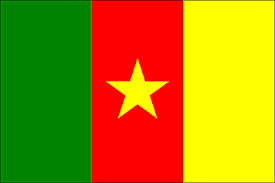
Flag of Cameroon
In Cameroon today, there is a strong dictatorship. The mafia that is synonymous with this regime has been repressing in blood all peaceful demonstrations and marches for the upholding of the genuine electoral results. All protest marches calling for the electoral records to be published are either banned or have seen the winner of the elections Maurice Kamto and his team arrested, including many innocents who have been screaming for a change, for a chance to have better life, roads, jobs, better healthcare, etc. People in the English-speaking provinces have been, hurt, beaten or killed, for simple claims which are basic human rights. A lot of them are currently displaced… people in the north provinces have been displaced, and hurt by Boko Haram… yet BBC, RFI, and the likes of them say nothing! Instead they applaud a government which refuses to negotiate with its own people. We do not ask them to intervene, but if those medias are supposed to be impartial, then they should be impartial, otherwise they should clearly state their agenda: portrayal of Africa as poor and in need of help, pillaging of African resources, promotion of wars on the African continent to help their cronies those western multinationals destroy and get all resources for nothing.
Thomas Sankara a Ouagadougou
We, Africans, should recognize that we are not, and never were independent. We should protest and fight pacifically like this is our last fight.A mother sending her child to school, a father being able to feed his family, university graduates finding jobs in countries where everything is yet to be built, roads, water, electricity, basic human rights to respect, all of that are rights… and it looks like we will have to earn them ourselves. Like Thomas Sankara said, “the slave who is not capable of assuming his rebellion does not deserve that we feel sorry for him. This slave will respond only to his misfortune if he is deluding himself about the suspect condescension of a master who claims to free him. Only struggle liberates…[ …l’esclave qui n’est pas capable d’assumer sa révolte ne mérite pas que l’on s’apitoie sur son sort.Cet esclave répondra seul de son malheur s’il se fait des illusions sur la condescendance suspecte d’un maître qui prétend l’affranchir.Seule la lutte libère …(Discours de Sankara à l’ONU le 4 octobre 1984 (texte intégral) Speech delivered on October 4, 1984 during the UN general Assembly)].” DO NOT trust this condescending I.C., DO NOT trust their media that is very partial, and were all against Laurent Gbagbo, who today has been acquitted from crimes invented by this I.C. and its cronies. We have to fight for our own rights, our own freedom, acknowledge that we are in charge of our own destinies, and never expect some partial Western media to report on the truth!
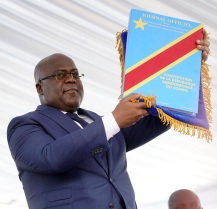
Felix Tshisekedi on investiture day 24 January 2019
On Thursday January 24th 2019, the Democratic Republic of the Congo saw a new day: the investiture of Félix Antoine Tshilombo Tshisekedi marked the first peaceful transfer of power in the history of the DRC in 60 years, since the Belgium granted it independence. This marked a great day not only for the DRC, but for Central Africa, and for Africa as a whole. Felix Tshisekedi won the presidential elections in DRC, which were also entirely funded by the country itself under the leadership of President Joseph Kabila … this is also a first in the nation’s history and the history of many countries on the African continent. So in clear, this was an election of the Congolese people for the Congolese people, entirely funded by the Congolese themselves.
Tshisekedi said, “We want to build a strong Congo in its cultural diversity.” He further declared, “We will promote its development in peace and security. A Congo for each and everyone, where everybody has his or her own place.”
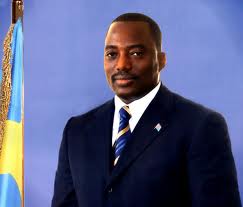
Joseph Kabila, outgoing President of DRC
Felix Tshisekedi is the son of Étienne Tshisekedi, a longtime beloved opposition leader who died in 2017, and has benefitted from the legacy his dad built. Tshisekedi is taking over the presidency from Joseph Kabila, the DRC’s president since 2001.
I take the time here to salute President Joseph Kabila who has allowed, by his selfless resolve to protect the Democratic Republic of the Congo. Joseph Kabila recently outlined some his achievements during his tenure of office, including the organization and total funding of the last democratic elections in 59 years, the construction of new infrastructures, the restoration of peace and the reunification of the country, and the financing of its own elections, and the peaceful passing of the banner to Felix Tshisekedi.
I live you here with Joseph Kabila’s last speech as President, and the passing of the baton, investiture of Felix Tshisekedi.
Today, Oliver Mtukudzi, one of Zimbabwe’s most renowned musicians, has changed his plane of existence. He passed away to join his ancestors, after over a four-decade career. He, like Bra Hugh, Hugh Masekela, was a giant of African music, particularly Afro-Jazz. Just like Bra Hugh, he passed away on the same day, a year later.
To his fans he was affectionately known as Tuku. With his deep voice, he came to prominence in the 1970s as one of the voices of the revolution fighting white-minority rule.
The singer and guitarist mixed several different styles to create his own distinctive Afro-jazz sound, known to his fans as “Tuku Music“.
In 2018, Mtukudzi spoke to Eyewitness News about why he chose to stay in the music business: “My music is about touching the hearts… never mind how old. If a baby is born today, she/he must be able to relate to my music.”
I live you here with one of my favorite from Tuku: Neria.
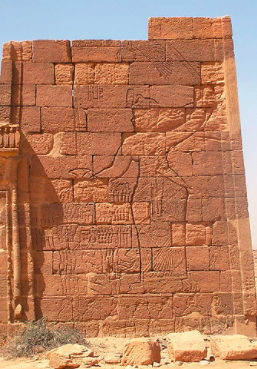
Sculpture of Candace Amanirenas on a pyramid wall in Barwa, Sudan
Amanirenas was a great Candace, queen, of the Nubian kingdom, mother to queen Amanishakheto, and grandmother to queen Amanitore. Amanirenas was a great warrior queen. She built considerable pyramids and temples at Wad Ban Naqa, where she was buried with great treasures.
Her full name and title was Amnirense qore li kdwe li (“Ameniras, Qore and Kandake“). She reigned from about 40BC to 10BC, and is one of the most famous Kandakes, because of her role leading Kushite armies against the Romans in a war that lasted five years, from 27 BCE to 22 BCE. After an initial victory when the Kushites attacked Roman Egypt, they were driven out of Egypt by Gaius Petronius and the Romans established a new frontier at HiereSycaminos (Maharraqa).Amanirenas was described as brave, and blind in one eye. Some say that her name means ‘Amani is her name’. Amani is the Nubian name for Imana/Amon, Unique God of Africa.
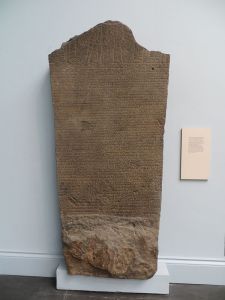
Hamadab stela showing Queen Amanirenas and Prince Akinidad facing various Egyptian deities Amun and Mut
Meroitic inscriptions give Amanirenas the title of qoreas well as Kandakesuggesting that she was a ruling queen. She is usually considered to be the queen referred to as “Candace” in Strabo‘s account of the Meroitic war against the Roman Empire. Her name is associated with those of Teriteqas and Akinidad. King Teriteqas died shortly after the beginning of the war. She was succeeded by Akinidad (possibly the son of Teriteqas) who continued the campaign with his mother Amanirenas. Akinidad died at Dakka c. 24BC. The loss of one eye during battle made Amanirenas even stronger and braver. She despised death, and her fearlessness forced the admiration of Strabo, the Greek historian, who said, “this queen has a courage above that of her gender.”
When Aelius Gallus, the Prefect, or chief magistrate, of Egypt, was absent on a campaign in Arabia in 24 BC, the Kushites launched an attack on Egypt. Amanirenas and Akinidad defeated Roman forces at Syene and Philae, and drove the Jews from Elephantine Island. They returned to Kush with prisoners and loot, including several statues of Emperor Augustus ; the Queen buried a bronze likeness of the Emperor beneath the entranceway to her palace so that she and all who came and went could tread on the head of her enemy. The head, found in Meroë in 1912, now resides in the British Museum
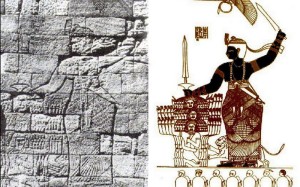
Stela showing Candace Amanirenas crushing Roman enemies. This also appears in Cheikh Anta Diop’s book cited below
The Kushites were driven out of Syene later in the year by Publius Petronius, who now held the office of Roman Prefect in Egypt. According to a detailed report made by Strabo, the Roman troops advanced far into the Kingdom of Kush, and finally reached Napata. Although they withdrew again to the north they left behind a garrison in Qasr Ibrim (Primis), which now became the border of the Roman Empire. The Kushites made a renewed attempt to seize Primis, but Petronius forestalled this attempt.
A peace treaty was signed between the Meroites and Augustus in the year 21/20 BC, which continued until the end of the third century AD, with relations between Meroë and Roman Egypt remaining generally peaceful during this time. However, the Kingdom of Kush had begun to fade as a power by the first or second century AD.
Nubia or the Kingdom of Kush in 400BC
Thereafter a preponderant place falls to two queens, Amanirenas and
Amanishakheto. Their husbands remain forgotten and we do not even know the name of Amanishakheto’s. The throne was also occupied for some years by a king, the former prince Akinidad, son of Queen Amanirenas and King Teriteqas. Nevertheless, it is important which of these two queens came first, both of them ‘Candace’, which is the transcription of the Meroitic title Kdke according to the tradition of the classical authors.
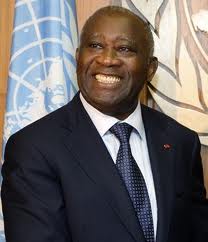
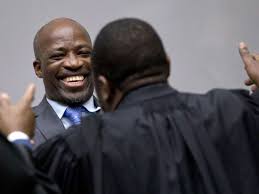
Joy is in our hearts! It has taken us 8 years but we have overcome, or rather Laurent Gbagbo and Charles Blé Goudé (How long shall they kill our prophets…?)have overcome. The hour is to joy, and gratitude, because truly perseverance has been their motto for the past few years. All these tough years of claiming their innocence, all these years of constant support and people’s prayers, dedication, love, and determination have born fruits. Yesterday, January 15th 2019, Laurent Gbagbo and Charles Blé Goudé were acquitted of war crimes at the ICC. I rejoice in this step forward. I live you with snippets of the article from the NPR below. In latest news, the prosecution is trying to bar Gbagbo and Blé Goudé from returning to their home country of Côte d’Ivoire, and instead wants to keep them roaming through in Europe: this is another case of Deportation of African Heads of States. We will keep fighting to the last drop! As Agostinho Neto said: “La luta continua e la victoria e certa!”
====
Charles Blé Goudé celebrating with his legal team on 01/15/2019 (SkyNews)
A panel of judges at the International Criminal Court has dismissedcharges of war crimesagainst former Ivory Coast President Laurent Gbagbo, the first former head of state to stand trial at the ICC. Charges against his former youth minister, Charles Blé Goudé, also were dropped.
[…] A majority of the three-judge panel concluded that prosecutors had failed to show that there was a “common plan” to keep Gbagbo in power, nor “the existence of patterns of violence from which it could be inferred that there was a ‘policy to attack a civilian population,’ ” the court said in a press release.
Public speeches by Gbagbo and Blé Goudé did not constitute ordering, soliciting or inducing the alleged crimes, the judges said – adding that they needed no further evidence from the defense.
[…] After refusing to hand over power, Gbagbo was pulled from an underground bunker at the presidential residence in Abidjan in April 2011, and thenwhisked to The Haguein November 2011. He was held in custody for more than seven years.
Who or what did we celebrate in 2018 in Africa. Here are 10 people, events and things, which marked the year 2018 (if there are some other you would like to share, please send them in):
Sahle-Work Zewde, Ethiopia’s first female president, with the Prime minister Abiy Ahmed, on the day she was elected
1. Abiy Ahmed Ali became prime minister of Ethiopia this year, and brought in a wave of new measures. He is particularly noted for ending decades of border disputes between Eritrea and Ethiopia, bringing in the 2 sisters back together, releasing thousands of political prisoners and for having half of his government made up of women, some in key positions including the ministry of defense.
2. Ethiopia welcomed its first female president in the person of Sahle-Work Zewde. Mrs. Zewde was unanimously elected president by members of the Federal Parliamentary Assembly on 25 October 2018. Sahle-Work’s appointment makes her the first female Ethiopian head of state since Empress Zewditu.
3. Peace between Eritrea and Ethiopia. Peace at last with the end of the border dispute in June and July of this year, marking the end to decades of tension between the 2 sisters.
4. The release from jail of Simone Gbagbo. The former first lady of Côte d’Ivoire was released on 8 August 2018, after 7 years in prison. We are so grateful; it took us 7 years, but Simone is free at last. Free at Last: Simone Gbagbo Liberated.
10. Not sure whether to applaud this or not: Major museums across Europe have agreed to loan important artifacts back to Nigeria for a new museum the country plans to open in 2021 (Europe’s Largest Museums to “Loan” Looted Benin (Nigerian) Artifacts back to Nigeria). How someone can loan you something they stole from you is beyond me! They should just return it!
Here is an anonymous poem I thought of sharing with all; it reflects the life of so many in the workplace in the West. Enjoy!
=====
Being Black in the Work Place
They take my kindness for weakness. They take my silence for speechless. They consider my uniqueness strange. They call my language slang. They see my confidence as conceit. They see my mistakes as defeat. They consider my success accidental. They minimize my intelligence to “potential”. My questions mean I’m unaware. My advancement is somehow unfair. Any praise is preferential treatment. To voice concern is discontentment. If I stand up for myself, I’m too defensive. If I don’t trust them, I am too apprehensive. I’m defiant if I separate. Yet, I am fake if I assimilate. So, constantly I am faced with work place hate. My character is constantly under attack. Pride for my race makes me “TOO BLACK”. Yet, I can only be me. And who am I you might ask? I am that Strong Black Person… Who stands on the backs of my ancestors. Achievements, with an erect spine pointing to the stars with pride, Dignity and respect which lets the work place in America know, that I not only possess the ability to play by the rules, but I can make them as Well!
Black History 365
Good, Better, Best, Never rest until YOUR Good is Better and YOUR Better is Best!
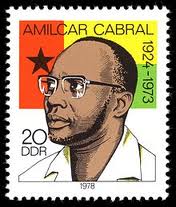
Amilcar Cabral on a stamp with the flag of Guinea Bissau
It so happens that in our country the Portuguese colonialists did not expropriate the land; they allowed us to cultivate the land. They did not create agricultural companies of the European type as they did, for instance, in Angola, displacing masses of Africans in order to settle Europeans. We maintained a basic structure under colonialism – the land as co-operative property of the village, of the community. This is a very important characteristic of our peasantry, which was not directly exploited by the colonisers but was exploited through trade, through the differences between the prices and the real value of products. This is where the exploitation occurs, not in work, as happens in Angola with the hired workers and company employees. This created a special difficulty in our struggle – that of showing the peasant that he was being exploited in his own country.
Map of Guinea Bissau
Telling the people that “the land belongs to those who work on it” was not enough to mobilise them, because we have more than enough land, there is all the land we need. We had to find appropriate formulae for mobilising our peasants, instead of using terms that our people could not yet understand. We could never mobilise our people simply on the basis of the struggle against colonialism-that has no effect. To speak of the fight against imperialism is not convincing enough. Instead we use a direct language that all can understand:
Flag of Cape Verde
“Why are you going to fight? What are you? What is your father? What has happened to your father up to now? What is the situation? Did you pay taxes? Did your father pay taxes? What have you seen from those taxes? How much do you get for your groundnuts? Have you thought about how much you will earn with your groundnuts? How much sweat has it cost your family? Which of you have been imprisoned? You are going to work on road-building: who gives you the tools? You bring the tools. Who provides your meals? You provide your meals. But who walks on the road? Who has a car? And your daughter who was raped-are you happy about that?”
Amilcar Cabral on the need to personalize, and adapt the fight to his country’s realities.











 “Your brain is your greatest weapon. Connect it to your heart, and you can go anywhere.”


 African Heritage