Early this month, I shared with you that the Belgian King Expressed his ‘Deepest Regrets’ for Colonial Past in Congo, by sending a letter to the President of the Democratic Republic of Congo (DRC) Felix Tshisekedi on the day of the celebration of the DRC’s independence from Belgium. I told you that those were empty words, and that coincidentally, King Philippe had forgotten to include the period from 1908 to the independence of Congo, and the treacherous role played by Belgium in the assassination of the Congolese Prime Minister Patrice Lumumba.
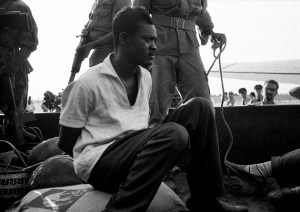
Lumumba detained, a few days before his death
Now the children of Patrice Lumumba, led by his daughter Juliana Amato Lumumba, have asked the Belgian king to prove his good faith by sending back the remains of their father. These remains are parts that were taken, like Lumumba‘s teeth, from his body at the time of his murder. We know from a documentary which aired in 2000 that Belgian Police Commissioner, Gerard Soete, told AFP that he and acolytes had decapitated Lumumba’s body and those of two others, Joseph Okito and Maurice Mpolo, and subsequently dissolved them in acid. In another documentary that same year, Soete showed two teeth which he said had belonged to Lumumba. He took Lumumba’s teeth as souvenir. In 2016, Ludo De Witte, author of the book “The assassination of Lumumba,” lodged a legal complaint against Soete’s daughter after she showed a gold tooth, which she said had belonged to Lumumba, during an interview with a newspaper.
According to AFP, Juliana Lumumba’s letter was written and addressed to the Belgian monarch on June 30, which happens to be the 60th anniversary of the Independence of the Democratic Republic of Congo from Belgium.
“We, Lumumba’s children, call for the just return of the relics of Patrice Emery Lumumba to the land of his ancestors,” Juliana said in the letter.
In Juliana Lumumba’s letter, which she said was written on behalf of her “wider family”, she said that her father was a “hero without a grave”.
“The remains of Patrice Emery Lumumba are being used on the one hand as trophies by some of your fellow citizens, and on the other as funereal possessions sequestered by your kingdom’s judiciary.”
How many Cameroonians have heard of Joseph Merrick? The Jamaican and first missionary to create a mission on the coast of Cameroon? Most people are used to hearing about the British missionary Alfred Saker who “brought” christianity to the coastal towns of Cameroon, and is often referred to as the pioneer, even though he was first hired as a ship mechanic, millwright, and naval engineer before becoming a missionary upon his arrival. So there are thousands of schools and streets named after this “great” white man in Cameroon: College Alfred Saker and Boulangerie Saker in Douala, Saker Baptist College in Limbe, to name just a few; there is even a monument to this man in downtown Limbe. Can you imagine my surprise when I learned that Alfred Saker was not the “pioneer” I had been made to believe, but rather a later pioneer following on the footsteps of others? Yes… Alfred Saker came after others had started sewing the seeds of Christianity on Cameroonian soil, and his main advantage was that he was a European (let’s call a spade a spade). The real man who should be considered missionary pioneer to the coastal towns of Cameroon was the Jamaican Baptist missionary, Joseph Merrick, who, assisted by another Jamaican Joseph Jackson Fuller, established the first successful mission on the Cameroonian coast of Africa.
Who was Joseph Merrick? Joseph Merrick was a Black Jamaican, who began preaching in 1837 in Jamaica and was ordained a full missionary in 1838. The work of the Baptist Society in Cameroons was an outcome of the freeing of the slaves in Jamaica. Many thousands of these freed slaves were members of Baptist Churches in that island, and the first-fruits of their new found liberty was the desire to help their own people in Africa, the land of their origin. Thus, Joseph Merrick had been recruited by the Baptist Missionary Society of London who was looking for Jamaicans to preach in Africa. Merrick, accompanied by his wife, arrived in Spanish-controlled Santa Isabel (then Clarence, and today known as Malabo) on the island of Fernando Po (Bioko) in 1843. In 1844, he visited Bimbia (near Limbe) and spoke to King William (William of Bimbia) of the Isubu people to request permission to establish a church on the mainland. After the initial resistance, he was granted permission, and in 1844-1845 he founded the Jubilee Mission. Over the next 5 years, he set up to translate parts of the New Testament in the Isubu language, set up a brick-making machine, a printing press, and translated the bible, and wrote a textbook for teaching in Isubu.
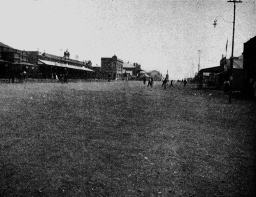
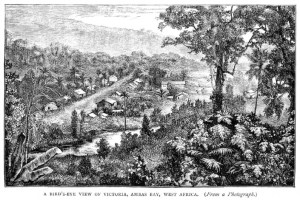
Bird’s eye view of then Victoria, now Limbe, Cameroon, in 1884
Adventurous, Merrick made several excursions into the interior from the coast, and climbed Mount Cameroon, thus becoming the first non-African to visit the Bakoko people.
Unfortunately, in 1849 he got sick, and set off to England with his wife for treatment but died at sea. Upon his death, Joseph Jackson Fuller took charge of the mission station and congregation at Bimbia. Merrick’s efforts also paved the way for Alfred Saker to make further progress – he made use of Merrick’s printing press to translate and print the Bible in Duala. Joseph Merrick can be seen as the pioneer of the missionary work in Cameroon. He had a talent for learning languages and within a short time he preached in both Isubu and Duala.
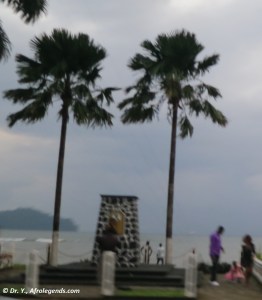
Monument to Alfred Saker in Downtown Beach in Limbe, Cameroon
In essence Joseph Merrick is the man who should be celebrated, just as much as Alfred Saker, if not more, particularly in the Limbe region. Why has Joseph Merrick been forgotten? Is it because he was Black?
With his poem, ‘Je suis venu chercher du travail’ / ‘I Came to Look for Work’ by Francis Bebey, the author talks about the story of many immigrants. Similarly Fatou Diome, the Franco-Senegalese author tells us about immigrants in her book Le Ventre de l’Atlantique [The Belly of the Atlantic]. It is as if Diome read Bebey’s poem, and made it into a novel. Her story The Belly of the Atlantic details the complexity of immigration, the struggles of those who have made it to maintain the image of ‘greatness’ of the promised land, and the hope those left behind have on those gone to send for them. Some young boys who are struggling to make ends meet in their home country of Senegal, and dream of immigrating to France for a ‘better future, with a loved one in Europe sending money back home. The book gives a glimpse into the families left behind, the joys, anxiety, scare, struggles, and sometimes the reconstruction of families around the women who are left behind to raise the children alone. As we have seen in reality, many will attempt to get to Europe via the Sahara desert, or even through the Atlantic on shady canoes.
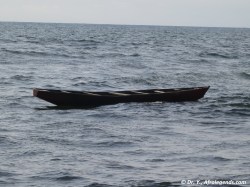
Canoe on the Atlantic Ocean
As Bebey said, the immigrant “has left everything, [his] wife, [his] kids.” Sometimes, the families never hear back from those who have gone, and their goodbyes were actually final, as Francis Bebey said “my poor mother was sorry to see me go.” Sometimes, the loved one who “had long days of travel” makes it safely, and sends money back, but never returns home and forms a new family in the new country. Sometimes, the loved ones make it to the new country, find jobs, make a living, and send for the rest of the family to join them back in the new country… This is a real struggle. The story of immigration in search of a job, of a better future, is a true struggle which rips apart some families, while strengthening others.
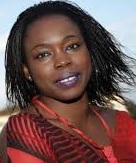
Fatou Diome
Once those who have left come back, they are often seen as “better”, “richer”, or “foreign”. As Diome says of the loved one who comes home, “I go home as a tourist in my own country, for I have become the other for the people I continue to call my family.” For the families who raised money for the loved one to be afforded to leave, leaving is synonymous with success and failure is not a possibility. “Leaving means having the courage necessary to go and give birth to one’s self.“
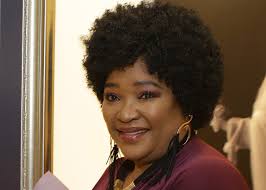
It is with sadness that I learnt of the passing of Zindziswa Mandela, daughter of Winnie Madikizela-Mandela and Nelson Mandela, this past Monday in a hospital of Johannesburg at the tender age of 59. Last child of her parents, she was affectionately called Zindzi. She grew up at the height of the anti-apartheid struggle in South Africa, of which her parents were at the forefront as revolutionaries: she was only 18 months old when her father was thrown in jail for 27 years. She was projected into the spotlight at the age of 16, when her mother was banished to Bramburg, and later on at 25 when her father Nelson Mandela was offered a conditional release in 1985 by the then-State President, P. W. Botha. Her father’s reply could not be delivered by either one of her parents. Consequently, Zindzi was chosen to read his refusal at a public meeting on 10 February 1985.
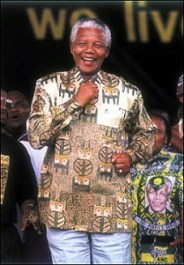
Nelson Mandela clothed in a Pathe’O shirt
In a statement, the Nelson Mandela Foundation said of her legacy, “Zindzi will be remembered for a rich and extraordinary life, marked by many iconic moments. The years she spent banished with Mama Winnie Madikizela-Mandela to the small town of Brandfort. That summer’s day in February 1985 at Jabulani Stadium when she read to the world Madiba’s rejection of President Botha’s offer of a conditional release from prison. Her own courageous work in underground structures. Public service as South African Ambassador to Denmark. We will also remember her as a special soul.”
Winnie Madikizela Mandela
Zindzi was a very strong woman who went through the struggles of her mother, Winnie, when she was banished and tortured during the apartheid regime; one could say that she was her mother’s closest companion. She had to grow up fast. In his personal archive, Nelson Mandela spoke of Zindzi’s strength, as well as to the nature of their relationship. In a 1969 letter from prison, Madiba noted that Zindzi’s “heart is sore because I am not at home and wants to know when I will come back.” In a 1987 letter to Zindzi, Madiba told her that he had heard from an acquaintance that she was as strong as a rock. He went on: “That is just the kind of remark a father would like to hear about his beloved child. I literally swelled with pride and satisfaction. That remark reached me at the right time, shortly after you had just gone through a rather harrowing experience.” He ended the letter: “Tons and tons of love darling, and a million kisses.”
I leave you here with Zindzi reading her father’s letter of rejection in 1985. You must admit that for a young woman, reading that letter must have required a lot of courage, determination and strength to defy the apartheid regime and stand in front of such a crowd (a full stadium) thirsty for words of encouragement, and hope from their leaders to keep facing the injustices of an inhumane regime. Bold!
Many cultures in Africa are matriarchal, and it absolutely makes sense that the homeland is constantly portrayed as a woman in African poetry. Today we will talk about the poem “Congolese Eve” by Jean-Baptiste Tati-Loutard. Tati-Loutard is a Congolese author from the Republic of Congo or Congo-Brazzaville. As an accomplished writer, he has published several compilation of poetry, and has won several awards. In his writings, he does a deep expose of the art, life, and nature; he often incorporates the feminine element in his work. Similar to other African authors like Léopold Sédar Senghor (former president of Senegal) or Ferdinand L. Oyono (minister in Cameroon), Tati-Loutard is also a politician, who has occupied several posts in the government of his country.
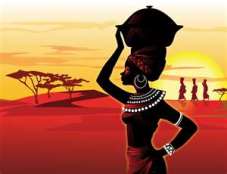
African princess
Enjoy ‘Ève Congolaise‘ by Jean-Baptiste Tati-Loutard, published in Anthologie africaine: poésie, Jacques Chevrier, Collection Monde Noir Poche, Hatier 1988, p. 136. Translated to English by Dr. Y. Afrolegends.com.
Eve Congolaise
Je l’ai vue quand Dieu l’a créée sur la Montagne :
C’était une pleine nuit, la lune ayant atteint
Le plus haut niveau de ses crues de lumière.
Avant que Dieu ne parût comme jadis sur l’Horeb,
L’herbe alentour marchait déjà tête baissée
Sous la brise.
Il prit de la terre non battue de quelque pied,
Et la coula – vierge comme au Jour Premier –
Dans un long rayon de lune.
En un tour de main, ce fut le tour des seins ;
Et la grâce et l’esprit giclaient d’Eve
En eclaboussements éblouissants de lumière.
Puis vint le signal :
Dans l’espace nu, le vent se mit à tourner sur lui-même
Comme s’il avait mal de ne pouvoir se détendre
Dans un arbre. Dieu reprit l’air dans le tourbillon ;
Et dans le silence plein de clarté,
L’Eve congolaise descendit vers le fleuve à l’heure
Où le soleil sort en refermant derrière lui
La porte de la nuit.
Congolese Eve
Isaw her when God created her on the Mountain:
It was a full night, the moon having reached
the fullest level of its light floods.
Before God appeared as He once did on the Horeb,
The grass around was already walking head down
Under the breeze
He took some dirt from some foot,
And the flow – virgin as on the First Day –
In a long moon ray.
In no time it was the turn of the breasts ;
And the grace and the spirit spurted from Eve
In dazzling splashes of light.
Then came the signal :
In the naked space, the wind started to turn on itself
As if it hurts not to be able to relax
In a tree. God took the air back in the whirlwind;
And in the silence full of clarity,
The Congolese eve descended towards the river at the time
Today we will talk about Beatrice of Congo, also known as Kimpa Vita, who was an African priestess and prophet who held a lot of power. Born into a noble clan, the Mwana Kongo clan, she was baptized in her youth, and later created her own religious movement which used Christian symbols but revitalized traditional Kongo cultural roots. She is seen as a strong antislavery figure; think about this for a moment, the catholic priests preaching christianity, yet silently participating in the slavery of the Kongolese. Didn’t it make total sense for her to turn away from catholicism and create a true Kongo religion? Her movement which is among some of the best documented in Kongo’s history is seen a precursor to modern African democracy movements. Below is the physical portrait of Beatrice of Congo by a contemporary Father Bernardo da Gallo in 1710 (Translated to English by Dr. Y., Afrolegends.com).
======
Kongo Kingdom map
This young woman was about twenty two years old. She was fairly tall and with fine features. On the exterior, she seemed very devout. She spoke with gravity, seeming to weigh all her words. She predicted “the future and announced among other things that the judgment was near.”
She walked on tiptoes (toes), almost without touching the ground with the rest of her feet; she moved her flanks and whole body, like a snake, even though her body was tense, as if deprived of spirit, and with bulging eyes; spoke frantically with delirium.
Rapport du Père Bernardo da Gallo, Rome, 17 Decembre 1710, publié par Louis Jadin
Les Africains Vol.9, Editions J.A, C.-A. Julien, P. 58, (1977)
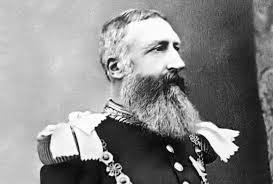
It took over 100 years for a Belgian King to finally ‘express his deepest regrets‘ for Belgium’s colonial past in Congo. As we recall, King Leopold II of Belgium perpetrated a genocide in Congo. Leopold II took Congo, a country at least 10 times the size of Belgium, as his private property and killed millions of Congolese. It is said that he must have executed and maimed over 15 million people!
So now, Belgian King Philippe wrote a letter to the president of Congo Felix Tshisekedi, on 30 June 2020, the anniversary of the Independence of the Democratic Republic of Congo, stating: “During the time of the Congo Free State [1885-1908], acts of violence and brutality were committed that weigh still on our collective memory. The colonial period that followed also caused suffering and humiliations. I would like to express my deepest regrets for the wounds of the past, the pain of today, which is rekindled by the discrimination all too present in our society.” His remarks fell short of an apology! Should we applaud for this?
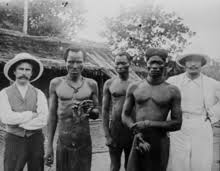
Picture of men holding cut-off hands (image by Alice S. Harris in Baringa 1904)
I say NO! To the Belgian King, I say you can eat your “deepest regrets”! Many are calling this progress, but I call this arrogance to wake up one day, and finally say, “I regret the past. Yes…, my grandfather committed acts of violence and brutality, killed your fathers, mothers, brothers, and sisters, … maimed your forefathers, decapitated so many of you … instilled fear into your psyche… destroyed your livelihood, your culture, and the entire foundation of your society.”
And so what? That’s it? Should we clap for you? where is the apology? Didn’t you think we knew that already? Where is the reparation? Don’t you know that Belgium is nothing without Congo? Coincidentally, King Philippe forgot to include the period following that time, from 1908 to the independence of Congo,and then to nowadays with the treacherous role played by Belgium in the assassination of the Congolese Prime Minister Patrice Lumumba, and countless others, and the unrest in the region to this day.
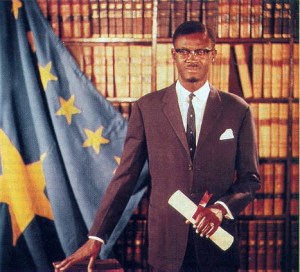
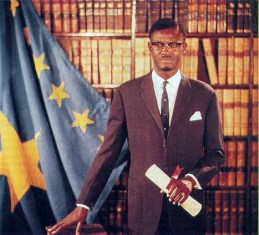
Official portrait of Patrice Lumumba, Prime Minister of Congo
And to stand up there, and say I “express my deepest regrets for the wounds of the past”… it’s like Hitler waking up today, and telling Holocaust survivors and their descendants, “I killed you, jailed your parents, forced you into exile, brought fear into your souls, and decimated every part of you… I regret it. What can you about it? ” It is simply arrogant! … It is just too easy. Until there is a clear “I am sorry”, until there is a clear “here is what we will do to right the wrongs,” until there is a clear “correction and inclusion in the history textbooks, opening of all classified documents”…. until there is a clear “respect for those killed, and for those living today” until then, there will be no respect for arrogant kings who claim to have been awaken by George Floyd’s killing in the USA and not the atrocities they themselves committed in Congo!
We, the people of Congo, cannot forget… we cannot forget that the unrest in Congo today is a direct result of the atrocities committed by Belgium in the region. We cannot forget the souls of our ancestors who still cry to us for justice today.
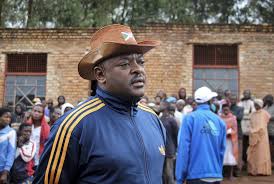
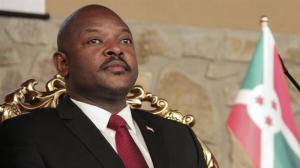
Pierre Nkurunziza during a community event (Source: PressHerald.com)
Given all the negative rhetoric played by the foreign media, I thought it will be good to remind all of Pierre Nkurunziza‘s achievements. I will focus mostly on his work within his country of Burundi. As we saw earlier, internationally he helped broker peace in Somalia.
A popular president
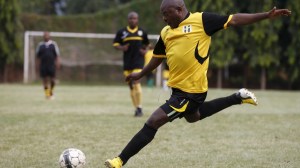
A president in office doing manual work, taking part in soccer games, had never been seen before. This president, Pierre Nkurunziza, was not a “traditional” president in his white marble castle, but was seen rather as a simple man, a man of the people, a man like the people he served. He was seen cycling, and taking part in community work. He was also an avid soccer player and lover; he owned a soccer team and trained them.
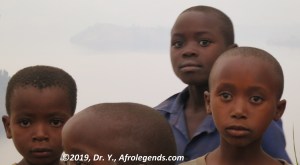
Some children
Free education and health
During his investiture, some of his first adopted measures were free primary school education (i.e. from Kindergarten through 6th grade), free childbirth, and free health for all children under 5. This might not be seen as much, but in a poor country such as Burundi, free primary school education definitely increases the literacy of the people and offers parents very needed help. Similarly, free health services for women during childbirth, and for children under 5 is a tremendous help. This is an achievement not seen in many places in the world, not even in Western countries.
A religious president
Nkurunziza was not afraid to show his faith. He was deeply religious. For each public event, or manual work, prayers were said at the beginning and at the end of these events. This led him to put God first in the constitution of the country, as well as establishing a day of national solidarity.
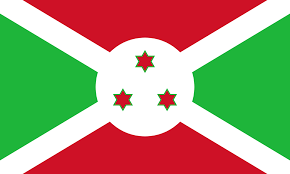
Flag of Burundi
A Patriot
He deeply loved his country Burundi and his people. He pushed for ancient local cultures and values long forgotten to be re-instated and taught in schools. He established the national day of the commune which is celebrated in the old fashion.
The works
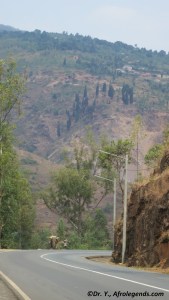
During his tenure, from 2007 to 2014,5200 schools were built, compared to 1900 schools from 1962 to 2007. Several roads were asphalted and created RN12, RN13, RN15, RN18, RN19, … Hospitals and community universities, classrooms, stadiums, modern markets, including the new Ntare Rushatsi presidential palace were erected.
Most importantly, he is the first president of Burundi to have ruled the country without a civil war.
So long Pierre Nkurunziza: we, the people, salute your patriotism, love of your country, and people. You will be remembered for your great achievements.
This past Monday, the relatively young (55 years-old) president of Burundi, Pierre Nkurunziza, died of a heart attack. It deeply saddened me. Why? Because of what he stood for, and his will to give decency to his own people or rather to govern his country without foreign involvement in their affairs. Pierre Nkurunziza was the first president of Burundi to have ruled without civil war.
With this global ‘pandemic,’ It has finally been understood that whatever the West calls democracy is not really democracy, but rather the government of the entirepopulation by a few. In the past, people have said that Pierre Nkurunziza was not a democrat and was holding onto power. Yet… he had been in power 15 years due to step down in August, and I did not hear the West complain about his neighbor Kagame in power for over 20 years. It is as if democracy is a word or rather a card pulled out of a bucket by Western powers to threaten those who prefer to do the bidding of the people rather than their bidding.
Flag of Burundi
Given that he had asked the UN to get out of his country last year, and then last month the WHO, and was one of the few countries to get out of the WHO because of their compromising and virulent tendencies in his country… is it a surprise that he died so suddenly?
Nobody talks about his achievements. What were Pierre Nkurunziza’s achievements?
Upon assuming office in 2005, Nkurunziza faced the significant challenges of maintaining peace and stability in the country, as well as rebuilding its war-battered economy. Burundi was emerging from over 10 years of civil war and unrest when he took over.
He united the country and brought in peace, during his first 10 years.
He rebuilt the infrastructures of his country, and oversaw the disarmament of several armed groups in Burundi.
He helped foster peace in the region: in 2007, he sent troops to Somalia as part of an African Union peacekeeping mission to prevent al-Shabab, an al-Qaeda-linked armed group, from overrunning the Horn of Africa country’s government.
Pierre Nkurunziza was an avid footballer (Source: Al-Jazeera)
The East African Community, a regional bloc, said in a statement: “Nkurunziza’s contribution to the re-establishment of constitutional order, peace, ethnic tranquility, rights and equality for all since his ascendancy to power in 2005 in Burundi cannot be overemphasised.”
“His commitment to security and rights for all irrespective of social, ethnic, religious or political background remains a beacon on which Burundians can build on to further their development objectives,” it added.
In 2015, Nkurunziza made the controversial decision to seek a third term in office. A coup was launched in May 2015 while Nkurunziza was abroad, but it was swiftly foiled. Despite several delays, an opposition boycott, and ‘international’ pressure (we know what that means), polls were held and Nkurunziza won a third term. After the 2015 elections, the situation took a turn for the worse, when donors cut off funding and placed sanctions on Burundi (similar to Côte d’Ivoire when France was bombing it in 2010, or Libya with the NATO coalition in 2011, or Zimbabwe). History repeats itself, we now know that when a country is placed under ‘international’ sanctions, it is usually because the leader might be serving his people.
In 2017, Nkurunziza formally withdrew Burundi from the International Criminal Court (ICC) – the first country to do so – amid accusations the court was focusing too much on the continent. Every African country should withdraw from that sham called ICC which only prosecutes African (Black) leaders. Later the UN left (remember ONUCI taking sides in Côte d’Ivoire?), and BBC and VOA were kicked out of the country for inciting violence, and spreading false news.
Burundi basket
In the streets of Bujumbura, “some residents said they would remember the former leader [avid football player], a born-again Christian known for his preaching, for the good things he did for their country.”
“I will remember him for the advice he gave us. He always told us to love our country. He always put God first and someone who does that will not face hardships in life,” Achel Niyongere told Al Jazeera.
Patrick Harakandi added: “He is the first president to govern Burundi until he finished his term. He made history. He ruled Burundi for 15 years without a civil war.” (Al Jazeera)
I remember dancing to the tunes of “Yé ké yé ké” as a child… I also have fond memories of seeing Mory Kante play his kora, and being amazed by his dexterity, finesse, and charisma. Every note transported me to different horizons. It did not matter that I did not understand his language, I could feel the emotions he conveyed with his voice and kora… it was like magic: one could travel all the way to Guinea and back within the confines of one’s room.
On May 22, 2020, an honorable member of the Griot (Djeli) family, Mory Kante, moved to the land of his ancestors. In reality, he just changed dimensions, and left us with the electricity of his music. Born in 1950 in a small town near Kissidougou in Guinea, Mory Kante came from a long family tradition of griots (Djeli). Both of his parents were griots, his father was from Guinea and his mother from MaliMory absorbed the singing of his parents and as a child learned to play the balafon. As a child, his family sent him to Mali to study the kora and other griot traditions.
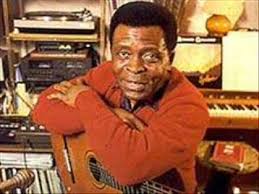
Mory Kante with some of the instruments he played including the balafon, kora, and djembe (Source: Express.co.uk)
Mory Kante is often known as the “electronic griot” because he modernized local traditional instruments such as his kora which he electrified, and fused African music with styles and instruments from Western pop. Kante’s 1987 single “Ye Ke Ye Ke” was a hit, first in Africa and then across Europe. It became the first African single to sell more than a million copies and has been licensed frequently for commercials and film soundtracks. It has even been reworked by other musicians into German techno, Bollywood film music and Chinese Cantopop.
If you ever come across a kora, or listen to Ye Ke Ye Ke remember this great man who modernized the ancient ways to share with us his love of the music of his forefathers. His music has inspired countless singers from the new generation. The New York Times , BBC, and Guardian have written articles about this great man.